What’s Observed on December 16
Born on December 16: Sagittarius ♐
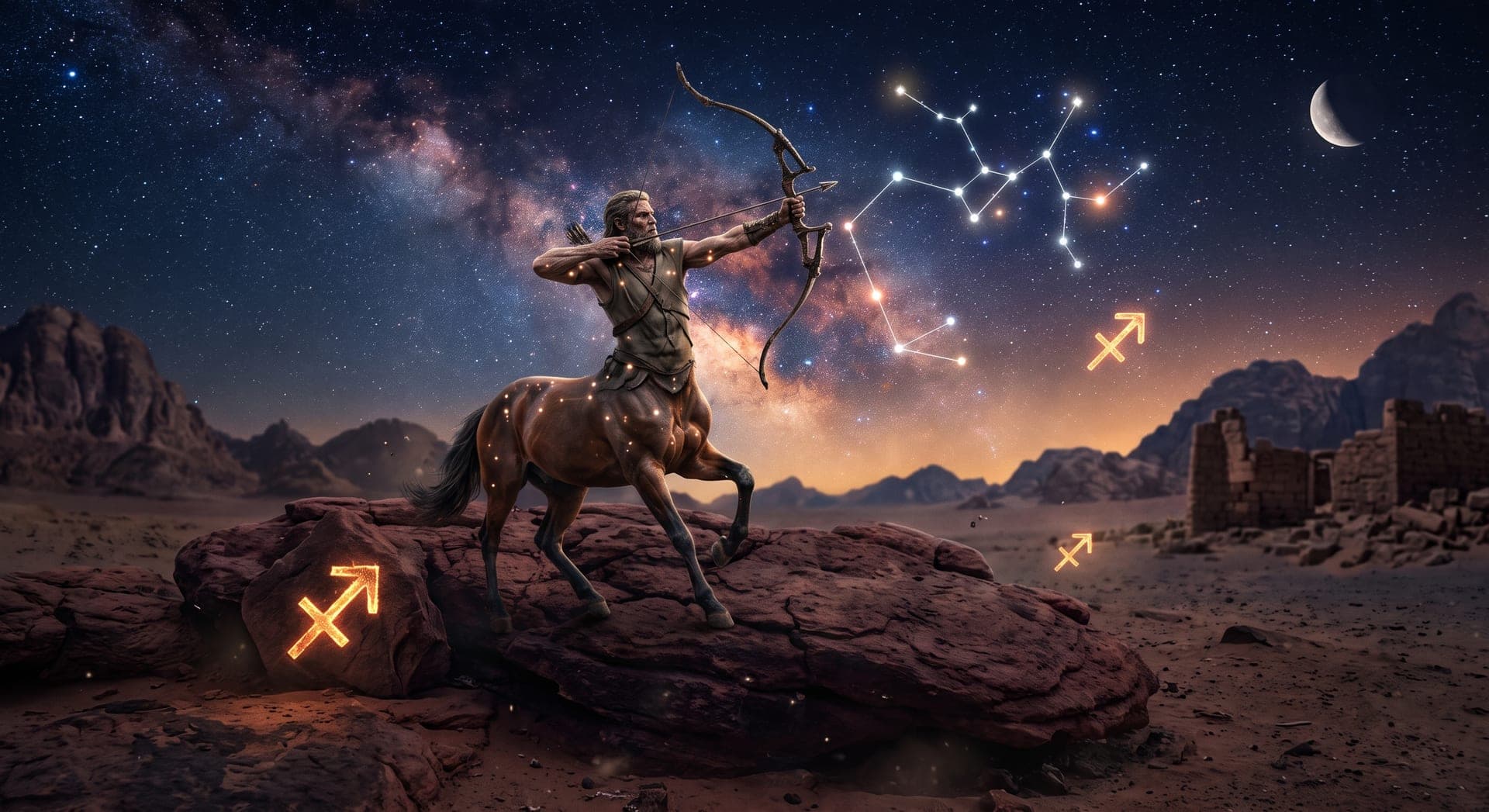
Sagittarius, the ninth sign of the zodiac, spans November 22 to December 21 and is symbolized by the archer, typically depicted as a centaur drawing a bow, representing a restless pursuit of knowledge, adventure, and far-off horizons. Ruled by Jupiter, the largest planet in the solar system and a symbol of growth, luck, and abundance, Sagittarius is widely regarded as one of the most optimistic and freedom-loving signs of the zodiac. As a Fire sign, Sagittarius approaches life with enthusiasm and a genuine hunger for new experiences, whether through literal travel or intellectual and philosophical exploration. Its Mutable modality reflects a deep aversion to routine and confinement, always looking toward the next adventure rather than settling into fixed patterns. People born under this sign are often drawn to travel, higher education, philosophy, or any pursuit that broadens their horizons and understanding of the world. Sagittarius's honesty and optimism make it excellent company, though its blunt directness and restless need for freedom can sometimes come across as tactless or noncommittal to those seeking more stability.
Personality Traits
Strengths
- Adventurous and open to new experiences
- Optimistic and enthusiastic
- Honest and direct
- Philosophical and broad-minded
- Generous and good-humored
Weaknesses
- Tactlessly blunt
- Impatient with routine
- Prone to overpromising
- Restless and commitment-averse
- Careless with details
Compatible Signs
Fun Facts
- Sagittarius's symbol, a centaur drawing a bow and arrow, connects to the Greek myth of Chiron, a wise and scholarly centaur unlike the more unruly members of his kind.
- Jupiter, Sagittarius' ruling planet, is the largest planet in the solar system, reflecting the sign's association with expansion, abundance, and big-picture thinking.
- Sagittarius is one of two zodiac signs, along with Capricorn, represented by a hybrid creature combining human and animal features.
- Notable Sagittarians include Taylor Swift, Walt Disney, Winston Churchill, and Jimi Hendrix.
- Sagittarius season spans the lead-up to the winter solstice, a period historically associated with travel, feasting, and philosophical reflection in many cultures.
Born on December 16
- 1630
Mary Somerset, Duchess of Beaufort
British botanist whose extensive collection of pressed plants and exotic specimens made her one of the most important botanical collectors of her era.
- 1770
Ludwig van Beethoven
German composer, one of history's most influential musicians
- 1775
Jane Austen
English novelist celebrated for works including Pride and Prejudice, Sense and Sensibility, and Emma, whose incisive social observation and wit made her one of the most widely read authors in the English language.
- 1790
Leopold I of Belgium
First King of the Belgians
- 1863
George Santayana
Spanish-American philosopher and writer
- 1866
Wassily Kandinsky
Russian painter and pioneer of abstract art
- 1882
Jack Hobbs
English cricketer regarded as one of the greatest batsmen in the sport's history, who scored a record 199 first-class centuries over a career spanning three decades.
- 1899
Noël Coward
English playwright, composer, and actor
- 1899
Noel Coward
English playwright, actor, composer, and singer known for witty works including Private Lives and Blithe Spirit, a defining figure of 20th-century British theatre.
- 1901
Margaret Mead
American cultural anthropologist
- 1917
Arthur C. Clarke
English science fiction writer and futurist best known for 2001: A Space Odyssey, who also proposed the concept of geostationary satellites for global communication.
- 1932
Quentin Blake
English illustrator and author renowned for his distinctive line drawings, especially his decades-long collaboration illustrating Roald Dahl's children's books.
- 1947
Martyn Poliakoff
English chemist and academic known to the public for the Periodic Videos YouTube series, which popularizes chemistry for a global audience.
- 1984
Theo James
English actor known for starring in the Divergent film series and the television series The White Lotus.

On This Day in History
- 1431
King Henry VI of England is crowned King of France at Notre Dame in Paris during the Hundred Years' War.
Henry VI's coronation as King of France, held while he was still a child, represented the high-water mark of English claims to the French throne under the terms of the earlier Treaty of Troyes. His French coronation ultimately proved largely symbolic, as Joan of Arc's earlier intervention had already begun reversing English fortunes in favor of the French claimant, Charles VII.
- 1431
Henry VI of England is crowned King of France at Notre-Dame Cathedral in Paris.
Still a child, Henry had already been crowned King of England two years earlier and was brought to Paris to bolster the English claim to the French throne during the Hundred Years' War. The ceremony, held in territory controlled by England's Burgundian allies, proved a hollow gesture: within a generation England lost nearly all its French territories, including Paris itself.
- 1497
Explorer Vasco da Gama passes the Great Fish River at Africa's southern tip, advancing his voyage toward India.
Vasco da Gama's voyage around Africa's southern tip, following the earlier route pioneered by Bartolomeu Dias, was part of his mission to establish a direct maritime trade route between Europe and India, bypassing the overland routes controlled by Muslim and Venetian merchants. His eventual arrival in India the following year opened an enormously lucrative spice trade that would reshape global commerce.
- 1653
Oliver Cromwell is installed as Lord Protector of the Commonwealth of England, Scotland, and Ireland.
Under the new Instrument of Government, Cromwell assumed near-monarchical powers as head of state following the execution of Charles I and the collapse of the Rump Parliament. His Protectorate governed Britain until his death in 1658, after which the monarchy was restored under Charles II.
- 1689
The Bill of Rights, based on the Declaration of Right, becomes law in England.
The act confirmed the terms under which William III and Mary II had accepted the throne after the Glorious Revolution, curbing royal power, barring Catholics from the throne, and asserting Parliament's rights, including free elections and freedom of speech in debate. It remains one of the foundational documents of the uncodified British constitution.
- 1773
Members of the Sons of Liberty dump an entire shipment of tea into Boston Harbor to protest British taxation policies.
The Boston Tea Party, in which colonists disguised as Mohawk warriors dumped an entire shipment of British tea into the harbor, protested both the Tea Act's monopoly granted to the British East India Company and the broader principle of taxation without colonial representation. Britain's harsh punitive response further galvanized colonial resistance, accelerating the path toward the American Revolutionary War.
- 1782
A rebellion against East India Company rule breaks out in Sylhet during a Muharram procession.
Led by two brothers known locally as Hada Miah and Mada Miah, several hundred rebels clashed with a small British-led sepoy garrison commanded by Superintendent Robert Lindsay. The uprising was crushed and its leaders killed, but it became one of the earliest recorded armed revolts against British East India Company authority in Bengal.
- 1838
Voortrekkers defeat Zulu forces at the Battle of Blood River in present-day South Africa.
The Battle of Blood River saw a heavily outnumbered force of Boer Voortrekkers, using defensive wagon formations and superior firearms, decisively defeat a much larger Zulu army under King Dingane. The victory, still commemorated in South African history, became deeply embedded in Afrikaner nationalist mythology in the following century.
- 1850
The first ships of English settlers, later called the Canterbury Pilgrims, arrive at Lyttelton, New Zealand.
Organized by the Canterbury Association, the settlers aimed to build a planned Church of England colony on New Zealand's South Island, giving rise to the city of Christchurch and the surrounding Canterbury region. Their arrival is still commemorated locally as Canterbury Anniversary Day.
- 1880
The First Boer War erupts between the South African Republic and the British Empire.
The First Boer War erupted after Britain's annexation of the South African Republic (Transvaal) provoked armed Boer resistance seeking to restore their independence. The relatively brief conflict ended in British defeat and the restoration of Boer self-government, though tensions between the two groups would erupt again in the much larger Second Boer War roughly two decades later.
- 1880
The First Boer War breaks out as Transvaal Boers rise up against British rule.
Resentful of Britain's 1877 annexation of the South African Republic, Transvaal Boers declared their independence restored and took up arms against British garrisons. The brief conflict ended in a decisive Boer victory within months, forcing Britain to grant the Transvaal self-government and setting the stage for the larger Second Boer War two decades later.
- 1882
Wales and England play their first rugby match against each other, beginning what became one of rugby's great international rivalries.
Played at the Racecourse Ground in Wrexham, the fixture predated the formal Home Nations Championship by a year and marked Wales's emergence as an organized rugby nation. The Wales-England match remains one of the most fiercely contested fixtures in the sport, now part of the annual Six Nations Championship.
- 1905
Wales defeats New Zealand's touring rugby team 3-0 in what became known as the 'Match of the Century.'
New Zealand's 'Original' All Blacks had swept through Britain undefeated until 41,000 spectators packed Cardiff Arms Park to watch Wales hand them their only loss of the tour. A disputed disallowed New Zealand try fueled decades of debate, and the match cemented rugby's place at the heart of Welsh national identity.
- 1914
German warships bombard the English coastal towns of Scarborough, Hartlepool, and Whitby, killing over a hundred civilians.
Battlecruisers under Admiral Franz von Hipper shelled the towns in a hit-and-run raid intended to lure out the British fleet, instead killing mostly civilians, including children on their way to school. The attack shocked Britain, fueled anti-German propaganda under the slogan 'Remember Scarborough,' and spurred a wave of wartime military recruitment.
- 1944
The Battle of the Bulge begins as three German armies launch a surprise offensive through the Ardennes forest.
The Battle of the Bulge represented Nazi Germany's last major offensive on the Western Front, catching Allied forces off guard through a surprise attack launched under poor weather conditions that grounded Allied air support. Despite initial German gains, the offensive ultimately failed, exhausting German reserves and hastening the collapse of Nazi resistance in the war's final months.
- 1944
Germany launches a major surprise offensive through the Ardennes forest, opening the Battle of the Bulge.
Hitler's gamble aimed to split Allied lines and recapture the port of Antwerp, catching American forces off guard and pushing a deep bulge into their front. Fierce Allied resistance, including the defense of Bastogne, eventually halted and reversed the German advance, in what became the largest and bloodiest battle fought by the US Army in the war.
- 1968
Spain officially revokes the historical Alhambra Decree expelling Jews from the country.
Spain's revocation of the historical Alhambra Decree expelling Jews from the country, originally issued in 1492, came amid a spirit of reconciliation between the Catholic Church and Jewish communities following the Second Vatican Council. The largely symbolic gesture reflected evolving Spanish and Catholic attitudes toward relations with Judaism during the mid-twentieth century.
- 1971
Pakistan's military surrenders, ending both the Bangladesh Liberation War and the Indo-Pakistani War.
Pakistan's surrender in Dhaka, following India's decisive military intervention in support of Bengali nationalists, ended the brutal nine-month conflict that had begun with a crackdown against East Pakistan's independence movement. The war resulted in the creation of Bangladesh as an independent nation and remains commemorated there as Victory Day.
- 1989
Protests erupt in Timișoara, Romania, marking the beginning of the Romanian Revolution.
Protests in the Romanian city of Timișoara, sparked initially by the government's attempt to evict a dissident pastor, rapidly escalated into a broader anti-government uprising that spread to Bucharest within days. The unrest culminated in the swift collapse of Nicolae Ceaușescu's decades-long communist dictatorship, one of the more violent among the era's Eastern European revolutions.
- 2014
Taliban militants attack an army school in Peshawar, Pakistan, killing 150 people, mostly children.
The Peshawar school attack, carried out by Taliban militants who stormed an army-run school, deliberately targeted children in one of the deadliest terrorist attacks in Pakistan's history. The massacre prompted the Pakistani government to lift its moratorium on the death penalty and launch intensified military operations against militant groups.