What’s Observed on December 15
Born on December 15: Sagittarius ♐
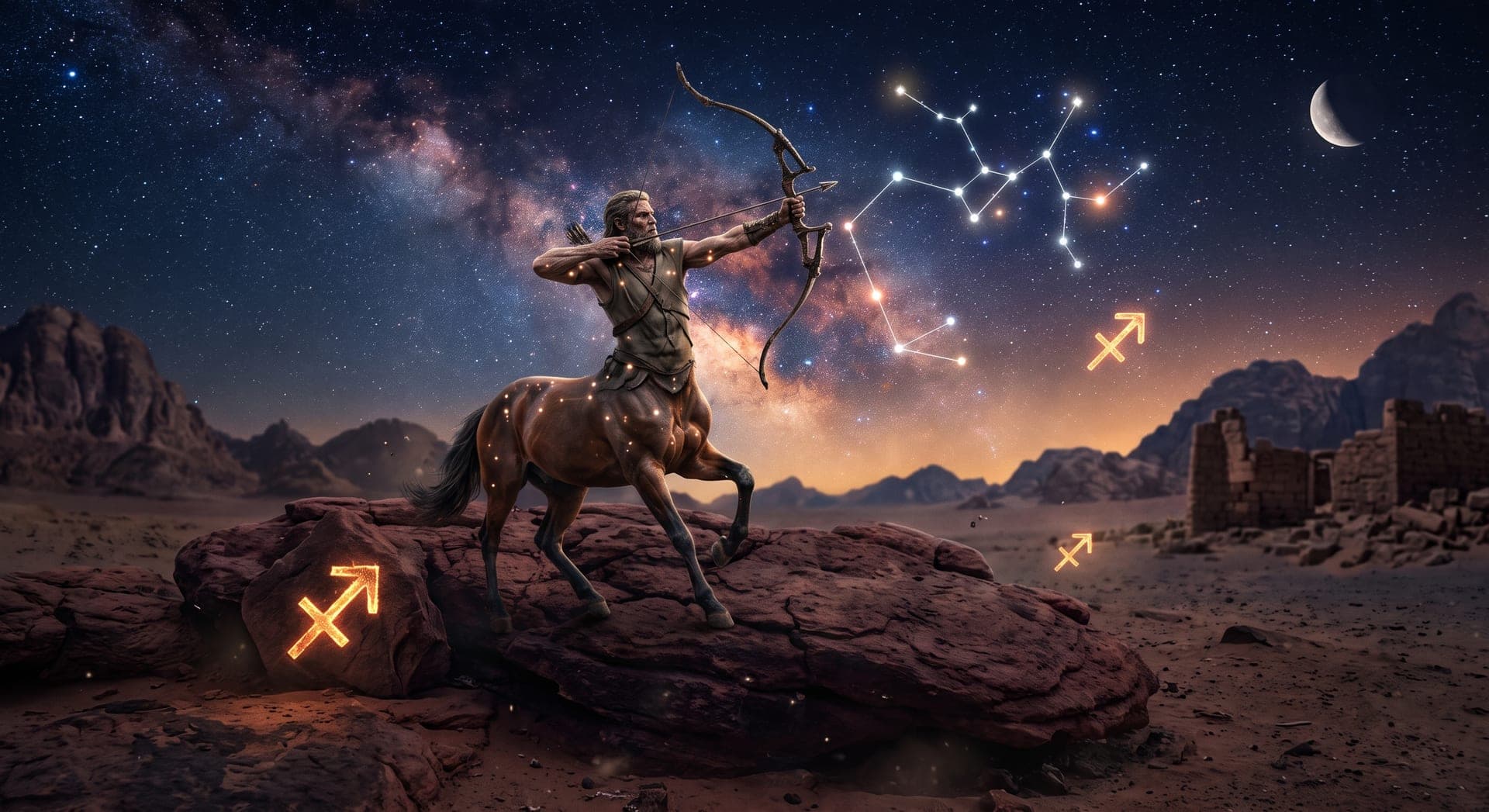
Sagittarius, the ninth sign of the zodiac, spans November 22 to December 21 and is symbolized by the archer, typically depicted as a centaur drawing a bow, representing a restless pursuit of knowledge, adventure, and far-off horizons. Ruled by Jupiter, the largest planet in the solar system and a symbol of growth, luck, and abundance, Sagittarius is widely regarded as one of the most optimistic and freedom-loving signs of the zodiac. As a Fire sign, Sagittarius approaches life with enthusiasm and a genuine hunger for new experiences, whether through literal travel or intellectual and philosophical exploration. Its Mutable modality reflects a deep aversion to routine and confinement, always looking toward the next adventure rather than settling into fixed patterns. People born under this sign are often drawn to travel, higher education, philosophy, or any pursuit that broadens their horizons and understanding of the world. Sagittarius's honesty and optimism make it excellent company, though its blunt directness and restless need for freedom can sometimes come across as tactless or noncommittal to those seeking more stability.
Personality Traits
Strengths
- Adventurous and open to new experiences
- Optimistic and enthusiastic
- Honest and direct
- Philosophical and broad-minded
- Generous and good-humored
Weaknesses
- Tactlessly blunt
- Impatient with routine
- Prone to overpromising
- Restless and commitment-averse
- Careless with details
Compatible Signs
Fun Facts
- Sagittarius's symbol, a centaur drawing a bow and arrow, connects to the Greek myth of Chiron, a wise and scholarly centaur unlike the more unruly members of his kind.
- Jupiter, Sagittarius' ruling planet, is the largest planet in the solar system, reflecting the sign's association with expansion, abundance, and big-picture thinking.
- Sagittarius is one of two zodiac signs, along with Capricorn, represented by a hybrid creature combining human and animal features.
- Notable Sagittarians include Taylor Swift, Walt Disney, Winston Churchill, and Jimi Hendrix.
- Sagittarius season spans the lead-up to the winter solstice, a period historically associated with travel, feasting, and philosophical reflection in many cultures.
Born on December 15
- 1832
Gustave Eiffel
French engineer who designed the Eiffel Tower
- 1852
Henri Becquerel
French physicist and Nobel Prize laureate for discovering radioactivity
- 1859
L. L. Zamenhof
Polish linguist who created Esperanto
- 1899
Harold Abrahams
English sprinter who won gold in the 100 metres at the 1924 Paris Olympics, later immortalized as one of the central figures in the film Chariots of Fire.
- 1907
Oscar Niemeyer
Brazilian architect known for modernist designs
- 1916
Maurice Wilkins
New Zealand-born English physicist who shared the Nobel Prize in Physiology or Medicine for his X-ray diffraction work on the structure of DNA, alongside James Watson and Francis Crick.
- 1923
Freeman Dyson
English-born physicist and mathematician known for his work in quantum electrodynamics and for wide-ranging speculative essays on science and the future.
- 1949
Don Johnson
American actor
- 1955
Paul Simonon
English musician best known as the bass guitarist of the punk rock band The Clash, whose bass-smashing image on the cover of London Calling became one of rock's iconic photographs.
- 1981
Michelle Dockery
English actress who found international fame playing Lady Mary Crawley in the television and film series Downton Abbey.
- 1982
Charlie Cox
English actor known for playing Matt Murdock in Marvel's Daredevil series and for the film Stardust.
- 1992
Jesse Lingard
English footballer who came through Manchester United's academy and represented England at the 2018 World Cup.
On This Day in History
- 1256
Mongol forces under Hulagu Khan destroy the Nizari Ismaili stronghold at Alamut Castle in present-day Iran.
The Mongol destruction of Alamut Castle, the legendary mountain fortress of the Nizari Ismaili sect sometimes called the "Assassins," eliminated a powerful and feared order that had used targeted political killings to influence regional politics for over a century and a half. Hulagu Khan's forces also destroyed the sect's renowned library, an incalculable loss of scholarly and scientific texts accumulated over generations.
- 1651
Castle Cornet in Guernsey surrenders, ending the last Royalist resistance in the British Isles during the English Civil War.
The castle, guarding Guernsey's harbor at St Peter Port, had held out for Charles I and then Charles II for years after the mainland fighting ended, even bombarding the town below. Its surrender to Parliamentarian forces closed the final chapter of the Civil Wars fought within the British Isles.
- 1778
British and French fleets clash in the naval Battle of St Lucia in the Caribbean.
The engagement, fought during the American Revolutionary War, saw a Royal Navy squadron under Samuel Barrington successfully defend a recently captured landing force against a larger French fleet attempting to retake the island. Britain went on to hold St Lucia, valued for its strategic anchorage overlooking French naval bases in the region.
- 1791
The United States Bill of Rights becomes law upon ratification by the Virginia General Assembly.
The Bill of Rights' ratification came after intense debate during the Constitution's original approval process, when Anti-Federalists successfully argued that explicit protections for individual liberties were necessary safeguards against potential federal overreach. Virginia's ratification provided the crucial ninth state approval needed to make the first ten amendments legally binding.
- 1836
A fire nearly destroys the U.S. Patent Office building, consuming close to 10,000 patents and 7,000 related models.
The fire at the U.S. Patent Office building destroyed nearly all of the young nation's patent records and models accumulated since the agency's founding, a devastating loss for inventors and for the historical record of early American innovation. The disaster prompted reforms to patent recordkeeping, including the practice of maintaining duplicate records, that continue to influence patent administration today.
- 1862
The Battle of Fredericksburg ends in Union defeat as General Burnside withdraws his forces across the Rappahannock River.
Union General Burnside's costly defeat at Fredericksburg, in which Union forces suffered casualties more than twice those of the Confederacy, prompted intense criticism of his leadership and calls for his removal, which President Lincoln granted the following month. The battle stands as one of the most lopsided Confederate victories of the entire Civil War.
- 1862
The Battle of Fredericksburg ends in a decisive Union defeat under General Ambrose Burnside.
After days of futile frontal assaults against entrenched Confederate positions, the battered Union Army of the Potomac withdrew back across the Rappahannock River. The battle stands as one of the costliest Union defeats of the American Civil War, with casualties more than double those suffered by Robert E. Lee's Confederate forces.
- 1890
Lakota leader Sitting Bull is killed during an attempted arrest at Standing Rock Indian Reservation.
Indian police sent to arrest the influential Hunkpapa Lakota chief, amid fears he would join the Ghost Dance movement, shot him during a struggle that erupted at his cabin. His death, two weeks before the Wounded Knee Massacre, marked a tragic climax to the US government's suppression of Native American resistance on the northern Plains.
- 1893
Antonín Dvořák's "From the New World" symphony premieres in public rehearsal at Carnegie Hall in New York City.
Dvořák composed his Ninth Symphony, "From the New World," during his tenure directing New York's National Conservatory of Music, drawing inspiration from African American spirituals and Native American musical themes he encountered while in the United States. The symphony's memorable melodies, including its famous largo movement, made it one of the most beloved and frequently performed works in the classical repertoire.
- 1899
British forces suffer a heavy defeat at the Battle of Colenso in South Africa.
The battle was the third and final defeat of 'Black Week,' a disastrous run for British arms during the Second Boer War, as General Redvers Buller's attempt to relieve besieged Ladysmith was repulsed with heavy losses, including the death of Lord Roberts's son. The setbacks forced Britain to send substantial reinforcements and rethink its strategy in South Africa.
- 1906
The Great Northern, Piccadilly and Brompton Railway, an early London Underground line, opens.
The opening of this early London Underground line reflected the rapid expansion of the city's transit network during the early twentieth century, as engineers tunneled ever-deeper routes to accommodate London's growing population and traffic congestion. The line would later be absorbed into what became the modern Piccadilly line, still in operation today.
- 1906
The Great Northern, Piccadilly and Brompton Railway, forerunner of the London Underground's Piccadilly line, opens.
The new deep-level 'tube' line connected Finsbury Park to Hammersmith, adding to London's rapidly expanding underground network in the early twentieth century. It later became known as the Piccadilly line and remains one of the busiest routes on the London Underground, serving Heathrow Airport since the 1970s.
- 1944
Bandleader Glenn Miller's military aircraft disappears over the English Channel during World War II.
Bandleader Glenn Miller's plane vanished during a flight from England to France, where he was scheduled to entertain American troops, and no wreckage or definitive explanation for the disappearance has ever been confirmed despite decades of investigation and speculation. His loss, at the height of his fame as one of the era's most popular musicians, remains one of aviation's enduring mysteries.
- 1944
Bandleader Glenn Miller's aircraft disappears over the English Channel while flying from England to France.
Miller, then leading the US Army Air Forces Band, had been stationed in England entertaining Allied troops and was flying ahead to arrange a Christmas broadcast for newly liberated Paris. Neither he nor the small aircraft was ever found, and his disappearance remains one of the enduring mysteries of the Second World War.
- 1961
Adolf Eichmann is sentenced to death by an Israeli court for his role in organizing the Holocaust.
The former SS officer, captured by Israeli agents in Argentina in 1960, was convicted on charges including crimes against humanity for his central role in coordinating the deportation of Jews to Nazi death camps. His trial in Jerusalem, extensively covered by international media, became a landmark moment in public reckoning with the Holocaust.
- 1965
Gemini 6A achieves the first crewed space rendezvous, meeting up with Gemini 7 in orbit.
The Gemini 6A and Gemini 7 rendezvous, in which the two spacecraft maneuvered to within roughly one foot of each other while orbiting at thousands of miles per hour, proved that precise orbital rendezvous was achievable, a capability essential for the planned lunar missions requiring separate spacecraft to reconnect in space.
- 1965
Gemini VI-A achieves the first space rendezvous, meeting up with Gemini 7 in orbit.
The two American spacecraft maneuvered to within roughly a foot of each other, flying in formation for several hours over multiple orbits of the Earth. The demonstration of orbital rendezvous, a technique essential for later Moon missions, was a crucial milestone for NASA in the space race against the Soviet Union.
- 1973
The American Psychiatric Association votes to remove homosexuality from its official list of psychiatric disorders.
The American Psychiatric Association's decision to remove homosexuality from its manual of mental disorders followed years of advocacy by gay rights activists and a growing body of research challenging the scientific basis for its earlier classification as pathological. The reclassification represented a significant milestone in the broader struggle against institutional discrimination faced by LGBTQ individuals.
- 1993
British Prime Minister John Major and Irish Taoiseach Albert Reynolds issue the Downing Street Declaration on Northern Ireland.
The joint statement affirmed that Northern Ireland's constitutional future was for its people alone to decide and that paramilitary groups renouncing violence could join political talks. The declaration was a crucial step in the Northern Ireland peace process, paving the way for ceasefires and eventually the 1998 Good Friday Agreement.
- 2001
The Leaning Tower of Pisa reopens after eleven years and a multimillion-dollar stabilization effort.
The Leaning Tower of Pisa's reopening followed an extensive engineering effort to stabilize the medieval bell tower, whose famous tilt had progressively worsened over centuries due to unstable soil beneath its foundation. Engineers carefully removed soil from the tower's higher side, reducing the lean to a safer, more sustainable angle while preserving the structure's iconic appearance.