What’s Observed on December 14
Born on December 14: Sagittarius ♐
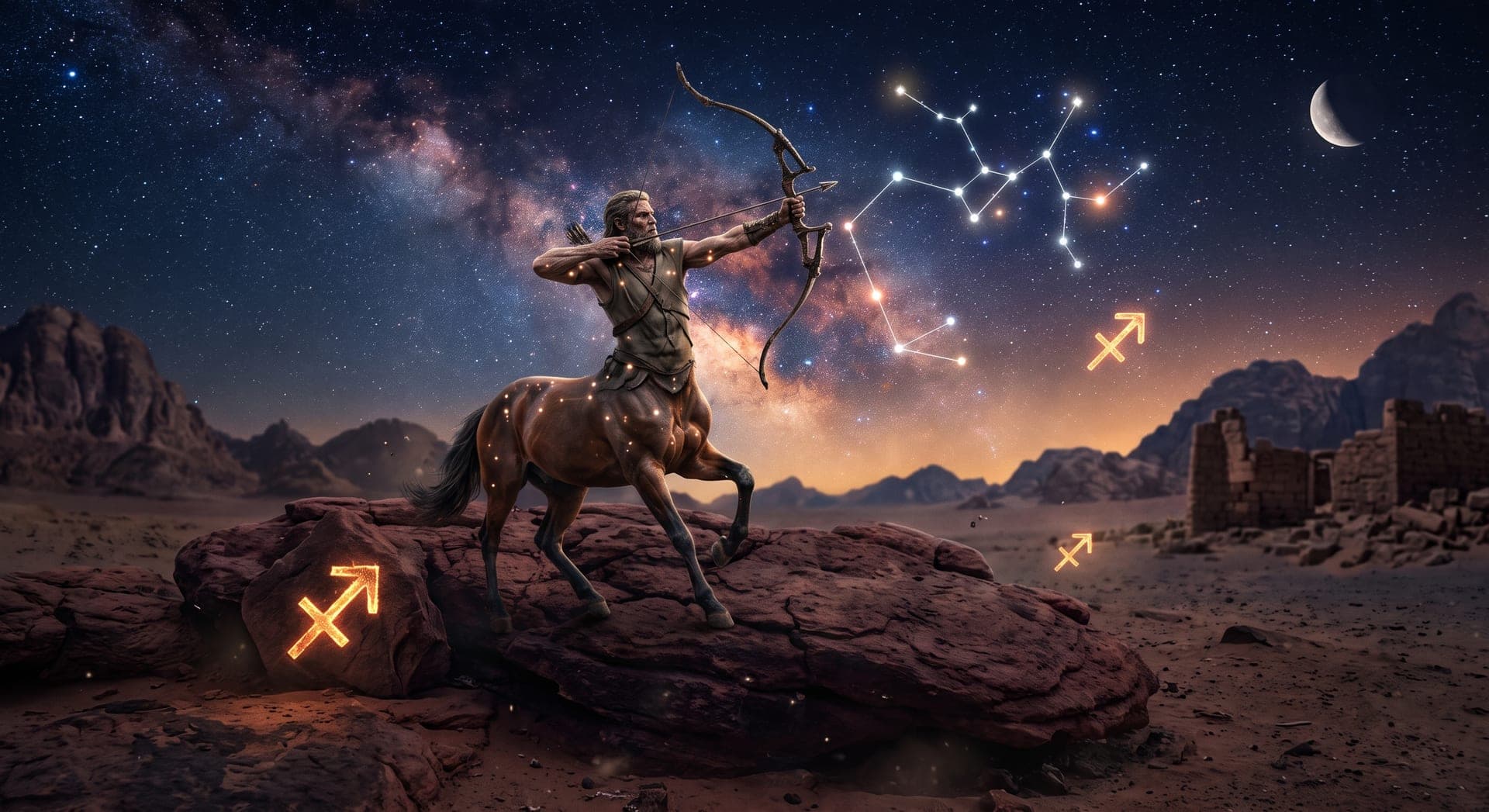
Sagittarius, the ninth sign of the zodiac, spans November 22 to December 21 and is symbolized by the archer, typically depicted as a centaur drawing a bow, representing a restless pursuit of knowledge, adventure, and far-off horizons. Ruled by Jupiter, the largest planet in the solar system and a symbol of growth, luck, and abundance, Sagittarius is widely regarded as one of the most optimistic and freedom-loving signs of the zodiac. As a Fire sign, Sagittarius approaches life with enthusiasm and a genuine hunger for new experiences, whether through literal travel or intellectual and philosophical exploration. Its Mutable modality reflects a deep aversion to routine and confinement, always looking toward the next adventure rather than settling into fixed patterns. People born under this sign are often drawn to travel, higher education, philosophy, or any pursuit that broadens their horizons and understanding of the world. Sagittarius's honesty and optimism make it excellent company, though its blunt directness and restless need for freedom can sometimes come across as tactless or noncommittal to those seeking more stability.
Personality Traits
Strengths
- Adventurous and open to new experiences
- Optimistic and enthusiastic
- Honest and direct
- Philosophical and broad-minded
- Generous and good-humored
Weaknesses
- Tactlessly blunt
- Impatient with routine
- Prone to overpromising
- Restless and commitment-averse
- Careless with details
Compatible Signs
Fun Facts
- Sagittarius's symbol, a centaur drawing a bow and arrow, connects to the Greek myth of Chiron, a wise and scholarly centaur unlike the more unruly members of his kind.
- Jupiter, Sagittarius' ruling planet, is the largest planet in the solar system, reflecting the sign's association with expansion, abundance, and big-picture thinking.
- Sagittarius is one of two zodiac signs, along with Capricorn, represented by a hybrid creature combining human and animal features.
- Notable Sagittarians include Taylor Swift, Walt Disney, Winston Churchill, and Jimi Hendrix.
- Sagittarius season spans the lead-up to the winter solstice, a period historically associated with travel, feasting, and philosophical reflection in many cultures.
Born on December 14
- 1546
Tycho Brahe
Danish astronomer known for precise pre-telescopic observations
- 1775
Thomas Cochrane
Scottish admiral and naval commander renowned for his daring exploits during the Napoleonic Wars, later a key inspiration for fictional heroes such as Horatio Hornblower and Jack Aubrey.
- 1866
Roger Fry
English painter and art critic who coined the term 'Post-Impressionism' and was a leading member of the Bloomsbury Group of writers and artists.
- 1870
Karl Renner
Austrian politician and President of Austria
- 1883
Morihei Ueshiba
Japanese martial artist who developed aikido
- 1895
Paul Éluard
French Surrealist poet
- 1895
George VI
King of the United Kingdom from 1936 to 1952, who came to the throne unexpectedly after his brother Edward VIII's abdication and became a symbol of national resolve during the Second World War.
- 1896
Jimmy Doolittle
American aviation general and Medal of Honor recipient
- 1897
Margaret Chase Smith
American politician and U.S. Senator
- 1916
Shirley Jackson
American author known for "The Lottery"
- 1943
Britt Allcroft
English writer and producer who created the television adaptation of Thomas the Tank Engine, bringing the Reverend W. Awdry's stories to a global audience.
- 1946
Antony Beevor
English military historian best known for narrative histories of the Second World War, including Stalingrad and Berlin: The Downfall 1945.
- 1946
Jane Birkin
English actress and singer who became a fixture of French popular culture, and after whom the iconic Hermes Birkin handbag is named.
- 1979
Michael Owen
English footballer who won the Ballon d'Or in 2001 and starred for Liverpool, Real Madrid, and the England national team, famed for his pace and finishing.

On This Day in History
- 1287
St. Lucia's flood devastates the Netherlands when the Zuiderzee sea wall collapses, killing more than 50,000 people.
St. Lucia's Flood struck the low-lying Netherlands when a powerful storm surge overwhelmed the sea defenses protecting the Zuiderzee, an inland sea vulnerable to North Sea flooding. The catastrophic loss of life, among the deadliest floods in recorded European history, prompted early Dutch efforts to improve coastal defenses, a centuries-long engineering endeavor that continues to define the Netherlands' relationship with the sea.
- 1542
Mary Stuart becomes Queen of Scots at just six days old following the death of her father, King James V.
Mary Stuart's accession as Queen of Scots at just six days old, following her father's death shortly after a military defeat to England, plunged Scotland into a prolonged regency period marked by intense political maneuvering. Her tumultuous later life, including her eventual execution by order of Elizabeth I of England, made her one of the most dramatic and tragic figures in British royal history.
- 1542
Mary Stuart becomes Queen of Scots at just one week old, following the death of her father, James V.
James V died shortly after a Scottish defeat by English forces at the Battle of Solway Moss, leaving his infant daughter as monarch. Mary's reign would be shaped by regency struggles, competing English and French influence, and, decades later, her own dramatic downfall and execution in England in 1587.
- 1782
The Montgolfier brothers conduct their first successful unmanned hot air balloon test, traveling nearly 2.5 kilometers in France.
The Montgolfier brothers' unmanned test flight, using a balloon filled with heated air, provided the crucial proof of concept that preceded their first manned flight just weeks later. Their pioneering work launched the age of human flight, initially through hot air balloons before eventually giving way to heavier-than-air aircraft over a century later.
- 1812
Napoleon's Grande Armée completes its disastrous retreat from Russia, effectively ending the French invasion.
Napoleon's retreat from Russia proved catastrophic, as the Grande Armée, which had numbered over 600,000 troops at the invasion's start, was reduced to a small fraction of its original size through combat losses, disease, starvation, and the brutal Russian winter. The disastrous campaign severely weakened Napoleon's military power and emboldened his European enemies to form a new coalition against him.
- 1814
British forces seize control of Lake Borgne in Louisiana during the War of 1812.
A Royal Navy flotilla of small boats overwhelmed a weaker American gunboat squadron in a sharp engagement on the lake east of New Orleans, clearing the way for a British invasion force to land nearby. The action set the stage for the Battle of New Orleans the following month, fought after a peace treaty had already been signed.
- 1896
The Glasgow Underground Railway opens, making Glasgow the third city in the world with an underground railway.
The cable-hauled subway ran a single circular route beneath the city, following London and Budapest as only the third urban underground system built anywhere. Now known simply as the Subway, it remains one of the oldest metro systems in the world and a distinctive feature of Glasgow's transport network.
- 1900
Max Planck presents his black-body radiation law and the foundations of quantum theory to the German Physical Society.
Planck's formula, which required assuming that energy is emitted and absorbed in discrete packets or 'quanta,' resolved a longstanding puzzle in classical physics known as the ultraviolet catastrophe. The insight is now regarded as the birth of quantum mechanics, one of the two pillars of modern physics.
- 1903
The Wright brothers make their first, unsuccessful attempt at powered flight with the Wright Flyer at Kitty Hawk.
The Wright brothers' first attempt at powered flight, using a coin flip to determine that Wilbur would pilot the aircraft, ended in a stall shortly after takeoff that caused minor damage to the Flyer. Undeterred, the brothers spent the following days making repairs, setting the stage for their historic successful flight just three days later.
- 1903
Orville and Wilbur Wright make their first attempt at powered flight at Kitty Hawk, North Carolina.
Wilbur's initial attempt stalled the Flyer shortly after takeoff, causing minor damage and requiring repairs. Three days later, on December 17, the brothers succeeded in the first sustained, controlled flight of a powered aircraft, a feat that launched the age of aviation.
- 1907
The seven-masted schooner Thomas W. Lawson wrecks off England's Isles of Scilly, killing all but two aboard.
The largest pure sailing ship ever built, laden with 58,000 barrels of paraffin oil bound for London, was driven onto rocks near Annet island in a storm after both anchor chains snapped. Seventeen of the nineteen men aboard died, and the spilled cargo is considered among the earliest major oil spills in maritime history.
- 1911
Roald Amundsen's Norwegian expedition becomes the first to reach the geographic South Pole.
Amundsen's expedition reached the South Pole after a grueling trek using dog sleds, narrowly beating a rival British expedition led by Robert Falcon Scott, whose team arrived over a month later only to perish on the return journey. Amundsen's careful planning and use of experienced polar techniques proved decisive in achieving the historic milestone safely.
- 1911
Roald Amundsen's Norwegian expedition becomes the first to reach the geographic South Pole.
Amundsen's team arrived roughly five weeks ahead of the rival British expedition led by Robert Falcon Scott, who reached the pole in January 1912 only to perish with his men on the return journey. The achievement, secured through meticulous planning and skilled use of sled dogs, remains one of the landmark feats of polar exploration.
- 1918
Women vote for the first time in a UK general election, and Sinn Féin wins a landslide victory in Ireland.
The 1918 UK general election marked the first time women, specifically those over 30 meeting certain property qualifications, were permitted to vote following the Representation of the People Act earlier that year. The same election saw the Irish republican party Sinn Féin win an overwhelming majority of Irish seats, leading its elected members to refuse to take their seats in Westminster and instead establish an independent Irish parliament.
- 1918
The United Kingdom holds a general election in which women vote for the first time.
Under the Representation of the People Act 1918, women over thirty who met property qualifications gained the vote, alongside all men over twenty-one. The same election saw Sinn Fein's Constance Markievicz become the first woman elected to the House of Commons, though, in line with her party's policy, she never took her seat at Westminster.
- 1962
NASA's Mariner 2 becomes the first spacecraft to successfully fly by another planet, passing Venus.
Mariner 2's successful flyby of Venus provided the first close-up scientific data about another planet, revealing the planet's crushingly high surface temperatures and dense atmosphere that dispelled earlier speculation about a potentially habitable Venusian surface. The mission demonstrated the feasibility of interplanetary spacecraft and paved the way for more ambitious future missions.
- 1962
NASA's Mariner 2 becomes the first spacecraft to successfully fly by another planet, passing Venus.
The uncrewed probe transmitted the first close-up scientific data about Venus's atmosphere and surface temperature, revealing the planet to be far hotter and more hostile than earlier speculation had suggested. The mission marked a milestone in the early space race and the beginning of robotic planetary exploration.
- 1972
Eugene Cernan becomes the most recent human to walk on the Moon as Apollo 17's final lunar activity concludes.
Eugene Cernan's final steps off the lunar surface, as he reboarded the Apollo 17 lunar module for the return journey to Earth, made him, more than five decades later, still the most recent human to have walked on the Moon. His parting words expressed both a farewell and a hope for humanity's eventual return to lunar exploration.
- 1972
Astronaut Eugene Cernan becomes the last person to walk on the Moon, closing out Apollo 17's third and final moonwalk.
Cernan and geologist Harrison Schmitt spent over seven hours outside their lunar module collecting samples before Cernan became the last person, to date, to climb back up the ladder from the lunar surface. More than fifty years later, no astronaut has since returned to the Moon.
- 2004
The Millau Viaduct, the world's tallest bridge, is formally inaugurated in France.
The Millau Viaduct, spanning a valley in southern France, briefly held the record as the world's tallest bridge structure, with one of its support towers taller than the Eiffel Tower. Designed by British architect Norman Foster, the striking cable-stayed bridge significantly reduced travel times across a previously difficult mountainous route.