
What’s Observed on January 28
Born on January 28: Aquarius ♒
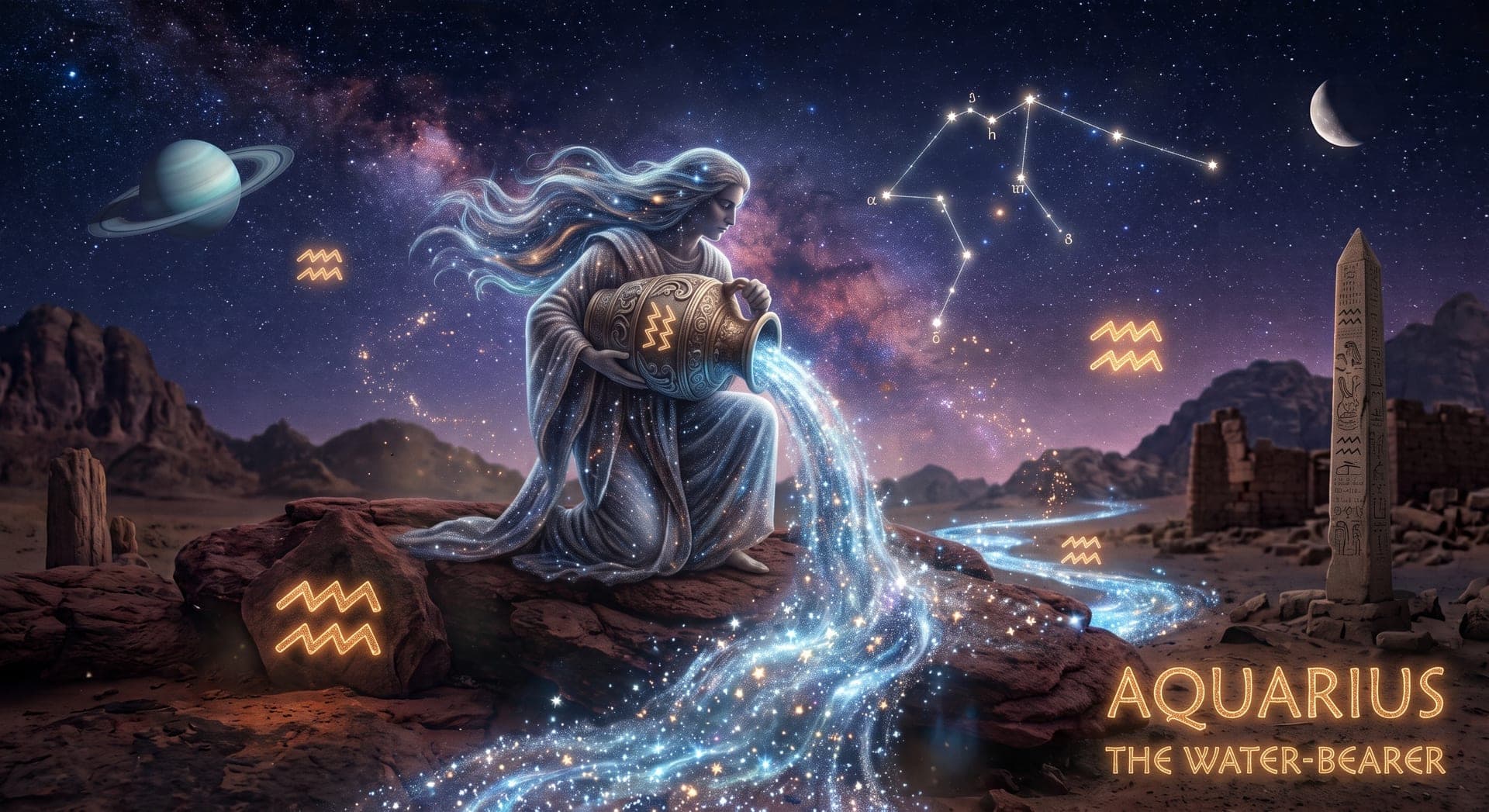
Aquarius, the eleventh sign of the zodiac, spans January 20 to February 18 and is symbolized by the water bearer, an image of someone pouring out knowledge and life-giving ideas to the world, despite Aquarius actually being an air sign rather than a water sign. Traditionally ruled by disciplined Saturn and, in modern astrology, by unpredictable Uranus, the planet of innovation and rebellion, Aquarius carries a distinctive blend of structure and originality. People born under this sign are often described as independent thinkers, forward-looking, and drawn to humanitarian causes, valuing the collective good over convention. As a Fixed sign, Aquarius can be famously stubborn once its mind is made up, even while championing change for everyone else. Intellectually curious and sometimes emotionally guarded, Aquarians tend to value friendship and community deeply, often serving as the visionary of their social circle, more comfortable debating ideas than discussing feelings.
Personality Traits
Strengths
- Original and forward-thinking
- Strong sense of fairness and justice
- Independent and self-sufficient
- Loyal to friends and causes alike
- Sees the bigger picture others miss
Weaknesses
- Can run from emotional expression
- Uncompromising once a position is fixed
- Prone to aloofness or detachment
- Sometimes contrarian just to stand apart
- Can prioritize ideas over people's feelings
Compatible Signs
Fun Facts
- Despite its watery name and imagery, Aquarius is classified as an air sign, grouped with Gemini and Libra as a sign of thought and communication rather than emotion.
- Aquarius has two ruling planets: Saturn in classical astrology, and Uranus, discovered in 1781, in the modern system most Western astrologers use today.
- The water bearer symbol traces back to Ganymede in Greek mythology, a cupbearer to the gods said to pour out a life-giving stream from the heavens.
- Notable Aquarians include Oprah Winfrey, Abraham Lincoln, Charles Darwin, Thomas Edison, and Bob Marley.
- Aquarius is one of the rarer signs to be represented by a person rather than an animal or object, alongside Gemini, Virgo, and Sagittarius's centaur half.
Born on January 28
- 1457
Henry VII of England
English king who founded the Tudor dynasty after his victory at the Battle of Bosworth Field
- 1706
John Baskerville
English printer and typeface designer famed for the Baskerville typeface
- 1784
George Hamilton-Gordon, 4th Earl of Aberdeen
British statesman who served as Prime Minister of the United Kingdom
- 1833
Charles George Gordon
English general known as "Gordon of Khartoum" for his death defending the city against Mahdist forces
- 1887
Arthur Rubinstein
Renowned Polish-American classical pianist
- 1912
Jackson Pollock
Influential American abstract expressionist painter
- 1927
Ronnie Scott
English jazz saxophonist who founded London's famous Ronnie Scott's Jazz Club
- 1936
Alan Alda
Actor and director best known for "M*A*S*H"
- 1940
Carlos Slim
Mexican business magnate and philanthropist
- 1955
Nicolas Sarkozy
Former President of France
- 1957
Frank Skinner
English comedian and broadcaster known for his stand-up and chat shows
- 1968
Sarah McLachlan
Canadian singer-songwriter
- 1978
Gianluigi Buffon
Widely regarded as one of the greatest football goalkeepers ever
- 1978
Jamie Carragher
English footballer who spent his career at Liverpool and later became a television pundit

On This Day in History
- 814
Charlemagne, the first Holy Roman Emperor, dies, and his son Louis the Pious succeeds him.
Charlemagne, who had been crowned Holy Roman Emperor by the pope in 800, ruled over a vast empire covering much of Western Europe, promoting a cultural and educational revival known as the Carolingian Renaissance. His death led to the empire's gradual fragmentation among his heirs, a division whose borders roughly foreshadowed the later emergence of France and Germany as distinct nations.
- 1069
Norman forces under Robert de Comines are killed by rebels in Durham, triggering the Harrying of the North.
Comines, newly appointed Earl of Northumbria by William the Conqueror, was ambushed and killed along with his men by Northumbrian rebels in Durham. The uprising provoked William into a brutal scorched-earth campaign across northern England, laying waste to farmland and settlements and causing widespread famine that devastated the region for years afterward.
- 1077
Holy Roman Emperor Henry IV makes his famous "Walk to Canossa," humbling himself before Pope Gregory VII to have his excommunication lifted.
Henry IV traveled to Canossa in northern Italy and reportedly stood barefoot in the snow for three days as a penitent, seeking to have his excommunication by Pope Gregory VII lifted amid a bitter dispute over the emperor's authority to appoint bishops. The episode became a lasting symbol of the tension between religious and secular power in medieval Europe.
- 1521
The Diet of Worms, an imperial assembly of the Holy Roman Empire, opens.
Convened by Emperor Charles V, the assembly is best remembered for summoning the reformer Martin Luther to defend or recant his writings against Catholic doctrine. Luther's refusal to recant led the emperor to issue the Edict of Worms declaring him an outlaw, a pivotal confrontation in the early Protestant Reformation.
- 1547
Edward VI becomes King of England following the death of his father, Henry VIII.
Edward VI, only nine years old at his accession, became king following the death of his father, Henry VIII, though real power rested with a council of regents, notably his uncle Edward Seymour. His brief six-year reign pushed England further toward Protestantism before his early death from illness led to the brief, contested reign of Lady Jane Grey and then his half-sister Mary I.
- 1547
Edward VI becomes King of England following the death of his father, Henry VIII.
Edward ascended the throne at just nine years old, with a regency council led first by his uncle Edward Seymour governing on his behalf. His short reign, cut off by his death in 1553, saw the English Reformation pushed decisively toward Protestantism, including the introduction of the Book of Common Prayer.
- 1591
Agnes Sampson is executed for witchcraft in Edinburgh.
Sampson, a Scottish midwife and healer, was tried in the North Berwick witch trials after confessing under torture to conspiring by witchcraft against King James VI. Her execution reflected the king's intense personal interest in witch-hunting, which he later documented in his treatise Daemonologie, fueling further persecutions across Scotland in the following years.
- 1624
Sir Thomas Warner founds the first permanent English colony in the Caribbean, on Saint Kitts.
Warner, an English adventurer and former soldier, established the settlement after earlier expeditions to South America, and it quickly became a base for further English colonization across the Leeward Islands. Saint Kitts was later shared uneasily with a French colony on the same island before passing entirely to British control in the eighteenth century.
- 1754
English writer Horace Walpole coins the word "serendipity" in a letter to a friend.
Walpole invented the term while describing the Persian fairy tale "The Three Princes of Serendip," whose heroes were, he wrote, always making fortunate discoveries by accident and sagacity that they were not seeking. The word entered wider English usage only gradually over the following two centuries, but is now a common part of the language.
- 1813
Jane Austen's novel "Pride and Prejudice" is first published in the United Kingdom.
Austen published "Pride and Prejudice" anonymously, as was common for female authors at the time, crediting it only to "the author of Sense and Sensibility." The novel's wit and social observation made it an immediate popular success, and it has since become one of the most widely read and beloved novels in the English language, still adapted regularly for film and television.
- 1813
Jane Austen's novel Pride and Prejudice is published in the United Kingdom.
The novel appeared anonymously, credited only to "the author of Sense and Sensibility," as was then customary for female novelists. Following the courtship of Elizabeth Bennet and Mr Darcy, it became one of the most widely read and enduringly popular novels in the English language, celebrated for its wit and social observation.
- 1846
British forces under Sir Harry Smith defeat the Sikh army at the Battle of Aliwal in India.
The battle, fought during the First Anglo-Sikh War, saw British and East India Company forces rout the Khalsa Army near the Sutlej River, inflicting heavy casualties. It was one of the decisive engagements of the war, which ended weeks later with a treaty that significantly curtailed Sikh power and expanded British influence over the Punjab.
- 1871
The Siege of Paris ends in French surrender during the Franco-Prussian War.
The four-month siege by Prussian and German forces starved Paris into surrender, ending the Franco-Prussian War in decisive German victory. The humiliating defeat, and the loss of Alsace-Lorraine that followed, fueled deep French resentment that contributed to tensions leading up to World War I more than four decades later.
- 1896
Walter Arnold becomes the first person in Britain convicted of speeding, fined one shilling.
Arnold was caught driving his motor car at roughly 8 mph through Paddock Wood in Kent, about four times the 2 mph legal limit then in force under earlier locomotive laws. A police constable reportedly had to chase him down on a bicycle. The case is often cited as the origin of Britain's long history of speeding enforcement.
- 1932
Japanese forces attack Shanghai, escalating tensions that precede the Second Sino-Japanese War.
Japanese naval forces bombed and attacked Shanghai, ostensibly in response to anti-Japanese boycotts and unrest, in an escalation that foreshadowed the far larger Japanese invasion of China later in the decade. Chinese resistance in the city drew international attention, and the incident deepened Sino-Japanese tensions that erupted into full-scale war in 1937.
- 1956
Elvis Presley makes his first appearance on national American television.
Presley's appearance on a popular variety show introduced his provocative performance style to a massive national television audience for the first time, sparking both enormous popularity among young viewers and considerable controversy among more conservative adults over his hip movements and rock-and-roll sound. The appearance helped launch him toward becoming one of the best-selling music artists in history.
- 1986
The Space Shuttle Challenger disintegrates 73 seconds after liftoff, killing all seven astronauts aboard.
The Challenger broke apart just 73 seconds after launch due to the failure of an O-ring seal in one of its solid rocket boosters, which had become brittle in unusually cold Florida weather that morning. The disaster, watched live by millions including many schoolchildren because a civilian teacher was aboard, led NASA to ground the shuttle program for over two years while implementing major safety reforms.
- 1986
The Space Shuttle Challenger disintegrates shortly after liftoff, killing all seven crew members.
The shuttle broke apart 73 seconds into its flight from Kennedy Space Center due to the failure of an O-ring seal in cold weather, killing all aboard including schoolteacher Christa McAuliffe. The disaster, watched live by millions, led to a nearly three-year grounding of the shuttle program and sweeping reforms to NASA's safety culture.
- 1988
Canada's Supreme Court strikes down the country's abortion law in R v Morgentaler.
The Canadian Supreme Court ruled that the country's existing abortion law, which required approval from hospital committees, violated a woman's constitutional right to security of the person under the Canadian Charter of Rights and Freedoms. The decision effectively decriminalized abortion nationwide, and Canada remains one of the few countries without specific criminal restrictions on the procedure.
- 2023
Nationwide protests begin in the United States following the release of video showing the police killing of Tyre Nichols.
Video footage showing Memphis police officers brutally beating Tyre Nichols during a traffic stop, released weeks after his death from his injuries, sparked protests across major American cities. The footage led to murder charges against several officers involved and renewed national debate over policing practices and accountability.