
What’s Observed on January 27
Born on January 27: Aquarius ♒
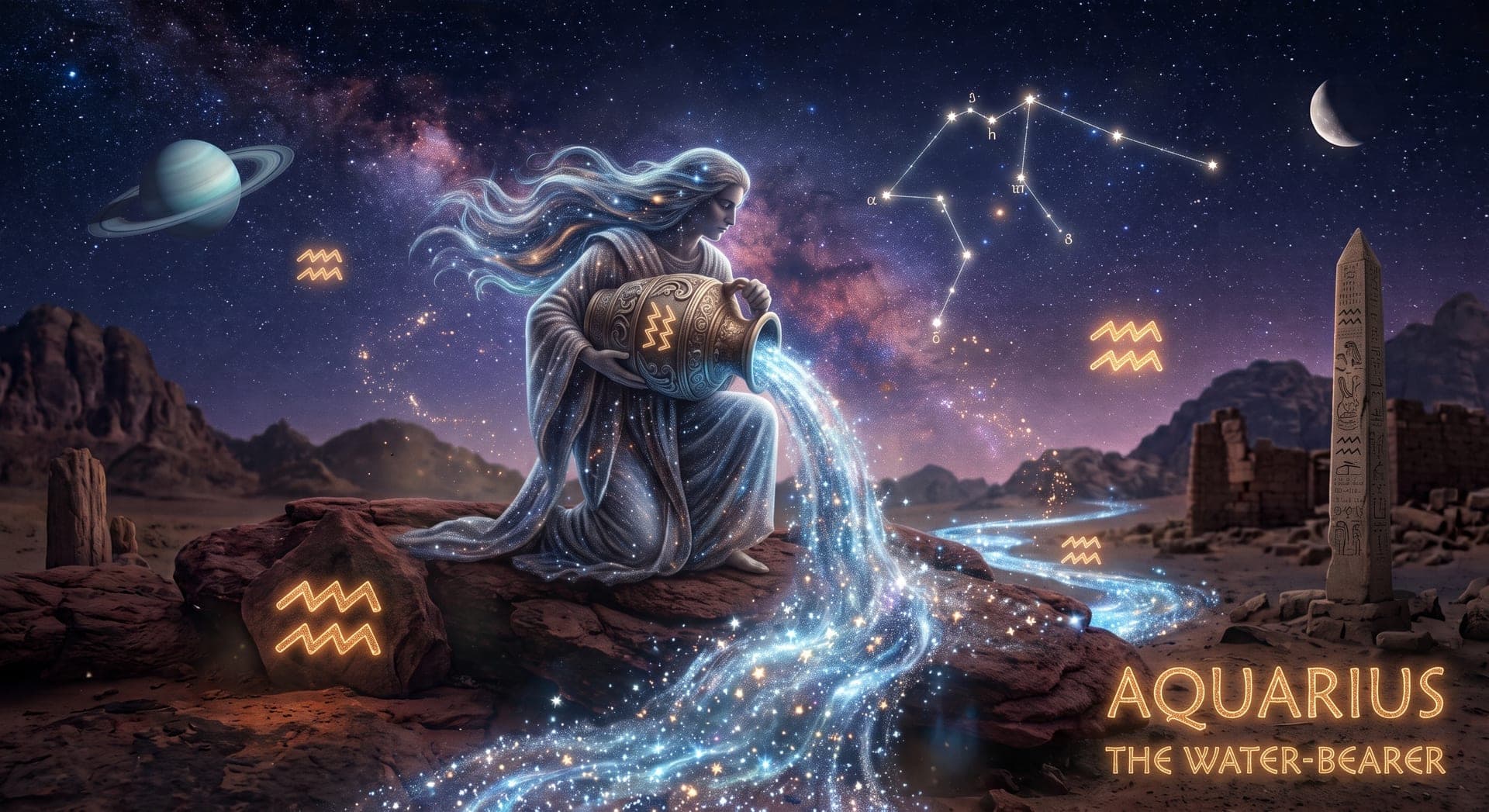
Aquarius, the eleventh sign of the zodiac, spans January 20 to February 18 and is symbolized by the water bearer, an image of someone pouring out knowledge and life-giving ideas to the world, despite Aquarius actually being an air sign rather than a water sign. Traditionally ruled by disciplined Saturn and, in modern astrology, by unpredictable Uranus, the planet of innovation and rebellion, Aquarius carries a distinctive blend of structure and originality. People born under this sign are often described as independent thinkers, forward-looking, and drawn to humanitarian causes, valuing the collective good over convention. As a Fixed sign, Aquarius can be famously stubborn once its mind is made up, even while championing change for everyone else. Intellectually curious and sometimes emotionally guarded, Aquarians tend to value friendship and community deeply, often serving as the visionary of their social circle, more comfortable debating ideas than discussing feelings.
Personality Traits
Strengths
- Original and forward-thinking
- Strong sense of fairness and justice
- Independent and self-sufficient
- Loyal to friends and causes alike
- Sees the bigger picture others miss
Weaknesses
- Can run from emotional expression
- Uncompromising once a position is fixed
- Prone to aloofness or detachment
- Sometimes contrarian just to stand apart
- Can prioritize ideas over people's feelings
Compatible Signs
Fun Facts
- Despite its watery name and imagery, Aquarius is classified as an air sign, grouped with Gemini and Libra as a sign of thought and communication rather than emotion.
- Aquarius has two ruling planets: Saturn in classical astrology, and Uranus, discovered in 1781, in the modern system most Western astrologers use today.
- The water bearer symbol traces back to Ganymede in Greek mythology, a cupbearer to the gods said to pour out a life-giving stream from the heavens.
- Notable Aquarians include Oprah Winfrey, Abraham Lincoln, Charles Darwin, Thomas Edison, and Bob Marley.
- Aquarius is one of the rarer signs to be represented by a person rather than an animal or object, alongside Gemini, Virgo, and Sagittarius's centaur half.
Born on January 27
- 1621
Thomas Willis
English physician and anatomist regarded as a founder of modern neurology
- 1756
Wolfgang Amadeus Mozart
Austrian composer, one of the most influential figures in classical music
- 1832
Lewis Carroll
English author and mathematician best known for Alice's Adventures in Wonderland
- 1850
Edward Smith
English sea captain who commanded the RMS Titanic on its fatal voyage
- 1859
Wilhelm II
Last German Emperor, who ruled through World War I
- 1944
Nick Mason
English drummer and founding member of the rock band Pink Floyd
- 1948
Mikhail Baryshnikov
Celebrated Russian-American ballet dancer and choreographer
- 1955
John Roberts
Chief Justice of the United States Supreme Court
- 1963
George Monbiot
English journalist and author known for his environmental and political writing
- 1964
Bridget Fonda
American actress from the Fonda acting family
- 1965
Alan Cumming
Scottish actor known for stage, film, and television roles including Cabaret and The Good Wife
- 1965
Mike Newell
English film director known for Four Weddings and a Funeral and Harry Potter and the Goblet of Fire
- 1980
Marat Safin
Russian tennis champion and former world number one

On This Day in History
- 98
Trajan succeeds his adoptive father Nerva as Roman emperor, ushering in a period of significant imperial expansion.
Trajan, a respected military commander adopted as heir by the childless and increasingly unpopular Emperor Nerva, succeeded him peacefully upon his death. Trajan went on to expand the Roman Empire to its greatest territorial extent, conquering Dacia and parts of Mesopotamia, and is remembered as one of the "Five Good Emperors" who presided over a golden age of stability.
- 1302
Poet Dante Alighieri is condemned and exiled from Florence.
Dante's exile from his native Florence, imposed by a rival political faction after he backed the losing side in a bitter power struggle, was ostensibly for corruption but was widely understood as political persecution. He never returned to the city and spent the rest of his life writing, including his masterpiece "The Divine Comedy," partly as a reflection on the political turmoil that had exiled him.
- 1606
The trial of Guy Fawkes and other Gunpowder Plot conspirators begins in London.
Guy Fawkes and his fellow conspirators stood trial for the failed 1605 plot to blow up the Houses of Parliament and assassinate King James I using barrels of gunpowder hidden in a cellar beneath the building. Convicted of treason, most of the plotters, including Fawkes, were executed. The foiled plot is still commemorated annually in Britain on Guy Fawkes Night.
- 1606
The trial of the Gunpowder Plot conspirators, including Guy Fawkes, begins in London.
The conspirators had been arrested after their plan to blow up the House of Lords during the state opening of Parliament on 5 November 1605 was uncovered. Tried at Westminster Hall for high treason, they were found guilty within days and executed shortly afterward, and the failed plot remains commemorated annually in Britain on Guy Fawkes Night.
- 1820
A Russian naval expedition led by Bellingshausen and Lazarev sights the Antarctic continent for the first time.
The Russian expedition, led by Fabian von Bellingshausen and Mikhail Lazarev, sighted an ice shelf now believed to be the first documented sighting of the Antarctic continent, though the claim has long been disputed by rival British and American expeditions that also claimed early sightings around the same time. Antarctica remained largely unexplored for another century afterward.
- 1820
A Russian naval expedition sights the Antarctic mainland.
The expedition, led by Fabian von Bellingshausen and Mikhail Lazarev, sighted an ice shelf now considered part of the Antarctic continent, in what is generally regarded as one of the earliest confirmed sightings of Antarctica. Rival claims by British and American sealers and explorers around the same period have made the question of who first sighted the continent a lasting historical debate.
- 1868
Forces loyal to the Japanese emperor defeat the shogunate at the Battle of Toba–Fushimi, a turning point in the Meiji Restoration.
Forces loyal to the young Emperor Meiji defeated troops of the Tokugawa shogunate near Kyoto, a pivotal early battle of the Boshin War that decided the future direction of Japan. The shogunate's defeat cleared the path for the sweeping Meiji Restoration reforms that would rapidly modernize and industrialize Japan over the following decades.
- 1874
Modest Mussorgsky's opera Boris Godunov premieres in Saint Petersburg.
The opera, based on the turbulent reign of the sixteenth-century Russian tsar Boris Godunov, debuted at the Mariinsky Theatre after Mussorgsky had substantially revised an earlier version rejected by the theatre's committee. It went on to become one of the most celebrated and frequently performed works in the Russian operatic repertoire.
- 1880
Thomas Edison receives a patent for his design of an incandescent electric lamp.
Edison's patent covered a lamp using a carbonized filament housed in a vacuum bulb, refining earlier experimental designs into a practical and commercially viable form. The invention became central to the rapid electrification of homes, streets, and businesses in the decades that followed, and cemented Edison's reputation as one of the era's most influential inventors.
- 1916
The British Military Service Act 1916 receives royal assent, introducing conscription.
The act imposed compulsory military service on single men aged eighteen to forty-one, marking the first time conscription had been used in British history. It came in response to declining rates of voluntary enlistment as the First World War dragged on; a follow-up act extending conscription to married men was passed later the same year.
- 1944
The 872-day Siege of Leningrad is lifted by Soviet forces during World War II.
The siege, one of the longest and deadliest in modern history, had trapped Leningrad's population under German blockade for nearly two and a half years, causing mass starvation that killed an estimated one million civilians. Its lifting by Soviet forces was celebrated with a 24-gun salute in the city, and it remains a defining, deeply commemorated event in Russian historical memory.
- 1944
The Siege of Leningrad is fully lifted after nearly 900 days.
Soviet forces drove back the encircling German and Finnish troops, ending one of the longest and deadliest sieges in modern history. Well over a million civilians and soldiers had died from starvation, disease, cold, and bombardment during the blockade, which had begun in September 1941 and become a defining symbol of Soviet wartime suffering and endurance.
- 1945
Soviet troops liberate the remaining prisoners at the Auschwitz-Birkenau concentration camp.
Soviet troops entering Auschwitz-Birkenau found roughly 7,000 surviving prisoners too weak to have been forced on the earlier death marches, along with evidence of the camp's machinery of mass murder. The date is now observed internationally as Holocaust Remembrance Day, commemorating the roughly six million Jews and millions of others killed during the Holocaust.
- 1945
Soviet forces liberate the Auschwitz-Birkenau concentration and extermination camp.
Advancing Red Army troops entered the camp complex in occupied Poland, freeing the roughly 7,000 prisoners who remained after the Nazis had forcibly marched most inmates westward in the preceding weeks. The liberation revealed the scale of the genocide committed there, and the date is now marked internationally as Holocaust Remembrance Day.
- 1967
A cabin fire during a launch pad test kills all three Apollo 1 astronauts; the same day, the Outer Space Treaty is signed by major spacefaring nations.
A flash fire swept through the Apollo 1 command module during a routine ground test, killing astronauts Gus Grissom, Ed White, and Roger Chaffee before they could escape the sealed capsule. The tragedy, attributed to faulty wiring and a pure-oxygen cabin atmosphere, led to a major redesign of the spacecraft and delayed the Apollo program by over a year, though it ultimately made later missions safer.
- 1967
The Outer Space Treaty is opened for signature by the United States, United Kingdom, and Soviet Union, the same day the Apollo 1 fire kills three astronauts.
The treaty, which bans weapons of mass destruction in orbit and on celestial bodies and establishes space as free for exploration by all nations, was signed simultaneously in Washington, London, and Moscow by the three depositary governments. On the same day, a cabin fire during a launch pad test killed Apollo 1 astronauts Gus Grissom, Ed White, and Roger Chaffee.
- 1973
The Paris Peace Accords are signed, officially ending direct U.S. involvement in the Vietnam War.
The accords, negotiated primarily between U.S. National Security Advisor Henry Kissinger and North Vietnamese official Lê Đức Thọ, established a ceasefire and the withdrawal of remaining U.S. troops from Vietnam. Fighting between North and South Vietnam continued afterward, however, and the South Vietnamese government ultimately collapsed when North Vietnamese forces captured Saigon in 1975.
- 1973
The Paris Peace Accords are signed, ending direct US military involvement in the Vietnam War.
Representatives of the United States, North Vietnam, South Vietnam, and the Viet Cong signed the agreement after years of negotiation, providing for a ceasefire and the withdrawal of remaining American troops. Fighting between North and South Vietnamese forces nevertheless continued, culminating in the fall of Saigon and reunification of Vietnam in 1975.
- 2010
Apple unveils the iPad, launching the modern tablet computer market.
Steve Jobs introduced the iPad as a new category of device positioned between a smartphone and a laptop, drawing some initial skepticism about whether consumers actually needed another gadget. It went on to sell millions of units within its first year and helped popularize the modern tablet computer, reshaping how people consume media and use apps on the go.
- 2010
Apple unveils the iPad tablet computer.
Announced by Steve Jobs at an event in San Francisco, the iPad was positioned as a new category of device between the iPhone and laptop computers, aimed at web browsing, media, and light productivity. Its commercial success helped popularize the modern tablet computer market and influenced a wave of competing devices from other manufacturers.