What’s Observed on September 25
Born on September 25: Libra ♎
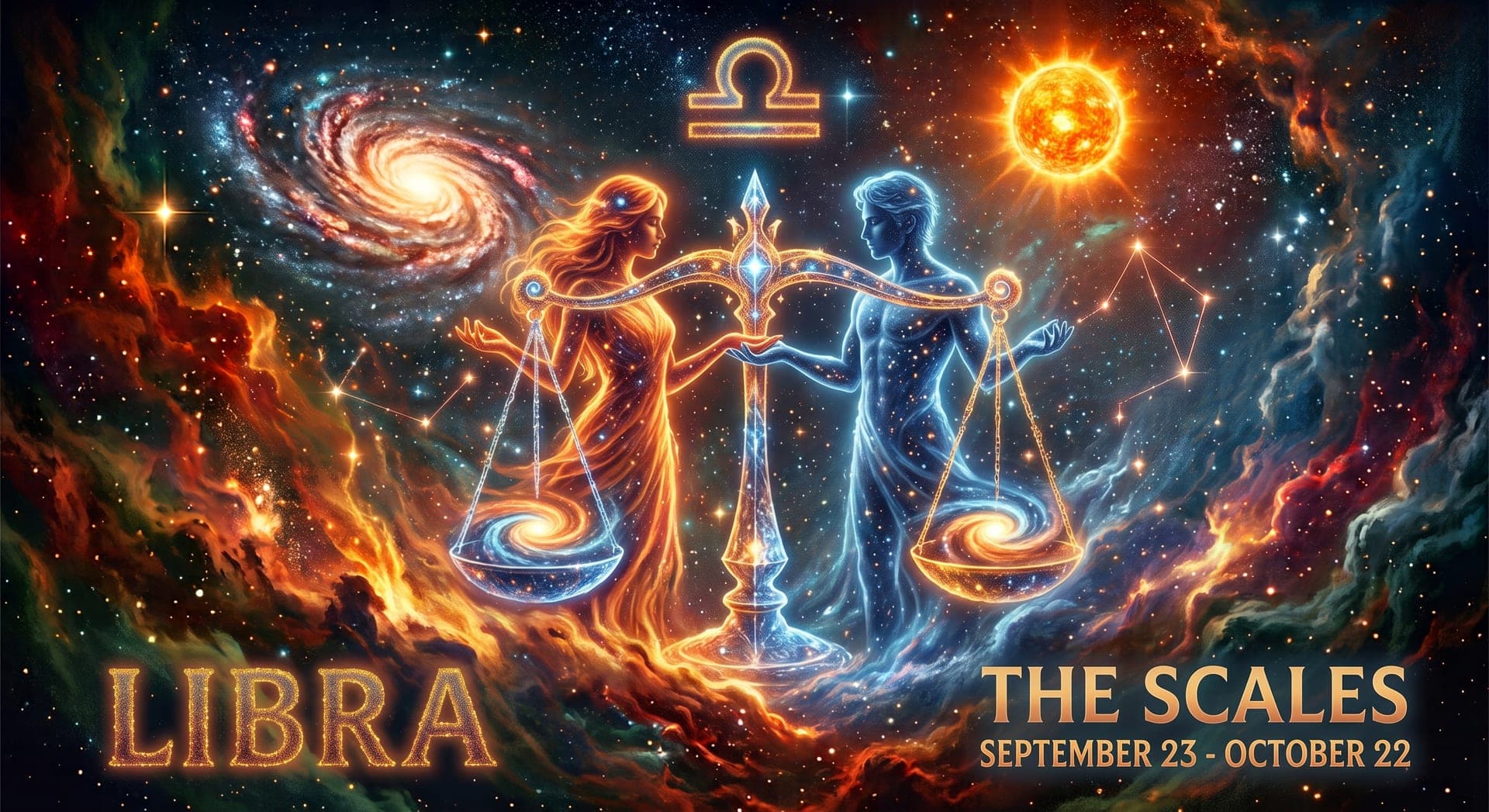
Libra, the seventh sign of the zodiac, spans September 23 to October 22 and is symbolized by the scales, the only zodiac symbol representing an inanimate object rather than a living creature, reflecting the sign's deep concern with balance, fairness, and justice. Ruled by Venus, the planet of love and beauty, Libra shares Taurus's appreciation for aesthetics and pleasure but channels it primarily through relationships, partnership, and social harmony. As an Air sign, Libra approaches the world intellectually and socially, valuing thoughtful conversation and diplomatic problem-solving over confrontation. Its Cardinal modality places it at the very start of autumn, beginning right at the equinox when day and night briefly achieve perfect balance. People born under this sign are often natural mediators, drawn to fairness and equilibrium in their relationships and surroundings, sometimes to the point of struggling to make decisions that might upset that balance. Libra's charm, diplomacy, and genuine desire to see all sides of an issue make it a valued friend and partner, even as its conflict-avoidance can occasionally leave real problems unresolved.
Personality Traits
Strengths
- Strong sense of fairness and justice
- Diplomatic peacemaker
- Charming and sociable
- Appreciates beauty and harmony
- Excellent at seeing multiple perspectives
Weaknesses
- Notoriously indecisive
- Conflict-avoidant to a fault
- Can be superficial
- People-pleasing tendencies
- Struggles with confrontation
Compatible Signs
Fun Facts
- Libra is the only zodiac sign represented by an inanimate object, the scales, rather than an animal or person.
- Libra's scales symbolize balance and justice, echoing the sign's association with fairness, harmony, and diplomacy.
- Venus, Libra's ruling planet, gives the sign its love of beauty, art, and romantic partnership, similar to Taurus but expressed through relationships rather than material comfort.
- As a Cardinal sign, Libra initiates autumn, beginning at the September equinox, when day and night are of equal length, fitting for a sign obsessed with balance.
- Notable Libras include Mahatma Gandhi, Kim Kardashian, John Lennon, and Will Smith.
Born on September 25
- 1525
Steven Borough
English explorer and navigator who pioneered England's early trade route to Russia via the White Sea.
- 1694
Henry Pelham
English politician who served as Prime Minister of Great Britain from 1743 to 1754, overseeing a period of relative peace and financial stability.
- 1889
C. K. Scott Moncrieff
Scottish author and translator best known for his acclaimed English translation of Marcel Proust's In Search of Lost Time.
- 1896
Sandro Pertini
7th President of Italy
- 1897
William Faulkner
American novelist and Nobel laureate
- 1903
Mark Rothko
Latvian-American abstract expressionist painter
- 1906
Dmitri Shostakovich
Russian composer
- 1906
Phyllis Pearsall
English cartographer and author who founded the Geographers' A-Z Map Company, creator of the iconic London A-Z street atlas.
- 1927
Colin Davis
English conductor renowned for his interpretations of Berlioz and his long association with the London Symphony Orchestra.
- 1929
Ronnie Barker
English actor and comedy writer celebrated for sitcoms including Porridge and Open All Hours.
- 1944
Michael Douglas
American actor and producer
- 1946
Felicity Kendal
English actress best known for her role in the sitcom The Good Life.
- 1952
Christopher Reeve
American actor known for playing Superman
- 1965
Scottie Pippen
American professional basketball player
- 1968
Will Smith
American actor and rapper
- 2003
Bella Ramsey
English actor known for playing Lyanna Mormont in Game of Thrones and Ellie in The Last of Us.

On This Day in History
- 1066
King Harold II of England defeats and kills Norwegian King Harald Hardrada at the Battle of Stamford Bridge.
King Harold II's English army defeated an invading Norwegian force led by Harald Hardrada at Stamford Bridge, killing Hardrada in a decisive victory that nonetheless left Harold's exhausted troops little time to rest before facing William the Conqueror's invasion in the south just weeks later.
- 1066
King Harold II of England defeats the invading Norwegian king Harald Hardrada at the Battle of Stamford Bridge.
Harald Hardrada invaded northern England alongside the rebellious Tostig Godwinson, defeating local forces at Fulford before Harold II force-marched his army north from London in a matter of days. The resulting battle near York ended in a decisive English victory and Hardrada's death, effectively ending large-scale Viking invasions of England. Harold's army then had to rush south to face William of Normandy at Hastings weeks later.
- 1237
England and Scotland establish their formal border through the Treaty of York.
England and Scotland formally established their mutual border through the Treaty of York, a diplomatic agreement between King Henry III of England and King Alexander II of Scotland that helped stabilize relations between the two frequently rival kingdoms. The treaty's boundary lines remained largely consistent with the modern England-Scotland border still recognized today.
- 1237
England and Scotland sign the Treaty of York, fixing the location of their shared border.
Negotiated between King Henry III of England and King Alexander II of Scotland, the treaty settled a long-running territorial dispute by having Alexander renounce Scottish claims to the northern English counties of Northumberland, Cumberland, and Westmorland in exchange for land grants. The agreed boundary line has remained largely unchanged ever since, making it one of the oldest fixed borders in Europe.
- 1396
Ottoman Sultan Bayezid I defeats a coalition of Christian forces at the Battle of Nicopolis.
Ottoman forces under Sultan Bayezid I decisively defeated a large coalition of Christian European knights, including forces from France, Hungary, and other kingdoms, at Nicopolis in present-day Bulgaria. The crushing defeat dealt a severe blow to the last major Crusade organized against Ottoman expansion into the Balkans, opening the way for further Ottoman advances into southeastern Europe.
- 1513
Spanish explorer Vasco Nunez de Balboa becomes the first European to sight the Pacific Ocean from the Americas.
Spanish explorer Vasco Nunez de Balboa led an expedition across the disease-ridden jungles of the Isthmus of Panama and became the first European to sight the Pacific Ocean from the shores of the Americas, wading into the water and formally claiming it for Spain. The discovery dramatically expanded European understanding of the New World's geography and its separation from Asia.
- 1513
Spanish explorer Vasco Núñez de Balboa becomes the first European to sight the Pacific Ocean from the Americas.
Balboa led an expedition across the Isthmus of Panama accompanied by indigenous guides and a small band of Spanish soldiers, cutting through dense jungle and hostile terrain. Upon reaching the shore he waded into the water and claimed the ocean, which he called the 'South Sea,' for the Spanish crown. The discovery revealed to Europeans the vast scale of the Americas separating the Atlantic and Pacific.
- 1555
The Peace of Augsburg is signed, establishing a legal framework for religious coexistence within the Holy Roman Empire.
Following decades of religious conflict, the Peace of Augsburg established a legal framework allowing individual rulers within the Holy Roman Empire to determine whether their territories would be Catholic or Lutheran, a landmark, if imperfect, step toward religious coexistence in Europe.
- 1690
Publick Occurrences, the first newspaper published in the Americas, releases its sole edition before being suppressed.
Publick Occurrences Both Foreign and Domestick, intended as a regular publication covering news of interest to colonial readers, was suppressed by British colonial authorities in Boston after just a single issue, delaying the development of a free colonial press by several decades.
- 1775
American revolutionary Ethan Allen surrenders to British forces after his attempt to capture Montreal fails at the Battle of Longue-Pointe.
Allen, famed for his earlier capture of Fort Ticonderoga, launched a rash and poorly supported assault on Montreal during the American invasion of Quebec. British and Canadian militia forces under Governor Guy Carleton repelled the attack and captured Allen along with several dozen of his men. He was sent to Britain as a prisoner before eventually being exchanged years later.
- 1789
Congress approves twelve constitutional amendments, ten of which become the Bill of Rights.
Congress approved a set of twelve proposed amendments to the newly ratified Constitution, ten of which were subsequently ratified by the required number of states and became known collectively as the Bill of Rights. These amendments guaranteed fundamental individual liberties including freedom of speech, religion, and the press, addressing concerns raised by Constitution skeptics during the original ratification debates.
- 1890
Congress establishes Sequoia National Park in California.
Responding to growing public concern about unchecked commercial logging of California's ancient giant sequoia trees, some of the largest living organisms on Earth, Congress established Sequoia National Park, the second national park created in the United States. The park's protection helped preserve groves of trees that had already been growing for well over a thousand years.
- 1918
The Battle of Megiddo ends, marking the climax of the British Army's Sinai and Palestine campaign under General Edmund Allenby.
Allenby's forces, including British, Australian, and Indian troops, broke through Ottoman lines in a rapid combined-arms offensive using cavalry, infantry, and airpower. The victory shattered Ottoman resistance in Palestine and Syria and hastened the collapse of the Ottoman Empire's war effort. It is often cited as one of the most decisive and swiftly executed campaigns of the First World War.
- 1944
Surviving soldiers of the British 1st Airborne Division withdraw across the Rhine from Arnhem, ending Operation Market Garden.
The division had been dropped near Arnhem in the Netherlands as part of a bold Allied plan to seize bridges into Germany, but found itself isolated and overwhelmed by German armor. After nine days of fierce fighting, fewer than a quarter of the roughly 10,000 men who landed made it back across the river to Allied lines, marking a costly defeat for Montgomery's offensive.
- 1956
TAT-1, the first submarine transatlantic telephone cable system, is inaugurated, linking Scotland and Canada.
The cable system ran from Gallanach Bay near Oban, Scotland, to Clarenville, Newfoundland, and was a joint venture between the British Post Office, the American AT&T, and the Canadian Overseas Telecommunications Corporation. It replaced unreliable radio links with a direct telephone connection across the Atlantic, dramatically improving call quality and capacity between Britain and North America.
- 1957
Federal troops enforce the integration of Little Rock's Central High School in Arkansas.
Under federal protection ordered by President Eisenhower, nine Black students, later known as the Little Rock Nine, successfully entered and attended classes at Central High School, a landmark moment in the enforcement of school desegregation following Brown v. Board of Education.
- 1957
United States Army troops enforce the integration of Central High School in Little Rock, Arkansas.
President Dwight D. Eisenhower ordered the 101st Airborne Division to escort nine Black students, later known as the Little Rock Nine, into the previously all-white school after the state's governor used National Guard troops to block their entry. The confrontation became a defining moment of the American civil rights movement, demonstrating federal willingness to enforce school desegregation against state resistance.
- 1963
Lord Denning releases his official report into the UK government's Profumo affair.
The report examined the scandal surrounding War Secretary John Profumo's affair with Christine Keeler, who was also linked to a Soviet naval attaché, and its security implications for Harold Macmillan's government. Denning's inquiry, conducted largely through private interviews, concluded there had been no breach of national security but heavily criticized aspects of establishment behavior, and the affair badly damaged public trust in the Conservative government.
- 1978
PSA Flight 182 collides with a small aircraft over San Diego, killing 144 people.
A Pacific Southwest Airlines passenger jet collided in midair with a small private Cessna over San Diego, killing all 135 people aboard the airliner, both people aboard the Cessna, and seven people on the ground, for a total of 144 deaths, remaining one of the deadliest aviation disasters in California history.
- 1983
Thirty-eight IRA prisoners hijack a meals lorry and break out of the Maze Prison in Northern Ireland.
Armed with smuggled handguns, the prisoners overpowered guards and commandeered a food delivery truck in what became the largest prison escape in British history and one of the largest in Europe since the Second World War. One prison officer died of a heart attack during the escape, and while many escapees were quickly recaptured, several remained at large for years, some fleeing abroad.