What’s Observed on September 19
Born on September 19: Virgo ♍
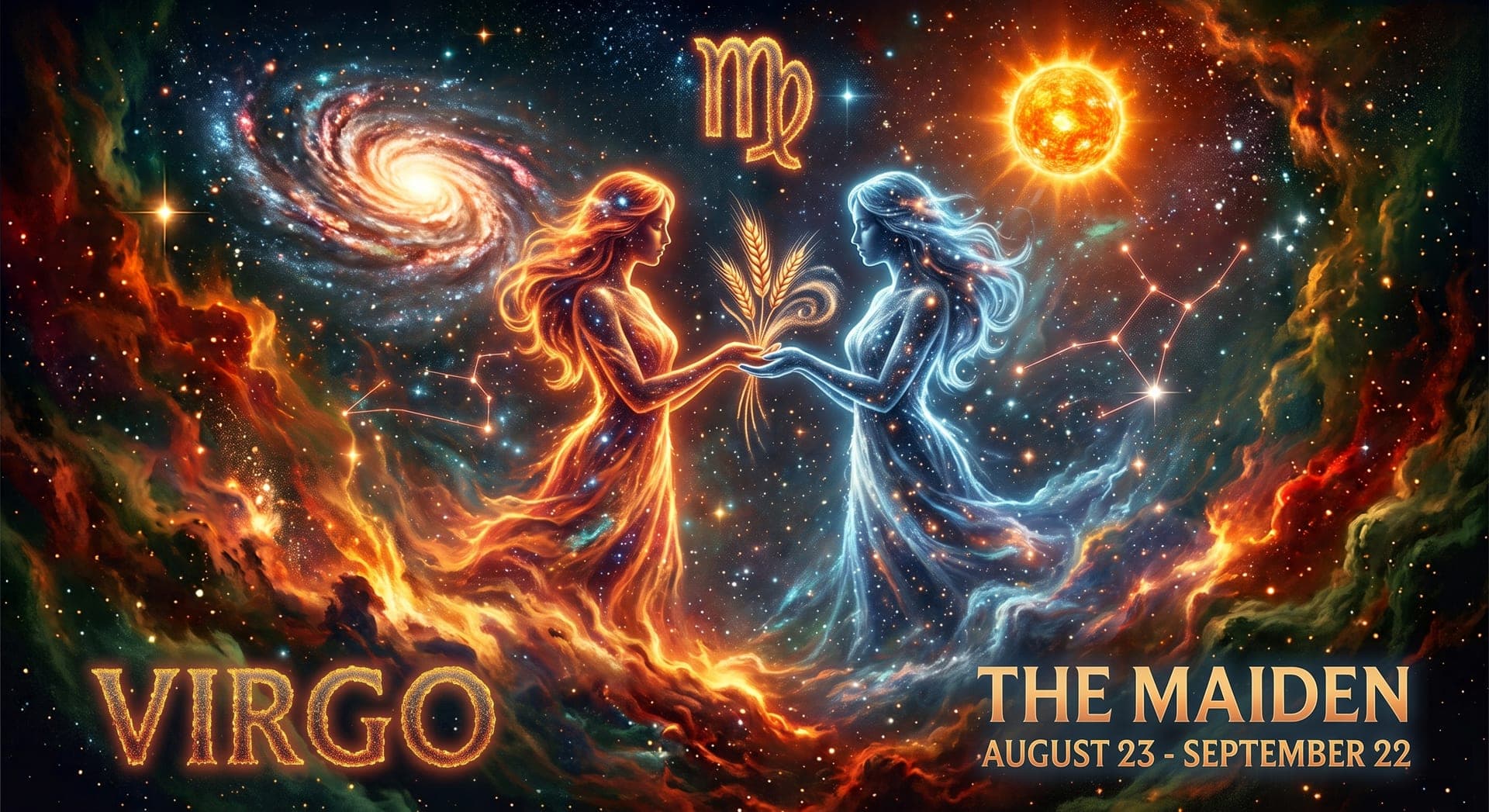
Virgo, the sixth sign of the zodiac, spans August 23 to September 22 and is symbolized by the maiden, often depicted holding a sheaf of wheat, representing purity, meticulous care, and the harvest. Ruled by Mercury, the planet of communication and intellect, Virgo channels its mental energy toward precision, analysis, and practical problem-solving rather than idle chatter. As an Earth sign, Virgo is grounded and detail-oriented, finding genuine satisfaction in organizing, refining, and perfecting the world around it. Its Mutable modality gives Virgo an adaptable, service-oriented nature, often finding purpose in quietly helping others and improving systems rather than seeking the spotlight. People born under this sign are frequently drawn to work requiring precision, research, or care for others, from science and medicine to editing and organization. Virgo's high standards make it an excellent problem-solver and a reliable presence others can count on, though that same perfectionism can turn inward as self-criticism or outward as an exacting, sometimes overly critical, eye toward the people and world around it.
Personality Traits
Strengths
- Highly organized and detail-oriented
- Reliable and hardworking
- Analytical problem-solver
- Genuinely helpful to others
- Modest and unpretentious
Weaknesses
- Prone to overcritical perfectionism
- Tends to worry excessively
- Can be overly critical of others
- Reserved to the point of aloofness
- Struggles to relax
Compatible Signs
Fun Facts
- Virgo's maiden symbol is often associated with Astraea, the Greek goddess of justice and purity, said to have been the last immortal to live among humans.
- Virgo is the only zodiac sign represented by a female human figure.
- Virgo and Gemini share Mercury as their ruling planet, though Virgo channels the planet's communicative energy toward analysis and precision rather than pure talkativeness.
- Notable Virgos include Beyoncé, Michael Jackson, Mother Teresa, and Stephen King.
- Virgo season falls at the tail end of summer, a period traditionally associated with harvest, meticulous preparation, and gathering resources for the colder months ahead.
Born on September 19
- 1551
Henry III of France
King of France during the Wars of Religion
- 1560
Thomas Cavendish
English naval explorer who became the first person to deliberately circumnavigate the globe, completing the voyage in under two years
- 1721
William Robertson
Scottish historian and Church of Scotland minister who served as Principal of the University of Edinburgh
- 1802
Lajos Kossuth
Hungarian statesman and independence leader
- 1867
Arthur Rackham
English illustrator celebrated for his richly detailed drawings for fairy tales including Alice in Wonderland and Peter Pan
- 1922
Emil Zatopek
Czech long-distance runner and triple Olympic gold medalist
- 1926
Duke Snider
American Major League Baseball player
- 1934
Brian Epstein
English music entrepreneur who discovered and managed the Beatles, shaping them into international stars
- 1940
Zandra Rhodes
English fashion designer known for her bold prints, punk-influenced designs, and trademark pink hair
- 1945
Kate Adie
English journalist and broadcaster who served as chief news correspondent for the BBC
- 1963
Jarvis Cocker
English singer-songwriter and frontman of the Britpop band Pulp
- 1963
David Seaman
English footballer who played goalkeeper for Arsenal and the England national team
- 1974
Hidetaka Miyazaki
Japanese video game designer known for "Dark Souls"
On This Day in History
- 96
Nerva becomes Roman emperor following Domitian's assassination, and the Senate annuls laws passed under his predecessor.
Following the assassination of the widely despised Domitian, the Roman Senate elevated the elderly senator Nerva to the throne, and he moved quickly to reverse many of his predecessor's harsh policies, beginning what historians consider the start of the relatively stable and prosperous "Five Good Emperors" era.
- 634
Rashidun Arab forces capture Damascus from Byzantine control after a prolonged siege.
After a prolonged siege, Arab Muslim forces under Khalid ibn al-Walid captured Damascus from Byzantine control, a major early conquest that established the city as an important center of the rapidly expanding Islamic caliphate and eventually the capital of the Umayyad dynasty.
- 1356
English forces under Edward the Black Prince defeat the French and capture King John II at the Battle of Poitiers.
English forces under Edward the Black Prince won a stunning victory against a much larger French army at Poitiers, capturing King John II of France himself, a humiliating blow to French royal authority that plunged the kingdom into further political turmoil during the Hundred Years' War.
- 1356
The Battle of Poitiers ends in a decisive English victory, with the Black Prince's forces capturing King John II of France.
Fought during the Hundred Years' War, the battle saw Edward, the Black Prince, lead a heavily outnumbered English and Gascon army to a crushing win over the French. King John II was taken prisoner and later held for ransom in England, a humiliation that plunged France into political chaos and cemented England's military reputation for decades to come.
- 1777
British forces win a costly victory over American troops at the First Battle of Saratoga.
British forces achieved a costly tactical victory over American troops at the First Battle of Saratoga, though the heavy losses suffered ultimately weakened British General Burgoyne's position ahead of his decisive surrender at the Second Battle of Saratoga weeks later.
- 1796
George Washington's Farewell Address is printed as an open letter across American newspapers.
As he prepared to leave office after two terms, George Washington's farewell message, warning against political factionalism and permanent foreign alliances, was published as an open letter in newspapers across the country rather than delivered as a spoken address, and it remains a frequently cited document in American political discourse.
- 1799
Anglo-Russian forces attempting to retake the Netherlands are repelled by French and Batavian troops at the Battle of Bergen.
The battle formed part of the Anglo-Russian invasion of Holland during the War of the Second Coalition, in which a British expeditionary force under the Duke of York, allied with Russian troops, tried to overturn French control of the Batavian Republic. The defeat was a setback for British strategy on the continent and foreshadowed the campaign's failure weeks later.
- 1870
The Siege of Paris begins during the Franco-Prussian War, lasting over four months.
Prussian forces encircled the French capital following their earlier victory at Sedan and the collapse of Napoleon III's government, beginning a grueling siege that lasted over four months. Parisians endured severe food shortages, reportedly resorting to eating zoo animals, before the city's eventual surrender in January 1871, a humiliation that fueled French resentment leading into World War I decades later.
- 1870
Prussian forces encircle Paris, beginning a four-month siege during the Franco-Prussian War.
Following France's defeat at Sedan and the collapse of the Second Empire, Prussian and allied German armies surrounded the French capital, cutting off supplies and bombarding the city. Parisians endured severe food shortages, resorting to eating zoo animals and household pets, before the city finally capitulated in January 1871, helping to spark the Paris Commune uprising.
- 1893
New Zealand grants women the right to vote through the Electoral Act, becoming the first self-governing nation to do so.
New Zealand's parliament passed the Electoral Act extending the right to vote to women, making it the first self-governing country in the world to grant women full national suffrage. The achievement followed years of organized campaigning led by activists including Kate Sheppard, and it set an influential precedent that helped inspire similar suffrage movements in other countries over the following decades.
- 1893
New Zealand, then a self-governing British colony, becomes the first country in the world to grant women the right to vote in parliamentary elections.
The Electoral Act 1893 was signed into law by the colony's governor after decades of campaigning by suffragists such as Kate Sheppard. As part of the British Empire, New Zealand's breakthrough put pressure on Britain and other Commonwealth nations to follow suit, though British women would not win full voting equality until 1928.
- 1946
Winston Churchill delivers his Zurich speech calling for a 'kind of United States of Europe', helping to set in motion the movement that would lead to the founding of the Council of Europe.
Speaking as a private citizen rather than a sitting head of government, the former British prime minister urged France and Germany to lead European reconciliation after the devastation of the Second World War. His call for unity is widely credited with inspiring the postwar European integration movement, which produced the Council of Europe in 1949 and, eventually, the European Union.
- 1970
Michael Eavis hosts the inaugural Glastonbury Festival in England.
Dairy farmer Michael Eavis hosted the first Glastonbury Festival on his farm in Somerset, England, charging a modest entry fee that included free milk from his farm, launching what would grow into one of the world's largest and most famous music festivals.
- 1970
The first Glastonbury Festival is held on Michael Eavis's farm in Somerset, England, launching what would become the world's largest greenfield music festival.
Originally called the Pilton Festival, the inaugural event drew around 1,500 attendees who paid £1 for entry, which included free milk from the farm. Headlined by T. Rex, it was a modest, improvised affair compared to today's sprawling festival, but it established the countercultural spirit and rural setting that turned Glastonbury into a fixture of British summer culture.
- 1983
Saint Kitts and Nevis becomes fully independent from the United Kingdom, the last British colony in the Caribbean to do so.
The twin-island nation had been under British control in various forms since the 17th century, serving as one of Britain's earliest Caribbean colonies. Independence was granted peacefully within the Commonwealth, with Queen Elizabeth II remaining head of state, marking the effective end of Britain's formal colonial presence in the Caribbean.
- 1985
A powerful earthquake devastates Mexico City, destroying hundreds of buildings and killing thousands.
A powerful earthquake struck Mexico City, collapsing hundreds of buildings and killing thousands of people in one of the deadliest disasters in the country's modern history, prompting significant reforms to building codes and disaster preparedness in the years that followed.
- 1985
A powerful earthquake strikes off the coast of Mexico, devastating Mexico City and killing thousands of people.
The magnitude-8.0 quake, centered in the Pacific off Michoacán, caused catastrophic damage in the capital hundreds of kilometers away due to the soft lakebed soil beneath the city amplifying the shaking. Thousands of buildings collapsed, including hospitals and apartment blocks, and the disaster exposed serious flaws in construction standards and disaster response.
- 1991
Hikers discover the naturally mummified body of a man, later named Ötzi the Iceman, in a melting glacier in the Ötztal Alps on the Austrian-Italian border.
Radiocarbon dating showed the remains were roughly 5,300 years old, making Ötzi one of the oldest and best-preserved human mummies ever found. His clothing, tools, and even stomach contents gave archaeologists an unprecedented window into Copper Age life in Europe, and forensic analysis later revealed he had been killed by an arrow wound to the shoulder.
- 2022
Queen Elizabeth II's state funeral is held at Westminster Abbey in London.
Queen Elizabeth II's state funeral, attended by world leaders and royalty from around the globe, was held at Westminster Abbey, drawing an enormous global television audience and marking the formal conclusion of an extended period of national mourning in Britain.
- 2022
The state funeral of Queen Elizabeth II is held at Westminster Abbey, ten days after her death, drawing world leaders and mourners from across the globe.
The ceremony was the first state funeral for a British monarch since Winston Churchill's in 1965 and marked the end of the second Elizabethan era after her record 70-year reign. Millions lined the streets of London and Windsor to watch the procession, while the service was broadcast to an estimated global audience of hundreds of millions.