What’s Observed on September 20
Born on September 20: Virgo ♍
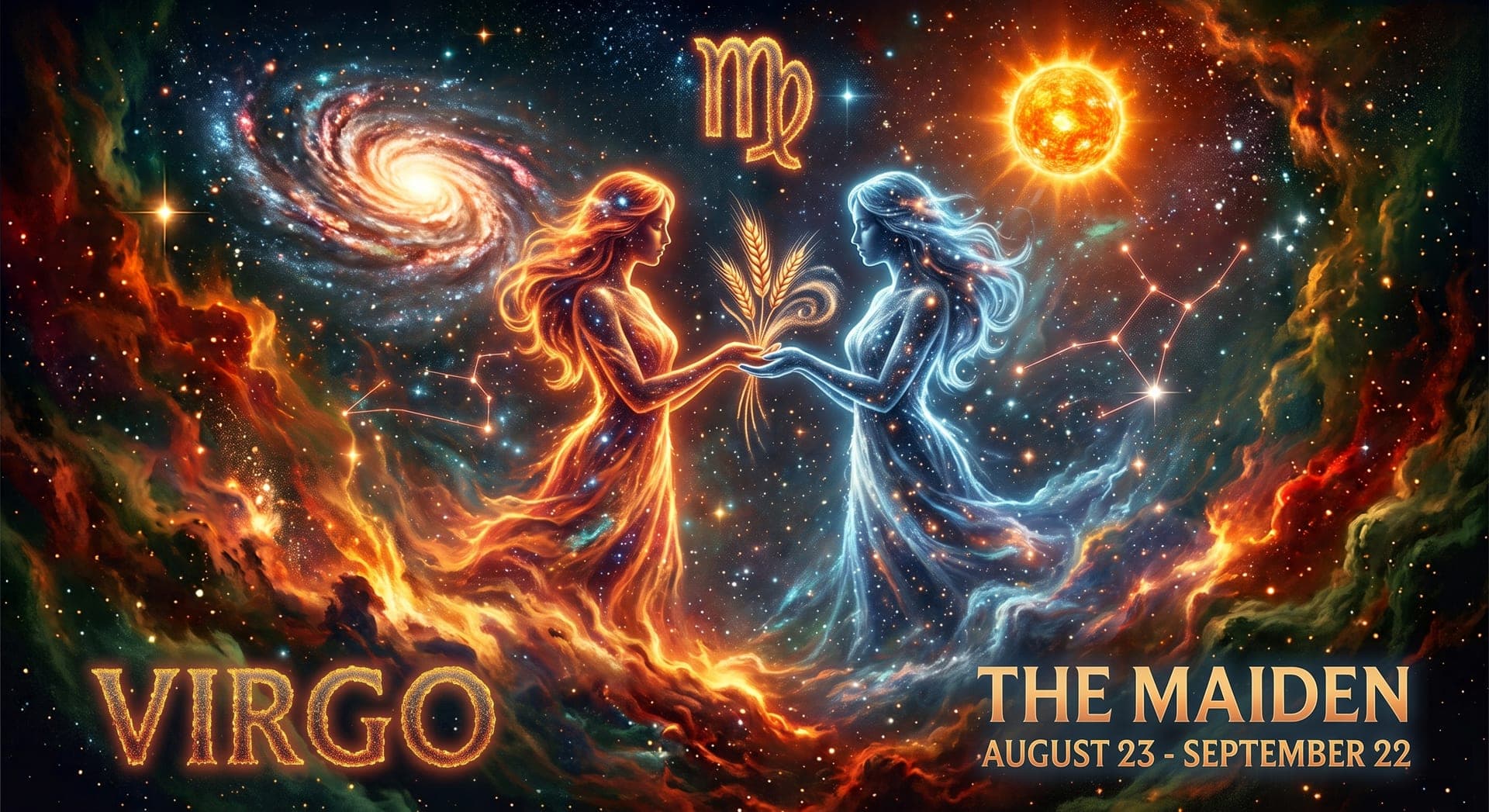
Virgo, the sixth sign of the zodiac, spans August 23 to September 22 and is symbolized by the maiden, often depicted holding a sheaf of wheat, representing purity, meticulous care, and the harvest. Ruled by Mercury, the planet of communication and intellect, Virgo channels its mental energy toward precision, analysis, and practical problem-solving rather than idle chatter. As an Earth sign, Virgo is grounded and detail-oriented, finding genuine satisfaction in organizing, refining, and perfecting the world around it. Its Mutable modality gives Virgo an adaptable, service-oriented nature, often finding purpose in quietly helping others and improving systems rather than seeking the spotlight. People born under this sign are frequently drawn to work requiring precision, research, or care for others, from science and medicine to editing and organization. Virgo's high standards make it an excellent problem-solver and a reliable presence others can count on, though that same perfectionism can turn inward as self-criticism or outward as an exacting, sometimes overly critical, eye toward the people and world around it.
Personality Traits
Strengths
- Highly organized and detail-oriented
- Reliable and hardworking
- Analytical problem-solver
- Genuinely helpful to others
- Modest and unpretentious
Weaknesses
- Prone to overcritical perfectionism
- Tends to worry excessively
- Can be overly critical of others
- Reserved to the point of aloofness
- Struggles to relax
Compatible Signs
Fun Facts
- Virgo's maiden symbol is often associated with Astraea, the Greek goddess of justice and purity, said to have been the last immortal to live among humans.
- Virgo is the only zodiac sign represented by a female human figure.
- Virgo and Gemini share Mercury as their ruling planet, though Virgo channels the planet's communicative energy toward analysis and precision rather than pure talkativeness.
- Notable Virgos include Beyoncé, Michael Jackson, Mother Teresa, and Stephen King.
- Virgo season falls at the tail end of summer, a period traditionally associated with harvest, meticulous preparation, and gathering resources for the colder months ahead.
Born on September 20
- 1486
Arthur, Prince of Wales
English prince, elder son of Henry VII, whose early death made his brother Henry VIII heir to the throne
- 1842
James Dewar
Scottish chemist and physicist who invented the vacuum-insulated Dewar flask and was first to liquefy hydrogen
- 1902
Stevie Smith
English poet and novelist best known for the poem 'Not Waving but Drowning'
- 1914
Kenneth More
English actor known for war films such as Reach for the Sky and A Night to Remember
- 1927
Rachel Roberts
Welsh actress celebrated for her roles in British New Wave films including This Sporting Life
- 1934
Sophia Loren
Italian actress
- 1936
Andrew Davies
Welsh screenwriter known for acclaimed television adaptations including Pride and Prejudice and House of Cards
- 1948
George R. R. Martin
American author of "A Song of Ice and Fire"
- 1951
Guy Lafleur
Canadian ice hockey player
- 1961
Caroline Flint
English Labour politician who served as a government minister and Member of Parliament for Don Valley
- 1975
Asia Argento
Italian actress and director
- 1976
Jon Bernthal
American actor known for "The Walking Dead"
- 1988
Khabib Nurmagomedov
Russian mixed martial artist
- 1990
John Tavares
Canadian ice hockey player
- 1993
Julian Draxler
German professional footballer
On This Day in History
- 1066
Norwegian King Harald Hardrada defeats English earls at the Battle of Fulford.
Norwegian King Harald Hardrada, invading northern England alongside the rebellious Earl Tostig, defeated the combined forces of English earls Edwin and Morcar near York, a victory that briefly opened the north to Norwegian control before Harald's defeat and death at Stamford Bridge days later.
- 1066
Norwegian king Harald Hardrada defeats the English earls Morcar and Edwin at the Battle of Fulford near York.
The battle was part of Hardrada's invasion of England, launched alongside the exiled English noble Tostig Godwinson, and left the city of York exposed to Norwegian occupation. The victory was short-lived: days later King Harold Godwinson force-marched his army north and crushed the Norwegian invaders at Stamford Bridge, before turning south to face William of Normandy at Hastings.
- 1187
Saladin launches his military campaign to retake Jerusalem from Crusader control.
Having consolidated his power in Egypt and Syria, the Muslim leader Saladin launched a determined military campaign to retake Jerusalem from Crusader control, a siege that succeeded within weeks and dealt a severe blow to Crusader holdings in the Levant.
- 1378
Cardinal Robert of Geneva becomes the rival Pope Clement VII, beginning the Western Schism within the Catholic Church.
Amid disputed papal elections following the death of Pope Gregory XI, Cardinal Robert of Geneva was elected as a rival pope taking the name Clement VII, establishing a parallel papacy based in Avignon that created decades of division within the Catholic Church known as the Western Schism.
- 1498
A tsunami destroys the hall housing the Great Buddha statue at Kotoku-in in Japan, leaving the bronze statue exposed to the elements ever since.
A massive tsunami, likely triggered by a distant earthquake, swept inland and destroyed the wooden hall that had sheltered Japan's Great Buddha statue at Kotoku-in for centuries, leaving the enormous bronze figure permanently exposed to the open air, as it remains to this day.
- 1519
Ferdinand Magellan departs on the expedition that ultimately achieves the first circumnavigation of the globe.
Portuguese navigator Ferdinand Magellan departed Spain with a fleet of five ships under Spanish sponsorship, embarking on the expedition that would achieve the first circumnavigation of the globe, though Magellan himself died in the Philippines before the voyage's completion. Only one battered ship and a small fraction of the original roughly 270-man crew ultimately returned to Spain three years later.
- 1586
Conspirators in the Babington Plot to assassinate Queen Elizabeth I are executed.
Fourteen conspirators implicated in a plot to assassinate Queen Elizabeth I and place the imprisoned Mary, Queen of Scots on the English throne were executed, a plot whose discovery ultimately sealed Mary's own fate as well, leading to her execution the following year.
- 1586
Anthony Babington and six fellow conspirators are hanged, drawn, and quartered in London for plotting to assassinate Queen Elizabeth I.
The Babington Plot aimed to free the imprisoned Mary, Queen of Scots, and place her on the English throne with Spanish backing. Intercepted letters, decoded by Elizabeth's spymaster Francis Walsingham, proved Mary's complicity in the conspiracy and directly led to her trial and execution the following year, removing the last serious Catholic claimant to Elizabeth's crown.
- 1697
The Treaty of Ryswick is signed, ending the Nine Years' War in Europe.
European powers signed the Treaty of Ryswick, concluding the costly Nine Years' War fought largely to contain the territorial ambitions of France's King Louis XIV against a broad coalition of rival European states. The negotiated settlement restored most conquered territories to their prewar rulers, offering only a temporary respite before renewed continental conflict erupted again within a few years.
- 1697
The Treaty of Ryswick is signed, ending the Nine Years' War between France and a coalition that included England, the Dutch Republic, Spain, and the Holy Roman Empire.
Negotiated in the Dutch town of Rijswijk, the treaty forced Louis XIV of France to recognize William III as the legitimate king of England, Scotland, and Ireland, undermining hopes of a Jacobite restoration backed by France. It also restored most captured territories to their prewar owners, offering a fragile peace that collapsed within a few years into the War of the Spanish Succession.
- 1792
French revolutionary forces achieve a decisive victory at the Battle of Valmy, halting the Prussian invasion.
French revolutionary forces, bolstered by patriotic fervor and effective artillery, halted an invading Prussian army at Valmy, an unexpected victory that saved the fledgling French Republic and is often credited with securing the revolution's survival in its earliest and most vulnerable phase.
- 1854
British and French forces defeat the Russian army at the Battle of the Alma during the Crimean War.
The battle was the first major engagement of the Crimean War, fought as Allied troops advanced on the Russian naval base at Sevastopol. British infantry, including the Guards and Highland brigades, stormed heavily defended Russian positions on high ground above the Alma River, and the victory opened the road toward the prolonged siege of Sevastopol that followed.
- 1857
British and Company forces recapture Delhi, effectively crushing the Indian Rebellion of 1857 and ending Mughal rule in the city.
After a prolonged siege, British troops stormed Delhi and captured the aged Mughal emperor Bahadur Shah II, who had been declared the rebellion's nominal leader. The recapture broke the back of the uprising against British East India Company rule and led directly to the Company's dissolution the following year, with India placed under direct British Crown control.
- 1860
The Prince of Wales, later King Edward VII, begins the first official visit to North America by an heir to the British throne.
The eighteen-year-old prince toured Canada and the United States over several weeks, laying the cornerstone of Canada's parliament buildings in Ottawa and meeting President James Buchanan at the White House. The trip was a diplomatic success that strengthened Anglo-American relations and set a precedent for future royal tours of the Commonwealth and beyond.
- 1870
Italian unification is completed as troops enter Rome, ending the Papal States' temporal rule.
Italian troops breached the walls of Rome and entered the city, completing the long process of Italian unification by ending the Pope's centuries-long temporal rule over the city, which was then incorporated as the new capital of the Kingdom of Italy.
- 1881
Chester A. Arthur is sworn in as U.S. president following the death of James Garfield.
Following the assassination of President James Garfield, Vice President Chester A. Arthur was sworn in as his successor at his New York City home in a modest late-night ceremony. Arthur went on to surprise many critics by championing civil service reform despite his earlier reputation as a product of the political patronage system he later helped dismantle.
- 1911
The White Star liner RMS Olympic collides with the Royal Navy cruiser HMS Hawke in the Solent off the English coast.
The collision tore a large hole in the Olympic's hull below the waterline, but the ship managed to return to Southampton under its own power. The costly accident, and the resulting inquiry that controversially blamed the Olympic, delayed the fitting-out of her sister ship, Titanic, and foreshadowed the scrutiny White Star Line's safety practices would soon face.
- 1920
British auxiliary police, the Black and Tans, burn much of the Irish town of Balbriggan in reprisal for an IRA attack, during the Irish War of Independence.
The reprisal followed the killing of a District Inspector in a pub brawl and saw Black and Tans and Auxiliaries torch factories, a hosiery mill, and dozens of homes, leaving hundreds jobless. The destruction drew international condemnation and became one of the most notorious episodes of British reprisal violence during the conflict, fueling support for Irish independence.
- 1967
The ocean liner Queen Elizabeth 2 is launched from the John Brown shipyard in Clydebank, Scotland.
Built for the Cunard Line as a successor to the earlier Queens, the QE2 was launched by Queen Elizabeth II herself before a large crowd on the River Clyde. Over more than three decades of service the ship became one of the most famous liners in the world, carrying passengers on transatlantic crossings and round-the-world cruises until her retirement in 2008.
- 2000
The headquarters of Britain's Secret Intelligence Service (MI6) on the River Thames in London is struck by an anti-tank missile.
The rocket-propelled grenade, fired from across the river, blew a hole in an upper-floor window of the Vauxhall Cross building but caused no injuries. The Real IRA, a dissident republican splinter group opposed to the Northern Ireland peace process, was blamed for the attack, which highlighted continuing security threats to Britain's intelligence establishment.