What’s Observed on July 5
Born on July 5: Cancer ♋
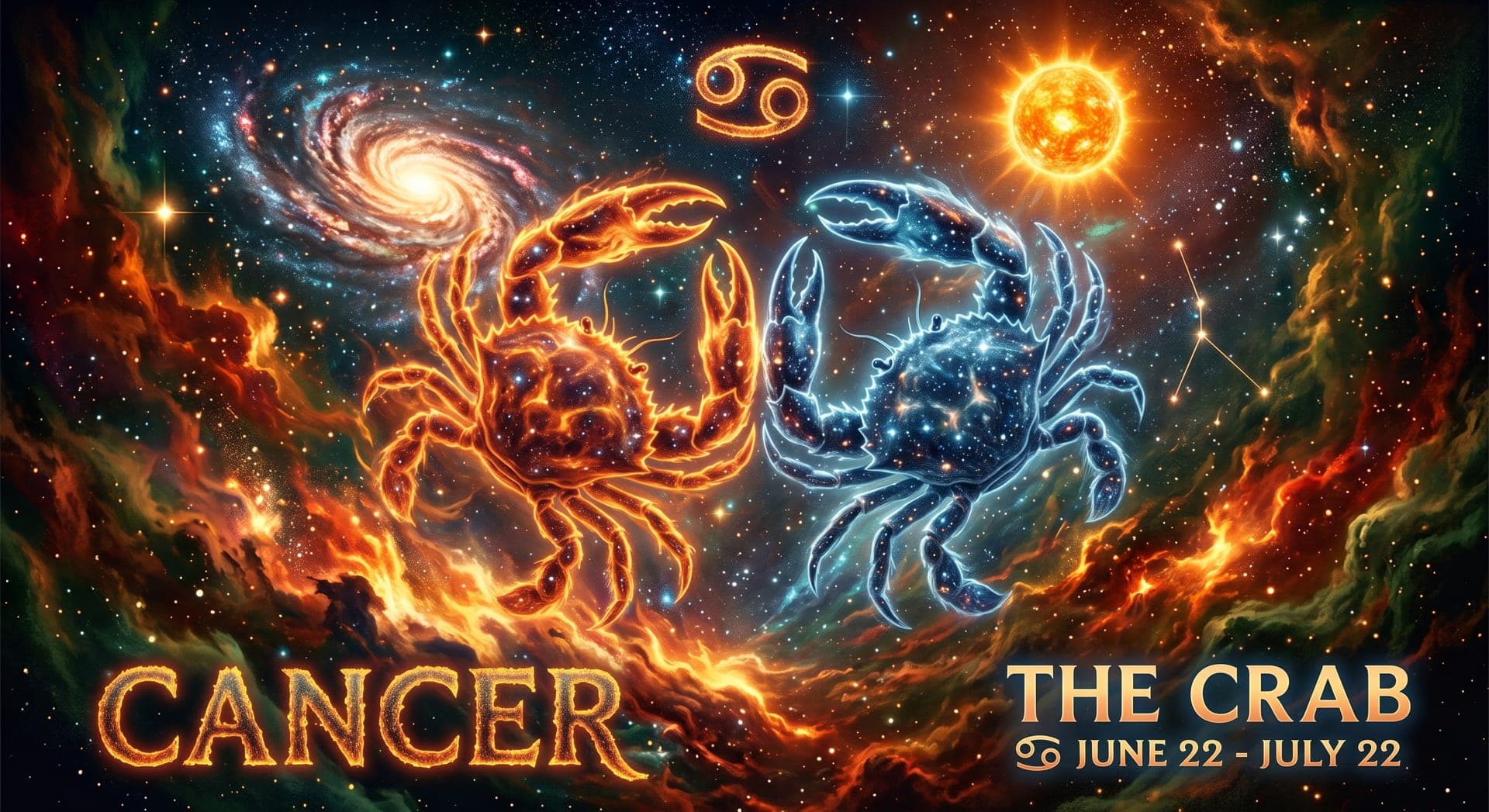
Cancer, the fourth sign of the zodiac, spans June 21 to July 22 and is symbolized by the crab, an animal known for carrying a protective shell while remaining soft and vulnerable underneath. Ruled by the Moon, the celestial body long associated with emotion, intuition, and the subconscious, Cancer is widely regarded as one of the most nurturing and emotionally attuned signs of the zodiac. As a Water sign, Cancer navigates the world through deep feeling, often forming strong emotional bonds and an acute sensitivity to the moods of others. Its Cardinal modality places it at the start of summer, beginning right at the June solstice, reflecting an instinct to initiate and create, especially around home and family. People born under this sign tend to be deeply loyal, protective of loved ones, and drawn to creating a comfortable, secure home environment. Cancer's emotional depth is a genuine strength, but it can also make the sign prone to moodiness or withdrawal when hurt, retreating like a crab into its shell until it feels safe enough to re-emerge.
Personality Traits
Strengths
- Deeply caring and nurturing
- Highly intuitive
- Fiercely loyal and protective
- Strong sense of family and tradition
- Emotionally perceptive
Weaknesses
- Prone to moodiness
- Overly sensitive to criticism
- Can be clingy
- Tends to hold grudges
- Retreats when hurt
Compatible Signs
Fun Facts
- Cancer's crab symbol comes from Greek mythology, where the goddess Hera placed a crab that had fought Hercules among the stars.
- Cancer is ruled by the Moon, the only zodiac sign ruled by a celestial body other than a planet.
- As a Cardinal sign, Cancer initiates summer, beginning at the June solstice, the longest day of the year in the Northern Hemisphere.
- Notable Cancers include Princess Diana, Tom Hanks, Ariana Grande, and Nelson Mandela.
- The crab's hard shell and soft interior are often used as a metaphor for Cancer's protective exterior guarding a deeply sensitive emotional core.
Born on July 5
- 1755
Sarah Siddons
Welsh-English actress widely regarded as the greatest tragedienne of the eighteenth century, celebrated for her Lady Macbeth
- 1781
Stamford Raffles
English statesman and colonial administrator who founded the British settlement of Singapore
- 1805
Robert FitzRoy
English naval officer and meteorologist who captained HMS Beagle on Charles Darwin's famous voyage and later founded the Met Office
- 1810
P.T. Barnum
American showman who co-founded the Barnum & Bailey Circus
- 1820
William John Macquorn Rankine
Scottish engineer and physicist who helped establish the science of thermodynamics
- 1853
Cecil Rhodes
English-born businessman and colonial politician who served as Prime Minister of the Cape Colony and founded the Rhodes Scholarship
- 1889
Jean Cocteau
French novelist, poet, and filmmaker
- 1911
Georges Pompidou
19th President of France
- 1936
James Mirrlees
Scottish economist who won the Nobel Memorial Prize in Economic Sciences for his work on information economics
- 1946
Paul Smith
English fashion designer known for reinterpreting classic British tailoring with colourful, quirky twists
- 1950
Huey Lewis
American singer-songwriter
- 1985
Megan Rapinoe
American soccer player and Olympic gold medalist
On This Day in History
- 1294
Pietro da Morrone is elected pope, taking the name Celestine V, before resigning the papacy just months later.
A hermit monk with a reputation for piety, Pietro da Morrone was elected pope after a lengthy conclave deadlock, taking the name Celestine V. Overwhelmed by the political demands of the papacy, he abdicated after only about five months, becoming one of the few popes in history to voluntarily resign, and was later imprisoned by his successor.
- 1687
Isaac Newton publishes "Philosophiae Naturalis Principia Mathematica," a foundational work establishing the laws of motion and universal gravitation.
Newton's landmark work, published with encouragement and funding from astronomer Edmond Halley, formulated the three laws of motion and the law of universal gravitation, unifying terrestrial and celestial mechanics under a single mathematical framework. Widely regarded as one of the most important scientific works ever written, it underpinned physics for more than two centuries.
- 1687
Isaac Newton publishes Philosophiæ Naturalis Principia Mathematica, laying out his laws of motion and universal gravitation.
Written in Latin and funded by the astronomer Edmond Halley, the Principia is regarded as one of the most important works in the history of science. It provided the mathematical foundation for classical mechanics that dominated physics for more than two centuries, until the advent of relativity and quantum theory.
- 1770
Russian naval forces inflict a major defeat on the Ottoman fleet at the Battle of Chesma.
During the Russo-Turkish War, a Russian fleet under Alexei Orlov trapped and destroyed a much larger Ottoman naval force in the Bay of Chesma near the Anatolian coast, one of history's most one-sided naval victories. The battle severely weakened Ottoman naval power in the Mediterranean and marked a significant strategic setback for the empire.
- 1775
The Second Continental Congress adopts the Olive Branch Petition, a final attempt to avoid war by seeking reconciliation with Britain.
In a last effort to avoid armed conflict, the Second Continental Congress sent a petition directly to King George III affirming loyalty to the crown while asking him to prevent further hostilities and address colonial grievances. The king refused even to read it, instead declaring the colonies in rebellion, which hardened the push toward full independence.
- 1814
American forces defeat British troops at the Battle of Chippawa during the War of 1812.
American forces under General Winfield Scott defeated British troops in a rare open-field engagement near the Niagara River, marking one of the few American tactical victories of the War of 1812. The disciplined performance of American regulars during the battle helped restore confidence in the fledgling U.S. Army after earlier setbacks.
- 1841
Thomas Cook organises his first package excursion, taking around 500 passengers by train from Leicester to a temperance meeting in Loughborough.
The trip is widely regarded as the origin of the modern package tourism industry. Cook went on to expand his excursions across Britain and later abroad, founding Thomas Cook & Son, which grew into one of the world's largest travel and tourism companies.
- 1852
Frederick Douglass delivers his renowned speech "What to the Slave is the Fourth of July?" in Rochester, New York.
Delivered at an event marking the 76th anniversary of American independence, Douglass's speech sharply contrasted the nation's professed ideals of liberty with the continued existence of slavery, asking his audience what the Fourth of July meant to an enslaved person. The address remains one of the most powerful orations in American abolitionist history.
- 1934
Police open fire on striking longshoremen in San Francisco on what became known as "Bloody Thursday," a pivotal moment in American labor history.
During a strike by West Coast dockworkers seeking union recognition, San Francisco police fired on picketing longshoremen, killing two and wounding many others. The violence galvanized public support for the strikers and led to a general strike across the city, marking a pivotal moment in the growth of the International Longshoremen's Association.
- 1945
The United Kingdom holds its first general election in ten years, resulting in a landslide victory for Clement Attlee's Labour Party.
Held shortly after victory in Europe but before the war with Japan had ended, the election unexpectedly ousted wartime leader Winston Churchill. Attlee's incoming government went on to found the National Health Service and nationalise major industries, reshaping post-war British society.
- 1946
The modern bikini swimsuit is publicly modeled for the first time by Micheline Bernardini at a Paris swimming pool.
Designed by Jacques Heim and later popularized by engineer Louis Reard, the minimalist two-piece swimsuit debuted at a Paris pool, modeled by a dancer since professional models refused to wear it. Reard reportedly named it after the recent nuclear tests at Bikini Atoll, betting on its similarly explosive cultural impact, and it went on to transform swimwear fashion worldwide.
- 1948
The National Health Service is established in the United Kingdom, providing healthcare free at the point of use.
Created under Health Minister Aneurin Bevan following the 1946 National Health Service Act, it became a defining institution of the British welfare state, funded through general taxation rather than fees or private insurance. It remains one of the most widely supported public institutions in Britain.
- 1954
The BBC broadcasts its first daily television news bulletin.
Earlier BBC news coverage had been confined largely to radio, or presented on television without an on-screen newsreader. The new bulletin marked a significant step in the development of British television journalism, establishing formats that would shape TV news for decades.
- 1975
Arthur Ashe becomes the first Black man to win the Wimbledon singles championship.
Ashe's victory over Jimmy Connors in the Wimbledon men's final made him the first Black man to win the tournament's singles title, a landmark achievement in tennis during an era of ongoing racial barriers in the sport. Ashe later became a prominent civil rights advocate and HIV/AIDS awareness campaigner following his own diagnosis.
- 1975
Arthur Ashe becomes the first Black man to win the Wimbledon singles title.
Ashe, an underdog against the heavily favoured defending champion Jimmy Connors, won by using a tactical, low-pace game that disrupted his opponent's power. The victory made him a pioneering figure in tennis, in addition to his prominent work as a civil rights activist.
- 1994
Jeff Bezos founds Amazon, a company that would go on to revolutionize global e-commerce.
Working from his garage in Bellevue, Washington, Bezos founded an online bookstore that he named Amazon after the world's largest river, reflecting his ambitions for scale. The company rapidly expanded beyond books into a vast range of products and services, eventually becoming one of the world's largest and most influential technology and retail corporations.
- 1996
Dolly the sheep is born at the Roslin Institute in Scotland, becoming the first mammal cloned from an adult somatic cell.
Created using a technique called somatic cell nuclear transfer, Dolly's existence was kept confidential and only announced publicly in early 1997. Her birth became a landmark moment in genetics and biotechnology, sparking global scientific interest and ethical debate over the future of cloning.
- 2009
The Staffordshire Hoard, the largest hoard of Anglo-Saxon gold and silver metalwork ever found, is discovered near Hammerwich, England.
Unearthed by a metal detectorist in a farmer's field, the hoard contains more than 4,000 items, most of them military fittings, dating from the sixth to eighth centuries. Its discovery transformed scholarly understanding of Anglo-Saxon craftsmanship, wealth, and warfare.
- 2012
The Shard skyscraper is formally inaugurated in London, becoming the tallest building in Europe at the time.
Designed by the Italian architect Renzo Piano, the 310-metre glass-clad tower rises above London Bridge station and quickly became an instantly recognisable addition to the city's skyline, symbolising London's continued growth as a global financial and architectural centre.
- 2024
Keir Starmer is appointed Prime Minister of the United Kingdom by King Charles III, becoming the first Labour leader to hold the office since Gordon Brown.
The appointment followed Labour's landslide general election victory the previous day, which brought fourteen years of Conservative-led government to an end. Starmer's government took office facing significant economic and public-service challenges inherited from its predecessors.