What’s Observed on July 4
Born on July 4: Cancer ♋
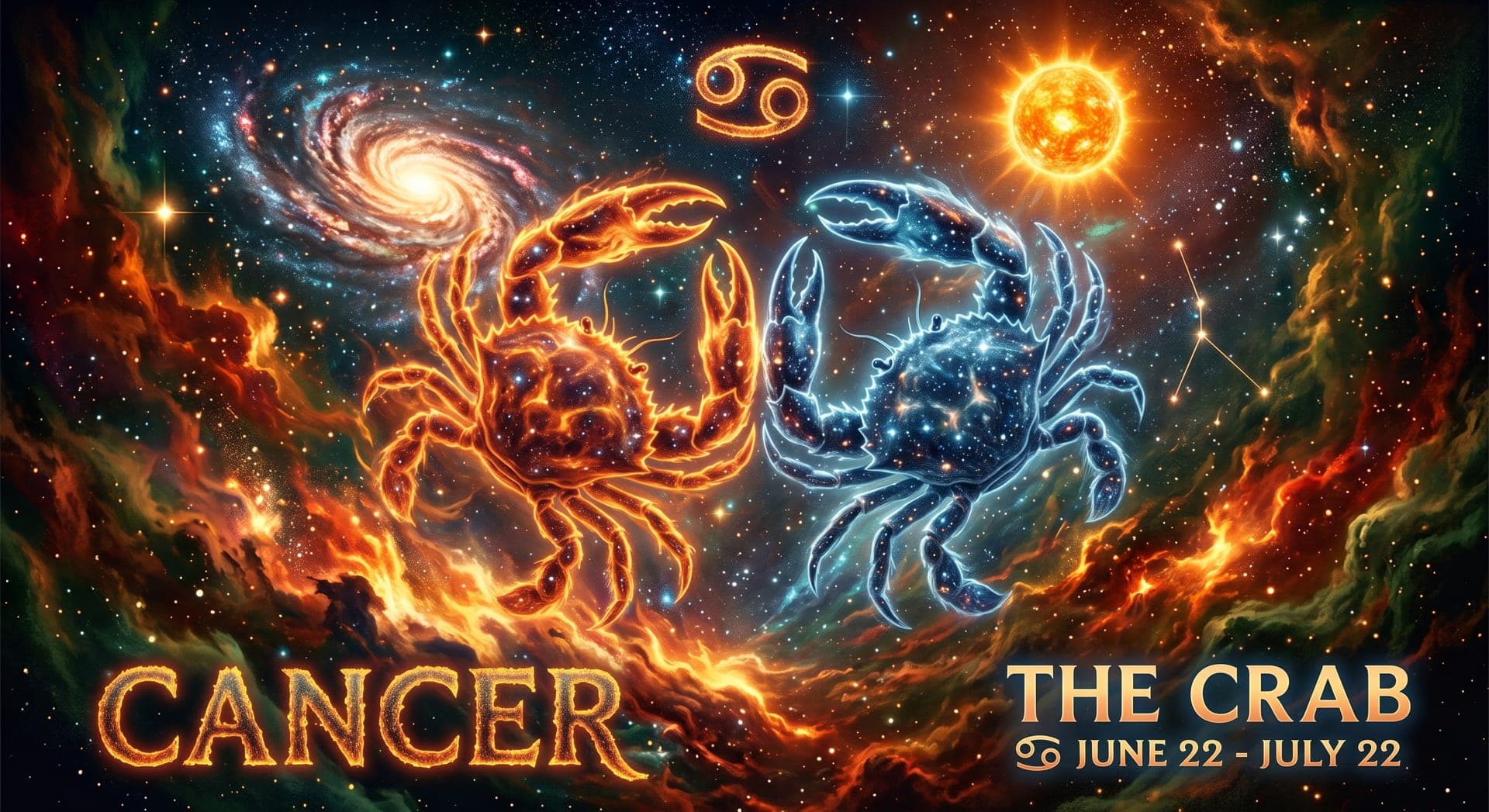
Cancer, the fourth sign of the zodiac, spans June 21 to July 22 and is symbolized by the crab, an animal known for carrying a protective shell while remaining soft and vulnerable underneath. Ruled by the Moon, the celestial body long associated with emotion, intuition, and the subconscious, Cancer is widely regarded as one of the most nurturing and emotionally attuned signs of the zodiac. As a Water sign, Cancer navigates the world through deep feeling, often forming strong emotional bonds and an acute sensitivity to the moods of others. Its Cardinal modality places it at the start of summer, beginning right at the June solstice, reflecting an instinct to initiate and create, especially around home and family. People born under this sign tend to be deeply loyal, protective of loved ones, and drawn to creating a comfortable, secure home environment. Cancer's emotional depth is a genuine strength, but it can also make the sign prone to moodiness or withdrawal when hurt, retreating like a crab into its shell until it feels safe enough to re-emerge.
Personality Traits
Strengths
- Deeply caring and nurturing
- Highly intuitive
- Fiercely loyal and protective
- Strong sense of family and tradition
- Emotionally perceptive
Weaknesses
- Prone to moodiness
- Overly sensitive to criticism
- Can be clingy
- Tends to hold grudges
- Retreats when hurt
Compatible Signs
Fun Facts
- Cancer's crab symbol comes from Greek mythology, where the goddess Hera placed a crab that had fought Hercules among the stars.
- Cancer is ruled by the Moon, the only zodiac sign ruled by a celestial body other than a planet.
- As a Cardinal sign, Cancer initiates summer, beginning at the June solstice, the longest day of the year in the Northern Hemisphere.
- Notable Cancers include Princess Diana, Tom Hanks, Ariana Grande, and Nelson Mandela.
- The crab's hard shell and soft interior are often used as a metaphor for Cancer's protective exterior guarding a deeply sensitive emotional core.
Born on July 4
- 1790
George Everest
Welsh geographer and surveyor who oversaw the Great Trigonometrical Survey of India; Mount Everest is named after him
- 1804
Nathaniel Hawthorne
American author known for "The Scarlet Letter"
- 1807
Giuseppe Garibaldi
Italian military leader who unified Italy
- 1871
Hubert Cecil Booth
English engineer who invented the powered vacuum cleaner
- 1872
Calvin Coolidge
30th President of the United States
- 1883
Rube Goldberg
American cartoonist known for absurdly complex contraptions
- 1898
Gertrude Lawrence
English actress, singer, and dancer celebrated for her work in West End and Broadway musical theatre
- 1904
Angela Baddeley
English actress known for playing the cook Mrs. Bridges in the television series Upstairs, Downstairs
- 1918
Alec Bedser
English cricketer regarded as one of the finest fast-medium bowlers of his generation
- 1927
Gina Lollobrigida
Italian actress and photographer
- 1927
Neil Simon
American playwright and screenwriter
- 1930
George Steinbrenner
Longtime owner of the New York Yankees
- 1931
Stephen Boyd
Northern Irish actor best known for his role as Messala in the film Ben-Hur
- 1934
Colin Welland
English actor and screenwriter who won an Academy Award for writing Chariots of Fire
- 1937
Queen Sonja of Norway
Queen consort of Norway

On This Day in History
- 362 BCE
Theban forces led by Epaminondas defeat the Spartans at the Battle of Mantinea, though Epaminondas is mortally wounded in the victory.
Theban general Epaminondas led an allied army against Sparta's coalition in one of ancient Greece's largest hoplite battles, achieving a tactical victory using an innovative oblique battle formation. However, Epaminondas was fatally wounded during the fighting, and his death left Thebes without the leadership that had made it briefly the dominant power in Greece.
- 1584
English explorers Philip Amadas and Arthur Barlowe arrive at Roanoke Island, an early step toward English colonization of North America.
English explorers sent by Sir Walter Raleigh landed on Roanoke Island off the coast of present-day North Carolina, surveying the area and establishing relations with local Native American communities. Their favorable reports led to England's first attempted colonial settlements in North America, including the ill-fated "Lost Colony" established a few years later.
- 1776
The Continental Congress formally adopts the Declaration of Independence, announcing the American colonies' separation from British rule.
Adopted two days after the Continental Congress voted for independence, the Declaration, drafted primarily by Thomas Jefferson, laid out the philosophical justification for separation from Britain and enumerated grievances against King George III. Its assertion that "all men are created equal" and possess unalienable rights became a foundational statement of American political ideals, celebrated annually as Independence Day.
- 1776
The Second Continental Congress formally adopts the United States Declaration of Independence, severing the thirteen American colonies from British rule.
Drafted principally by Thomas Jefferson, the declaration set out grievances against King George III and followed the Lee Resolution passed two days earlier. It launched a war that Britain would ultimately lose in 1783 with the Treaty of Paris, recognising American independence.
- 1802
The United States Military Academy opens at West Point, New York.
Established by Congress and signed into law by President Jefferson, the academy at West Point became the first engineering school in the United States and the nation's premier institution for training army officers. It has since produced generations of military leaders, including numerous American presidents, and remains one of the most selective and storied military academies in the world.
- 1832
Durham University is established by an Act of Parliament, becoming the third-oldest university in England.
Founded using the endowments of the Dean and Chapter of Durham Cathedral, it followed Oxford and Cambridge by several centuries and adopted a similar collegiate structure. Durham became a model for other English civic and cathedral-linked universities founded in the following decades.
- 1837
The Grand Junction Railway opens, linking Birmingham and Liverpool via Crewe.
It was one of the first long-distance trunk railways in the world, connecting at Warrington with the earlier Liverpool and Manchester Railway. The junction town of Crewe, little more than a hamlet before the line arrived, grew rapidly into a major railway engineering and manufacturing centre.
- 1862
Lewis Carroll tells ten-year-old Alice Liddell the story that would become Alice's Adventures in Wonderland during a boat trip on the River Thames.
Carroll, an Oxford mathematics don whose real name was Charles Dodgson, later wrote the story down at Alice's request. Published in 1865, Alice's Adventures in Wonderland became one of the most celebrated and enduringly popular works of English children's literature.
- 1863
Confederate forces at Vicksburg, Mississippi, surrender to Union troops after a grueling 47-day siege, giving the Union control of the Mississippi River.
After weeks of bombardment and starvation during Grant's siege, Confederate General John Pemberton surrendered the strategically vital river city, giving the Union complete control of the Mississippi River and effectively splitting the Confederacy in two. Coming a day after the Union victory at Gettysburg, the fall of Vicksburg is often cited as a turning point in the Civil War.
- 1879
British forces capture and burn Ulundi, the Zululand capital, concluding the Anglo-Zulu War.
British imperial forces under Lord Chelmsford captured and torched Ulundi, the royal capital of the Zulu Kingdom, decisively defeating King Cetshwayo's army and ending the war that had begun with a stunning Zulu victory at Isandlwana months earlier. The conflict resulted in the British annexation of Zululand and the fragmentation of Zulu political power.
- 1879
British forces capture Ulundi, the Zulu royal capital, effectively ending the Anglo-Zulu War.
The victory avenged Britain's earlier catastrophic defeat at the Battle of Isandlwana months before and led to the capture and exile of the Zulu king, Cetshwayo. In the war's aftermath, Britain broke up the Zulu kingdom into smaller, weaker chiefdoms to prevent further resistance.
- 1927
The Lockheed Vega aircraft completes its inaugural flight.
Developed by Lockheed, the streamlined single-engine Vega became renowned for its speed and range, attracting record-setting aviators of the era. Amelia Earhart famously flew a Vega across the Atlantic solo in 1932, and the aircraft's distinctive monocoque wooden fuselage construction influenced subsequent aircraft design during aviation's rapid interwar development.
- 1947
The Indian Independence Bill is presented to the British House of Commons, setting out the partition and independence of India and Pakistan.
Introduced by Prime Minister Clement Attlee's government, the bill passed within weeks and led to independence on 15 August 1947, ending nearly two centuries of British rule on the subcontinent. Partition triggered mass displacement and communal violence that killed hundreds of thousands.
- 1954
Food rationing officially ends in Great Britain, nearly nine years after the end of the Second World War.
Meat had been the last commodity still restricted under the wartime rationing scheme introduced in 1940 to manage scarce supplies. Its unusually long continuation into peacetime reflected Britain's slow post-war economic recovery compared with some other nations.
- 1976
Israeli commandos raid Entebbe Airport in Uganda, rescuing most hostages from a hijacked Air France flight.
The hijackers, demanding the release of imprisoned militants, had separated Israeli and Jewish passengers from the rest. The daring nighttime rescue operation, carried out over 2,500 miles from Israel, became one of the most celebrated counter-terrorism missions of the twentieth century.
- 1997
NASA's Pathfinder probe successfully lands on Mars, deploying the Sojourner rover.
After a seven-month journey, the Pathfinder mission touched down on the Martian surface using an innovative airbag landing system, then deployed the small Sojourner rover, the first wheeled vehicle to operate on another planet. The mission captured public imagination and demonstrated low-cost planetary exploration techniques that influenced subsequent Mars missions.
- 2004
The cornerstone for the Freedom Tower is laid at the World Trade Center site in New York City.
At a ceremony marking the third anniversary of the September 11 attacks, officials laid the cornerstone for what was originally planned as the Freedom Tower at the World Trade Center site. The building's design evolved considerably over subsequent years before its completion in 2014 as One World Trade Center, the tallest building in the Western Hemisphere.
- 2012
Scientists at CERN announce the discovery of the Higgs boson particle using the Large Hadron Collider.
Physicists at the CERN research facility near Geneva announced experimental evidence confirming the existence of the Higgs boson, a fundamental particle theorized decades earlier to explain how other particles acquire mass. The discovery, made using the Large Hadron Collider, completed the Standard Model of particle physics and earned the theory's originators the Nobel Prize the following year.
- 2012
Physicists at CERN announce the discovery of a particle consistent with the long-sought Higgs boson.
The finding, made using the Large Hadron Collider, confirmed a key prediction of the Standard Model of particle physics first proposed in the 1960s. Theorists Peter Higgs and François Englert, who had predicted the particle decades earlier, were awarded the Nobel Prize in Physics the following year.
- 2024
The Labour Party wins a landslide victory in the United Kingdom general election, with Keir Starmer set to become prime minister.
The result ended fourteen years of Conservative-led government, delivering Labour one of the largest parliamentary majorities in its history amid widespread public dissatisfaction with the outgoing administration. Starmer was formally appointed prime minister by King Charles III the following day.