
What’s Observed on July 3
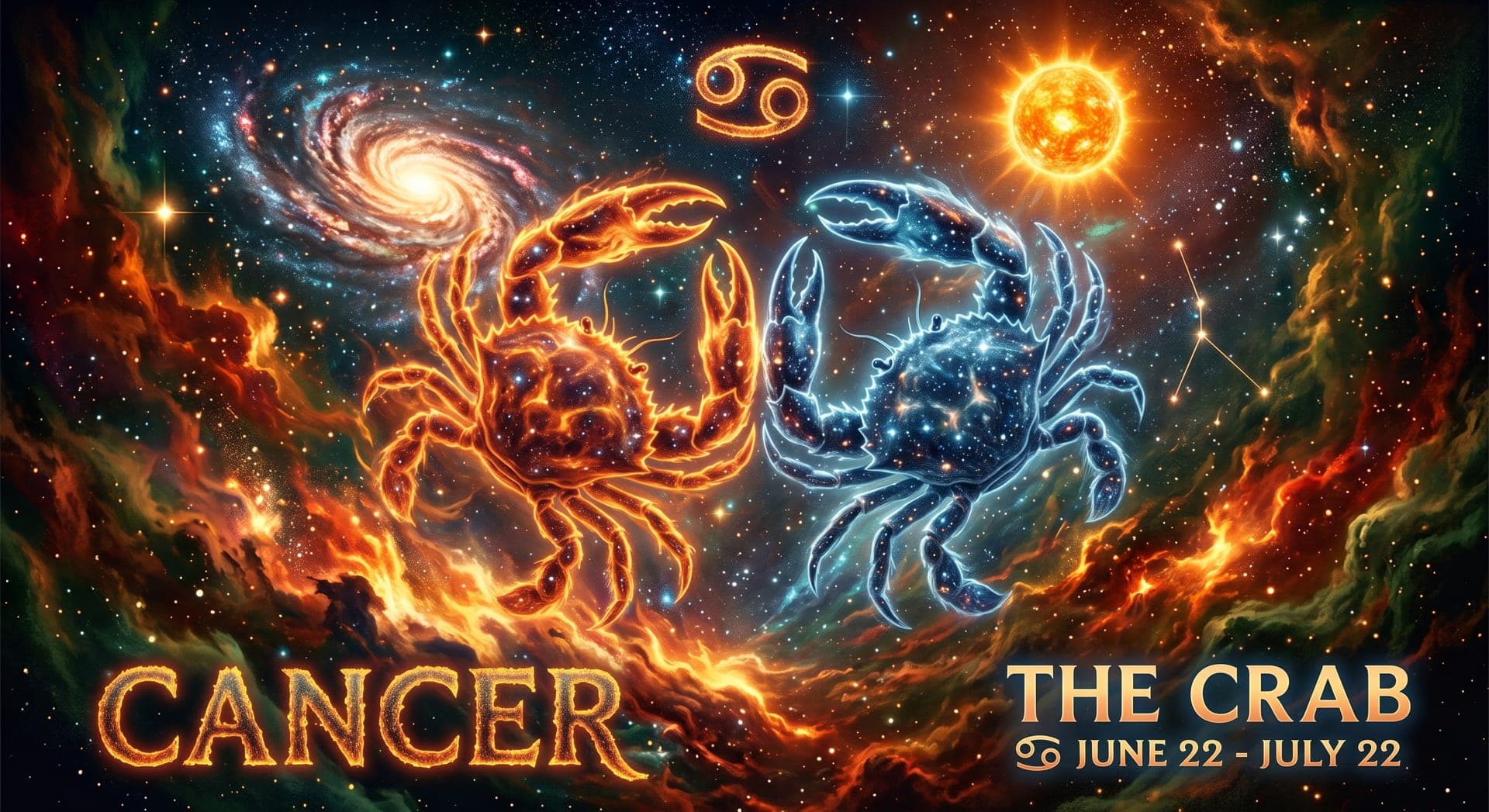
Born on July 3: Cancer ♋
Cancer, the fourth sign of the zodiac, spans June 21 to July 22 and is symbolized by the crab, an animal known for carrying a protective shell while remaining soft and vulnerable underneath. Ruled by the Moon, the celestial body long associated with emotion, intuition, and the subconscious, Cancer is widely regarded as one of the most nurturing and emotionally attuned signs of the zodiac. As a Water sign, Cancer navigates the world through deep feeling, often forming strong emotional bonds and an acute sensitivity to the moods of others. Its Cardinal modality places it at the start of summer, beginning right at the June solstice, reflecting an instinct to initiate and create, especially around home and family. People born under this sign tend to be deeply loyal, protective of loved ones, and drawn to creating a comfortable, secure home environment. Cancer's emotional depth is a genuine strength, but it can also make the sign prone to moodiness or withdrawal when hurt, retreating like a crab into its shell until it feels safe enough to re-emerge.
Personality Traits
Strengths
- Deeply caring and nurturing
- Highly intuitive
- Fiercely loyal and protective
- Strong sense of family and tradition
- Emotionally perceptive
Weaknesses
- Prone to moodiness
- Overly sensitive to criticism
- Can be clingy
- Tends to hold grudges
- Retreats when hurt
Compatible Signs
Fun Facts
- Cancer's crab symbol comes from Greek mythology, where the goddess Hera placed a crab that had fought Hercules among the stars.
- Cancer is ruled by the Moon, the only zodiac sign ruled by a celestial body other than a planet.
- As a Cardinal sign, Cancer initiates summer, beginning at the June solstice, the longest day of the year in the Northern Hemisphere.
- Notable Cancers include Princess Diana, Tom Hanks, Ariana Grande, and Nelson Mandela.
- The crab's hard shell and soft interior are often used as a metaphor for Cancer's protective exterior guarding a deeply sensitive emotional core.
Born on July 3
- 1728
Robert Adam
Scottish neoclassical architect renowned for his elegant interior designs and country houses
- 1854
Leoš Janáček
Czech composer
- 1860
Charlotte Perkins Gilman
American sociologist and feminist author
- 1878
George M. Cohan
American songwriter and Broadway performer
- 1883
Franz Kafka
Czech-Austrian writer known for existential fiction
- 1927
Ken Russell
English film director known for provocative works including Women in Love and The Devils
- 1935
Harrison Schmitt
American geologist and Apollo 17 astronaut
- 1937
Tom Stoppard
Czech-English playwright
- 1957
Poly Styrene
British punk singer who fronted the band X-Ray Spex
- 1959
Julie Burchill
English journalist and author known for provocative cultural commentary
- 1960
Vince Clarke
English musician and songwriter, founding member of Depeche Mode, Yazoo, and Erasure
- 1962
Tom Cruise
American actor and producer
- 1963
Tracey Emin
British artist associated with the Young British Artists movement, known for confessional conceptual works
- 1971
Julian Assange
Australian journalist who founded WikiLeaks
- 1975
Matt Haig
British author and journalist known for novels including The Midnight Library

On This Day in History
- 987
Hugh Capet is crowned King of France, founding the Capetian dynasty that, through its various branches, would rule France almost continuously until the monarchy's final abolition in 1848.
Elected by an assembly of nobles after the death of the last Carolingian king, Hugh Capet founded a dynasty whose direct and cadet branches, including the Valois and Bourbon lines, would rule France almost continuously until the monarchy's final abolition in 1848. His accession marked a foundational shift in medieval French political history.
- 1035
William, later known as William the Conqueror, becomes Duke of Normandy at around age eight following his father's death.
William inherited the duchy as an illegitimate but acknowledged son after his father, Duke Robert I, died returning from a pilgrimage to Jerusalem. His minority was marked by violent power struggles among Norman nobles. William survived numerous assassination attempts and rebellions to eventually consolidate control, later launching the 1066 conquest of England that transformed him into one of history's most consequential rulers.
- 1035
William becomes Duke of Normandy at around age seven, following his father's death, later becoming known as William the Conqueror.
William's illegitimate birth and youth made his early years as duke turbulent, with rebellious Norman barons repeatedly challenging his authority. He would go on to invade and conquer England in 1066 at the Battle of Hastings, fundamentally reshaping English language, law, and aristocracy for centuries.
- 1450
Rebels led by Jack Cade enter London during a popular uprising against the government of King Henry VI.
The rebellion protested official corruption, high taxation, and recent losses in the Hundred Years' War. Cade's forces briefly controlled parts of the city and executed unpopular royal officials before the revolt collapsed within weeks and Cade himself was killed while fleeing.
- 1608
French explorer Samuel de Champlain founds Quebec City, establishing a foothold for French colonization in North America.
Champlain established a fortified trading post at a narrow point along the Saint Lawrence River, chosen for its strategic and defensible position. The settlement grew into the capital of New France and remains one of the oldest continuously inhabited European-founded cities in North America, serving as a cornerstone of French colonial presence on the continent.
- 1754
A young George Washington surrenders Fort Necessity to French forces, his only military surrender, during the opening engagements of the French and Indian War.
During the opening skirmishes that helped spark the French and Indian War, the young Virginia militia officer built a hastily constructed stockade in present-day Pennsylvania. Surrounded and outnumbered by French and allied Native American forces, Washington was compelled to surrender, the only capitulation of his military career, an experience that shaped his later leadership in the Revolutionary War.
- 1767
British midshipman Robert Pitcairn sights the uninhabited South Pacific island later named Pitcairn Island in his honour.
The island remained unsettled until 1790, when mutineers from HMS Bounty and their Tahitian companions took refuge there to escape capture by the Royal Navy. Their descendants formed a small community that still inhabits Pitcairn today, a British Overseas Territory.
- 1775
George Washington formally assumes command of the newly established Continental Army at Cambridge, Massachusetts.
Appointed by the Continental Congress, Washington rode to Massachusetts to take charge of the loosely organized colonial militia forces besieging British troops in Boston. His acceptance of command, delivered under an elm tree according to tradition, marked the formal creation of a unified American fighting force under continental rather than individual colonial authority.
- 1778
A force of Loyalists and Iroquois allied with Britain defeats Patriot militia at the Battle of Wyoming in Pennsylvania during the American Revolutionary War.
Many surrendering militiamen were killed in the battle's aftermath, and the engagement became notorious in American memory as the 'Wyoming massacre.' It fuelled retaliatory campaigns the following year against British-allied Iroquois settlements in New York.
- 1814
American forces capture Fort Erie from British troops, opening the Niagara campaign of the War of 1812.
The fort changed hands and was besieged repeatedly over the following months during heavy fighting along the Niagara frontier. American forces ultimately withdrew across the river and destroyed the fort that November as the campaign wound down.
- 1863
The Battle of Gettysburg concludes with the disastrous failure of Pickett's Charge, marking the turning point of the American Civil War.
Confederate General George Pickett led roughly 12,500 soldiers in a massive frontal assault against entrenched Union positions on Cemetery Ridge, the climactic infantry attack of the battle. Union artillery and rifle fire devastated the advancing lines, and the attack collapsed with over half its participants killed, wounded, or captured. The failure forced Lee to withdraw his army from Pennsylvania the next day.
- 1886
Karl Benz publicly unveils the Benz Patent-Motorwagen, widely regarded as the first purpose-built automobile.
Benz's three-wheeled vehicle, powered by a single-cylinder internal combustion engine, is widely credited as the first practical automobile designed from the ground up rather than adapted from a horse-drawn carriage. Benz had patented the design in January 1886, and his wife Bertha's long-distance test drive the following year helped prove the vehicle's viability and generate public interest.
- 1938
The British steam locomotive Mallard sets a world speed record of 125.88 miles per hour, a record for steam locomotives that still stands.
Streamlined for speed, the LNER Class A4 locomotive Mallard reached its record pace while descending Stoke Bank in Lincolnshire, England, during a brief test run. The achievement came just before the outbreak of World War II curtailed further high-speed rail experimentation, and Mallard's record for steam-powered locomotives has never been surpassed.
- 1938
The LNER Class A4 steam locomotive Mallard sets the world speed record for steam locomotives, reaching 125.88 mph in England.
Designed by engineer Nigel Gresley, Mallard achieved the record while running downhill near Grantham, Lincolnshire. The record has never been broken by another steam locomotive, and Mallard is now preserved on public display at the National Railway Museum in York.
- 1940
The Royal Navy attacks the French fleet at Mers-el-Kebir to prevent its potential capture by Nazi Germany, killing over a thousand French sailors.
After France's surrender to Germany, Britain feared the powerful French fleet anchored at Mers-el-Kebir in Algeria might fall under Axis control. When French commanders refused an ultimatum to join the British, scuttle their ships, or sail to neutral ports, the Royal Navy opened fire, sinking or damaging several battleships. The attack strained Anglo-French relations for years afterward.
- 1940
The Royal Navy attacks the French fleet at Mers-el-Kébir in Algeria to prevent its capture by Nazi Germany.
Following France's armistice with Germany, Britain feared the powerful French fleet could fall into Axis hands and shift the naval balance of the war. The attack killed around 1,300 French sailors and badly strained relations between Britain and Vichy France for years afterward.
- 1967
British forces retake the Crater district of Aden from rebel fighters during the Battle of the Crater in the Aden Emergency.
The operation, led by Lieutenant Colonel Colin Mitchell's Argyll and Sutherland Highlanders, restored order after mutineers had held the district for days. Despite the tactical success, Britain withdrew entirely from Aden just months later as its colonial presence in the region ended.
- 1970
The British Army imposes the Falls Curfew, a three-day curfew and weapons search across the Falls Road area of Belfast.
Thousands of troops sealed off the nationalist district in an operation intended to seize IRA weapons, and several civilians were killed during the search. The heavy-handed operation badly damaged relations between the Army and the local community early in the Troubles.
- 1988
The USS Vincennes mistakenly shoots down Iran Air Flight 655 over the Persian Gulf, killing all 290 people aboard.
Amid heightened tensions during the Iran-Iraq War, the American guided-missile cruiser mistakenly identified a civilian Iranian passenger jet as an attacking military aircraft and shot it down over the Persian Gulf, killing everyone aboard, including 66 children. The incident remains one of the deadliest civilian aviation disasters caused by military action and a lasting source of tension between the United States and Iran.
- 1996
Prime Minister John Major announces that the Stone of Scone will be returned to Scotland after seven hundred years in England.
The stone, traditionally used in the coronation of Scottish and later British monarchs, had been seized from Scone Abbey by Edward I in 1296 and kept beneath the Coronation Chair at Westminster Abbey. It was formally returned to Edinburgh Castle later in 1996, though it still travels south for coronations.