What’s Observed on July 26
Born on July 26: Leo ♌
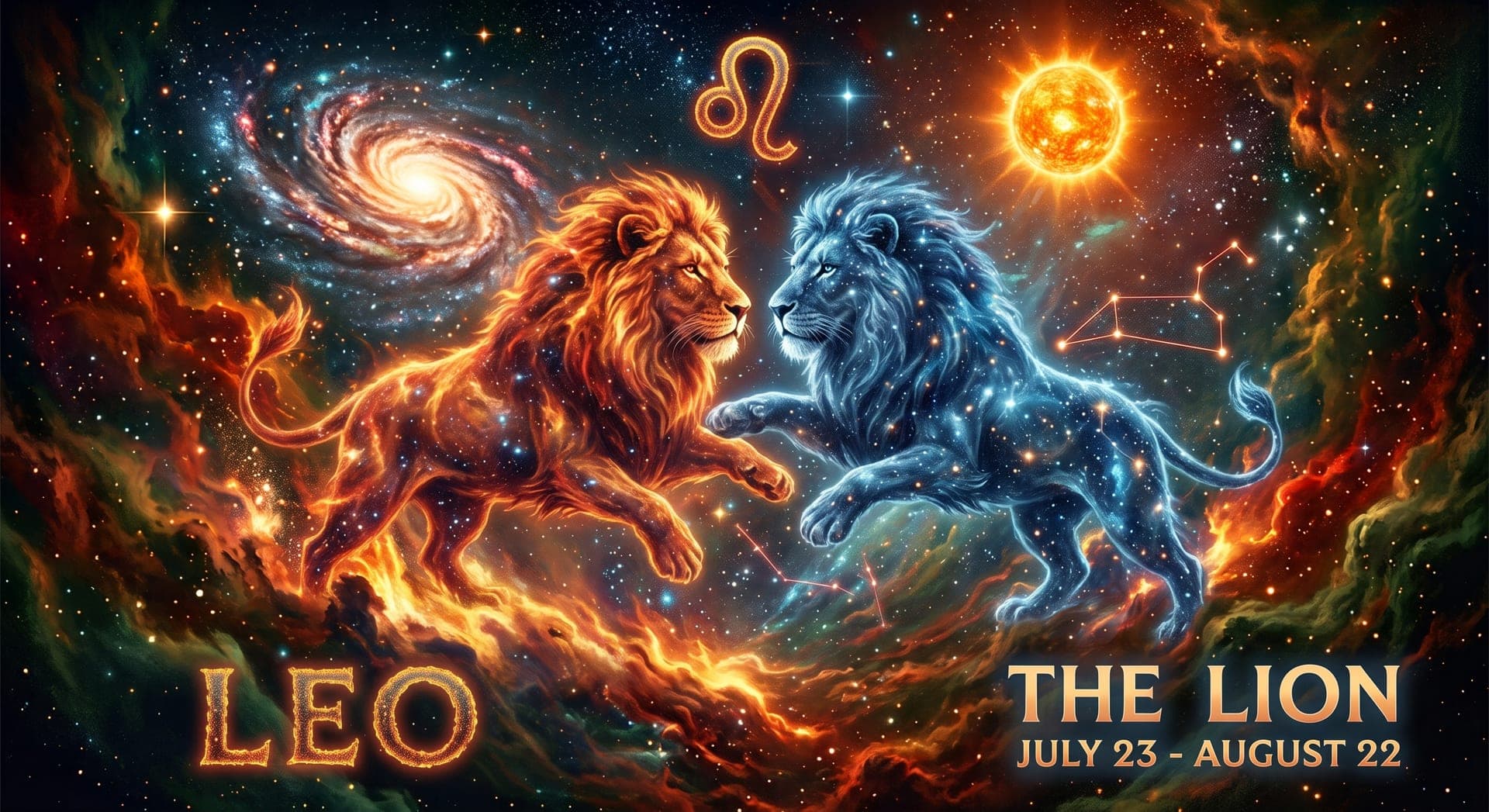
Leo, the fifth sign of the zodiac, spans July 23 to August 22 and is symbolized by the lion, an animal long associated with courage, pride, and natural leadership. Ruled by the Sun, the center of the solar system and the source of light and life, Leo is widely regarded as one of the most confident, warm, and charismatic signs of the zodiac, naturally drawn to the spotlight. As a Fire sign, Leo approaches life with passion, enthusiasm, and a flair for the dramatic, rarely content to blend quietly into the background. Its Fixed modality gives Leo a strong sense of loyalty and consistency, along with a stubborn streak once its mind is made up. People born under this sign are often natural performers, leaders, or creatives who thrive when appreciated and celebrated by those around them. Leo's generosity and warmth make it a beloved friend and steadfast ally, though its genuine need for recognition and admiration can tip into vanity or a demand for center stage if left unchecked.
Personality Traits
Strengths
- Naturally charismatic leader
- Generous and warm-hearted
- Confident and self-assured
- Creative and expressive
- Loyal to friends and family
Weaknesses
- Prone to arrogance
- Craves attention and validation
- Stubborn once decided
- Can be domineering
- Sensitive to criticism of their ego
Compatible Signs
Fun Facts
- Leo's lion symbol connects to the Greek myth of the Nemean Lion, slain by Hercules as the first of his twelve labors.
- Leo is ruled by the Sun, the only zodiac sign ruled directly by a star rather than a planet or moon.
- As a Fixed Fire sign, Leo season falls at the height of summer, when the sun's warmth and intensity are strongest in the Northern Hemisphere.
- Notable Leos include Barack Obama, Madonna, Jennifer Lawrence, and Napoleon Bonaparte.
- Leo rules the heart in traditional medical astrology, reflecting the sign's association with vitality, courage, and life force.
Born on July 26
- 1842
Alfred Marshall
English economist regarded as one of the founders of modern neoclassical economics
- 1856
George Bernard Shaw
Irish playwright and Nobel laureate
- 1875
Carl Jung
Swiss psychiatrist and founder of analytical psychology
- 1894
Aldous Huxley
English novelist and essayist best known for the dystopian novel Brave New World
- 1919
James Lovelock
English scientist who proposed the Gaia hypothesis, viewing Earth as a self-regulating system
- 1928
Stanley Kubrick
American filmmaker
- 1943
Mick Jagger
English singer-songwriter and frontman of the Rolling Stones
- 1945
Helen Mirren
English actress known for her Academy Award-winning performance in The Queen
- 1959
Kevin Spacey
American actor
- 1964
Sandra Bullock
American actress and producer
- 1967
Jason Statham
English actor known for action films including The Transporter series
- 1975
Liz Truss
English politician who served as Prime Minister of the United Kingdom
- 1980
Jacinda Ardern
Prime Minister of New Zealand
On This Day in History
- 811
Byzantine Emperor Nikephoros I is killed in battle against Bulgarian forces led by Khan Krum.
Byzantine Emperor Nikephoros I was killed in battle against the forces of Bulgarian Khan Krum during a campaign deep into Bulgarian territory, a defeat so severe that Krum reportedly had the emperor's skull fashioned into a ceremonial drinking cup, an event that shocked contemporary Byzantine chroniclers.
- 1469
Ferdinand of Aragon and Isabella of Castile marry, a union that later leads to the unification of Spain.
The marriage of Ferdinand of Aragon and Isabella of Castile united two of medieval Spain's most powerful kingdoms under a joint monarchy. Their combined reign later financed Columbus's voyages, completed the Reconquista by conquering Granada, and laid the political foundation for the unified Spanish state.
- 1745
The world's first recorded women's cricket match is played in Surrey, England.
Two amateur women's cricket teams played what is considered the earliest documented match of its kind in Surrey, England, at a time when organized sport for women was extremely rare. The match reflects the surprisingly early, if limited, presence of women's participation in English cricket history.
- 1745
The first recorded women's cricket match takes place near Guildford, England.
The match was reportedly played between two teams of local women and covered in the contemporary press, predating the first written Laws of Cricket by decades. It stands as the earliest known documented instance of organised women's cricket, though the sport remained a marginal and often disapproved-of pursuit for women well into the 19th century.
- 1757
A French army defeats an outnumbered British-Hanoverian force at the Battle of Hastenbeck during the Seven Years' War.
The battle, fought near Hamelin in the Electorate of Hanover, saw the Duke of Cumberland's Allied 'Army of Observation' driven back by a larger French force under the Duc d'Estrées. The defeat forced Cumberland into a disastrous retreat that ended with the Convention of Klosterzeven, briefly knocking Hanover out of the war and provoking outrage back in Britain over his conduct.
- 1758
The Siege of Louisbourg ends with British forces defeating the French and taking control of the fortress on Cape Breton Island.
The seven-week siege, led by General Jeffery Amherst and supported by a Royal Navy fleet, eliminated French naval power in the region and opened the route for the British advance on Quebec the following year. Louisbourg's capture was a major turning point in the Seven Years' War's North American theatre and effectively sealed the fate of French Canada.
- 1775
The U.S. Post Office is established, with Benjamin Franklin appointed its first Postmaster General.
The Second Continental Congress established a centralized postal system for the American colonies, appointing Benjamin Franklin, who had previously served as a British colonial postmaster, as the first Postmaster General. The service laid the foundation for the modern United States Postal Service.
- 1788
New York becomes the 11th state to ratify the U.S. Constitution.
New York became the eleventh state to ratify the newly drafted U.S. Constitution, doing so narrowly after intense debate between Federalist and Anti-Federalist factions, including influential essays later compiled as the Federalist Papers. Ratification allowed New York to join the new federal union alongside the other founding states.
- 1803
The Surrey Iron Railway, arguably the world's first public railway, opens in south London.
Running between Wandsworth and Croydon, the horse-drawn line carried goods rather than passengers and charged tolls to any operator using its tracks, much like a turnpike road. Though it predated steam locomotion and closed within a few decades, historians regard it as an important precursor to the public railway network that would transform Britain in the following century.
- 1892
Dadabhai Naoroji is elected as the first Indian Member of Parliament in Britain.
Naoroji won the Finsbury Central seat for the Liberal Party by a narrow margin, becoming the first Asian to sit in the British House of Commons. A prominent nationalist thinker and founder of the Indian National Congress, he used his position at Westminster to campaign against British economic exploitation of India, articulating what became known as the 'drain theory.'
- 1897
Pashtun fakir Saidullah leads an army of more than 10,000 to begin a siege of the British garrison in the Malakand Agency.
The uprising, part of a wider frontier revolt against British expansion in the region, besieged the small garrison for days before a relief force fought through to break the siege. A young Winston Churchill, serving with the Malakand Field Force, later chronicled the campaign in his first book, an experience that helped launch his career as a writer and public figure.
- 1908
The Bureau of Investigation, later renamed the FBI, is founded in the United States.
The U.S. Department of Justice established the Bureau of Investigation, a small force of special agents tasked with investigating federal crimes. The agency was later renamed the Federal Bureau of Investigation in 1935 and grew into the United States' principal federal law enforcement and domestic intelligence agency.
- 1936
King Edward VIII officially unveils the Canadian National Vimy Memorial in northern France, one of his few official duties before his abdication.
The memorial commemorates the Canadian soldiers killed in the First World War, including at the Battle of Vimy Ridge. Edward's appearance drew huge crowds of veterans, but he abdicated the British throne just months later to marry Wallis Simpson, making the unveiling one of the most prominent public engagements of his brief reign.
- 1941
British forces defending Malta destroy an Italian attack on Grand Harbour by the Decima Flottiglia MAS.
The Italian navy's elite unit attempted to breach the harbour's defences using explosive motorboats and manned torpedoes to strike shipping sheltering at Valletta. Coastal artillery and radar-directed searchlights detected and destroyed the raiding force before it could inflict damage, one of the more notable British defensive successes during the prolonged Axis siege of Malta.
- 1945
The Labour Party wins the United Kingdom general election by a landslide, removing wartime leader Winston Churchill from power.
Despite Churchill's popularity as a war leader, voters turned to Clement Attlee's Labour Party in large numbers, driven by a desire for social reform and reconstruction after years of hardship. The result, announced with a delay to allow overseas servicemen's votes to be counted, paved the way for the creation of the National Health Service and the modern British welfare state.
- 1945
HMS Vestal becomes the last British Royal Navy ship sunk during the Second World War.
The minesweeper was attacked by Japanese aircraft while clearing mines in the Andaman Sea, just weeks before the war's end. Her loss was a reminder that Allied naval forces remained under threat in Asian waters even as Germany's defeat receded into the past, right up until Japan's surrender in August 1945.
- 1953
Fidel Castro leads an armed attack on the Moncada Barracks in Cuba, an event later commemorated as the start of the Cuban Revolution.
A group of Cuban revolutionaries led by Fidel Castro launched a poorly planned and ultimately unsuccessful assault on the Moncada army barracks in Santiago de Cuba. Though the attack failed and many participants were killed or imprisoned, the date became a rallying symbol for Castro's later successful revolution against the Batista government.
- 1956
Egyptian President Gamal Abdel Nasser nationalizes the Suez Canal, precipitating the Suez Crisis.
Egyptian President Gamal Abdel Nasser announced the nationalization of the Suez Canal, previously operated by a British and French-controlled company, intending to use its revenues to fund the Aswan Dam project. The move triggered the Suez Crisis, a brief war and major geopolitical rupture between Egypt and the former colonial powers.
- 1963
The first geosynchronous communications satellite, Syncom 2, is successfully launched.
The United States successfully launched Syncom 2, the first satellite placed into a geosynchronous orbit, meaning it remained roughly above the same point on Earth's surface. The technology proved transformative for global telecommunications, enabling continuous satellite coverage for television and communication signals.
- 1971
Apollo 15 launches from Kennedy Space Center on a mission featuring the first use of a Lunar Roving Vehicle.
Astronauts David Scott, Alfred Worden, and James Irwin launched aboard Apollo 15, a mission notable for introducing the battery-powered Lunar Roving Vehicle, which allowed astronauts to travel much greater distances across the Moon's surface than earlier missions had permitted on foot.