What’s Observed on July 15
Born on July 15: Cancer ♋
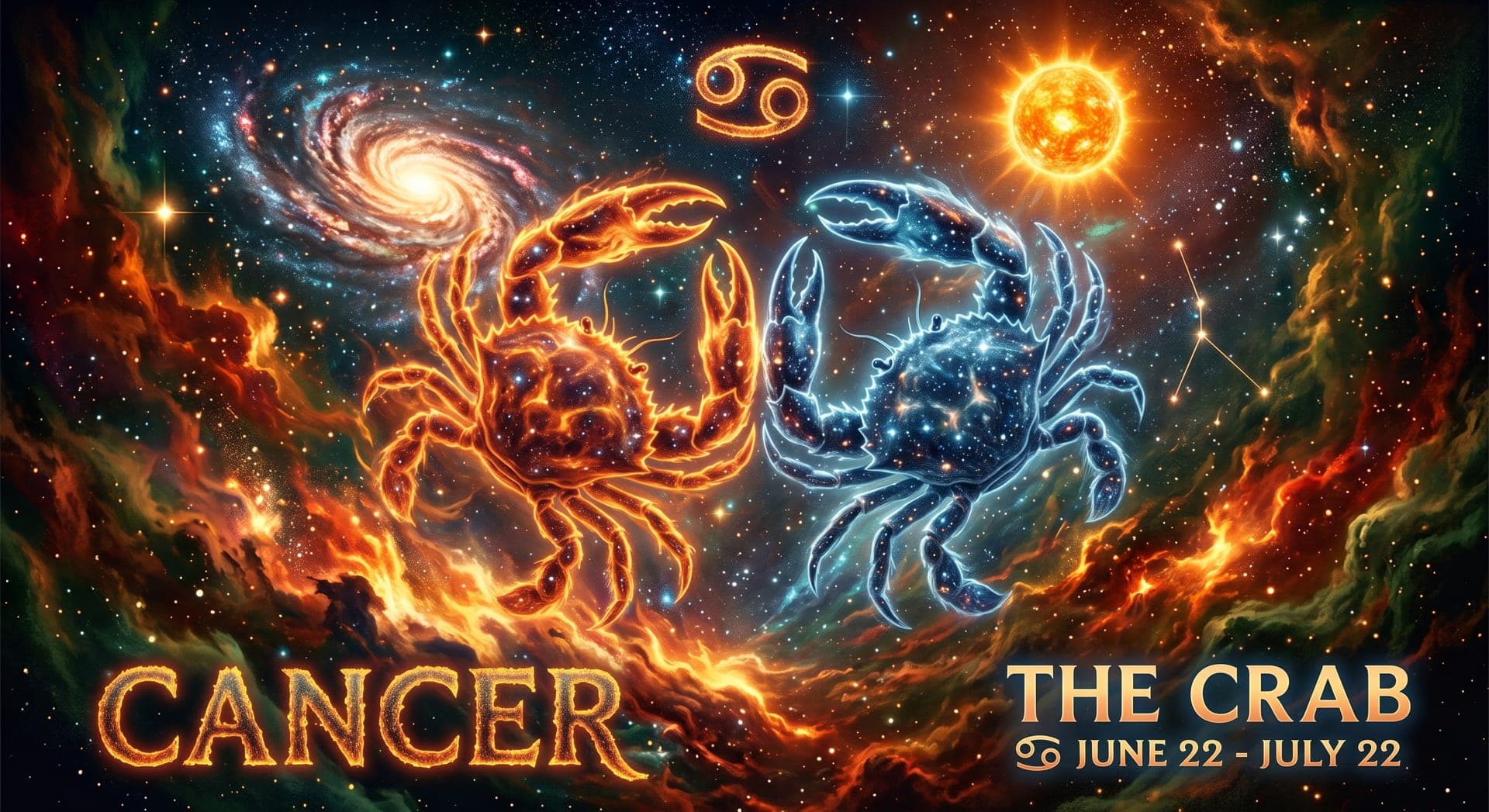
Cancer, the fourth sign of the zodiac, spans June 21 to July 22 and is symbolized by the crab, an animal known for carrying a protective shell while remaining soft and vulnerable underneath. Ruled by the Moon, the celestial body long associated with emotion, intuition, and the subconscious, Cancer is widely regarded as one of the most nurturing and emotionally attuned signs of the zodiac. As a Water sign, Cancer navigates the world through deep feeling, often forming strong emotional bonds and an acute sensitivity to the moods of others. Its Cardinal modality places it at the start of summer, beginning right at the June solstice, reflecting an instinct to initiate and create, especially around home and family. People born under this sign tend to be deeply loyal, protective of loved ones, and drawn to creating a comfortable, secure home environment. Cancer's emotional depth is a genuine strength, but it can also make the sign prone to moodiness or withdrawal when hurt, retreating like a crab into its shell until it feels safe enough to re-emerge.
Personality Traits
Strengths
- Deeply caring and nurturing
- Highly intuitive
- Fiercely loyal and protective
- Strong sense of family and tradition
- Emotionally perceptive
Weaknesses
- Prone to moodiness
- Overly sensitive to criticism
- Can be clingy
- Tends to hold grudges
- Retreats when hurt
Compatible Signs
Fun Facts
- Cancer's crab symbol comes from Greek mythology, where the goddess Hera placed a crab that had fought Hercules among the stars.
- Cancer is ruled by the Moon, the only zodiac sign ruled by a celestial body other than a planet.
- As a Cardinal sign, Cancer initiates summer, beginning at the June solstice, the longest day of the year in the Northern Hemisphere.
- Notable Cancers include Princess Diana, Tom Hanks, Ariana Grande, and Nelson Mandela.
- The crab's hard shell and soft interior are often used as a metaphor for Cancer's protective exterior guarding a deeply sensitive emotional core.
Born on July 15
- 1573
Inigo Jones
English architect who introduced Italian classical architecture to Britain
- 1606
Rembrandt
Dutch painter and etcher of the Baroque period
- 1858
Emmeline Pankhurst
English political activist who founded the Women's Social and Political Union and led the suffragette movement
- 1865
Alfred Harmsworth, 1st Viscount Northcliffe
British newspaper publisher who founded the Daily Mail and transformed British popular journalism
- 1892
Walter Benjamin
German philosopher and critic
- 1911
Edward Shackleton, Baron Shackleton
English geographer and politician, son of explorer Ernest Shackleton, who served as Leader of the House of Lords
- 1919
Iris Murdoch
Anglo-Irish novelist and philosopher
- 1930
Jacques Derrida
Algerian-French philosopher known for deconstruction
- 1933
Julian Bream
English classical guitarist and lutenist credited with popularising the classical guitar in Britain
- 1943
Jocelyn Bell Burnell
Northern Irish astrophysicist who co-discovered the first radio pulsars
- 1946
Linda Ronstadt
American singer
- 1961
Forest Whitaker
American actor and director
- 1965
David Miliband
English politician who served as Foreign Secretary
- 1990
Damian Lillard
American professional basketball player
On This Day in History
- 484 BCE
The Temple of Castor and Pollux is dedicated in the Roman Forum.
Ancient Roman tradition held an annual procession honoring the twin gods Castor and Pollux on the anniversary of their temple's dedication in the Forum, commemorating their legendary aid to Rome in an early battle. The temple remained a significant religious and civic site in Roman public life for centuries.
- 1099
Crusader forces capture Jerusalem after a difficult siege, establishing the Crusader-controlled Kingdom of Jerusalem.
After a difficult five-week siege, Crusader forces breached the walls of Jerusalem and captured the city, followed by a notorious massacre of many of its Muslim and Jewish inhabitants. The conquest established the Crusader Kingdom of Jerusalem, the primary political entity of the Crusader states in the Levant for nearly a century afterward.
- 1099
Soldiers of the First Crusade breach the walls of Jerusalem and capture the Church of the Holy Sepulchre.
The capture of Jerusalem, accompanied by a notorious massacre of the city's Muslim and Jewish inhabitants, marked the culmination of the First Crusade and led to the establishment of the Crusader Kingdom of Jerusalem, which survived in various forms for nearly two centuries.
- 1207
King John of England expels the monks of Canterbury who had supported the disputed election of Archbishop Stephen Langton.
John's refusal to accept Langton, who had been chosen with papal backing, triggered a bitter dispute with Pope Innocent III that led to England being placed under interdict and John himself excommunicated. The conflict was only resolved in 1213 when John submitted to the pope.
- 1381
Radical preacher John Ball is hanged, drawn, and quartered following the suppression of the Peasants' Revolt under King Richard II.
Ball, famous for his egalitarian sermon asking 'when Adam delved and Eve span, who was then the gentleman,' had been a leading ideological voice of the uprising against poll taxes and feudal restrictions. His execution came after the revolt's leaders were tricked into disbanding following the killing of Wat Tyler.
- 1410
Combined Polish-Lithuanian forces decisively defeat the Teutonic Knights at the Battle of Grunwald.
A combined army of Polish, Lithuanian, and allied forces decisively defeated the Teutonic Knights near the villages of Grunwald and Tannenberg in one of medieval Europe's largest battles. The victory broke the military dominance of the Teutonic Order in the region and marked a turning point in Polish-Lithuanian power in Central Europe.
- 1410
The combined forces of Poland and Lithuania decisively defeat the Teutonic Knights at the Battle of Grunwald.
One of the largest battles of medieval Europe, the victory broke the military power of the Teutonic Order and marked a turning point in the balance of power in northeastern Europe, though the Order continued to exist in weakened form for another century.
- 1799
French soldiers accompanying Napoleon's Egyptian campaign discover the Rosetta Stone, a find that later enabled the decipherment of Egyptian hieroglyphs.
During Napoleon's Egyptian campaign, French soldiers rebuilding a fort near the town of Rosetta unearthed a stone slab inscribed with the same text in three scripts, including ancient Greek and Egyptian hieroglyphs. The find later enabled scholars, most notably Jean-Francois Champollion, to finally decipher hieroglyphic writing after centuries of mystery.
- 1799
The Rosetta Stone is discovered in the Egyptian village of Rosetta by French soldiers during Napoleon's campaign.
The inscribed stone, bearing the same decree in Egyptian hieroglyphs, Demotic script, and Ancient Greek, proved crucial to deciphering hieroglyphic writing decades later. It was seized by Britain under the 1801 Treaty of Alexandria and has remained on display in the British Museum ever since.
- 1815
Napoleon Bonaparte formally surrenders to British forces aboard HMS Bellerophon, ending his final bid for power.
Following his final defeat at Waterloo weeks earlier, Napoleon boarded the British warship HMS Bellerophon and surrendered himself to British custody, hoping for asylum in England. Instead, he was exiled to the remote South Atlantic island of Saint Helena, where he spent his remaining years and died in 1821.
- 1815
Napoleon Bonaparte surrenders to British forces aboard HMS Bellerophon following his defeat at Waterloo.
Having failed to escape to the United States, Napoleon boarded the British warship off the French coast, hoping for asylum in England. Instead, he was exiled by the British government to the remote South Atlantic island of Saint Helena, where he died in 1821.
- 1834
The Spanish Inquisition is officially disbanded after operating for approximately 356 years.
After more than three centuries of operation targeting heresy and religious dissent within Spain and its territories, the Spanish Inquisition was formally abolished by royal decree, reflecting the liberal political reforms sweeping Spain in the early nineteenth century following the Napoleonic Wars and subsequent constitutional movements.
- 1840
The Great Powers of Europe conclude the Convention of London to stabilise the ongoing crisis in the Near East.
Negotiated by Britain, Austria, Prussia, and Russia in support of the Ottoman Empire against Muhammad Ali of Egypt, the agreement aimed to prevent a wider European war over the collapsing Ottoman position in the Levant. British diplomacy under Lord Palmerston played a central role in brokering the settlement.
- 1870
Rupert's Land is transferred from the Hudson's Bay Company to Canada, and the new provinces of Manitoba and the Northwest Territories are established.
The vast territory, covering much of what is now central and northern Canada, had been controlled by the British-chartered Hudson's Bay Company for two centuries. Its transfer massively expanded the young Dominion of Canada and led directly to the Red River Rebellion led by Louis Riel.
- 1888
Mount Bandai erupts violently in Japan, killing roughly 500 people in Fukushima Prefecture.
A powerful volcanic eruption at Mount Bandai in northern Japan devastated surrounding villages, triggering landslides and destroying homes and farmland. The disaster killed several hundred people and prompted early Japanese scientific study of volcanic hazards, influencing later disaster preparedness policy in the region.
- 1918
The Second Battle of the Marne begins near the Marne River in France, a major Allied victory that turned the tide of World War I.
German forces launched what became their final major offensive of World War I along the Marne River in France, but Allied troops, bolstered by American reinforcements, halted the advance and soon counterattacked. The battle marked the definitive turning of the tide against Germany on the Western Front, leading toward the war's end that November.
- 1946
The state of North Borneo, now Sabah in Malaysia, is annexed by the United Kingdom as a Crown Colony.
The territory had previously been administered by the British North Borneo Company since the late nineteenth century. Direct Crown rule continued until 1963, when North Borneo joined Malaya, Sarawak, and Singapore to form the Federation of Malaysia.
- 1975
The Apollo-Soyuz Test Project launches, marking the first joint American-Soviet human spaceflight mission.
American and Soviet spacecraft launched separately before docking in orbit two days later, the first joint human spaceflight mission between the two Cold War rivals. Conceived as a symbol of détente, the mission featured astronauts and cosmonauts conducting joint experiments and handshakes broadcast worldwide, easing tensions in the ongoing space race.
- 2006
The social media platform Twitter is publicly launched.
Founders Jack Dorsey, Biz Stone, and Evan Williams launched a short-message social platform originally limited to 140 characters, inspired partly by SMS text messaging. Twitter rapidly grew into a globally influential communication tool used for everything from personal updates to breaking news and political discourse, later rebranded as X in 2023.
- 2018
France wins its second FIFA World Cup title, defeating Croatia 4–2 in the final.
Held in Russia, the tournament final featured a high-scoring match that included an own goal and a penalty awarded by video assistant referee, a technology used for the first time at a World Cup. Nineteen-year-old Kylian Mbappé became one of the youngest players to score in a World Cup final.