
What’s Observed on July 16
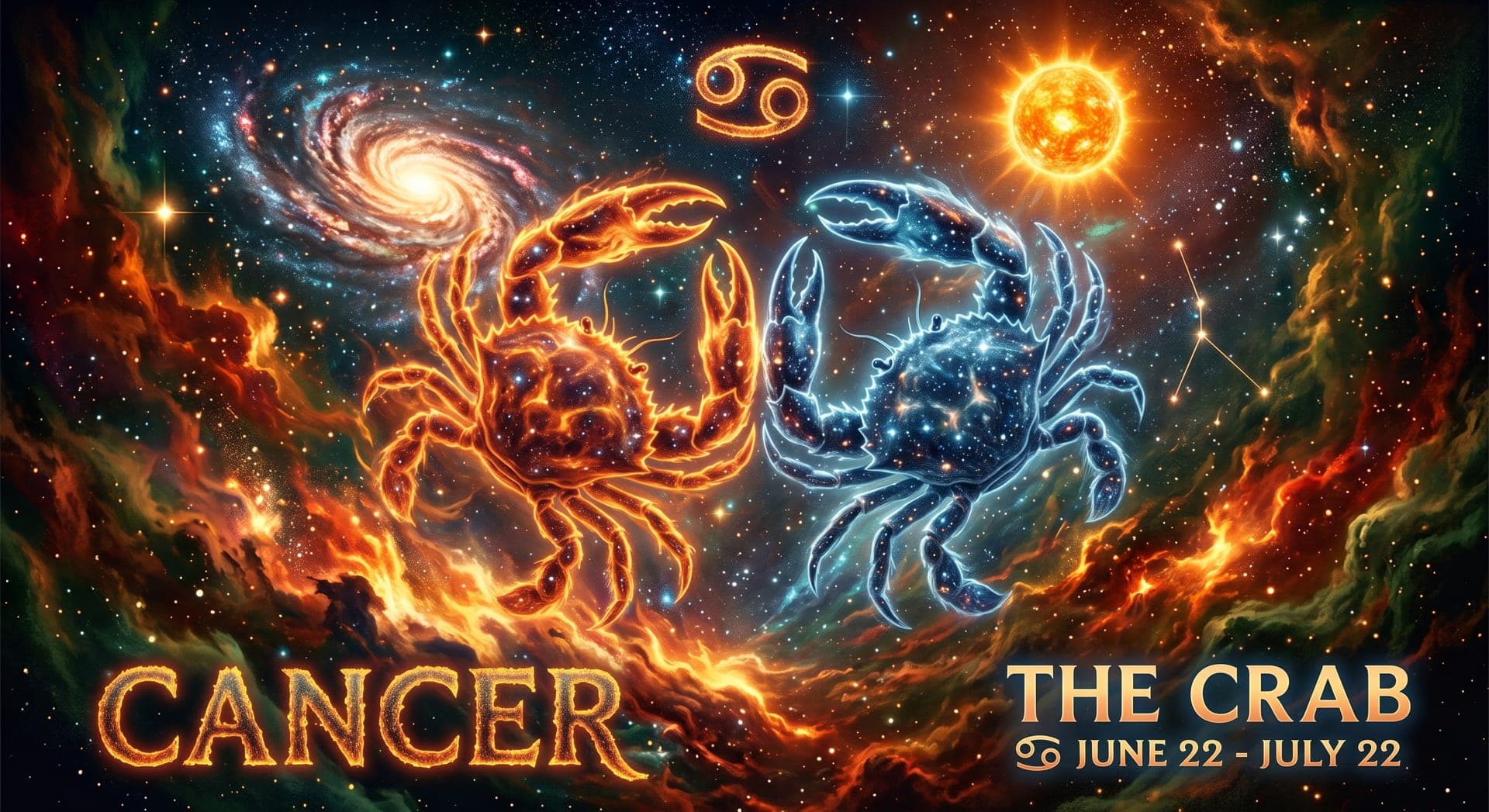
Born on July 16: Cancer ♋
Cancer, the fourth sign of the zodiac, spans June 21 to July 22 and is symbolized by the crab, an animal known for carrying a protective shell while remaining soft and vulnerable underneath. Ruled by the Moon, the celestial body long associated with emotion, intuition, and the subconscious, Cancer is widely regarded as one of the most nurturing and emotionally attuned signs of the zodiac. As a Water sign, Cancer navigates the world through deep feeling, often forming strong emotional bonds and an acute sensitivity to the moods of others. Its Cardinal modality places it at the start of summer, beginning right at the June solstice, reflecting an instinct to initiate and create, especially around home and family. People born under this sign tend to be deeply loyal, protective of loved ones, and drawn to creating a comfortable, secure home environment. Cancer's emotional depth is a genuine strength, but it can also make the sign prone to moodiness or withdrawal when hurt, retreating like a crab into its shell until it feels safe enough to re-emerge.
Personality Traits
Strengths
- Deeply caring and nurturing
- Highly intuitive
- Fiercely loyal and protective
- Strong sense of family and tradition
- Emotionally perceptive
Weaknesses
- Prone to moodiness
- Overly sensitive to criticism
- Can be clingy
- Tends to hold grudges
- Retreats when hurt
Compatible Signs
Fun Facts
- Cancer's crab symbol comes from Greek mythology, where the goddess Hera placed a crab that had fought Hercules among the stars.
- Cancer is ruled by the Moon, the only zodiac sign ruled by a celestial body other than a planet.
- As a Cardinal sign, Cancer initiates summer, beginning at the June solstice, the longest day of the year in the Northern Hemisphere.
- Notable Cancers include Princess Diana, Tom Hanks, Ariana Grande, and Nelson Mandela.
- The crab's hard shell and soft interior are often used as a metaphor for Cancer's protective exterior guarding a deeply sensitive emotional core.
Born on July 16
- 1723
Joshua Reynolds
English painter and first president of the Royal Academy of Arts
- 1821
Mary Baker Eddy
American founder of Christian Science
- 1870
Ellen Oliver
British suffragette and activist for women's voting rights
- 1872
Roald Amundsen
Norwegian polar explorer
- 1898
Lady Eve Balfour
British farmer and educator who co-founded the Soil Association and pioneered the organic farming movement
- 1907
Barbara Stanwyck
American actress
- 1911
Ginger Rogers
American actress and dancer
- 1927
Shirley Hughes
English author and illustrator best known for the Alfie children's book series
- 1928
Anita Brookner
English novelist and art historian who won the Booker Prize for her novel Hotel du Lac
- 1939
Corin Redgrave
English actor and political activist, a member of the Redgrave acting family
- 1942
Margaret Court
Australian tennis champion
- 1967
Will Ferrell
American actor and comedian
- 1989
Gareth Bale
Welsh footballer who won multiple UEFA Champions League titles with Real Madrid

On This Day in History
- 622
The Hijrah, Muhammad's migration from Mecca to Medina, begins, an event that later marks the start of the Islamic calendar.
According to Islamic tradition, the Prophet Muhammad and his followers departed Mecca for the city of Medina to escape persecution, an event known as the Hijrah. The migration marked a pivotal turning point in early Islamic history and was later chosen as the starting point of the Islamic lunar calendar.
- 1054
A papal legate places a bull of excommunication on the altar of Hagia Sophia, an act that formally triggers the East-West Schism dividing Christianity.
A papal representative placed a decree of excommunication against the Patriarch of Constantinople on the altar of Hagia Sophia during a dispute over church authority and doctrine, an act reciprocated by the patriarch days later. The mutual excommunications formalized the East-West Schism, dividing Christianity into the Roman Catholic and Eastern Orthodox branches.
- 1212
Christian forces from Castile, Aragon, and Navarre decisively defeat the Almohad Caliphate at the Battle of Las Navas de Tolosa, a turning point in the Reconquista.
A coalition of Christian kingdoms from Castile, Aragon, Navarre, and Portugal won a decisive victory over Almohad forces at Las Navas de Tolosa in southern Spain, significantly weakening Muslim power on the Iberian Peninsula. The battle is regarded as a major turning point in the centuries-long Reconquista.
- 1251
The English Carmelite friar Simon Stock reportedly receives a vision of the Virgin Mary presenting the brown scapular.
Simon Stock, an English prior general of the Carmelite Order, is traditionally credited with the vision at Aylesford in Kent, though the earliest surviving accounts date from over a century later. The brown scapular associated with the vision became a widely used devotional object within the Catholic Church.
- 1377
Richard II is crowned King of England at age ten.
Richard became king at age ten upon the death of his grandfather, Edward III, since his father, Edward the Black Prince, had died the previous year, and he was crowned at Westminster Abbey soon afterward. His reign would later be shaped by the ongoing Hundred Years' War, the Peasants' Revolt of 1381, and mounting conflict with the English nobility that ultimately led to his deposition in 1399.
- 1377
Richard II is crowned King of England at Westminster Abbey at the age of ten.
Richard's minority was dominated by powerful noble councillors, and his reign was later marked by the Peasants' Revolt of 1381 and growing conflict with his own barons. He was eventually deposed in 1399 by his cousin, who took the throne as Henry IV.
- 1661
Stockholms Banco issues Europe's first banknotes, an early milestone in the development of paper currency.
Sweden's central bank precursor, Stockholms Banco, issued the first banknotes in European history, intended to address a shortage of usable coinage caused by heavy, low-value copper currency. Though the bank later collapsed from over-issuance, the innovation laid conceptual groundwork for modern paper currency systems.
- 1769
Father Junipero Serra establishes Mission San Diego de Alcala, California's first Spanish mission.
Spanish Franciscan missionary Junipero Serra established the first in a chain of California missions near present-day San Diego, aiming to convert local Indigenous populations to Christianity. The mission system profoundly and often violently reshaped Indigenous life along the California coast over the following decades of Spanish colonization.
- 1779
The Continental Army seizes a fortified British position at the Battle of Stony Point during the American Revolutionary War.
Led by General Anthony Wayne, American troops carried out a daring nighttime bayonet assault on the heavily fortified position overlooking the Hudson River. Though the fort was abandoned soon after due to its indefensibility, the raid boosted American morale during a difficult phase of the war.
- 1790
The District of Columbia is established as the permanent capital of the United States.
Congress passed legislation establishing a federal district along the Potomac River to serve as the permanent seat of the United States government, resolving earlier debates over locating the capital in an existing state. The city that developed there was later named Washington in honor of the first president.
- 1809
La Paz declares independence from Spain, forming the Junta Tuitiva, considered the first independent government in Spanish America.
Although the junta was suppressed by royalist forces within months, the uprising is regarded as an early spark of the broader Spanish American wars of independence that would sweep the continent over the following two decades.
- 1915
American-born novelist Henry James becomes a naturalised British citizen.
James, who had lived in England for decades and was a devoted admirer of British culture, took citizenship partly as a gesture of solidarity with Britain during the First World War, after the United States had not yet entered the conflict. He died the following year.
- 1945
The United States conducts the Trinity nuclear test in New Mexico, the first detonation of a nuclear weapon, ushering in the atomic age.
In the New Mexico desert, American scientists working on the Manhattan Project detonated the world's first nuclear weapon, code-named Trinity, producing an explosion far more powerful than most researchers had anticipated. The successful test paved the way for the atomic bombings of Hiroshima and Nagasaki weeks later, ushering in the nuclear age.
- 1945
The United States detonates the world's first nuclear weapon in the Trinity test near Alamogordo, New Mexico.
The test, the culmination of the Manhattan Project, confirmed the viability of a plutonium implosion-type bomb weeks before atomic weapons were used against Hiroshima and Nagasaki. It ushered in the nuclear age and reshaped global military and political strategy for decades afterward.
- 1951
J. D. Salinger publishes his novel The Catcher in the Rye.
The novel's account of teenage alienation, narrated by protagonist Holden Caulfield, became one of the most widely read and frequently banned books of the twentieth century, exerting lasting influence on American literature and popular culture.
- 1969
Apollo 11 launches from Cape Kennedy, Florida, beginning the mission that would land the first humans on the Moon.
The Saturn V rocket carrying astronauts Neil Armstrong, Buzz Aldrin, and Michael Collins lifted off from Florida, beginning the historic mission that would achieve humanity's first crewed lunar landing four days later. Millions watched the launch in person and on television, marking a defining moment of the Space Race.
- 1969
Apollo 11 launches from Cape Kennedy, beginning the mission that would land the first humans on the Moon.
Astronauts Neil Armstrong, Buzz Aldrin, and Michael Collins lifted off atop a Saturn V rocket on a mission that fulfilled President Kennedy's decade-old goal of a crewed lunar landing. Armstrong and Aldrin walked on the lunar surface four days later, on 20 July 1969.
- 1983
A Sikorsky S-61 helicopter crashes into the sea off the Isles of Scilly, killing twenty people.
The helicopter, operated by British International Helicopters, was carrying passengers on a routine flight between the Scilly Isles and Penzance when it went down in poor weather. It remains one of the deadliest civil helicopter accidents in British aviation history.
- 1994
Fragments of Comet Shoemaker-Levy 9 begin colliding with Jupiter, providing astronomers with an unprecedented direct observation of a cosmic impact event.
Fragments of a comet that had broken apart under Jupiter's gravity began slamming into the planet's atmosphere over the course of about a week, producing massive dark scars visible even through amateur telescopes. It was the first time astronomers directly observed a collision between two solar system bodies.
- 1994
Comet Shoemaker-Levy 9 begins colliding with Jupiter, the first observed collision of two Solar System bodies.
The comet had broken into more than twenty fragments after a close approach to Jupiter the previous year, and observatories around the world watched as the pieces struck the planet over several days. The impacts left dark scars in Jupiter's atmosphere visible for months.