
What’s Observed on June 9
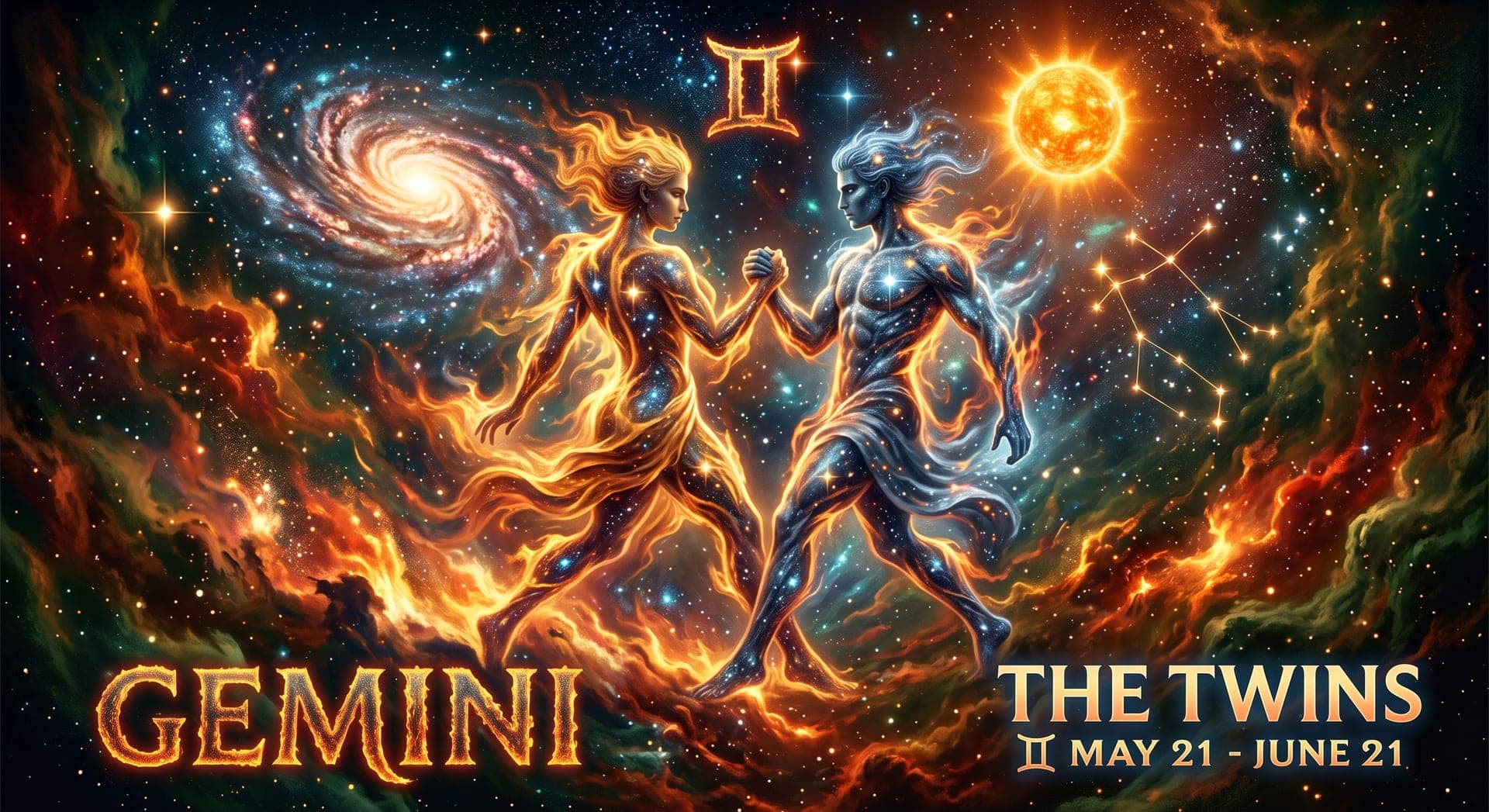
Born on June 9: Gemini ♊
Gemini, the third sign of the zodiac, spans May 21 to June 20 and is symbolized by twins, representing the sign's dual nature and its ability to see multiple sides of any situation at once. Ruled by Mercury, the planet of communication and intellect, Gemini is widely regarded as one of the most talkative, curious, and quick-witted signs of the zodiac, constantly gathering new information and ideas. As an Air sign, Gemini approaches the world primarily through thought and conversation, thriving on mental stimulation and social interaction. Its Mutable modality reflects a restless adaptability, since Gemini tends to resist routine and prefers variety, novelty, and the freedom to change course whenever something more interesting comes along. People born under this sign are often skilled communicators, natural storytellers, and quick learners who can hold their own in nearly any conversation. That same adaptability can also come across as inconsistency, and Gemini's dual nature sometimes earns an unfair reputation for being two-faced, when in reality it simply reflects genuine curiosity about every side of a story.
Personality Traits
Strengths
- Quick-witted and intelligent
- Excellent communicator
- Adaptable to new situations
- Curious and eager to learn
- Charming and sociable
Weaknesses
- Prone to inconsistency
- Can be superficial
- Easily bored
- Indecisive
- Tendency to gossip
Compatible Signs
Fun Facts
- Gemini's twin symbol traces back to the Greek myth of Castor and Pollux, twin brothers placed among the stars as the constellation Gemini.
- Mercury, Gemini's ruling planet, was the swift Roman messenger god, reflecting the sign's associations with communication and quick thinking.
- Gemini is one of only a few zodiac signs represented by human figures rather than animals or objects.
- Notable Geminis include Marilyn Monroe, Kanye West, Angelina Jolie, and John F. Kennedy.
- Gemini season overlaps with the transition from spring to summer in the Northern Hemisphere, reflecting the sign's changeable, in-between nature.
Born on June 9
- 1672
Peter the Great
Russian emperor who modernized Russia
- 1781
George Stephenson
English engineer known as the 'father of railways,' who built the Locomotion No. 1 and pioneered the Liverpool and Manchester Railway.
- 1836
Elizabeth Garrett Anderson
English physician and politician who became the first woman in Britain to qualify as a doctor and co-founded a hospital staffed entirely by women.
- 1875
Henry Hallett Dale
English pharmacologist who shared the 1936 Nobel Prize in Physiology or Medicine for discoveries on the chemical transmission of nerve impulses.
- 1890
Leslie Banks
English actor and director best remembered for his roles in The Man Who Knew Too Much and The Most Dangerous Game.
- 1891
Cole Porter
American composer of classic Broadway songs
- 1913
Patrick Steptoe
English gynaecologist who, with Robert Edwards, pioneered in vitro fertilization, leading to the birth of the world's first 'test-tube baby' in 1978.
- 1915
Les Paul
American guitarist who pioneered the solid-body electric guitar
- 1917
Eric Hobsbawm
British historian noted for his tetralogy on the "long 19th century" and studies of nationalism
- 1936
George Radda
Hungarian-born British biochemist known for pioneering magnetic resonance imaging of heart metabolism
- 1941
Jon Lord
English keyboardist and co-founder of the rock band Deep Purple, celebrated for his pioneering fusion of classical and rock music.
- 1943
Charles Saatchi
Iraqi-born British advertising executive who co-founded Saatchi & Saatchi and the Saatchi Gallery
- 1946
James Kelman
Scottish novelist and playwright who won the Booker Prize in 1994 for How Late It Was, How Late.
- 1961
Michael J. Fox
Canadian-American actor known for "Back to the Future"
- 1963
Johnny Depp
American actor
- 1978
Matt Bellamy
English singer, guitarist, and songwriter, best known as the frontman of the rock band Muse.
- 1981
Natalie Portman
Israeli-American actress

On This Day in History
- 68
Roman Emperor Nero takes his own life amid a military revolt, ending the Julio-Claudian dynasty and triggering the chaotic Year of the Four Emperors.
Roman Emperor Nero took his own life with assistance from a secretary after the Senate declared him a public enemy amid a widespread military revolt against his increasingly erratic and tyrannical rule, ending the Julio-Claudian dynasty founded by Augustus and plunging Rome into the chaotic Year of the Four Emperors, a brief period of civil war and rapid successive rulers.
- 68
Roman emperor Nero dies by suicide, ending the Julio-Claudian dynasty.
Facing a Senate that had declared him a public enemy and abandoned by his own guards, Nero fled Rome and took his own life with the help of a secretary, reportedly lamenting 'what an artist dies in me.' His death ended the dynasty founded by Augustus and plunged Rome into the brief civil war known as the Year of the Four Emperors.
- 721
Frankish forces under Odo of Aquitaine defeat an invading Umayyad army at the Battle of Toulouse.
Frankish forces under Duke Odo of Aquitaine defeated an invading Umayyad Muslim army at the Battle of Toulouse, halting an early advance into Frankish territory from Islamic Spain, a victory that, alongside the later and more famous Battle of Tours, helped check the northward expansion of Umayyad conquest into Western Europe.
- 1311
Duccio di Buoninsegna's monumental altarpiece "Maestà" is installed in Siena Cathedral to great public celebration.
Sienese painter Duccio di Buoninsegna's monumental double-sided altarpiece, the "Maesta," was ceremonially installed in Siena Cathedral amid a jubilant public procession through the city, a work now regarded as one of the masterpieces of early Italian Gothic art and a pivotal bridge between Byzantine artistic tradition and the emerging Renaissance style.
- 1534
French explorer Jacques Cartier becomes the first European to chart the Saint Lawrence River.
French explorer Jacques Cartier's expedition became the first documented Europeans to chart and explore the Saint Lawrence River, a discovery that opened the interior of North America to French exploration and eventual colonization, laying crucial groundwork for the establishment of New France and the fur trade economy that followed.
- 1534
French explorer Jacques Cartier becomes the first European to chart and describe the Saint Lawrence River.
During his first voyage to North America in search of a route to Asia, Cartier sailed into the Gulf of Saint Lawrence and began mapping the waterway that would become a vital artery for French colonization of Canada. His explorations laid the groundwork for New France and generations of European settlement along the river.
- 1732
James Oglethorpe receives a royal charter to establish the British colony of Georgia in North America.
Granted by King George II, the charter authorised Oglethorpe and a board of trustees to found the thirteenth British colony as a refuge for imprisoned debtors and the 'deserving poor,' as well as a military buffer protecting the Carolinas from Spanish Florida. Oglethorpe personally led the first settlers to found Savannah later that year.
- 1772
American colonists burn the grounded British customs schooner Gaspee in Narragansett Bay, Rhode Island.
The Gaspee had been aggressively enforcing unpopular British trade laws when it ran aground while chasing a smuggling vessel. Local colonists boarded the stranded ship overnight, shot its commander, and set it ablaze. The attack on Crown property, one of the earliest violent acts of colonial defiance against British authority, foreshadowed the resistance that would erupt into revolution three years later.
- 1798
British and loyalist forces defeat United Irishmen rebels at the Battles of Arklow and Saintfield during the Irish Rebellion.
Fought on the same day in different parts of Ireland, the battles were significant reversals for the rebellion against British rule. At Arklow, government forces halted the rebel advance toward Dublin, while at Saintfield in County Down, United Irishmen briefly held off Crown troops before the wider uprising was crushed within weeks.
- 1815
The Congress of Vienna concludes, redrawing the map of Europe in the aftermath of the Napoleonic Wars.
The Congress of Vienna, a series of diplomatic conferences among Europe's major powers following Napoleon's defeat, concluded with a final settlement redrawing the continent's political map, restoring many pre-revolutionary monarchies and establishing a balance-of-power framework intended to prevent future large-scale European conflict, a system that largely succeeded for several decades.
- 1815
The Congress of Vienna concludes, with Britain playing a central role in redrawing the map of post-Napoleonic Europe.
Represented chiefly by Foreign Secretary Viscount Castlereagh, Britain worked alongside Austria, Russia, and Prussia to construct a balance-of-power settlement intended to prevent future French expansionism. The resulting Vienna system shaped European diplomacy for decades and secured Britain's position as a leading arbiter of continental affairs without acquiring significant new European territory itself.
- 1863
The Battle of Brandy Station, the largest cavalry engagement of the American Civil War, ends Confederate cavalry dominance in the war's eastern theater.
The Battle of Brandy Station, the largest predominantly cavalry engagement ever fought on American soil, ended in a tactical draw but marked a symbolic turning point in the Civil War's eastern theater, as Union cavalry demonstrated for the first time that it could match the previously dominant Confederate horsemen under J.E.B. Stuart.
- 1900
Birsa Munda, the tribal leader who led an uprising against British colonial rule in India, dies of cholera in a British jail.
Birsa Munda led the Munda tribal peoples of present-day Jharkhand in the Ulgulan ('Great Tumult') rebellion against British land policies and exploitative landlords in the 1890s. Captured and imprisoned in Ranchi, he died of cholera at just twenty-five. He is remembered today as a folk hero and symbol of indigenous resistance to colonial rule.
- 1928
Aviator Charles Kingsford Smith completes the first trans-Pacific flight, piloting the Southern Cross from the United States to Australia.
Australian aviator Charles Kingsford Smith and his crew completed the first flight across the Pacific Ocean, piloting the aircraft Southern Cross from Oakland, California, to Brisbane, Australia, over roughly nine days including refueling stops, a grueling and dangerous achievement that captured international attention and cemented Kingsford Smith's reputation as a pioneering aviator.
- 1928
Aviator Charles Kingsford Smith completes the first trans-Pacific flight, landing in Brisbane, Australia.
Flying the Southern Cross with a crew of three, Kingsford Smith departed Oakland, California, and island-hopped via Hawaii and Fiji before completing the roughly 7,400-mile journey. The flight was a landmark in aviation history, proving the feasibility of long-distance ocean flying and making Kingsford Smith a national hero in Australia.
- 1954
Attorney Joseph Welch delivers his famous rebuke, "Have you no sense of decency, sir?" to Senator Joseph McCarthy during the televised Army-McCarthy hearings.
During the televised Army-McCarthy hearings investigating Senator Joseph McCarthy's anti-communist crusade, Army attorney Joseph Welch delivered his famous rebuke, "Have you no sense of decency, sir, at long last?" after McCarthy attacked a young lawyer's background, a moment widely credited with turning public opinion decisively against McCarthy and accelerating his political downfall.
- 1954
Attorney Joseph Welch famously rebukes Senator Joseph McCarthy during the Army-McCarthy hearings.
As McCarthy attacked a young lawyer in Welch's firm over tenuous Communist associations, Welch interrupted with the now-famous rebuke, 'Have you no sense of decency, sir, at long last?' Broadcast live on television, the exchange crystallized growing public disgust with McCarthy's tactics and hastened the decline of his political influence.
- 1967
Israeli forces capture the Golan Heights from Syria in the closing days of the Six-Day War.
Israeli forces captured the strategically vital Golan Heights from Syria in the closing days of the Six-Day War, seizing high ground that had long been used by Syrian artillery to shell Israeli farming communities below, a territorial gain that remains a significant and unresolved point of contention in Israeli-Syrian relations today.
- 1973
Secretariat wins the Belmont Stakes by an astonishing 31 lengths, completing horse racing's Triple Crown in record time.
Secretariat completed horse racing's Triple Crown by winning the Belmont Stakes by an astonishing 31 lengths, setting a track record that still stands today, a performance widely regarded as one of the greatest in thoroughbred racing history and one that transformed the horse into an enduring American sporting legend.
- 1973
Secretariat wins the Belmont Stakes by a record 31 lengths, completing horse racing's US Triple Crown.
Having already won the Kentucky Derby and Preakness Stakes in record time, Secretariat delivered a historic final performance, finishing the mile-and-a-half Belmont Stakes in 2:24, a track record that still stands. His Triple Crown sweep, the first in twenty-five years, made him one of the most celebrated racehorses of all time.