What’s Observed on June 26
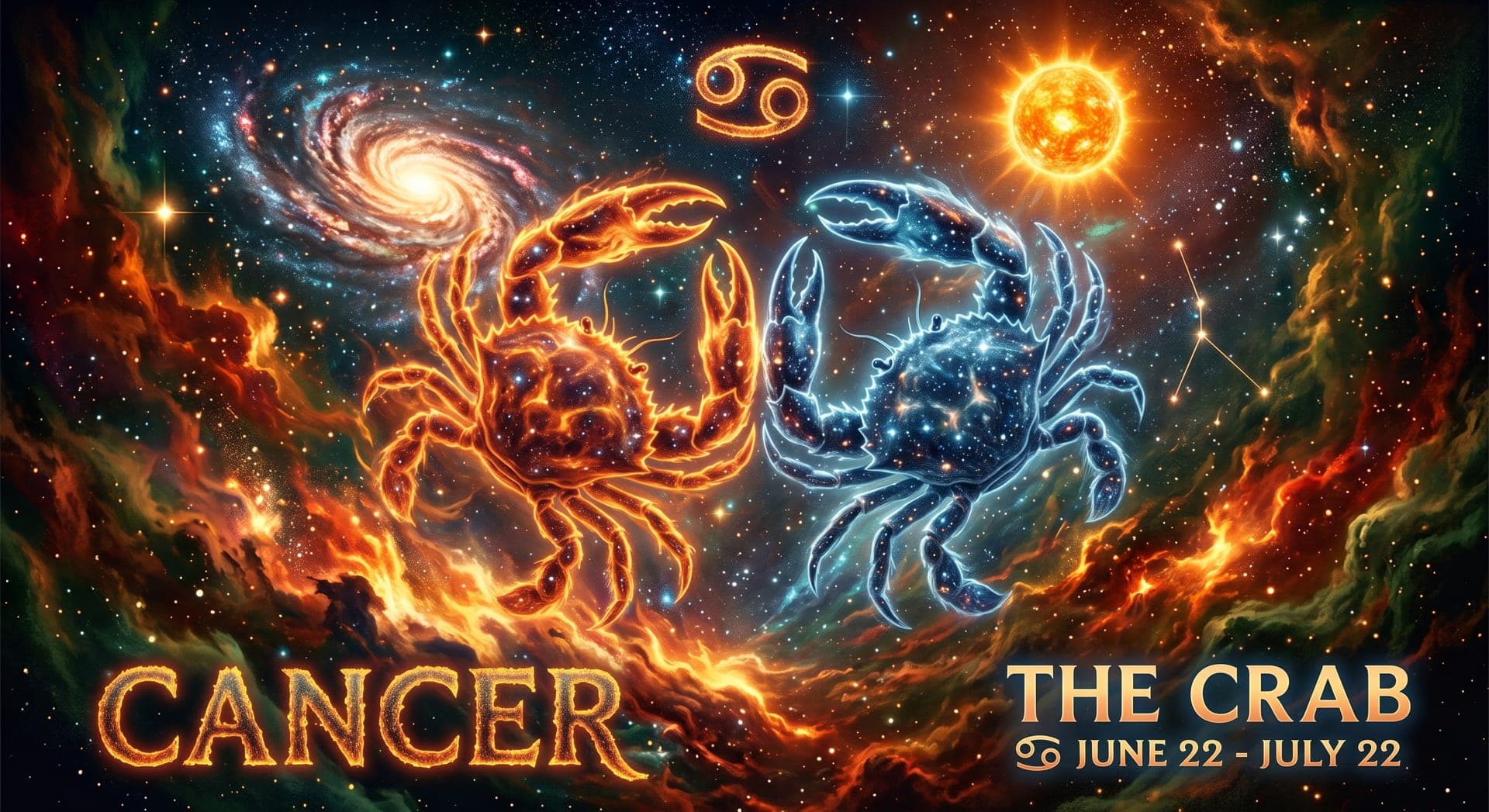
Born on June 26: Cancer ♋
Cancer, the fourth sign of the zodiac, spans June 21 to July 22 and is symbolized by the crab, an animal known for carrying a protective shell while remaining soft and vulnerable underneath. Ruled by the Moon, the celestial body long associated with emotion, intuition, and the subconscious, Cancer is widely regarded as one of the most nurturing and emotionally attuned signs of the zodiac. As a Water sign, Cancer navigates the world through deep feeling, often forming strong emotional bonds and an acute sensitivity to the moods of others. Its Cardinal modality places it at the start of summer, beginning right at the June solstice, reflecting an instinct to initiate and create, especially around home and family. People born under this sign tend to be deeply loyal, protective of loved ones, and drawn to creating a comfortable, secure home environment. Cancer's emotional depth is a genuine strength, but it can also make the sign prone to moodiness or withdrawal when hurt, retreating like a crab into its shell until it feels safe enough to re-emerge.
Personality Traits
Strengths
- Deeply caring and nurturing
- Highly intuitive
- Fiercely loyal and protective
- Strong sense of family and tradition
- Emotionally perceptive
Weaknesses
- Prone to moodiness
- Overly sensitive to criticism
- Can be clingy
- Tends to hold grudges
- Retreats when hurt
Compatible Signs
Fun Facts
- Cancer's crab symbol comes from Greek mythology, where the goddess Hera placed a crab that had fought Hercules among the stars.
- Cancer is ruled by the Moon, the only zodiac sign ruled by a celestial body other than a planet.
- As a Cardinal sign, Cancer initiates summer, beginning at the June solstice, the longest day of the year in the Northern Hemisphere.
- Notable Cancers include Princess Diana, Tom Hanks, Ariana Grande, and Nelson Mandela.
- The crab's hard shell and soft interior are often used as a metaphor for Cancer's protective exterior guarding a deeply sensitive emotional core.
Born on June 26
- 1817
Branwell Brontë
English painter and poet, the only brother of novelists Charlotte, Emily and Anne Brontë, whose own literary and artistic ambitions were overshadowed by addiction and early death.
- 1824
William Thomson, Lord Kelvin
Belfast-born physicist and engineer who formulated the absolute temperature scale that bears his name and made major contributions to thermodynamics and transatlantic telegraphy.
- 1866
George Herbert, 5th Earl of Carnarvon
English archaeologist and financier who funded Howard Carter's excavations in Egypt, backing the 1922 discovery of Tutankhamun's tomb.
- 1892
Pearl S. Buck
American novelist and Nobel Prize laureate in Literature
- 1904
Peter Lorre
Slovak-American actor
- 1908
Salvador Allende
Chilean physician and President of Chile
- 1911
Babe Didrikson Zaharias
American Olympic athlete and golfer
- 1913
Maurice Wilkes
English computer scientist who built the EDSAC, one of the first practical stored-program computers, and pioneered the concept of microprogramming.
- 1914
Laurie Lee
English poet and author best known for his autobiographical memoir Cider with Rosie, evoking rural English childhood in the years after the First World War.
- 1921
Violette Szabo
British Special Operations Executive agent during WWII, posthumously awarded the George Cross for her courage under Nazi interrogation and imprisonment
- 1931
Colin Wilson
English philosopher and author whose acclaimed debut The Outsider made him a prominent, if controversial, figure among Britain's postwar intellectuals.
- 1952
Olive Morris
Jamaican-born British community activist and co-founder of the Brixton Black Women's Group who campaigned for Black rights and housing justice
- 1955
Mick Jones
English guitarist and songwriter who co-founded the punk rock band the Clash, one of the most influential groups of the era.
- 1974
Derek Jeter
American baseball Hall of Famer
- 1993
Ariana Grande
American singer-songwriter and actress

On This Day in History
- 1460
Richard Neville, Earl of Warwick, and Edward, Earl of March, landed in England with a rebel army during the Wars of the Roses.
The two Yorkist lords, having fled to Calais after an earlier defeat, returned with troops and marched on London, gathering support along the way. Their campaign led swiftly to the capture of King Henry VI at the Battle of Northampton weeks later, a major turning point that strengthened the Yorkist position in the ongoing dynastic civil war.
- 1483
Richard III becomes King of England amid controversy over the fate of his young nephews, the "Princes in the Tower."
Richard, Duke of Gloucester, became King Richard III of England amid persistent controversy and suspicion surrounding the fate of his two young nephews, the "Princes in the Tower," who disappeared from public view shortly after his accession, an unresolved mystery that has shadowed his historical reputation ever since.
- 1483
Richard III became King of England after his nephews, the young Edward V and his brother, were declared illegitimate.
Richard, who had been serving as Lord Protector for his twelve-year-old nephew Edward V, took the throne after Parliament declared the boy king's parents' marriage invalid, making Edward and his brother illegitimate. The princes were subsequently confined to the Tower of London and never seen again, a mystery that has shadowed Richard's reputation for over five centuries.
- 1541
Spanish conquistador Francisco Pizarro is assassinated in Lima by rivals loyal to Diego de Almagro.
Spanish conquistador Francisco Pizarro, the conqueror of the Inca Empire, was assassinated in his own palace in Lima by a group of rivals loyal to his former partner and later enemy Diego de Almagro, whom Pizarro had earlier had executed, a killing rooted in bitter internal conflict among Spanish conquerors.
- 1794
French Revolutionary forces win the Battle of Fleurus, notably employing a tethered observation balloon in one of the earliest military uses of aircraft.
French Revolutionary forces won the Battle of Fleurus against a coalition army, notably employing a tethered hydrogen observation balloon to gather aerial reconnaissance, one of the earliest documented military uses of aircraft, a victory that helped secure French control over the Austrian Netherlands.
- 1830
William IV becomes King of the United Kingdom following the death of his brother, George IV.
William IV became King of the United Kingdom following the death of his brother, King George IV, inheriting a monarchy amid growing political pressure for electoral and social reform, developments that culminated in his reign with the passage of the landmark Great Reform Act.
- 1830
William IV became King of the United Kingdom following the death of his brother George IV.
William, a former naval officer known affectionately as the 'Sailor King,' ascended the throne at the age of 64 after George IV died without a legitimate heir. His seven-year reign saw major political reform, including the passage of the Reform Act 1832 and the abolition of slavery across the British Empire, before the crown passed to his niece Victoria.
- 1843
The Treaty of Nanking took effect, ceding Hong Kong Island to Britain 'in perpetuity.'
Signed the previous year to end the First Opium War, the treaty forced China to open several ports to British trade and hand over Hong Kong Island as a colony. The exchange of ratifications on this day formally brought the treaty into force, beginning more than 150 years of British colonial rule over Hong Kong that lasted until the 1997 handover.
- 1857
Queen Victoria presides over the first investiture ceremony for the Victoria Cross, Britain's highest military honor.
Queen Victoria personally presided over the first investiture ceremony for the newly created Victoria Cross in London's Hyde Park, awarding Britain's highest military decoration for gallantry to soldiers who had distinguished themselves during the recently concluded Crimean War. The medal, cast from captured Russian cannon metal, remains the United Kingdom's most prestigious award for valor in combat.
- 1857
Queen Victoria presented the first Victoria Crosses in a ceremony in London's Hyde Park.
The newly created medal, Britain's highest award for gallantry, was given to 62 recipients who had distinguished themselves in the Crimean War, in a ceremony attended by huge crowds. Cast from the bronze of captured Russian cannon, the Victoria Cross remains the most prestigious British military decoration, awarded for extreme acts of valour regardless of rank.
- 1906
The first Grand Prix motor race is held near Le Mans, France.
The first Grand Prix motor race was held near Le Mans, France, establishing a new competitive format for automobile racing distinct from earlier point-to-point road races, an event that helped standardize modern circuit racing and laid groundwork for France's enduring motorsport tradition.
- 1909
London's Science Museum became an independent institution, separating from the Victoria and Albert Museum.
Having grown out of the South Kensington Museum's collections related to science and industry, the museum was granted its own administrative identity, allowing it to develop a distinct focus on the history of science, technology and medicine. It went on to become one of the world's leading science museums, housing objects ranging from early steam engines to spacecraft.
- 1944
The Royal Air Force mistakenly bombed the neutral state of San Marino, killing dozens of civilians.
Believing German forces were using the tiny republic as cover amid the fighting in nearby Italy, RAF bombers struck San Marino despite its official neutrality, causing significant civilian casualties. The bombing became a painful episode in the small nation's wartime history and prompted British apologies once the mistake was recognised.
- 1945
Delegates from fifty nations sign the United Nations Charter in San Francisco, formally establishing the United Nations.
Delegates from fifty nations signed the United Nations Charter in San Francisco, formally establishing the international organization intended to prevent future large-scale conflicts following the devastation of two world wars, creating a framework for collective security, diplomacy, and international cooperation that continues today.
- 1960
British Somaliland gained independence from Britain, becoming the State of Somaliland.
The former protectorate's independence was short-lived as a separate state; days later it united with the former Italian Somaliland to form the Somali Republic. Somaliland later declared independence again in 1991 amid Somalia's civil war, though it remains internationally unrecognised, a legacy still shaped by its earlier history as a distinct British territory.
- 1963
President John F. Kennedy delivers his famous "Ich bin ein Berliner" speech in West Berlin, affirming American support for the divided city.
President John F. Kennedy delivered his famous "Ich bin ein Berliner" speech before a massive crowd in West Berlin, powerfully affirming American solidarity with the divided city and its residents living under the shadow of the recently constructed Berlin Wall during the height of Cold War tensions.
- 1981
Dan-Air Flight 240 crashed in Leicestershire, killing all three crew members aboard.
The cargo aircraft, a Handley Page Dart Herald, went down near the village of Nailstone shortly after suffering a structural failure in flight. The subsequent investigation into the crash contributed to a wider examination of maintenance and structural safety standards within Britain's civil aviation industry during the period.
- 1997
J.K. Rowling published Harry Potter and the Philosopher's Stone, the first book in her series.
Released by the small London publisher Bloomsbury after being rejected by several other houses, the novel introduced the world to the young wizard Harry Potter. It became a publishing phenomenon, spawning six sequels, a hugely successful film franchise, and a global fandom, and turning Rowling into one of the best-selling authors in history.
- 2013
The U.S. Supreme Court strikes down a key provision of the Defense of Marriage Act as unconstitutional.
The U.S. Supreme Court struck down a key provision of the Defense of Marriage Act as unconstitutional in "United States v. Windsor," ruling that the federal government could not deny recognition and benefits to same-sex marriages legally performed in states that permitted them, a significant precursor to full nationwide legalization.
- 2015
The U.S. Supreme Court legalizes same-sex marriage nationwide in "Obergefell v. Hodges."
The U.S. Supreme Court ruled in "Obergefell v. Hodges" that same-sex couples have a constitutional right to marry under the Fourteenth Amendment, legalizing same-sex marriage nationwide and effectively overturning remaining state-level bans, a landmark decision celebrated as a major milestone for LGBTQ civil rights.