What’s Observed on June 15
Born on June 15: Gemini ♊
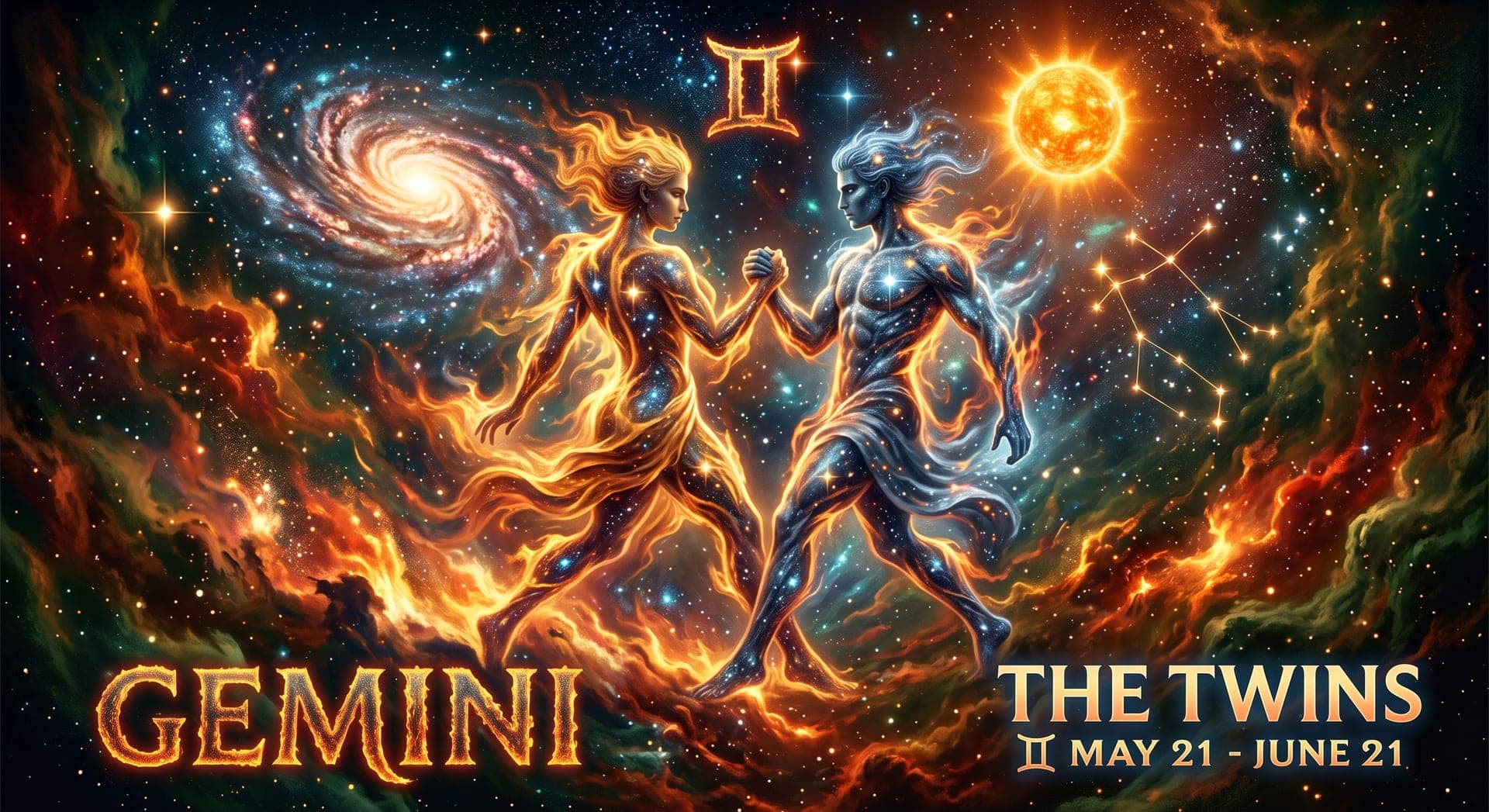
Gemini, the third sign of the zodiac, spans May 21 to June 20 and is symbolized by twins, representing the sign's dual nature and its ability to see multiple sides of any situation at once. Ruled by Mercury, the planet of communication and intellect, Gemini is widely regarded as one of the most talkative, curious, and quick-witted signs of the zodiac, constantly gathering new information and ideas. As an Air sign, Gemini approaches the world primarily through thought and conversation, thriving on mental stimulation and social interaction. Its Mutable modality reflects a restless adaptability, since Gemini tends to resist routine and prefers variety, novelty, and the freedom to change course whenever something more interesting comes along. People born under this sign are often skilled communicators, natural storytellers, and quick learners who can hold their own in nearly any conversation. That same adaptability can also come across as inconsistency, and Gemini's dual nature sometimes earns an unfair reputation for being two-faced, when in reality it simply reflects genuine curiosity about every side of a story.
Personality Traits
Strengths
- Quick-witted and intelligent
- Excellent communicator
- Adaptable to new situations
- Curious and eager to learn
- Charming and sociable
Weaknesses
- Prone to inconsistency
- Can be superficial
- Easily bored
- Indecisive
- Tendency to gossip
Compatible Signs
Fun Facts
- Gemini's twin symbol traces back to the Greek myth of Castor and Pollux, twin brothers placed among the stars as the constellation Gemini.
- Mercury, Gemini's ruling planet, was the swift Roman messenger god, reflecting the sign's associations with communication and quick thinking.
- Gemini is one of only a few zodiac signs represented by human figures rather than animals or objects.
- Notable Geminis include Marilyn Monroe, Kanye West, Angelina Jolie, and John F. Kennedy.
- Gemini season overlaps with the transition from spring to summer in the Northern Hemisphere, reflecting the sign's changeable, in-between nature.
Born on June 15
- 1330
Edward, the Black Prince
Eldest son of King Edward III, celebrated as one of medieval England's greatest military commanders for his victories at Crécy and Poitiers.
- 1792
Thomas Mitchell
Scottish-born surveyor and explorer who mapped large areas of southeastern Australia as Surveyor-General of New South Wales.
- 1843
Edvard Grieg
Norwegian composer
- 1906
Gordon Welchman
English mathematician and World War II codebreaker at Bletchley Park who helped design the Bombe machine used to crack German Enigma codes.
- 1911
Wilbert Awdry
English clergyman and author who created The Railway Series, the children's books that introduced Thomas the Tank Engine.
- 1921
Erroll Garner
American jazz pianist and composer
- 1932
Mario Cuomo
American politician and Governor of New York
- 1932
David Alliance
Iranian-born British textile industrialist and life peer who built Coats Viyella into a global textile business
- 1937
Waylon Jennings
American country music singer-songwriter
- 1938
Brian Jacques
English author best known for the Redwall series of children's fantasy novels.
- 1949
Simon Callow
English actor, director, and writer known for stage roles and films including Four Weddings and a Funeral.
- 1962
Chris Morris
English satirist, director, and actor known for pioneering dark comedy in shows such as Brass Eye.
- 1973
Neil Patrick Harris
American actor and television host
- 1992
Mohamed Salah
Egyptian professional footballer
On This Day in History
- 763 BCE
Assyrian scribes record a solar eclipse later used by historians to fix the chronology of ancient Mesopotamia.
The eclipse, noted in the Assyrian eponym lists alongside a revolt in the city of Assur, could be dated precisely using modern astronomical calculations. This allowed historians to anchor the otherwise relative chronology of Assyrian kings to an exact year, making the record one of the most valuable astronomical references in ancient Near Eastern history.
- 1215
King John of England seals the Magna Carta at Runnymede, a foundational document limiting royal power and establishing legal principles still influential today.
King John of England affixed his royal seal to the Magna Carta at Runnymede under pressure from rebellious barons, agreeing to a charter limiting royal authority and establishing principles including protection from arbitrary imprisonment, an agreement John repudiated almost immediately but which endured as a foundational touchstone of constitutional governance and legal rights.
- 1215
King John of England seals Magna Carta at Runnymede, limiting royal power for the first time.
Facing rebellion from his barons over high taxes and arbitrary rule, John agreed to a charter guaranteeing certain legal rights, protections from illegal imprisonment, and limits on the crown's authority. Although John sought to annul it almost immediately, Magna Carta was reissued by later monarchs and became a foundational document in the development of constitutional law and civil liberties in England and beyond.
- 1389
Ottoman and Serbian forces fight the legendary Battle of Kosovo, with both commanding leaders killed, a defeat that became central to Serbian national memory.
Ottoman and Serbian-led coalition forces fought the legendary Battle of Kosovo, a brutal and costly engagement in which both the Ottoman Sultan Murad I and the Serbian Prince Lazar were killed, a defeat that, despite its inconclusive immediate military outcome, became deeply embedded in Serbian national identity and folklore for centuries afterward.
- 1520
Pope Leo X issues a decree threatening to excommunicate Martin Luther unless he recants his teachings.
Pope Leo X issued the papal bull "Exsurge Domine," formally threatening to excommunicate reformer Martin Luther unless he recanted forty-one of his theological positions within sixty days, an ultimatum Luther publicly defied by burning the document, a defiant act that accelerated the definitive break leading to the Protestant Reformation.
- 1567
Confronted by rebellious Scottish nobles at Carberry Hill, Mary, Queen of Scots surrenders.
Mary's marriage to the Earl of Bothwell, widely suspected of murdering her previous husband, provoked a coalition of Scottish lords to rise against her. Facing their army near Musselburgh, her own forces melted away without a fight, forcing her surrender. She was imprisoned and forced to abdicate soon after, setting in motion the long exile that ended with her execution in England in 1587.
- 1607
English colonists complete James Fort in Virginia, fortifying the settlement against potential attack.
English colonists in the Jamestown settlement completed construction of James Fort, a triangular wooden stockade intended to defend the fledgling colony against potential attacks from both Spanish rivals and neighboring Powhatan Confederacy tribes, providing crucial early protection during the settlement's precarious first years in America.
- 1607
English colonists in Virginia finish building James's Fort, the first permanent English settlement in North America.
Named for King James I, the triangular wooden stockade on the James River housed the settlers of the Virginia Company's Jamestown expedition. Despite disease, starvation, and conflict with the Powhatan Confederacy nearly destroying the colony in its early years, Jamestown survived and became the foundation for England's, and later Britain's, expanding presence in North America.
- 1846
The United States and Britain sign the Oregon Treaty, establishing the boundary between American and British territory in the Pacific Northwest.
The United States and Britain signed the Oregon Treaty, peacefully resolving a longstanding territorial dispute over the Pacific Northwest by extending the existing border along the 49th parallel to the Pacific Ocean, averting a feared war over the region sometimes referred to by the slogan "Fifty-Four Forty or Fight."
- 1846
The Oregon Treaty extends the border between the United States and British North America westward to the Pacific.
Ending a long-running dispute over the Pacific Northwest, the treaty set the boundary along the 49th parallel, with Vancouver Island remaining entirely under British control. The agreement resolved years of tension between Washington and London over the region and secured what would become British Columbia for the British Empire, avoiding a feared armed conflict sometimes called the 'Fifty-Four Forty or Fight' crisis.
- 1896
A massive tsunami strikes Japan's Sanriku coast, killing more than 22,000 people.
A massive earthquake-triggered tsunami struck Japan's Sanriku coast, killing more than 22,000 people in one of the deadliest natural disasters in the nation's history, a catastrophe made especially devastating because the relatively mild earthquake itself caused little alarm, leaving coastal residents with almost no warning before the massive waves struck.
- 1896
One of the deadliest tsunamis in Japanese history strikes the Sanriku coast, killing more than 22,000 people.
Triggered by a powerful undersea earthquake, the tsunami struck without significant warning, generating waves reported to exceed 100 feet in some coastal inlets. Entire fishing villages along the Sanriku coast were destroyed in moments. The disaster prompted Japan to develop some of the world's earliest tsunami warning systems and building practices aimed at mitigating future coastal disasters.
- 1919
Aviators John Alcock and Arthur Brown complete the first nonstop transatlantic flight, landing in Ireland.
Aviators John Alcock and Arthur Brown successfully completed the first nonstop transatlantic flight, landing their converted bomber aircraft in a boggy field in County Galway, Ireland, after a grueling roughly sixteen-hour journey through fog, ice, and mechanical difficulties, earning them a substantial cash prize and lasting aviation fame.
- 1919
British aviators John Alcock and Arthur Whitten Brown complete the first nonstop transatlantic flight.
Flying a modified Vickers Vimy bomber from St. John's, Newfoundland, the pair crossed roughly 1,900 miles of open ocean in under sixteen hours before crash-landing in a bog in County Galway, Ireland. Battling ice, fog, and equipment failures throughout the flight, they were knighted by King George V for the achievement, which stood as a landmark moment in aviation history.
- 1940
Operation Aerial begins, evacuating remaining Allied troops and civilians from France after the German breakthrough.
Following the fall of Paris and the collapse of French resistance, British forces launched a second major evacuation effort from ports along the French Atlantic and Channel coasts, distinct from the earlier Dunkirk operation. Over the following two weeks, roughly 191,000 British, Polish, and other Allied personnel were shipped to safety, though the operation was marred by the loss of the troopship Lancastria.
- 1944
American forces launch the invasion of Saipan, a pivotal battle in the Pacific theater of World War II.
American forces launched a massive amphibious invasion of Saipan in the Mariana Islands, a pivotal and costly battle in the Pacific War whose capture brought Japan's home islands within range of American long-range bombers for the first time, significantly accelerating the strategic bombing campaign against Japan.
- 1977
Spain holds its first democratic elections in over four decades following the death of dictator Francisco Franco.
Spain held its first free, democratic parliamentary elections in over four decades, marking a decisive milestone in the country's peaceful transition from Francisco Franco's authoritarian dictatorship, which had ended with Franco's death two years earlier, toward a stable constitutional democracy and eventual integration into the European Union.
- 1991
Mount Pinatubo erupts in the Philippines in the second-largest volcanic eruption of the 20th century.
Mount Pinatubo in the Philippines erupted in what became the second-largest volcanic eruption of the 20th century, ejecting massive quantities of ash and sulfur dioxide that measurably cooled global temperatures for approximately two years and forced the evacuation of over 60,000 people from surrounding areas, including a major U.S. air base.
- 1991
Mount Pinatubo in the Philippines erupts in the second-largest volcanic eruption of the 20th century.
The eruption ejected roughly ten cubic kilometers of material into the atmosphere, killing hundreds and forcing the evacuation of tens of thousands of people, including U.S. military personnel from nearby Clark Air Base. Sulfur dioxide from the eruption cooled global temperatures by about half a degree Celsius for more than a year, giving scientists valuable data on the climatic effects of major eruptions.
- 1996
The Provisional IRA detonates a large truck bomb in Manchester city centre, injuring over 200 people.
The device, hidden in a delivery van near the Arndale Centre, exploded after a coded warning prompted a mass evacuation, meaning no one was killed despite devastating damage to the city centre. It remains one of the largest bombs detonated in Britain since the Second World War and led to a major redevelopment of central Manchester in its aftermath.