What’s Observed on June 14
Born on June 14: Gemini ♊
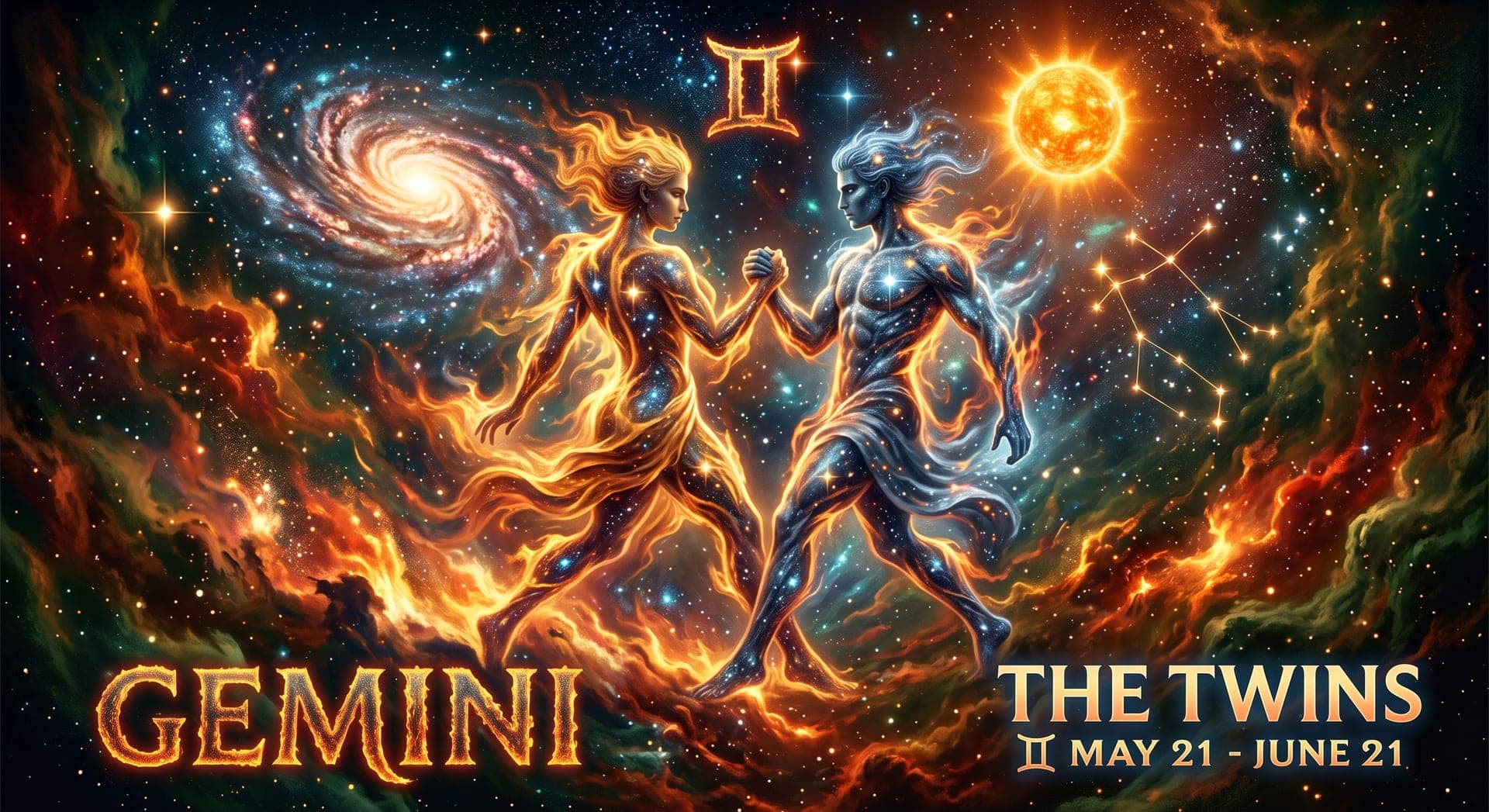
Gemini, the third sign of the zodiac, spans May 21 to June 20 and is symbolized by twins, representing the sign's dual nature and its ability to see multiple sides of any situation at once. Ruled by Mercury, the planet of communication and intellect, Gemini is widely regarded as one of the most talkative, curious, and quick-witted signs of the zodiac, constantly gathering new information and ideas. As an Air sign, Gemini approaches the world primarily through thought and conversation, thriving on mental stimulation and social interaction. Its Mutable modality reflects a restless adaptability, since Gemini tends to resist routine and prefers variety, novelty, and the freedom to change course whenever something more interesting comes along. People born under this sign are often skilled communicators, natural storytellers, and quick learners who can hold their own in nearly any conversation. That same adaptability can also come across as inconsistency, and Gemini's dual nature sometimes earns an unfair reputation for being two-faced, when in reality it simply reflects genuine curiosity about every side of a story.
Personality Traits
Strengths
- Quick-witted and intelligent
- Excellent communicator
- Adaptable to new situations
- Curious and eager to learn
- Charming and sociable
Weaknesses
- Prone to inconsistency
- Can be superficial
- Easily bored
- Indecisive
- Tendency to gossip
Compatible Signs
Fun Facts
- Gemini's twin symbol traces back to the Greek myth of Castor and Pollux, twin brothers placed among the stars as the constellation Gemini.
- Mercury, Gemini's ruling planet, was the swift Roman messenger god, reflecting the sign's associations with communication and quick thinking.
- Gemini is one of only a few zodiac signs represented by human figures rather than animals or objects.
- Notable Geminis include Marilyn Monroe, Kanye West, Angelina Jolie, and John F. Kennedy.
- Gemini season overlaps with the transition from spring to summer in the Northern Hemisphere, reflecting the sign's changeable, in-between nature.
Born on June 14
- 1726
Thomas Pennant
Welsh naturalist and travel writer, celebrated for his pioneering works on British zoology and his vivid tours of Wales and Scotland.
- 1811
Harriet Beecher Stowe
American author of "Uncle Tom's Cabin"
- 1864
Alois Alzheimer
German psychiatrist who identified Alzheimer's disease
- 1868
Karl Landsteiner
Austrian biologist and Nobel Prize laureate who discovered blood types
- 1904
Margaret Bourke-White
American photojournalist
- 1909
Burl Ives
American actor and folk singer
- 1923
Judith Kerr
German-born British author and illustrator best known for "The Tiger Who Came to Tea" and the Mog series
- 1924
James Black
Scottish pharmacologist who developed beta-blockers and other drugs, awarded the Nobel Prize in Physiology or Medicine in 1988.
- 1946
Donald Trump
American businessman and 45th and 47th President of the United States
- 1949
Jim Lea
English bassist and songwriter for the glam rock band Slade, co-writing many of the group's biggest hits.
- 1949
Antony Sher
South African-born British actor and writer celebrated for his Royal Shakespeare Company performances
- 1950
Rowan Williams
Welsh theologian and poet who served as Archbishop of Canterbury from 2002 to 2012.
- 1955
Paul O'Grady
English television presenter and comedian, widely known for his drag persona Lily Savage and his warmth as a broadcaster.
- 1961
Boy George
English singer-songwriter and Culture Club frontman, known for hits like "Karma Chameleon" and his flamboyant style.
- 1969
Steffi Graf
German tennis champion
- 1976
Alan Carr
English comedian and television presenter known for his distinctive laugh and camp comic style.

On This Day in History
- 1158
Henry the Lion founds the city of Munich on the banks of the Isar River.
German nobleman Henry the Lion founded the city of Munich along the banks of the Isar River, establishing a toll bridge and marketplace that grew over subsequent centuries into the capital of Bavaria and one of Germany's most significant cultural, economic, and political centers.
- 1216
Prince Louis of France seizes the city of Winchester after it is abandoned by King John of England.
During the First Barons' War, English rebel barons invited Louis, son of the French king, to take the English throne. After landing in Kent, his forces advanced rapidly, and King John abandoned Winchester rather than face him. Louis's occupation of the ancient capital briefly gave him control of more than half of England before John's death and a change in fortunes turned the tide against him.
- 1381
King Richard II meets the leaders of the Peasants' Revolt at Mile End as rebels storm the Tower of London.
Facing the largest popular uprising in medieval English history, the fourteen-year-old king rode out to Mile End to negotiate with Wat Tyler's rebels, promising an end to serfdom and unfair taxes. While talks proceeded, other rebels breached the supposedly impregnable Tower of London without resistance, seizing and executing the Archbishop of Canterbury and the Lord Treasurer inside.
- 1404
Welsh rebel leader Owain Glyndŵr, having proclaimed himself Prince of Wales, forms an alliance with France against King Henry IV.
Glyndŵr had led a widespread Welsh revolt against English rule since 1400. Seeking to strengthen his position, he negotiated the Franco-Welsh alliance, in which France recognized his claim to the Welsh principality and pledged military support against their common enemy, Henry IV of England. The pact marked the high point of Glyndŵr's rebellion, though ultimate independence for Wales was never achieved.
- 1645
Parliamentary forces decisively defeat the Royalist army at the Battle of Naseby, a turning point in the English Civil War.
Parliamentary forces under Oliver Cromwell and Thomas Fairfax decisively defeated the Royalist army at the Battle of Naseby, destroying King Charles I's main field army and capturing his private correspondence, a crushing blow from which Royalist fortunes in the English Civil War never fully recovered.
- 1645
Parliamentarian forces decisively defeat the Royalist army at the Battle of Naseby, a turning point in the English Civil War.
Oliver Cromwell's New Model Army, though outnumbered, routed King Charles I's forces in Northamptonshire, destroying the core of the Royalist infantry and capturing the king's private correspondence, which was later published to damage his cause. Naseby effectively broke Royalist military power and set England on the path toward the eventual execution of Charles I and the establishment of the Commonwealth.
- 1690
King William III of England lands in Ireland to confront the deposed King James II.
Having been invited to take the English throne in the Glorious Revolution of 1688, William landed near Carrickfergus at the head of a large army to finish off resistance from his father-in-law and predecessor, James II. The campaign culminated weeks later in William's victory at the Battle of the Boyne, cementing Protestant rule in Ireland for generations to come.
- 1775
The Continental Congress establishes the Continental Army, with George Washington later appointed as its commander.
The Second Continental Congress voted to establish the Continental Army, unifying the various colonial militias besieging British forces in Boston under a single command structure, and appointed George Washington as its commander-in-chief just one day later, formally organizing American military resistance in the Revolutionary War.
- 1777
The Second Continental Congress adopts the Stars and Stripes as the official flag of the United States.
The Second Continental Congress passed a resolution adopting a design featuring thirteen stripes and thirteen stars representing the states as the official flag of the United States, an anniversary now commemorated annually as Flag Day, though the flag's exact original design and creator remain subjects of some historical debate.
- 1789
Survivors of the mutiny on the Bounty, cast adrift by mutineers, reach Timor after an extraordinary 4,600-mile open-boat voyage.
Survivors of the mutiny aboard HMS Bounty, who had been cast adrift by mutineers in a small open boat with minimal supplies, reached the Dutch port of Timor after an extraordinary 47-day, roughly 4,600-mile voyage across open ocean navigated by Captain William Bligh using only rudimentary instruments.
- 1789
Captain William Bligh and eighteen loyal crewmen reach Timor after a nearly 4,600-mile open-boat voyage following the mutiny on HMS Bounty.
Cast adrift by mutineers led by Fletcher Christian, Bligh navigated an overloaded open launch across the Pacific with minimal supplies and instruments, an extraordinary feat of seamanship. Remarkably, all but one of his companions survived the seven-week ordeal. Bligh's account of the mutiny and his voyage became one of the most celebrated survival stories in Royal Navy history.
- 1800
Napoleon's army defeats Austrian forces at the Battle of Marengo in northern Italy.
Napoleon Bonaparte's forces narrowly defeated an Austrian army at the Battle of Marengo in northern Italy, a hard-fought victory achieved partly through the timely arrival of reinforcements that consolidated French control over northern Italy and significantly boosted Napoleon's political standing as First Consul of France.
- 1807
Napoleon's Grande Armee decisively defeats Russian forces at the Battle of Friedland.
Napoleon's Grande Armee decisively defeated Russian forces at the Battle of Friedland, a victory that forced Tsar Alexander I to sue for peace, resulting in the Treaties of Tilsit that temporarily aligned Russia with France and marked the height of Napoleon's continental dominance before his later disastrous invasion of Russia.
- 1822
British mathematician Charles Babbage proposes his difference engine to the Royal Astronomical Society.
Babbage's paper outlined a mechanical calculator capable of automatically computing and printing mathematical tables, eliminating the human errors that plagued hand-calculated figures used in navigation and science. Although only a small portion of the machine was ever built in his lifetime, the proposal is widely regarded as a foundational moment in the history of computing.
- 1839
The town of Henley-on-Thames stages its first regatta on the River Thames, the event that would become the Henley Royal Regatta.
Organized by the town's mayor and leading residents to boost the local economy, the initial regatta quickly grew in prestige, attracting rowing crews from Oxford and Cambridge. It became an annual fixture of the English summer social calendar and, after gaining royal patronage from Prince Albert in 1851, took the name by which it is known today.
- 1919
Aviators John Alcock and Arthur Brown depart Newfoundland on the first nonstop transatlantic flight.
Aviators John Alcock and Arthur Brown departed from Newfoundland aboard a modified World War I bomber, beginning the first-ever nonstop transatlantic flight, a grueling and dangerous roughly 16-hour journey through poor weather that ended the following day with a rough but survivable landing in an Irish bog.
- 1940
German forces occupy Paris without resistance during World War II.
German forces occupied Paris without significant resistance as the French government declared it an open city to spare it from destruction, a swift and demoralizing conquest that came just weeks into the Battle of France and led directly to France's formal surrender to Nazi Germany days later.
- 1982
Argentine forces surrender to British troops in the Falkland Islands, ending the Falklands War.
Argentine military forces surrendered to advancing British troops at Port Stanley, effectively ending the Falklands War over the disputed South Atlantic islands, a decisive British victory that boosted Prime Minister Margaret Thatcher's domestic political standing while contributing to the collapse of Argentina's ruling military junta.
- 1982
Argentine forces in Stanley surrender to British troops, effectively ending the Falklands War.
After ten weeks of conflict following Argentina's invasion of the British territory, British forces recaptured the capital, prompting the Argentine garrison to lay down arms. The war claimed over 900 lives and reaffirmed British sovereignty over the South Atlantic islands, while also contributing to the fall of Argentina's military government and boosting Prime Minister Margaret Thatcher's political standing at home.
- 2017
A fire engulfs Grenfell Tower, a residential high-rise in North Kensington, London, killing 72 people.
The blaze, which spread rapidly up the building's exterior cladding, became one of the deadliest structural fires in modern British history and exposed serious failings in fire safety regulation and social housing oversight. The disaster prompted a public inquiry, changes to building safety law, and lasting national debate over inequality and government accountability in housing.