What’s Observed on June 13
Born on June 13: Gemini ♊
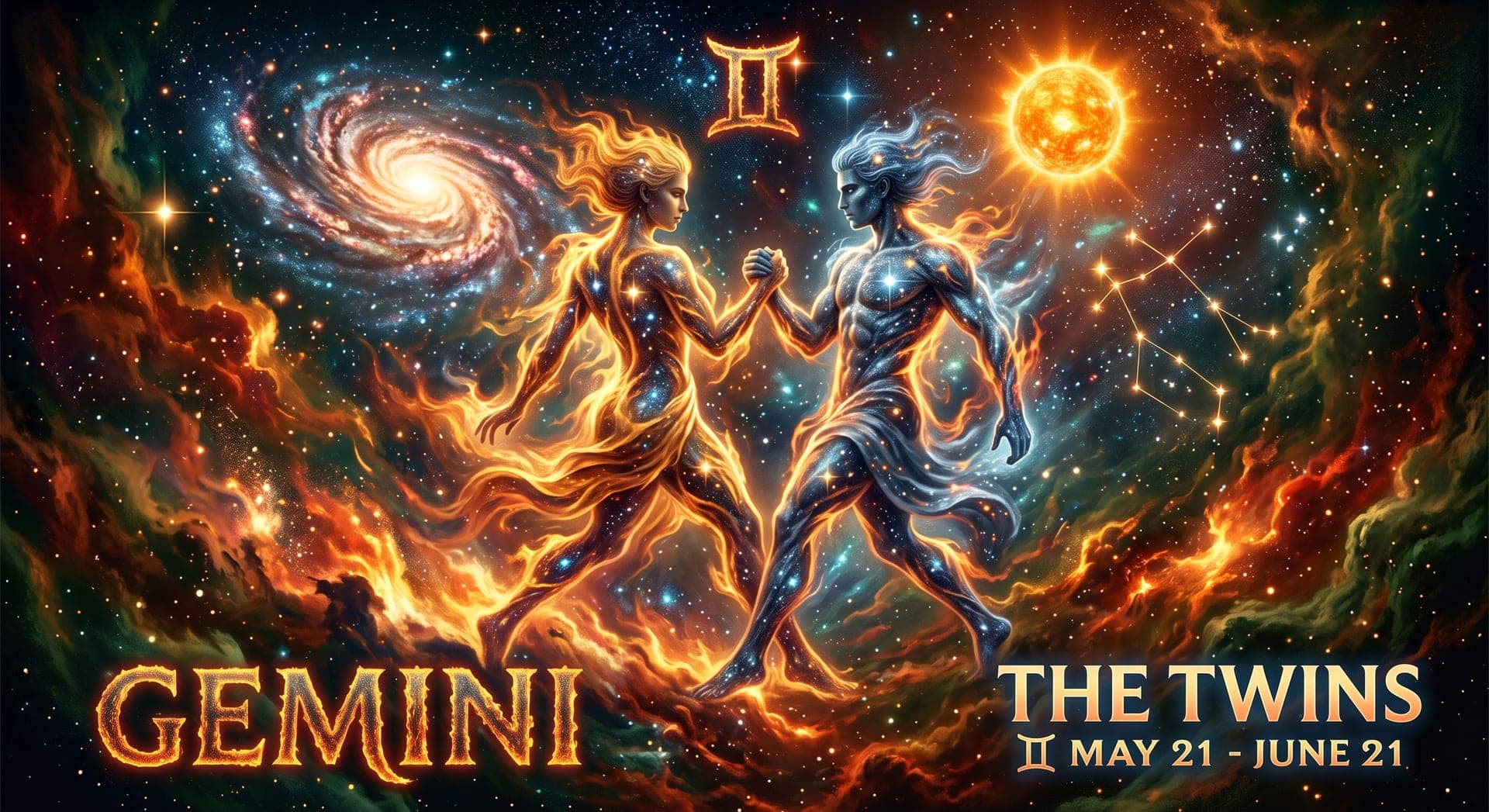
Gemini, the third sign of the zodiac, spans May 21 to June 20 and is symbolized by twins, representing the sign's dual nature and its ability to see multiple sides of any situation at once. Ruled by Mercury, the planet of communication and intellect, Gemini is widely regarded as one of the most talkative, curious, and quick-witted signs of the zodiac, constantly gathering new information and ideas. As an Air sign, Gemini approaches the world primarily through thought and conversation, thriving on mental stimulation and social interaction. Its Mutable modality reflects a restless adaptability, since Gemini tends to resist routine and prefers variety, novelty, and the freedom to change course whenever something more interesting comes along. People born under this sign are often skilled communicators, natural storytellers, and quick learners who can hold their own in nearly any conversation. That same adaptability can also come across as inconsistency, and Gemini's dual nature sometimes earns an unfair reputation for being two-faced, when in reality it simply reflects genuine curiosity about every side of a story.
Personality Traits
Strengths
- Quick-witted and intelligent
- Excellent communicator
- Adaptable to new situations
- Curious and eager to learn
- Charming and sociable
Weaknesses
- Prone to inconsistency
- Can be superficial
- Easily bored
- Indecisive
- Tendency to gossip
Compatible Signs
Fun Facts
- Gemini's twin symbol traces back to the Greek myth of Castor and Pollux, twin brothers placed among the stars as the constellation Gemini.
- Mercury, Gemini's ruling planet, was the swift Roman messenger god, reflecting the sign's associations with communication and quick thinking.
- Gemini is one of only a few zodiac signs represented by human figures rather than animals or objects.
- Notable Geminis include Marilyn Monroe, Kanye West, Angelina Jolie, and John F. Kennedy.
- Gemini season overlaps with the transition from spring to summer in the Northern Hemisphere, reflecting the sign's changeable, in-between nature.
Born on June 13
- 1752
Frances Burney
English novelist and playwright whose witty social novels, including Evelina, influenced later writers such as Jane Austen.
- 1773
Thomas Young
English polymath physicist and physiologist who advanced the wave theory of light and contributed to deciphering the Rosetta Stone's hieroglyphics.
- 1831
James Clerk Maxwell
Scottish physicist whose unification of electricity, magnetism, and light into a single theory is considered one of the great achievements of nineteenth-century science.
- 1854
Charles Algernon Parsons
English engineer who invented the steam turbine, revolutionising marine propulsion and electricity generation worldwide.
- 1865
W. B. Yeats
Irish poet and Nobel Prize laureate in Literature
- 1876
William Sealy Gosset
English statistician who, publishing under the pseudonym 'Student,' developed the widely used Student's t-test while working as a chemist for the Guinness brewery.
- 1892
Basil Rathbone
English actor best known for playing Sherlock Holmes in a series of Hollywood films
- 1893
Dorothy L. Sayers
English author and poet best known for her detective novels featuring the aristocratic sleuth Lord Peter Wimsey.
- 1897
Paavo Nurmi
Finnish Olympic distance runner
- 1928
John Forbes Nash Jr.
American mathematician and Nobel Prize laureate in Economics
- 1943
Malcolm McDowell
English actor known for his roles in A Clockwork Orange and Caligula, among the most striking performances of 1970s cinema.
- 1953
Tim Allen
American actor and comedian
- 1955
Alan Hansen
Scottish footballer who captained Liverpool to multiple league titles before becoming a prominent television football pundit.
- 1981
Chris Evans
American actor known for portraying Captain America
- 1986
Kat Dennings
American actress
On This Day in History
- 313
Roman co-emperors Constantine and Licinius issue the Edict of Milan, granting religious tolerance and freedom of worship throughout the Roman Empire.
Roman co-emperors Constantine and Licinius issued the Edict of Milan, a landmark proclamation establishing religious tolerance throughout the Roman Empire and specifically ending the persecution of Christians, a policy shift that paved the way for Christianity's eventual transformation from a persecuted minority faith into the empire's dominant religion.
- 1381
English rebels set fire to the Savoy Palace in London during the Peasants' Revolt.
During the widespread Peasants' Revolt against oppressive taxation and feudal restrictions, English rebels stormed and set fire to the lavish Savoy Palace in London, the residence of the powerful and widely resented John of Gaunt, in one of the uprising's most dramatic and destructive episodes of targeted violence against symbols of aristocratic wealth.
- 1381
Rebels led by Wat Tyler set fire to the Savoy Palace during the Peasants' Revolt.
The Savoy, an opulent London residence belonging to the deeply unpopular royal uncle John of Gaunt, became a target for rebels who saw it as a symbol of aristocratic excess. Rather than looting the palace, the rebels deliberately destroyed its contents and burned it to the ground, an act of calculated political theatre during the uprising against the poll tax.
- 1514
The Henry Grace a Dieu, then the world's largest warship, is dedicated at Woolwich Dockyard in England.
The Henry Grace a Dieu, an enormous English warship commissioned by King Henry VIII and briefly the largest warship in the world at the time, was formally dedicated at Woolwich Dockyard, reflecting Henry's ambitious efforts to build a powerful modern navy capable of projecting English power across European waters.
- 1514
The English warship Henry Grace à Dieu, one of the largest vessels of its age, is dedicated at Woolwich Dockyard.
Commissioned by Henry VIII as flagship of his growing navy, the carrack known as the 'Great Harry' displaced over 1,000 tons and bristled with dozens of cannon, an unprecedented scale for an English warship. Its construction reflected Henry's determination to build a navy capable of rivalling the great powers of continental Europe.
- 1625
King Charles I of England marries the Catholic French princess Henrietta Maria at Canterbury.
King Charles I of England married the young Catholic French princess Henrietta Maria at Canterbury Cathedral in a politically fraught union that stirred significant unease among Charles's Protestant subjects, tensions over the queen's religion and influence that later contributed to the deepening political conflicts preceding the English Civil War.
- 1625
King Charles I of England marries the French Catholic princess Henrietta Maria, with the couple received at Canterbury Cathedral.
The marriage, arranged to secure a French alliance, proved deeply controversial in staunchly Protestant England, where fears of Catholic influence at court ran high. Henrietta Maria's religion and perceived sway over the king became recurring grievances for Charles's parliamentary opponents in the years leading up to the English Civil War.
- 1740
British colonial governor James Oglethorpe launches an unsuccessful siege of Spanish-held St. Augustine, Florida.
Oglethorpe, founder and governor of the British colony of Georgia, led a mixed force of colonial troops, Native American allies, and Royal Navy ships against the Spanish stronghold during the War of Jenkins' Ear. Poor coordination and stiff Spanish resistance forced Oglethorpe to abandon the month-long siege, leaving the contested Florida-Georgia border unresolved.
- 1774
Rhode Island becomes the first British North American colony to prohibit the importation of enslaved people.
The colonial assembly passed legislation banning the further importation of slaves into Rhode Island, though existing slavery within the colony continued for decades afterward. The law, passed amid growing colonial unrest against British rule, marked an early and largely symbolic step in the long process toward the abolition of slavery in the British Atlantic world.
- 1777
The Marquis de Lafayette lands in South Carolina to volunteer his services to the American Revolutionary cause.
The young Marquis de Lafayette, a French aristocrat inspired by American revolutionary ideals, landed in South Carolina to volunteer his military services to the Continental Congress, beginning a partnership that made him one of General George Washington's most trusted commanders and a lasting symbol of Franco-American friendship.
- 1895
Emile Levassor wins the world's first major automobile race, completing the 732-mile Paris-to-Bordeaux route in under 49 hours.
French mechanic and racing driver Emile Levassor won the world's first major automobile race, completing the grueling 732-mile round-trip route between Paris and Bordeaux in under 49 hours despite driving through the night largely alone, a feat that dramatically demonstrated the emerging automobile's practical long-distance capabilities.
- 1917
German aircraft carry out their deadliest bombing raid on London during World War I, killing over 160 people.
German Gotha bombers carried out the deadliest air raid on London during World War I, dropping bombs on the city in broad daylight and killing over 160 people, including many children at a school that suffered a direct hit, an attack that shocked British civilians and spurred the development of dedicated home air defenses.
- 1917
German bombers carry out the deadliest air raid of the First World War on London, killing 162 people.
A daylight raid by German Gotha bombers struck the East End of London, including a direct hit on a primary school in Poplar that killed eighteen young children. The attack, the worst single air raid Britain suffered in the war, shocked the public and spurred the development of Britain's home air defences.
- 1944
Germany launches its first V-1 flying bomb attack against England.
Days after the D-Day landings, Germany fired the first of its pilotless 'doodlebug' bombs at London from launch sites in occupied France; only a handful of the initial salvo reached their targets. The V-1 campaign that followed killed thousands of British civilians over the following months and became one of the last major threats Britain faced in the war.
- 1966
The U.S. Supreme Court rules in "Miranda v. Arizona" that police must inform criminal suspects of their constitutional rights.
The U.S. Supreme Court ruled in "Miranda v. Arizona" that police must inform criminal suspects of their constitutional rights, including the right to remain silent and to legal counsel, before conducting a custodial interrogation, establishing the now-familiar "Miranda warning" as a fundamental safeguard in American criminal procedure.
- 1971
The New York Times begins publishing the leaked Pentagon Papers, exposing government deception about the Vietnam War.
The New York Times began publishing excerpts from the leaked Pentagon Papers, a classified Defense Department study revealing that successive U.S. administrations had misled the public about the scope and prospects of the Vietnam War, triggering a landmark First Amendment legal battle over press freedom and government secrecy.
- 1981
A teenager fires blank shots at Queen Elizabeth II during the Trooping the Colour ceremony in London.
As the Queen rode down The Mall on horseback, seventeen-year-old Marcus Sarjeant fired six blank rounds from a starting pistol in her direction, causing her horse to shy briefly before she regained control and continued the parade. Sarjeant was swiftly arrested and later imprisoned; the incident led to tightened security at royal public engagements.
- 1982
British forces capture Mount Tumbledown and Wireless Ridge in the final battles of the Falklands War.
In hard-fought night engagements on the hills overlooking Stanley, British units, including the Scots Guards at Tumbledown, dislodged entrenched Argentine defenders in some of the war's fiercest close-quarters combat. The victories opened the way to Stanley itself, and Argentine forces surrendered the following day, ending the conflict.
- 2005
Pop star Michael Jackson is acquitted on all charges in his highly publicized child sexual abuse trial.
Pop star Michael Jackson was acquitted on all ten counts, including charges of child sexual abuse, following a highly publicized months-long criminal trial in California, a verdict that concluded one of the most closely watched celebrity trials in American legal history.
- 2023
A stabbing and van-ramming attack in Nottingham, England, kills three people.
The attacker fatally stabbed two university students and a school caretaker before attempting to run down pedestrians with a stolen van, injuring three others. The apparently random attack shocked the city and prompted a major police response, with the perpetrator later found to have serious mental health issues and detained under hospital order following his conviction.