What’s Observed on June 12
Born on June 12: Gemini ♊
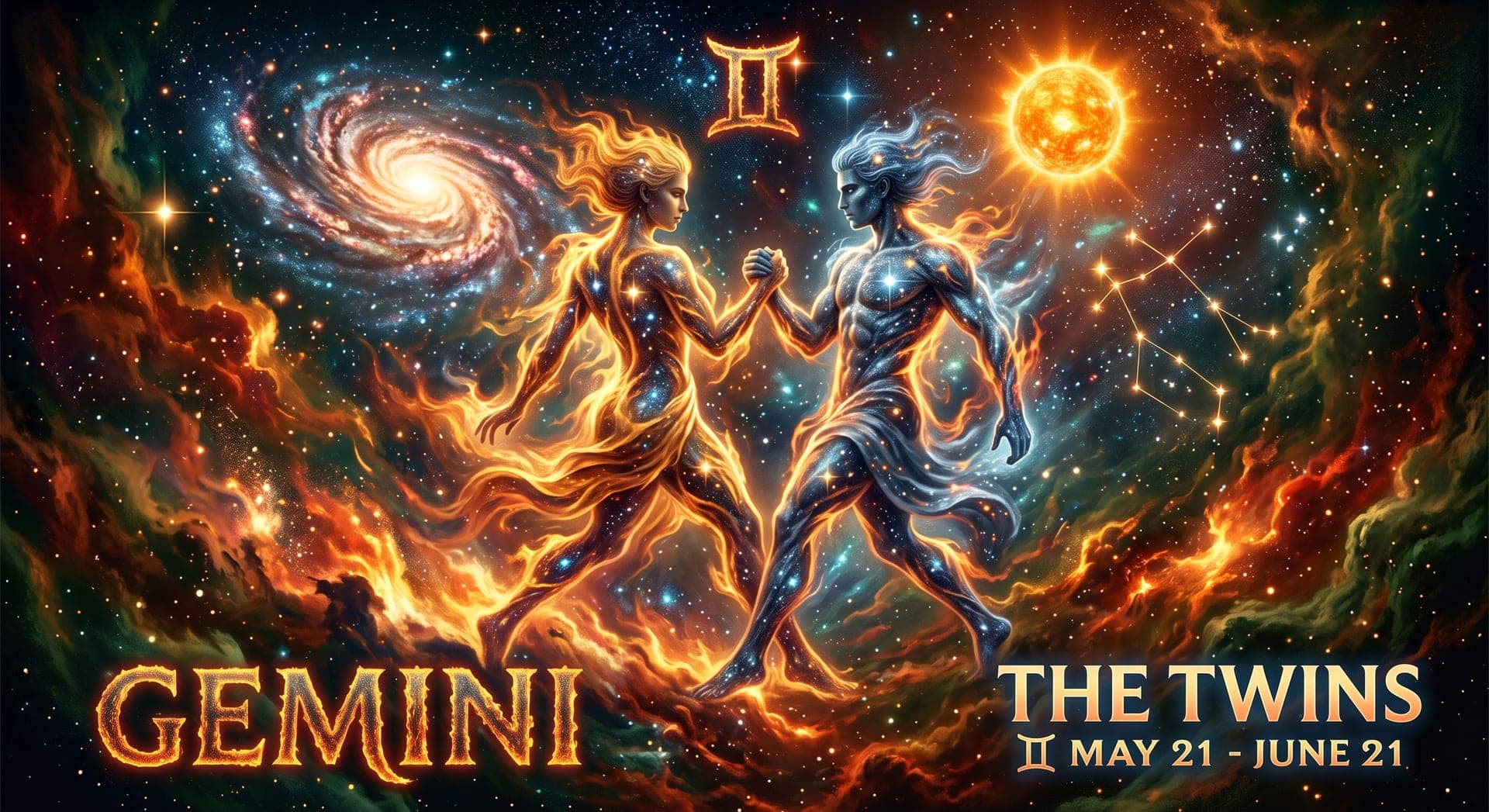
Gemini, the third sign of the zodiac, spans May 21 to June 20 and is symbolized by twins, representing the sign's dual nature and its ability to see multiple sides of any situation at once. Ruled by Mercury, the planet of communication and intellect, Gemini is widely regarded as one of the most talkative, curious, and quick-witted signs of the zodiac, constantly gathering new information and ideas. As an Air sign, Gemini approaches the world primarily through thought and conversation, thriving on mental stimulation and social interaction. Its Mutable modality reflects a restless adaptability, since Gemini tends to resist routine and prefers variety, novelty, and the freedom to change course whenever something more interesting comes along. People born under this sign are often skilled communicators, natural storytellers, and quick learners who can hold their own in nearly any conversation. That same adaptability can also come across as inconsistency, and Gemini's dual nature sometimes earns an unfair reputation for being two-faced, when in reality it simply reflects genuine curiosity about every side of a story.
Personality Traits
Strengths
- Quick-witted and intelligent
- Excellent communicator
- Adaptable to new situations
- Curious and eager to learn
- Charming and sociable
Weaknesses
- Prone to inconsistency
- Can be superficial
- Easily bored
- Indecisive
- Tendency to gossip
Compatible Signs
Fun Facts
- Gemini's twin symbol traces back to the Greek myth of Castor and Pollux, twin brothers placed among the stars as the constellation Gemini.
- Mercury, Gemini's ruling planet, was the swift Roman messenger god, reflecting the sign's associations with communication and quick thinking.
- Gemini is one of only a few zodiac signs represented by human figures rather than animals or objects.
- Notable Geminis include Marilyn Monroe, Kanye West, Angelina Jolie, and John F. Kennedy.
- Gemini season overlaps with the transition from spring to summer in the Northern Hemisphere, reflecting the sign's changeable, in-between nature.
Born on June 12
- 1802
Harriet Martineau
English writer and pioneering sociologist whose wide-ranging works helped popularise economics and social theory for a general readership.
- 1806
John A. Roebling
German-American engineer who designed the Brooklyn Bridge
- 1819
Charles Kingsley
English clergyman and novelist best known for The Water-Babies and the historical adventure Westward Ho!
- 1827
Johanna Spyri
Swiss author of "Heidi"
- 1843
David Gill
Scottish astronomer who pioneered the use of photography and precise measurement techniques to determine astronomical distances.
- 1851
Oliver Lodge
English physicist and pioneer of radio technology whose early experiments with wireless transmission helped lay the groundwork for modern telecommunications.
- 1897
Anthony Eden
English politician who served as Prime Minister of the United Kingdom from 1955 to 1957, a tenure dominated by the Suez Crisis.
- 1924
George H. W. Bush
41st President of the United States
- 1929
Anne Frank
German-Dutch diarist and Holocaust victim
- 1941
Chick Corea
American jazz pianist and composer
- 1941
Roy Harper
English folk singer-songwriter whose idiosyncratic style influenced artists including Led Zeppelin and Kate Bush.
- 1945
Pat Jennings
Northern Irish footballer regarded as one of the finest goalkeepers of his era, renowned for his long career with Tottenham Hotspur and Arsenal.
- 1978
Lewis Moody
English rugby union flanker who was part of England's World Cup-winning squad in 2003.
On This Day in History
- 1206
Qutb ud-Din Aibak establishes the Delhi Sultanate, beginning centuries of Muslim rule in northern India.
Turkic military commander Qutb ud-Din Aibak, a former slave who had risen through the ranks to become a powerful general, established the Delhi Sultanate in northern India, founding a series of Muslim dynasties that would rule large portions of the Indian subcontinent for the following three centuries.
- 1381
Rebels led by Wat Tyler gather at Blackheath before marching on London during the Peasants' Revolt.
Thousands of angry commoners from Kent and Essex, provoked by a hated poll tax and demands for an end to serfdom, assembled southeast of London before advancing into the city. Their march culminated in the storming of the Tower of London and a dramatic confrontation with the teenage King Richard II, briefly threatening the stability of the English crown.
- 1429
Joan of Arc leads French forces to capture the town of Jargeau during the Hundred Years' War.
Joan of Arc led French royal forces to capture the town of Jargeau from English occupation during the Hundred Years' War, one of several rapid successive victories following her earlier relief of Orleans that dramatically shifted momentum in France's favor and paved the way for the coronation of Charles VII weeks later.
- 1429
Joan of Arc's French forces capture Jargeau and take the English commander William de la Pole prisoner during the Hundred Years' War.
Fresh from lifting the siege of Orléans, Joan of Arc led an assault on the English-held town of Jargeau on the Loire, breaching its defences after fierce fighting. The Earl of Suffolk, commanding the English garrison, was captured attempting to negotiate his surrender individually, a symbolic blow that accelerated the collapse of English fortunes in the campaign.
- 1550
King Gustav I of Sweden founds the city of Helsinki.
King Gustav I of Sweden founded the trading town of Helsinki on the coast of Finland, then a Swedish possession, intending it to compete commercially with the nearby Estonian city of Tallinn, though Helsinki grew slowly for centuries before eventually becoming the capital of an independent Finland in the 20th century.
- 1643
The Westminster Assembly convenes without royal assent to reform the Church of England.
Called by Parliament during the English Civil War despite King Charles I's opposition, the assembly of clergy and scholars was tasked with reshaping English church doctrine and governance along more Puritan lines. Its deliberations produced the influential Westminster Confession of Faith, which remains a foundational document for Presbyterian churches worldwide.
- 1653
The English fleet defeats the Dutch at the Battle of the Gabbard during the First Anglo-Dutch War.
Fought off the English coast, the battle saw the English navy, employing newly formalised line-of-battle tactics, inflict a decisive defeat on the Dutch fleet under Maarten Tromp. The victory helped secure English control of the English Channel and forced the Dutch onto the defensive for the remainder of the war.
- 1665
Thomas Willett is installed as the first mayor of New York City under English colonial rule.
England had seized the Dutch colony of New Amsterdam the previous year, renaming it New York after the Duke of York. Willett, an English merchant with long experience in the colonies, became its first mayor under the new administration, symbolising the transfer of the settlement from Dutch to English control.
- 1758
British general James Wolfe launches his assault during the Siege of Louisbourg in the French and Indian War.
Wolfe commanded a brigade in the British expedition to capture the powerful French fortress guarding the approach to the Saint Lawrence River. The successful siege, which fell weeks later, eliminated French naval power in the region and opened the way for the following year's British campaign against Quebec, in which Wolfe would command the final assault.
- 1775
British General Thomas Gage declares martial law in Massachusetts, offering amnesty to colonists who lay down arms.
As tensions escalated after the battles of Lexington and Concord, Gage, the British military governor, sought to defuse the crisis by pardoning rebels who submitted to royal authority, explicitly excluding rebel leaders Samuel Adams and John Hancock. The proclamation had little effect, and fighting between British and colonial forces continued to intensify.
- 1776
Virginia's colonial convention adopts the Virginia Declaration of Rights, an influential precursor to the U.S. Bill of Rights.
Virginia's colonial convention adopted the Virginia Declaration of Rights, drafted primarily by George Mason, asserting fundamental principles including popular sovereignty, freedom of the press, and protection against unreasonable searches, a document that profoundly influenced both the Declaration of Independence weeks later and the U.S. Bill of Rights.
- 1798
British Crown forces defeat United Irishmen rebels at the Battle of Ballynahinch during the Irish Rebellion.
Fought in County Down, the battle was one of the last major engagements of the rebellion in Ulster. After initial rebel successes, government troops regrouped and routed the poorly organised insurgent force, effectively crushing the uprising in the north of Ireland and prompting brutal reprisals against the local population.
- 1813
British naval forces capture the American revenue cutter USRC Surveyor in Chesapeake Bay during the War of 1812.
A British boarding party from HMS Narcissus rowed out under cover of darkness and seized the American vessel in a sharp close-quarters fight, despite the Surveyor's crew putting up determined resistance. The action was part of Britain's sustained naval campaign to blockade and harass American shipping along the Atlantic coast during the war.
- 1898
Filipino revolutionary leader Emilio Aguinaldo declares the Philippines' independence from Spain.
Filipino revolutionary leader Emilio Aguinaldo declared the Philippines' independence from Spanish colonial rule following the collapse of Spanish authority during the Spanish-American War, though the newly proclaimed republic's independence proved short-lived as the United States subsequently asserted its own colonial control over the islands.
- 1939
The National Baseball Hall of Fame opens in Cooperstown, New York.
The National Baseball Hall of Fame officially opened its doors in Cooperstown, New York, a town chosen based on a now largely discredited legend crediting Abner Doubleday with inventing the sport there, establishing a museum and shrine that has since become the sport's most revered institution honoring its greatest players.
- 1940
German general Erwin Rommel accepts the surrender of around 13,000 British and French troops at Saint-Valery-en-Caux.
Trapped against the Channel coast as the Battle of France collapsed, the largely British 51st Highland Division and accompanying French forces were surrounded by Rommel's advancing panzers and forced to surrender after fierce resistance. It was one of the largest British troop losses of the campaign, overshadowed in memory by the successful evacuation from Dunkirk days earlier.
- 1967
The U.S. Supreme Court rules unanimously in "Loving v. Virginia" that state laws banning interracial marriage are unconstitutional.
The U.S. Supreme Court ruled unanimously in "Loving v. Virginia" that state laws banning interracial marriage violated the Constitution's Equal Protection and Due Process Clauses, striking down anti-miscegenation statutes still in effect in sixteen states and establishing a legal precedent later cited in other landmark civil rights cases.
- 1981
"Raiders of the Lost Ark," the first Indiana Jones film, premieres in American theaters.
"Raiders of the Lost Ark," directed by Steven Spielberg and starring Harrison Ford as archaeologist-adventurer Indiana Jones, premiered in American theaters, becoming an enormous critical and commercial success that launched one of the most beloved action-adventure film franchises in cinema history.
- 1987
President Ronald Reagan delivers his famous "tear down this wall" speech at the Brandenburg Gate in West Berlin.
President Ronald Reagan, standing before the Berlin Wall at the Brandenburg Gate, delivered his famous challenge to Soviet leader Mikhail Gorbachev, "Mr. Gorbachev, tear down this wall," a Cold War speech that, while not immediately acted upon, became emblematic of the ideological standoff in the years before the wall's fall two years later.
- 2018
President Donald Trump and North Korean leader Kim Jong Un hold their first summit meeting in Singapore.
President Donald Trump and North Korean leader Kim Jong Un held an unprecedented first summit meeting in Singapore, marking the first time a sitting American president had ever met with a North Korean leader, resulting in a vague joint statement on denuclearization that produced limited concrete follow-through in subsequent negotiations.