What’s Observed on April 26
Born on April 26: Taurus ♉
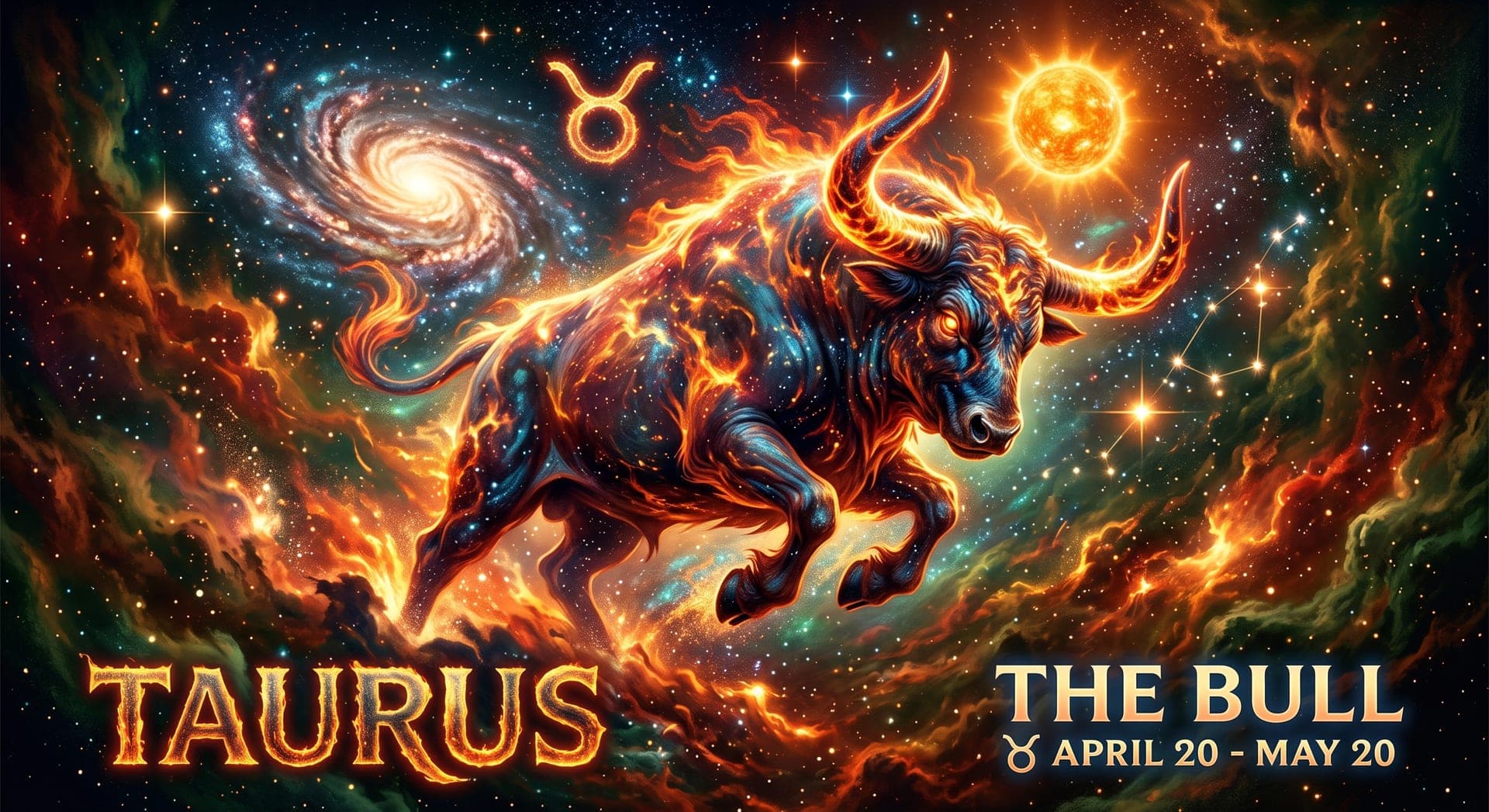
Taurus, the second sign of the zodiac, spans April 20 to May 20 and is symbolized by the bull, an animal prized for its strength, steadiness, and quiet determination. Ruled by Venus, the planet of love, beauty, and material comfort, Taurus is often described as one of the most sensual and pleasure-loving signs, drawn to good food, fine art, and physical comfort. As an Earth sign, Taurus is grounded, practical, and deeply connected to the physical world, valuing stability and tangible security over abstract ideas or sudden change. Its Fixed modality gives Taurus a well-earned reputation for stubbornness, since once a Taurus has settled on a plan or opinion, shifting it can be remarkably difficult. People born under this sign tend to be dependable, loyal, and patient, often the steady presence others rely on during difficult times. While their resistance to change can occasionally frustrate those around them, Taurus's persistence and work ethic make them exceptionally good at seeing long-term goals through to completion.
Personality Traits
Strengths
- Dependable and steady
- Patient and persistent
- Devoted to loved ones
- Appreciates beauty and comfort
- Financially sensible
Weaknesses
- Extremely stubborn
- Resistant to change
- Can be possessive
- Overindulgent
- Slow to forgive
Compatible Signs
Fun Facts
- Taurus's bull symbol connects to the Greek myth of Zeus transforming into a white bull to abduct Europa.
- Venus, Taurus' ruling planet, is the Roman goddess of love and beauty, reflecting the sign's love of comfort, art, and sensory pleasure.
- Taurus is considered by many astrologers to be the most stubborn sign of the zodiac, a trait often attributed to its Fixed modality and bull symbolism.
- Notable Taureans include Queen Elizabeth II, William Shakespeare, Adele, and David Beckham.
- The star cluster known as the Pleiades sits within the constellation Taurus and has been referenced in mythology and literature across many cultures.
Born on April 26
- 121
Marcus Aurelius
Roman emperor and Stoic philosopher known for "Meditations"
- 1710
Thomas Reid
Scottish philosopher born in Strachan, Kincardineshire, founder of the Scottish School of Common Sense philosophy.
- 1785
John James Audubon
American naturalist and painter known for ornithological illustrations
- 1798
Eugène Delacroix
French Romantic painter known for "Liberty Leading the People"
- 1889
Ludwig Wittgenstein
Austrian-born British philosopher and Cambridge professor best known for "Tractatus Logico-Philosophicus" and "Philosophical Investigations"
- 1898
John Grierson
Scottish filmmaker born in Deanston, widely regarded as the father of the documentary film movement.
- 1926
David Coleman
British sports commentator born in Alderley Edge, Cheshire, a familiar voice of BBC sports broadcasting for over four decades.
- 1927
Anne McLaren
British developmental biologist born in London, a pioneer of in vitro fertilization research and mammalian genetics.
- 1933
Carol Burnett
American comedian known for "The Carol Burnett Show"
- 1960
Roger Taylor
English drummer born in Birmingham, a founding member of the pop rock band Duran Duran.
- 1963
Jet Li
Chinese martial artist and actor
- 1967
Marianne Jean-Baptiste
English actress born in London, Oscar-nominated for her performance in Mike Leigh's Secrets & Lies.
- 1990
Nevin Spence
Rugby union player born in Northern Ireland, who represented Ulster and Ireland before his death in 2012.
On This Day in History
- 1289
Mamluk forces under Sultan Qalawun capture the Crusader stronghold of Tripoli after a lengthy siege.
Mamluk forces under Sultan Qalawun captured the wealthy Crusader port city of Tripoli after a determined siege, massacring many inhabitants and effectively ending nearly two centuries of Crusader presence in the region, with the last remaining Crusader stronghold at Acre falling just two years later.
- 1326
France and Scotland conclude the Treaty of Corbeil, renewing their alliance against England.
The treaty reaffirmed the mutual-defense pact first struck in 1295, later known as the 'Auld Alliance,' under which each kingdom pledged to support the other if attacked by England. It bound Scotland and France together diplomatically and militarily for centuries, shaping Scottish foreign policy and its long rivalry with its southern neighbor well into the 16th century.
- 1478
Conspirators of the Pazzi family attack Lorenzo de' Medici during Mass in Florence, fatally wounding his brother Giuliano.
Conspirators from the rival Pazzi family, with tacit support from the papacy, attacked Lorenzo de' Medici and his brother Giuliano during Mass in Florence's cathedral, fatally wounding Giuliano while Lorenzo escaped with lesser injuries. The failed coup attempt, known as the Pazzi Conspiracy, led to brutal reprisals against the plotters and further cemented Medici control over Florence.
- 1564
William Shakespeare is baptized in Stratford-upon-Avon, England.
Parish records show the baptism took place on 26 April 1564; his actual birth date is unrecorded but traditionally celebrated three days earlier, on 23 April. He grew up in the Warwickshire market town before moving to London, where he became England's most celebrated playwright and poet, author of Hamlet, Macbeth, and Romeo and Juliet.
- 1607
Colonists chartered by the English Virginia Company make landfall at Cape Henry, Virginia.
The expedition, sponsored by a joint-stock company under royal charter from King James I, went on to found Jamestown weeks later, becoming the first permanent English settlement in North America. The landing marked the beginning of sustained English colonization of the continent, laying groundwork for what would become the United States.
- 1803
Thousands of meteorite fragments fall near L'Aigle, France, providing definitive proof to skeptical scientists that meteorites originate in space.
Thousands of stony meteorite fragments rained down on the town of L'Aigle in Normandy, France, an event investigated by physicist Jean-Baptiste Biot, whose detailed scientific report finally convinced a skeptical European scientific establishment that rocks could indeed fall from space, a claim previously dismissed as folklore.
- 1865
Union cavalry track down and kill John Wilkes Booth, the assassin of President Abraham Lincoln, in Virginia.
Union cavalry cornered John Wilkes Booth, the assassin of President Abraham Lincoln, in a Virginia tobacco barn nearly two weeks after the shooting, and Booth was fatally shot after refusing to surrender, either by a soldier's bullet or possibly by his own hand, ending the manhunt that had gripped the nation.
- 1916
British troops and Irish rebels clash at the Battle of Mount Street Bridge during the Easter Rising.
A small contingent of Irish Volunteers, positioned in houses overlooking a canal bridge in Dublin, inflicted heavy casualties on advancing British reinforcements attempting to reach the city center. The engagement became one of the bloodiest of the rising for the British Army, which suffered roughly 234 casualties in the fighting around the bridge.
- 1920
Ice hockey makes its Olympic debut, with Canada defeating Sweden 12-1 in the gold medal match.
Ice hockey made its Olympic debut at the Antwerp Games, with Canada's amateur club team overwhelming Sweden 12-1 to claim the gold medal, establishing Canadian dominance in international hockey that would continue for decades. The sport's Olympic inclusion helped accelerate its growth as a major international spectator sport.
- 1923
The Duke of York, the future King George VI, marries Lady Elizabeth Bowes-Lyon at Westminster Abbey.
The bride, a Scottish aristocrat, was the first commoner in centuries to marry so close to the British throne. The couple became King and Queen in 1936 after the abdication of Edward VIII, and Elizabeth, later known as the Queen Mother, remained one of Britain's most popular royals until her death in 2002.
- 1937
German and Italian warplanes bomb the Basque town of Guernica, Spain, during the Spanish Civil War, an atrocity later immortalized in Picasso's painting.
German and Italian warplanes supporting Francisco Franco's Nationalist forces bombed the Basque town of Guernica during the Spanish Civil War, killing an unknown but substantial number of civilians in an attack widely condemned as a deliberate test of terror bombing tactics. The atrocity was immortalized in Pablo Picasso's famous anti-war mural of the same name.
- 1937
The Basque town of Guernica, Spain, is bombed by German and Italian forces during the Spanish Civil War.
Flying in support of Francisco Franco's Nationalist forces, warplanes of the German Condor Legion and Italian Aviazione Legionaria attacked the town on a busy market day, killing civilians in numbers estimated from the low hundreds to over a thousand. The attack, one of the first aimed at a civilian population from the air, shocked the world and inspired Pablo Picasso's famous painting 'Guernica.'
- 1944
British-led commandos capture German General Heinrich Kreipe in occupied Crete.
A small team of British Special Operations Executive officers, including Patrick Leigh Fermor, working with Cretan resistance fighters, ambushed Kreipe's car and smuggled him across the mountainous island to a waiting British submarine. The daring operation became one of the most celebrated feats of the SOE, later dramatized in books and film.
- 1954
The first large-scale clinical trials of Jonas Salk's polio vaccine begin in the United States.
Nearly two million American schoolchildren took part in what became the largest medical field trial in history, testing the injectable vaccine's safety and effectiveness against a disease that had crippled and killed thousands of children each year. The trial's success, announced the following year, led to widespread vaccination campaigns that dramatically reduced polio cases.
- 1962
Britain's first satellite, Ariel 1, is launched into orbit as part of a joint programme with NASA.
Built with British instrumentation to study the ionosphere and solar radiation and launched aboard a NASA rocket, Ariel 1 made Britain the third nation, after the Soviet Union and the United States, to operate a satellite in space. The mission reflected close scientific cooperation between British and American space researchers during the early space age.
- 1986
A reactor at the Chernobyl Nuclear Power Plant in Soviet Ukraine explodes, causing the worst nuclear disaster in history.
A reactor at the Chernobyl Nuclear Power Plant in Soviet Ukraine exploded during a botched safety test, releasing massive amounts of radioactive material across the surrounding region and much of Europe in the worst nuclear disaster in history. The catastrophe forced the permanent evacuation of the nearby city of Pripyat and left a lasting exclusion zone.
- 1986
A reactor at the Chernobyl Nuclear Power Plant explodes, causing the worst nuclear accident in history.
A flawed reactor design combined with a botched safety test led to an explosion and fire at the plant in the Ukrainian SSR, releasing massive quantities of radioactive material across much of Europe. Dozens died in the immediate aftermath, a wide exclusion zone was established around the plant, and the disaster's long-term health and environmental consequences are still being studied today.
- 1989
A devastating tornado strikes central Bangladesh, killing over 1,300 people in one of the deadliest tornadoes ever recorded.
A devastating tornado tore through densely populated areas of central Bangladesh, including the city of Manikganj, killing more than 1,300 people and injuring tens of thousands more, making it among the deadliest tornadoes ever recorded anywhere in the world, a toll reflecting the region's high population density and vulnerable housing.
- 1994
China Airlines Flight 140 crashes while landing at Nagoya Airport in Japan, killing 264 of the 271 people aboard.
China Airlines Flight 140, an Airbus A300, crashed while attempting to land at Nagoya Airport in Japan after a pilot's conflicting inputs with the plane's autopilot system led to a stall, killing 264 of the 271 people aboard. The disaster prompted significant changes in pilot training regarding automation and manual override procedures.
- 2005
Syria completes the withdrawal of its military forces from Lebanon after nearly three decades of occupation.
Syria completed the withdrawal of its military forces from Lebanon, ending nearly three decades of occupation and significant political influence over its smaller neighbor, a withdrawal driven by intense international pressure and mass protests following the assassination of former Lebanese Prime Minister Rafic Hariri weeks earlier.