What’s Observed on April 17
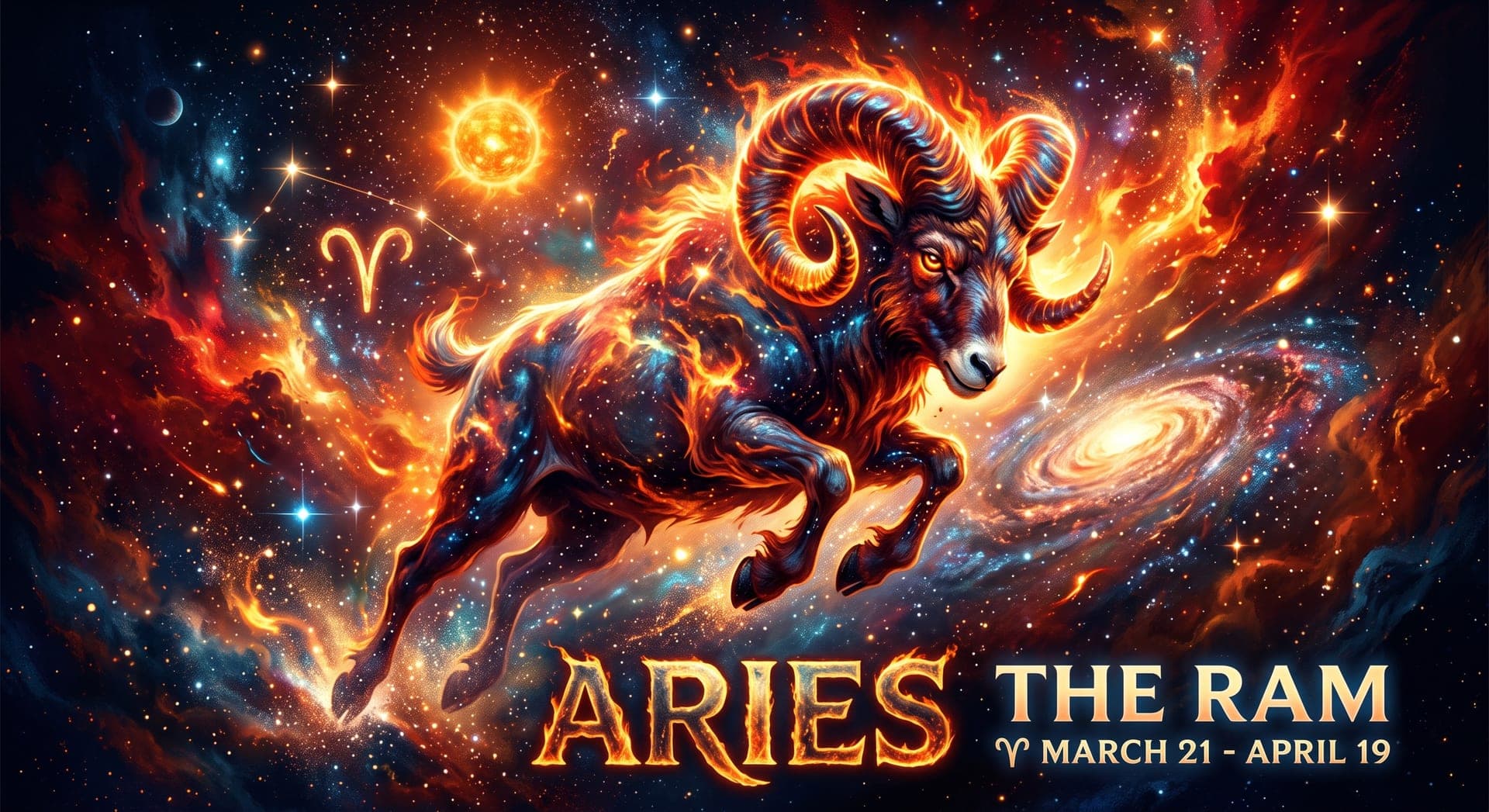
Born on April 17: Aries ♈
Aries, the first sign of the zodiac, spans March 21 to April 19 and is represented by the ram, an animal known for its boldness, stubborn determination, and willingness to charge forward. Ruled by Mars, the planet of action, drive, and war, Aries is often characterized as one of the most energetic and assertive signs in the zodiac, comfortable taking initiative and leading the way into new territory. As a Fire sign, Aries burns with passion and enthusiasm, approaching life with an instinctive, competitive edge and a low tolerance for hesitation. Its Cardinal modality reflects its role as an initiator, the sign that kicks off the astrological year at the spring equinox and each new season's start. People born under this sign are frequently drawn to leadership roles, sports, entrepreneurship, or any pursuit that rewards courage and quick decision-making. Direct and refreshingly honest, Aries individuals tend to say exactly what they think and rarely shy away from a challenge worth having.
Personality Traits
Strengths
- Courageous and determined
- Natural-born leader
- Honest and direct
- Enthusiastic and optimistic
- Quick to act on opportunities
Weaknesses
- Impatient and quick-tempered
- Impulsive, acts before thinking
- Can be overly competitive
- Struggles with follow-through
- Prone to selfishness
Compatible Signs
Fun Facts
- Aries is the first sign of the zodiac, marking the start of the astrological year at the spring equinox.
- The ram symbol is tied to the Greek myth of the golden-fleeced ram that rescued Phrixus, whose fleece later became the prize sought by Jason and the Argonauts.
- Mars, Aries' ruling planet, was the Roman god of war, reflecting the sign's associations with boldness, drive, and aggression.
- As a Cardinal sign, Aries is one of four signs, along with Cancer, Libra, and Capricorn, that initiate a new season.
- Notable Aries include Lady Gaga, Robert Downey Jr., Mariah Carey, and Leonardo da Vinci.
Born on April 17
- 1586
John Ford
English Jacobean playwright best known for the tragedy 'Tis Pity She's a Whore, noted for its dark psychological intensity.
- 1799
Eliza Acton
English food writer and poet whose cookery book Modern Cookery for Private Families pioneered listing ingredients and cooking times in recipes.
- 1837
J. P. Morgan
American banker and financier who founded J.P. Morgan & Co.
- 1866
Ernest Starling
English physiologist who, with William Bayliss, discovered secretin and coined the term "hormone" to describe chemical messengers in the body.
- 1885
Karen Blixen
Danish author known for "Out of Africa," written as Isak Dinesen
- 1897
Thornton Wilder
American novelist and playwright known for "Our Town"
- 1916
Sirimavo Bandaranaike
World's first female prime minister, of Sri Lanka
- 1918
William Holden
American actor known for "Sunset Boulevard"
- 1923
Lindsay Anderson
British film director and leading figure of the Free Cinema movement, best known for "if...." (1968), winner of the Palme d'Or
- 1930
Chris Barber
English jazz trombonist and bandleader whose group helped popularize traditional jazz and skiffle in Britain during the 1950s and 1960s.
- 1940
Billy Fury
English singer-songwriter and one of Britain's most successful pop stars of the pre-Beatles rock and roll era.
- 1951
Olivia Hussey
Argentine-born British actress best known for playing Juliet in Franco Zeffirelli's 1968 film "Romeo and Juliet" and for horror roles including "Black Christmas"
- 1957
Nick Hornby
English novelist and screenwriter known for books including High Fidelity and About a Boy, which blend humour with reflections on masculinity and popular culture.
- 1959
Sean Bean
English actor known for roles including Boromir in The Lord of the Rings and Eddard Stark in Game of Thrones.
- 1967
Henry Ian Cusick
Peruvian-born Scottish actor best known for playing Desmond Hume in the ABC series "Lost"
- 1974
Victoria Beckham
English singer and fashion designer who rose to fame as a member of the Spice Girls before establishing her own eponymous fashion label.
On This Day in History
- 1492
Spain and Christopher Columbus sign the Capitulations of Santa Fe, laying out the terms of his planned westward voyage in search of a new route to Asia.
Spanish monarchs Ferdinand and Isabella signed the Capitulations of Santa Fe with Christopher Columbus, granting him noble titles, a share of future profits, and governance rights over any lands he discovered in exchange for undertaking his westward voyage in search of a new trade route to Asia. The agreement financed the expedition that, months later, reached the Americas.
- 1521
Martin Luther's trial before the Diet of Worms begins over his religious writings challenging the Catholic Church.
Reformer Martin Luther appeared before the Diet of Worms, an assembly of the Holy Roman Empire, to answer charges of heresy over his writings challenging Catholic Church doctrine and practices. Luther's refusal to recant, reportedly declaring "here I stand, I can do no other," became a defining moment of the Protestant Reformation, though the assembly ultimately declared him an outlaw.
- 1524
Italian explorer Giovanni da Verrazzano becomes the first European to sail into New York Harbor.
Italian explorer Giovanni da Verrazzano, sailing under the French flag, became the first European recorded to enter New York Harbor, describing the area's natural beauty in his subsequent report to King Francis I. The Verrazzano-Narrows Bridge in New York was later named in his honor, though the Dutch would not establish a permanent settlement in the region for another century.
- 1783
A Spanish garrison defeats a force of British-allied irregulars at Arkansas Post in one of the final clashes of the American Revolutionary War in the western theatre.
Captain Jacobo du Breuil commanded a small Spanish garrison that repelled an attack by British-backed raiders, led by trader James Colbert, seeking to capture the Spanish post on the Arkansas River. The skirmish was a minor but notable episode in the wider contest between Britain and Spain for control of the Mississippi Valley during the Revolutionary War, and helped secure Spanish control of the region.
- 1797
British forces under Sir Ralph Abercromby launch a major assault on the Spanish-held city of San Juan, Puerto Rico.
The attack, mounted with a large fleet and thousands of troops, aimed to seize one of Spain's most strategically important Caribbean strongholds during the French Revolutionary Wars. Despite the scale of the assault, Spanish defenders under Ramón de Castro held the fortified city, and Abercromby's forces withdrew after roughly two weeks, marking one of Britain's rare setbacks in the Caribbean campaigns of the period.
- 1861
Virginia's secession convention votes to leave the Union, becoming the eighth state to join the Confederacy.
Virginia's secession convention voted to leave the Union following President Lincoln's call for troops to suppress the rebellion after the attack on Fort Sumter, making Virginia the eighth state to join the Confederacy. The decision led directly to the western counties of the state splitting off to remain loyal to the Union, eventually forming the separate state of West Virginia.
- 1876
The whaling ship Catalpa rescues six Fenian prisoners from Fremantle Prison in Western Australia, spiriting them away from British colonial custody.
The prisoners, Irish nationalists convicted for their role in Fenian uprisings against British rule, had been transported to the penal colony years earlier. A daring operation organised by Irish-American sympathisers smuggled the men aboard the American whaler, which outran pursuing British vessels to reach international waters. The escape became a celebrated episode in Irish nationalist history and embarrassed British colonial authorities.
- 1895
The Treaty of Shimonoseki ends the First Sino-Japanese War, with China ceding Taiwan and other territory to Japan.
China and Japan signed the Treaty of Shimonoseki, ending the First Sino-Japanese War with a decisive Japanese victory that forced the weakened Qing dynasty to cede Taiwan, the Penghu Islands, and other territory while recognizing Korean independence. The treaty marked Japan's emergence as a major regional power and accelerated the decline of Chinese imperial influence in East Asia.
- 1951
The Peak District becomes the United Kingdom's first National Park.
Designated under the newly passed National Parks and Access to the Countryside Act 1949, the Peak District's moorlands and dales in central England became a testing ground for balancing public access, conservation, and rural livelihoods. Its creation followed decades of campaigning, including the 1932 mass trespass at Kinder Scout, and paved the way for a network of national parks established across Britain over the following years.
- 1961
CIA-trained Cuban exiles launch the failed Bay of Pigs Invasion in an attempt to overthrow Fidel Castro's government.
A brigade of roughly 1,400 CIA-trained Cuban exiles launched an amphibious invasion at Cuba's Bay of Pigs, intending to spark a popular uprising against Fidel Castro's government. The poorly coordinated operation collapsed within days against determined Cuban resistance, embarrassing the recently inaugurated Kennedy administration and pushing Castro further into the Soviet orbit.
- 1961
Cuban exiles trained and financed by the CIA land at the Bay of Pigs in an attempt to overthrow Fidel Castro's government.
The invasion force of around 1,400 exiles aimed to spark a popular uprising against the Cuban revolutionary government but was quickly overwhelmed by Castro's forces after promised American air support was scaled back. The failed operation embarrassed the Kennedy administration, pushed Cuba further toward the Soviet Union, and contributed to the tensions that culminated in the Cuban Missile Crisis the following year.
- 1970
The crippled Apollo 13 spacecraft returns safely to Earth after its harrowing journey around the Moon.
The damaged Apollo 13 spacecraft, its crew having endured a harrowing four-day ordeal after an oxygen tank explosion crippled the vessel en route to the Moon, splashed down safely in the Pacific Ocean, to the immense relief of NASA and a worldwide television audience. The mission's successful, improvised rescue became one of the space agency's most celebrated achievements.
- 1970
The damaged Apollo 13 spacecraft splashes down safely in the Pacific Ocean, ending a perilous mission to the Moon.
After an oxygen tank explosion crippled the spacecraft days earlier, astronauts James Lovell, Jack Swigert, and Fred Haise had used the lunar module as a lifeboat to survive the return journey. Mission controllers on the ground improvised solutions to conserve power and remove carbon dioxide from the cabin air. The crew's safe recovery turned a near-catastrophe into one of NASA's most celebrated achievements.
- 1975
Khmer Rouge forces capture Phnom Penh, ending the Cambodian Civil War and beginning a brutal genocidal regime.
Khmer Rouge forces captured the Cambodian capital of Phnom Penh, ending the country's civil war but beginning a brutal four-year totalitarian regime under Pol Pot that forcibly evacuated cities and caused the deaths of an estimated one to two million Cambodians through executions, starvation, and forced labor in what became known as the Killing Fields.
- 1982
Queen Elizabeth II proclaims Canada's new constitution, completing the country's full legal independence from Britain.
Queen Elizabeth II traveled to Ottawa to formally proclaim Canada's new constitution, which included a domestic amending formula and the Canadian Charter of Rights and Freedoms, completing the process known as "patriation" that ended the need for British parliamentary approval of Canadian constitutional changes. The event marked Canada's full legal independence from the United Kingdom.
- 1982
Queen Elizabeth II proclaims the Constitution Act, 1982, patriating Canada's constitution and ending the British Parliament's remaining authority to legislate for Canada.
The ceremony in Ottawa marked the culmination of decades of negotiation over how to bring Canada's founding constitutional documents fully under Canadian control. The new act added a Charter of Rights and Freedoms and an amending formula that no longer required approval from Westminster. It was the final formal step in Canada's long constitutional separation from the United Kingdom, though the monarchy remained the head of state.
- 1986
An alleged 335-year state of war between the Netherlands and England's Isles of Scilly is formally declared over.
The bloodless 'war,' said to have originated from a diplomatic oversight during the English Civil War era when a Dutch fleet allegedly declared war on the Royalist stronghold of the Scilly Isles, had never resulted in any fighting and was more legend than genuine hostility. A Dutch ambassador travelled to the islands off Cornwall to sign a peace treaty, closing out what is often cited as the longest war in history — in name only.
- 2013
A fertilizer plant explosion in West, Texas, kills 15 people and injures more than 160 others.
An explosion at a fertilizer storage and distribution facility in the small town of West, Texas, killed 15 people, mostly first responders, and injured more than 160 others, leveling much of the surrounding area including a nearby school and nursing home. The disaster prompted renewed scrutiny of chemical storage regulations and emergency response protocols for hazardous facilities.
- 2013
The ceremonial funeral of former British Prime Minister Margaret Thatcher takes place at St Paul's Cathedral in London.
Thatcher, who led Britain from 1979 to 1990 as its first female prime minister, was honoured with a ceremonial funeral with military honours, an event normally reserved for monarchs and attended by the Queen. Thousands lined the procession route through London, while the divisive legacy of her economic and social policies drew both tributes and protests across the country on the day of the service.
- 2021
The funeral of Prince Philip, Duke of Edinburgh, husband of Queen Elizabeth II, takes place at St George's Chapel, Windsor Castle.
Held amid coronavirus restrictions that limited the congregation to just 30 people, the ceremony combined military tradition with personal touches reflecting Philip's decades of naval and public service. He had died on April 9 at age 99, having been the longest-serving consort in British history. The pared-down, socially distanced service was widely noted for the image of the Queen mourning alone in a pew.