
What’s Observed on February 12
Born on February 12: Aquarius ♒
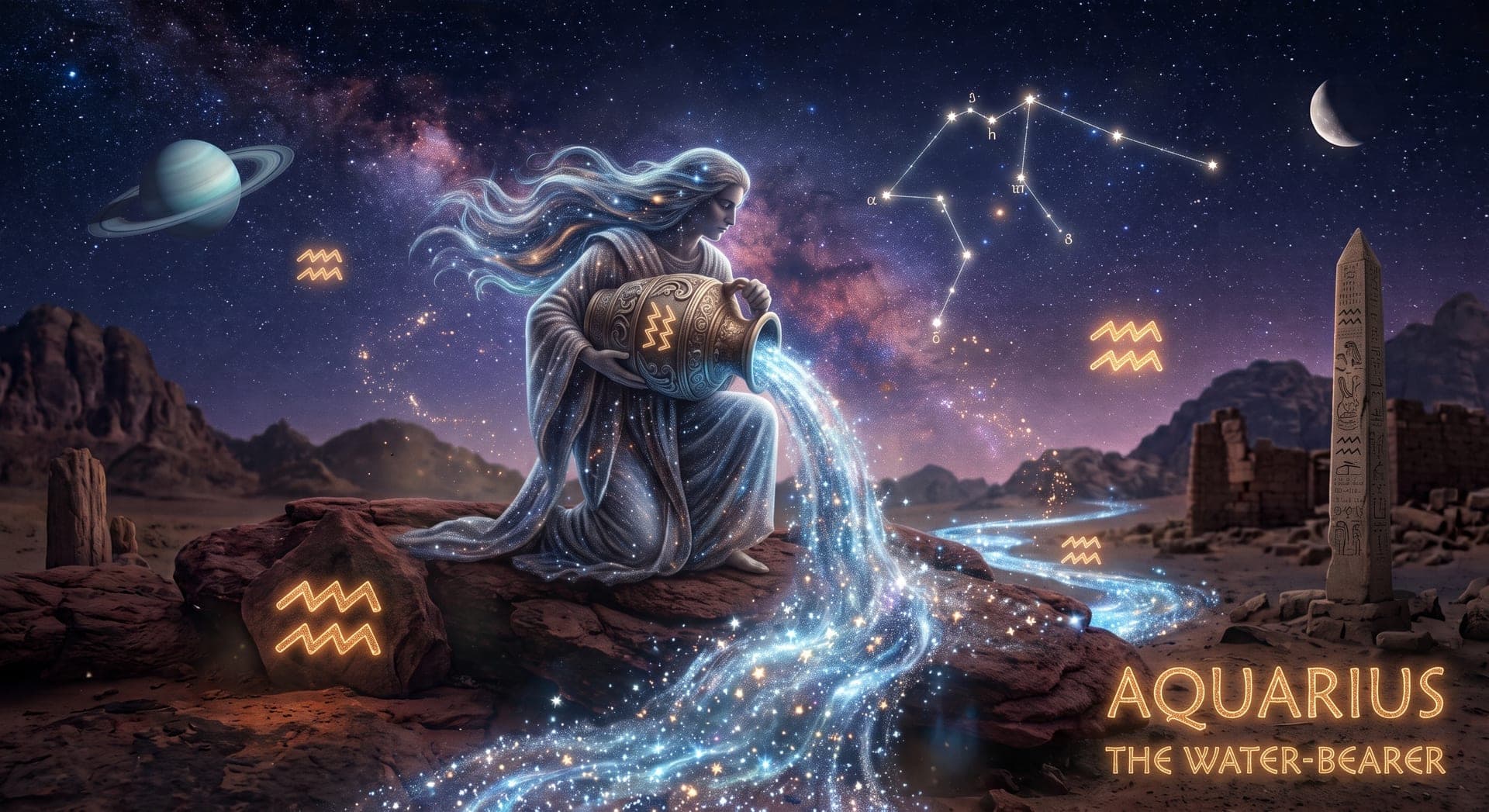
Aquarius, the eleventh sign of the zodiac, spans January 20 to February 18 and is symbolized by the water bearer, an image of someone pouring out knowledge and life-giving ideas to the world, despite Aquarius actually being an air sign rather than a water sign. Traditionally ruled by disciplined Saturn and, in modern astrology, by unpredictable Uranus, the planet of innovation and rebellion, Aquarius carries a distinctive blend of structure and originality. People born under this sign are often described as independent thinkers, forward-looking, and drawn to humanitarian causes, valuing the collective good over convention. As a Fixed sign, Aquarius can be famously stubborn once its mind is made up, even while championing change for everyone else. Intellectually curious and sometimes emotionally guarded, Aquarians tend to value friendship and community deeply, often serving as the visionary of their social circle, more comfortable debating ideas than discussing feelings.
Personality Traits
Strengths
- Original and forward-thinking
- Strong sense of fairness and justice
- Independent and self-sufficient
- Loyal to friends and causes alike
- Sees the bigger picture others miss
Weaknesses
- Can run from emotional expression
- Uncompromising once a position is fixed
- Prone to aloofness or detachment
- Sometimes contrarian just to stand apart
- Can prioritize ideas over people's feelings
Compatible Signs
Fun Facts
- Despite its watery name and imagery, Aquarius is classified as an air sign, grouped with Gemini and Libra as a sign of thought and communication rather than emotion.
- Aquarius has two ruling planets: Saturn in classical astrology, and Uranus, discovered in 1781, in the modern system most Western astrologers use today.
- The water bearer symbol traces back to Ganymede in Greek mythology, a cupbearer to the gods said to pour out a life-giving stream from the heavens.
- Notable Aquarians include Oprah Winfrey, Abraham Lincoln, Charles Darwin, Thomas Edison, and Bob Marley.
- Aquarius is one of the rarer signs to be represented by a person rather than an animal or object, alongside Gemini, Virgo, and Sagittarius's centaur half.
Born on February 12
- 1567
Thomas Campion
English composer, poet, and physician known for his lute songs and influential writings on English versification
- 1809
Abraham Lincoln
16th President of the United States
- 1809
Charles Darwin
English naturalist who developed the theory of evolution by natural selection, set out in On the Origin of Species
- 1828
George Meredith
English novelist and poet known for works such as The Egoist and Modern Love
- 1870
Marie Lloyd
English music hall singer and actress who became one of the most popular entertainers of Victorian and Edwardian Britain
- 1881
Anna Pavlova
Legendary Russian prima ballerina
- 1934
Bill Russell
NBA legend with a record 11 championships
- 1934
Annette Crosbie
Scottish actress known for playing Queen Victoria in the television series Edward the Seventh and for the sitcom One Foot in the Grave
- 1938
Judy Blume
Best-selling author of young adult fiction
- 1950
Steve Hackett
English guitarist and songwriter best known as a member of the progressive rock band Genesis
- 1965
Brett Kavanaugh
Associate Justice of the U.S. Supreme Court
- 1968
Josh Brolin
American actor known for major film franchises
- 1974
Naseem Hamed
English boxer who held multiple world featherweight titles during a flamboyant career in the 1990s
- 1980
Christina Ricci
American actress and producer

On This Day in History
- 1429
English forces under Sir John Fastolf repel a French and Scottish attack on a supply convoy near Rouvray, France, in what becomes known as the Battle of the Herrings.
The convoy was carrying supplies, including barrels of herring for the Lenten season, to English troops besieging Orléans during the Hundred Years' War. Fastolf arranged the wagons into a defensive barricade and used longbowmen to fend off the attacking force, inflicting heavy casualties. The English victory came a few months before the siege of Orléans was broken by the intervention of Joan of Arc.
- 1689
England's Convention Parliament declares that King James II's flight from the country the previous December constitutes an abdication of the throne.
James had fled to France after William of Orange landed with an invading army during the Glorious Revolution of 1688. The Convention Parliament's declaration cleared the way for it to offer the crown jointly to William and his wife Mary, James's daughter, establishing a constitutional monarchy and cementing Parliament's authority over royal succession.
- 1733
English philanthropist James Oglethorpe founds the colony of Georgia at Savannah, the last of the thirteen British colonies established in North America.
Oglethorpe envisioned Georgia partly as a refuge for England's imprisoned debtors and working poor, offering them a fresh start in the New World, and partly as a military buffer protecting the Carolinas from Spanish Florida. Named for King George II, the colony was governed under strict early rules banning slavery and alcohol, though these were later overturned.
- 1909
The National Association for the Advancement of Colored People (NAACP) is founded in New York in response to ongoing racial violence against Black Americans.
The organisation was formed by a coalition of Black and white activists, including W. E. B. Du Bois, following a series of race riots and lynchings across the United States. It grew into one of the most influential civil rights organisations in American history, pursuing legal challenges to segregation that eventually contributed to landmark rulings such as Brown v. Board of Education.
- 1912
The Xuantong Emperor, better known as Puyi, abdicates the Chinese throne, ending over two thousand years of imperial rule.
Puyi, who had become emperor as a small child, abdicated under pressure following the Xinhai Revolution, ending over two thousand years of Chinese imperial rule. He briefly returned to power decades later as a Japanese-installed puppet ruler of Manchukuo before eventually living out his life as a private citizen under Communist rule.
- 1912
China's last emperor, the child Xuantong Emperor (Puyi), formally abdicates the throne, ending more than two thousand years of imperial rule.
The abdication followed the Xinhai Revolution, which had toppled the Qing dynasty and led to the establishment of the Republic of China. Puyi was permitted to retain his imperial title and live in the Forbidden City for a time under the terms of the abdication agreement, before being briefly restored in 1917 and later becoming a Japanese puppet ruler in Manchuria.
- 1945
A devastating tornado outbreak strikes Mississippi and Alabama, killing 45 people across the region.
The outbreak produced multiple violent tornadoes across Mississippi and Alabama, striking before the era of modern radar-based warning systems gave residents little advance notice. Such disasters helped drive the postwar development of more sophisticated severe weather forecasting and public warning systems.
- 1946
The Royal Navy concludes Operation Deadlight, a mission to scuttle the majority of Germany's surrendered U-boat fleet in the Atlantic after the Second World War.
Britain and its allies had captured over 150 German submarines at the war's end and, unable to agree on how to divide them among the victorious powers, chose to sink most in deep water northwest of Ireland. Royal Navy vessels used gunfire, torpedoes, and demolition charges over several months to destroy the fleet, though a handful of wrecks broke free and drifted ashore before being sunk.
- 1947
A massive meteorite shower creates the Sikhote-Alin impact craters in the Soviet Far East, among the largest observed iron meteorite falls in recorded history.
A massive meteor exploded over the Sikhote-Alin mountains, showering the region with an estimated 23 tons of iron meteorite fragments and creating over a hundred impact craters. It remains one of the largest and best-documented meteorite falls in recorded history, providing scientists with valuable material for studying asteroid composition.
- 1947
Designer Christian Dior unveils his "New Look" collection in Paris, reviving the city's status as the global capital of fashion after World War II.
Dior's cinched-waist, full-skirted silhouette represented a dramatic departure from wartime fabric rationing and utilitarian styles, using far more material than had been considered acceptable in years. The collection was an instant sensation, restoring Paris's position as the center of the global fashion industry after years of wartime disruption.
- 1961
The Soviet Union launches Venera 1 toward Venus, the first spacecraft aimed at another planet, though contact was lost before arrival.
Venera 1 was designed to fly past Venus and transmit data on its atmosphere and magnetic field, but a malfunction caused ground controllers to lose contact with the probe about a week into its journey. Despite the failure, it remains an early milestone in the Soviet Union's ambitious planetary exploration program.
- 1965
American civil rights leader Malcolm X visits Smethwick, near Birmingham, England, to highlight racial discrimination against immigrants in British housing.
The visit came just days before his assassination in New York and followed a bitterly contested local election in which a candidate had campaigned on an overtly racist slogan. Malcolm X toured streets where Black and Asian residents faced discrimination in buying homes, drawing international attention to racial tensions in Britain during a period of large-scale Commonwealth immigration.
- 1974
Nobel laureate Aleksandr Solzhenitsyn is stripped of his citizenship and expelled from the Soviet Union after publishing "The Gulag Archipelago."
Solzhenitsyn's expulsion followed the Soviet government's fury over the smuggled publication abroad of "The Gulag Archipelago," his sweeping account of the Soviet forced-labor camp system. His exile, and the international attention his writing drew, became a significant moment in exposing the realities of Soviet repression to the wider world.
- 1974
Soviet authorities strip Aleksandr Solzhenitsyn of his citizenship and forcibly exile him from the Soviet Union following the publication of The Gulag Archipelago.
The Nobel Prize-winning author had smuggled his exposé of the Soviet forced-labour camp system to the West, provoking fury from Soviet leadership. He was arrested, charged with treason, and deported to West Germany, eventually settling in the United States. Solzhenitsyn returned to Russia in 1994 after the Soviet Union's collapse.
- 1993
Two-year-old James Bulger is abducted from a shopping centre in Bootle, England, and murdered, a case that shocked Britain and led to changes in the justice system.
Bulger was led away by two ten-year-old boys who abducted and killed him; their subsequent trial and conviction made them the youngest defendants tried for murder in England in modern times. The case prompted lasting public debate in Britain over youth crime, the age of criminal responsibility, and media reporting on child offenders.
- 1994
Thieves break into Norway's National Gallery and steal Edvard Munch's iconic painting "The Scream" during the Lillehammer Winter Olympics.
"The Scream," one of the most recognizable images in art history, was stolen in broad daylight in under a minute, with thieves leaving a taunting note. The painting was recovered undamaged a few months later after Norwegian police, aided by a British undercover operation, tracked down the thieves.
- 1999
The U.S. Senate acquits President Bill Clinton in his impeachment trial over the Monica Lewinsky scandal.
The Senate acquitted Clinton on charges of perjury and obstruction of justice stemming from his relationship with intern Monica Lewinsky, falling well short of the two-thirds majority needed for conviction and removal. He remained in office for the rest of his term, though the scandal significantly damaged his political legacy.
- 1999
The United States Senate acquits President Bill Clinton on both articles of impeachment stemming from the Monica Lewinsky scandal, allowing him to remain in office.
Clinton had been impeached by the House of Representatives in December 1998 on charges of perjury and obstruction of justice. Neither charge secured the two-thirds majority required for conviction in the Senate trial, and Clinton served out the remainder of his term, becoming only the second U.S. president to be impeached and acquitted.
- 2001
NASA's NEAR Shoemaker spacecraft touches down on the asteroid Eros, becoming the first spacecraft ever to land on an asteroid.
NEAR Shoemaker had already spent a year orbiting the asteroid Eros when engineers attempted an unplanned soft landing, an outcome the spacecraft wasn't originally designed for. Its successful touchdown and continued data transmission from the surface offered valuable insight into asteroid composition and structure.
- 2016
Pope Francis and Russian Orthodox Patriarch Kirill sign a joint declaration, the first meeting between leaders of the two churches since their split nearly a thousand years earlier.
The joint declaration between Pope Francis and Patriarch Kirill, signed during a historic meeting in Havana, Cuba, addressed shared concerns including persecution of Christians in the Middle East, though it did not resolve deep theological and jurisdictional disputes dating back to the Great Schism of 1054.