What’s Observed on December 6
Born on December 6: Sagittarius ♐
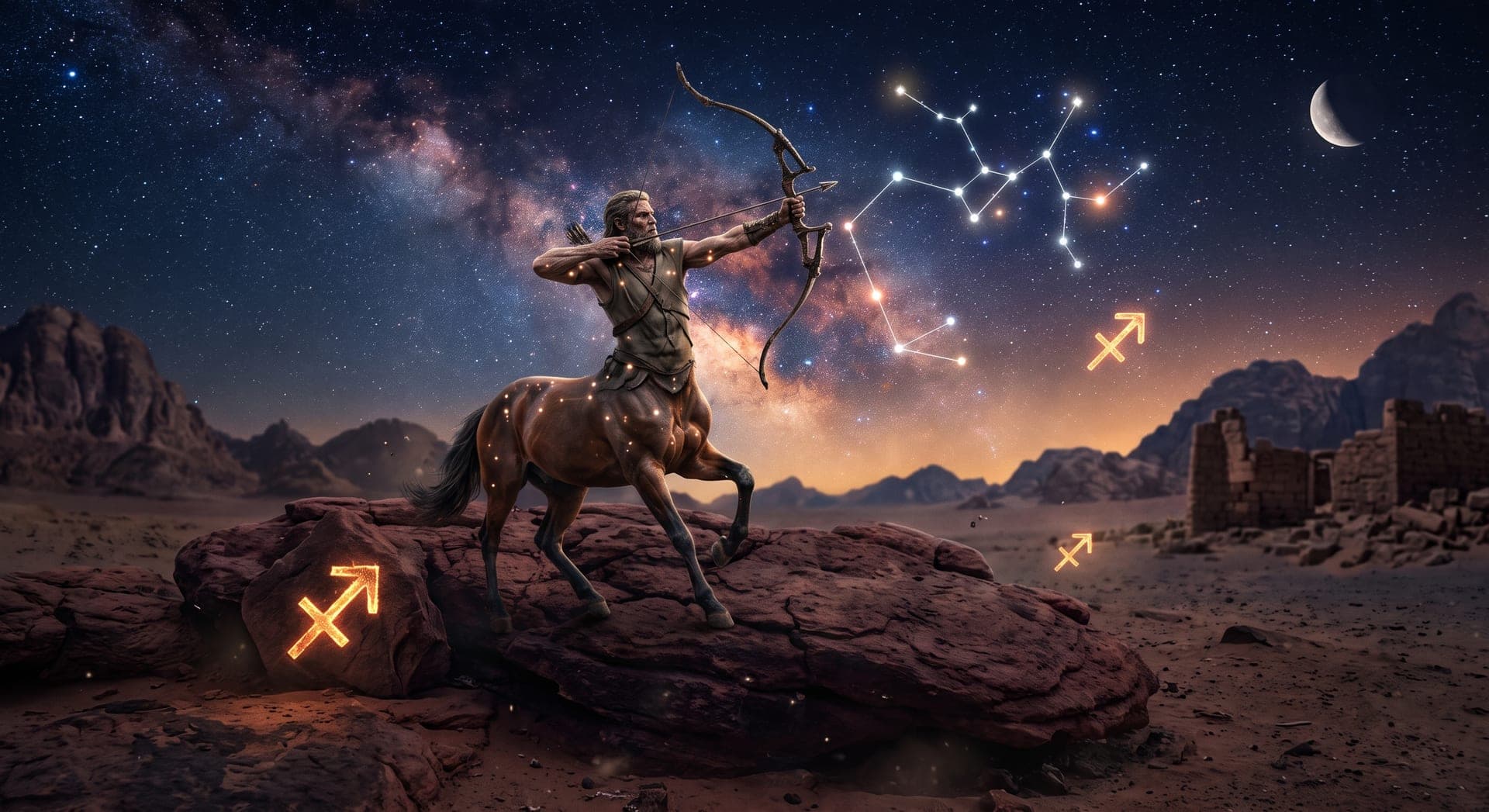
Sagittarius, the ninth sign of the zodiac, spans November 22 to December 21 and is symbolized by the archer, typically depicted as a centaur drawing a bow, representing a restless pursuit of knowledge, adventure, and far-off horizons. Ruled by Jupiter, the largest planet in the solar system and a symbol of growth, luck, and abundance, Sagittarius is widely regarded as one of the most optimistic and freedom-loving signs of the zodiac. As a Fire sign, Sagittarius approaches life with enthusiasm and a genuine hunger for new experiences, whether through literal travel or intellectual and philosophical exploration. Its Mutable modality reflects a deep aversion to routine and confinement, always looking toward the next adventure rather than settling into fixed patterns. People born under this sign are often drawn to travel, higher education, philosophy, or any pursuit that broadens their horizons and understanding of the world. Sagittarius's honesty and optimism make it excellent company, though its blunt directness and restless need for freedom can sometimes come across as tactless or noncommittal to those seeking more stability.
Personality Traits
Strengths
- Adventurous and open to new experiences
- Optimistic and enthusiastic
- Honest and direct
- Philosophical and broad-minded
- Generous and good-humored
Weaknesses
- Tactlessly blunt
- Impatient with routine
- Prone to overpromising
- Restless and commitment-averse
- Careless with details
Compatible Signs
Fun Facts
- Sagittarius's symbol, a centaur drawing a bow and arrow, connects to the Greek myth of Chiron, a wise and scholarly centaur unlike the more unruly members of his kind.
- Jupiter, Sagittarius' ruling planet, is the largest planet in the solar system, reflecting the sign's association with expansion, abundance, and big-picture thinking.
- Sagittarius is one of two zodiac signs, along with Capricorn, represented by a hybrid creature combining human and animal features.
- Notable Sagittarians include Taylor Swift, Walt Disney, Winston Churchill, and Jimi Hendrix.
- Sagittarius season spans the lead-up to the winter solstice, a period historically associated with travel, feasting, and philosophical reflection in many cultures.
Born on December 6
- 1421
Henry VI of England
King of England from 1422 who presided over the loss of most English territory in France and the descent into the Wars of the Roses; he was deposed, briefly restored, and later murdered in the Tower of London.
- 1608
George Monck, 1st Duke of Albemarle
English general who played the decisive role in restoring the monarchy in 1660, marching his army to London to help engineer the return of Charles II after the collapse of the Commonwealth.
- 1732
Warren Hastings
British colonial administrator who became the first Governor-General of India, later impeached (and acquitted) by Parliament over allegations of corruption and abuse of power in his rule of Bengal.
- 1778
Joseph Louis Gay-Lussac
French chemist known for his gas laws
- 1888
Will Hay
English comic actor and film director, one of Britain's most popular screen comedians of the 1930s, celebrated for playing bumbling authority figures.
- 1896
Ira Gershwin
American lyricist who collaborated with composer George Gershwin
- 1920
Dave Brubeck
American jazz pianist and composer
- 1920
George Porter
English chemist awarded the Nobel Prize in Chemistry for developing flash photolysis, a technique for studying extremely fast chemical reactions.
- 1921
Otto Graham
American football quarterback
- 1942
Peter Handke
Austrian writer and Nobel Prize laureate in Literature
- 1947
Geoffrey Hinton
British-Canadian computer scientist known as one of the 'godfathers of AI' for his pioneering work on neural networks, awarded the Nobel Prize in Physics in 2024.
- 1957
Andrew Cuomo
American politician and Governor of New York
- 1958
Nick Park
English animator and filmmaker who created Wallace and Gromit and Shaun the Sheep at Aardman Animations, winning four Academy Awards.
- 1977
Andrew Flintoff
English cricketer known as 'Freddie', an all-rounder who starred in England's Ashes-winning campaigns and later became a popular broadcaster and coach.
On This Day in History
- 1240
Kyiv falls to Mongol forces under Batu Khan during the invasion of the Rus' principalities.
The fall of Kyiv to Batu Khan's Mongol forces devastated what had been one of medieval Europe's largest and most prosperous cities, with contemporary accounts describing widespread destruction and massacre. The conquest effectively ended the political and cultural dominance of the Kyivan Rus' state and ushered in over two centuries of Mongol dominance, known as the Tatar Yoke, over Russian principalities.
- 1492
Christopher Columbus reaches the island of Hispaniola after exploring the coast of Cuba.
Columbus's arrival at Hispaniola, after briefly exploring Cuba's coastline believing it to be part of mainland Asia, marked the beginning of sustained Spanish presence in the Caribbean. The island would become the site of the first permanent European settlement in the Americas, though the encounter also initiated centuries of colonization that devastated the indigenous Taíno population.
- 1648
Colonel Thomas Pride leads a purge of Parliament, forcibly excluding MPs sympathetic to a negotiated peace with King Charles I.
The coup, engineered by the New Model Army amid the English Civil War, left a rump of Parliament willing to put the king on trial. The resulting Rump Parliament went on to abolish the monarchy weeks later and execute Charles I in January 1649, a pivotal moment in Britain's slide toward republican government.
- 1745
Charles Edward Stuart's Jacobite army begins its retreat from Derby back toward Scotland, ending its advance into England.
Having reached within striking distance of London two days earlier, the Jacobite leadership decided against continuing south in the face of mustering government forces and the absence of promised French reinforcements. The retreat marked the beginning of the end for the 1745 rising, which collapsed the following spring at the Battle of Culloden.
- 1790
The U.S. Congress relocates from New York City to Philadelphia.
The temporary relocation of Congress to Philadelphia, agreed upon as part of a political compromise, was intended to last only a decade while the permanent capital was constructed along the Potomac River. Philadelphia served as the nation's capital during this interim period, hosting the young federal government through several formative years of the republic.
- 1803
The Royal Navy captures five French warships attempting to evacuate troops from Saint-Domingue, marking the effective end of the Haitian Revolution.
With Napoleon's army in the colony defeated by Haitian revolutionary forces and disease, the surviving French garrison tried to escape by sea, only to be intercepted by a British naval blockade. Haiti declared independence weeks later, while Britain's Caribbean squadron continued its wartime campaign against French shipping.
- 1884
Construction of the Washington Monument in Washington, D.C. is completed.
The Washington Monument's completion came after decades of delays, including a lengthy pause during the Civil War caused by funding shortages, resulting in the visible color change in the stone partway up the structure where construction resumed with material from a different quarry. At the time of completion, it stood as the tallest structure in the world, a record it held only briefly before being surpassed.
- 1897
London becomes the world's first city to introduce licensed taxicabs, requiring registered drivers and metered fares.
The new regulations, overseen by London's Metropolitan Police, aimed to bring order and accountability to the capital's growing fleet of horse-drawn and early motorised cabs. The word 'taxicab' itself derives from the taximeter devices these vehicles were required to carry, and London's black cab trade traces its licensing tradition directly to this reform.
- 1917
Finland declares independence from Russia amid the chaos following the Russian Revolution.
Finland's declaration of independence came amid the chaos of the Russian Revolution, as the newly formed Bolshevik government initially recognized Finnish sovereignty in hopes of securing goodwill. The young nation would soon face its own brutal civil war between socialist and conservative factions before establishing itself as a stable, independent republic in the following years.
- 1917
A munitions ship explosion devastates Halifax, Nova Scotia, killing more than 1,900 people.
The Halifax Explosion occurred when a French cargo ship laden with wartime explosives collided with another vessel in the harbor, igniting a blast so powerful it remains one of the largest artificial explosions in history prior to nuclear weapons. The disaster leveled a significant portion of the city and prompted an outpouring of international aid, particularly from Boston, a relationship commemorated annually to this day.
- 1917
A French cargo ship carrying wartime explosives collides with another vessel in Halifax Harbour, Nova Scotia, triggering a massive explosion that kills more than 1,900 people.
The blast, the largest human-made explosion prior to the development of nuclear weapons, flattened much of the north end of Halifax and injured thousands more, many from flying glass as they watched the burning ship from their windows. The disaster prompted a huge international relief effort and remains one of the deadliest accidental explosions in history.
- 1921
British and Irish representatives sign the Anglo-Irish Treaty in London, establishing the Irish Free State.
The Anglo-Irish Treaty ended the Irish War of Independence by establishing the Irish Free State as a self-governing dominion within the British Commonwealth, while allowing Northern Ireland to opt out and remain part of the United Kingdom. The treaty's terms proved deeply divisive among Irish nationalists, triggering a bitter civil war within months over whether the settlement went far enough toward full independence.
- 1921
British and Irish delegations sign the Anglo-Irish Treaty in London, ending the Irish War of Independence and creating the Irish Free State.
Negotiated by figures including Michael Collins and Arthur Griffith on the Irish side and David Lloyd George on the British side, the treaty granted southern Ireland dominion status within the British Empire while allowing Northern Ireland to opt out and remain part of the United Kingdom. Its terms split the Irish independence movement and triggered the Irish Civil War the following year.
- 1922
The Irish Free State comes into existence under the terms of the Anglo-Irish Treaty, formalising the partition of Ireland.
The arrangement created the political border that still divides the island of Ireland today. Northern Ireland retained the right, exercised the following day, to remain under British sovereignty with its own devolved parliament, while the twenty-six counties of the south became a self-governing dominion within the British Empire.
- 1933
A U.S. federal judge rules that James Joyce's novel Ulysses is not obscene, clearing the way for its legal publication in the United States.
Judge John M. Woolsey's decision in United States v. One Book Called Ulysses found that the novel's frank content served a genuine literary purpose. The ruling was a landmark in American censorship law and allowed the modernist classic, previously banned in the U.S. for over a decade, to be published.
- 1967
Adrian Kantrowitz performs the first human heart transplant in the United States.
Kantrowitz's operation, performed on an infant with a severe congenital heart defect, came just three days after the world's first heart transplant in South Africa, reflecting how quickly surgical teams worldwide raced to apply the newly demonstrated technique. The infant survived only a few hours, underscoring the immense technical and immunological challenges that still needed to be overcome in transplant medicine.
- 1975
A Provisional IRA active service unit takes a British couple hostage in their London flat on Balcombe Street, beginning a six-day siege.
The gunmen, responsible for a string of bombings and shootings in London, were cornered by police after a car chase and took refuge in the flat with its occupants. The siege ended peacefully when the gang surrendered on 12 December, and the resulting trial of the 'Balcombe Street Four' became one of the most prominent IRA prosecutions of the Troubles.
- 1982
The Irish National Liberation Army bombs a pub packed with off-duty soldiers and civilians in Ballykelly, Northern Ireland, killing 17 people.
The bomb was planted at the Droppin Well bar, a popular disco venue near a British Army base, and caused the building's roof to collapse onto the crowd below. It remains one of the deadliest single attacks of the Troubles and a stark illustration of the conflict's toll on both military personnel and civilians.
- 1989
Marc Lépine kills fourteen women in a mass shooting at École Polytechnique in Montreal.
Marc Lépine's attack targeted women specifically, as he separated female engineering students from their male classmates before opening fire, explicitly citing his hatred of feminism as his motive in a note found after his subsequent suicide. The massacre profoundly shaped Canadian discourse on gender-based violence and gun control, leading to the annual National Day of Remembrance and Action on Violence Against Women.
- 2006
NASA releases images suggesting the presence of liquid water on Mars.
NASA's images, captured by the Mars Global Surveyor spacecraft, showed gully formations that scientists interpreted as evidence of possible recent liquid water flow on the Martian surface, a finding that significantly heightened interest in the planet's potential to harbor microbial life. Subsequent missions have continued investigating these features, though their exact formation mechanism remains an active area of scientific research.