What’s Observed on December 5
Born on December 5: Sagittarius ♐
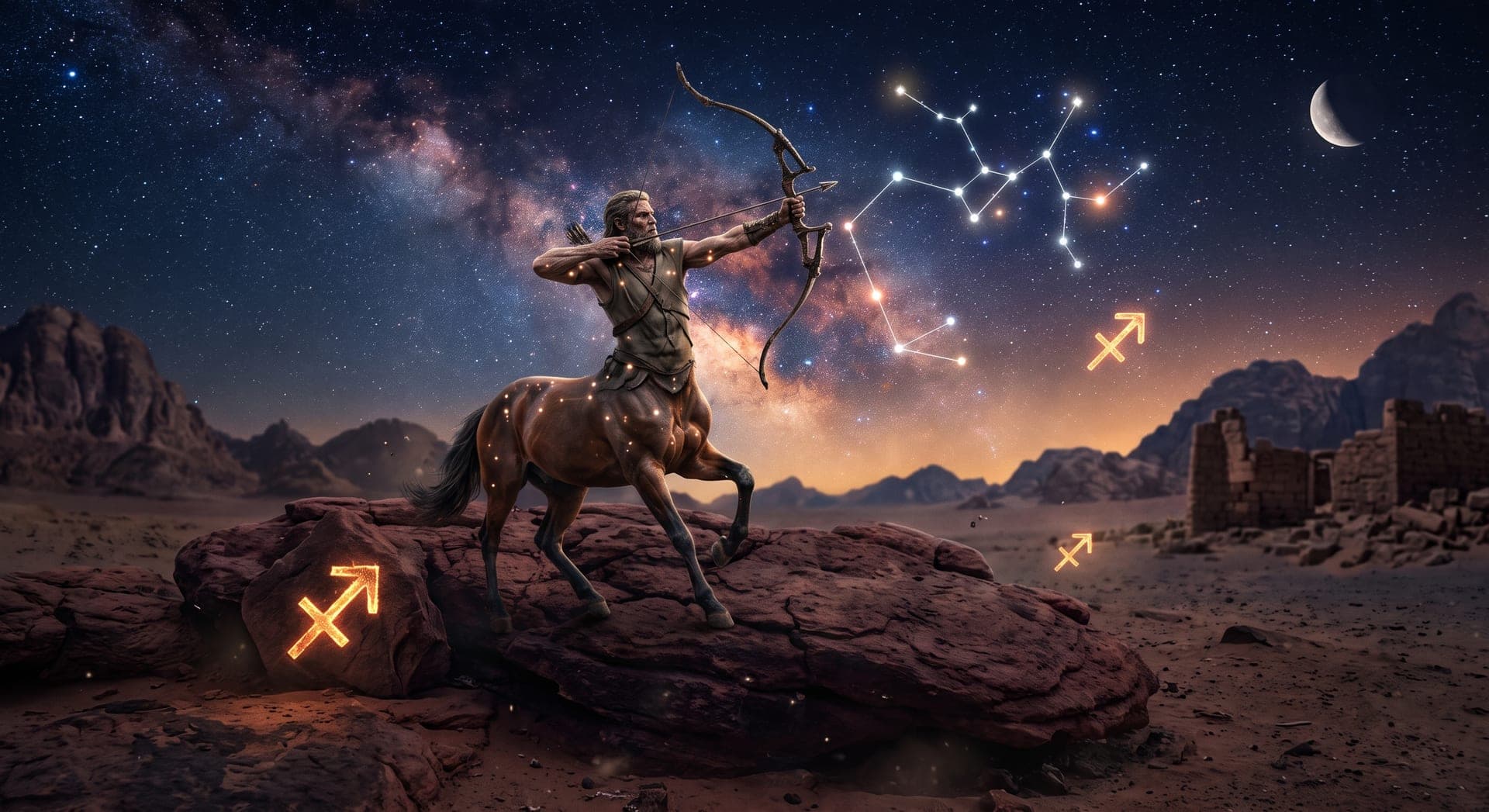
Sagittarius, the ninth sign of the zodiac, spans November 22 to December 21 and is symbolized by the archer, typically depicted as a centaur drawing a bow, representing a restless pursuit of knowledge, adventure, and far-off horizons. Ruled by Jupiter, the largest planet in the solar system and a symbol of growth, luck, and abundance, Sagittarius is widely regarded as one of the most optimistic and freedom-loving signs of the zodiac. As a Fire sign, Sagittarius approaches life with enthusiasm and a genuine hunger for new experiences, whether through literal travel or intellectual and philosophical exploration. Its Mutable modality reflects a deep aversion to routine and confinement, always looking toward the next adventure rather than settling into fixed patterns. People born under this sign are often drawn to travel, higher education, philosophy, or any pursuit that broadens their horizons and understanding of the world. Sagittarius's honesty and optimism make it excellent company, though its blunt directness and restless need for freedom can sometimes come across as tactless or noncommittal to those seeking more stability.
Personality Traits
Strengths
- Adventurous and open to new experiences
- Optimistic and enthusiastic
- Honest and direct
- Philosophical and broad-minded
- Generous and good-humored
Weaknesses
- Tactlessly blunt
- Impatient with routine
- Prone to overpromising
- Restless and commitment-averse
- Careless with details
Compatible Signs
Fun Facts
- Sagittarius's symbol, a centaur drawing a bow and arrow, connects to the Greek myth of Chiron, a wise and scholarly centaur unlike the more unruly members of his kind.
- Jupiter, Sagittarius' ruling planet, is the largest planet in the solar system, reflecting the sign's association with expansion, abundance, and big-picture thinking.
- Sagittarius is one of two zodiac signs, along with Capricorn, represented by a hybrid creature combining human and animal features.
- Notable Sagittarians include Taylor Swift, Walt Disney, Winston Churchill, and Jimi Hendrix.
- Sagittarius season spans the lead-up to the winter solstice, a period historically associated with travel, feasting, and philosophical reflection in many cultures.
Born on December 5
- 1830
Christina Rossetti
English poet known for lyrical and devotional verse such as 'Goblin Market' and the Christmas carol 'In the Bleak Midwinter'.
- 1859
John Jellicoe
English admiral who commanded the Royal Navy's Grand Fleet at the Battle of Jutland in 1916, the largest naval battle of the First World War.
- 1901
Walt Disney
American animator and co-founder of The Walt Disney Company
- 1901
Werner Heisenberg
German physicist and Nobel Prize laureate
- 1902
Strom Thurmond
American politician and longtime U.S. Senator
- 1905
Otto Preminger
Austrian-American film director and producer
- 1927
Bhumibol Adulyadej
King of Thailand
- 1932
Little Richard
American singer-songwriter and rock and roll pioneer
- 1932
Sheldon Glashow
American physicist and Nobel Prize laureate
- 1932
Alf Dubs, Baron Dubs
British Labour politician and life peer who arrived in Britain from Czechoslovakia as a child on the Kindertransport and later became a prominent campaigner for refugee rights.
- 1934
Joan Didion
American novelist and essayist
- 1954
Hanif Kureishi
English novelist and screenwriter best known for The Buddha of Suburbia and the screenplay for My Beautiful Laundrette.
- 1969
Sajid Javid
British politician who served as Chancellor of the Exchequer, Home Secretary, and Health Secretary, among the most senior British Asian politicians of his generation.
- 1969
Catherine Tate
English actress and comedian known for The Catherine Tate Show and for playing Donna Noble in Doctor Who.
- 1975
Ronnie O'Sullivan
English professional snooker player widely regarded as one of the greatest players in the sport's history, with a record number of World Championship and ranking titles.
- 2009
Owen Cooper
English actor who won a Primetime Emmy Award for his role in the television series Adolescence at age fifteen, becoming one of the youngest winners in the award's history.

On This Day in History
- 63 BCE
Cicero delivers the fourth and final of his Catiline Orations, warning the Roman Senate of a conspiracy against the republic.
Cicero's fourth Catiline Oration urged the Roman Senate to impose the death penalty on conspirators who had plotted to overthrow the republic and assassinate him, arguing that the severity of the threat justified extreme measures even without formal trial. The speech's persuasive power secured the executions, though Cicero's controversial bypassing of due process would later be used against him politically and contribute to his eventual exile.
- 1456
A major earthquake estimated at magnitude 7.2 strikes Italy, causing extreme destruction and killing approximately 70,000 people.
The 1456 earthquake struck the Kingdom of Naples with such force that it triggered landslides and devastated dozens of towns across a wide swath of southern Italy, killing tens of thousands in a region already vulnerable to seismic activity due to its location along active fault lines. Contemporary accounts describe the disaster's scale as unprecedented, and it remains one of the deadliest earthquakes in European recorded history.
- 1484
Pope Innocent VIII issues a papal bull authorizing inquisitors to suppress alleged witchcraft in Germany.
Pope Innocent VIII's papal bull, known as Summis desiderantes affectibus, granted inquisitors explicit authority to investigate and prosecute alleged witchcraft in parts of Germany, lending papal legitimacy to witch-hunting efforts that had been gaining momentum. The bull is often cited as a significant catalyst for the intensifying witch persecutions that would sweep across Europe over the following two centuries.
- 1560
Charles IX ascends to the French throne at age ten, with his mother Catherine de' Medici serving as regent.
Charles IX's accession at age ten placed effective governing power in the hands of his mother, Catherine de' Medici, during a turbulent period marked by escalating conflict between French Catholics and Protestant Huguenots. Her regency and subsequent influence over her son's reign would prove deeply consequential, including her role in the infamous St. Bartholomew's Day massacre a decade later.
- 1578
English privateer Francis Drake raids the Spanish port of Valparaíso in Chile after becoming the first Englishman to sail through the Strait of Magellan.
The raid came during Drake's circumnavigation of the globe aboard the Golden Hind, part of a voyage that combined exploration with plundering Spanish shipping in the Pacific. His exploits made him a hero in England and a source of fury in Spain; he returned home in 1580 having sailed around the world.
- 1766
Auctioneer James Christie holds his first sale in London, founding what would become the auction house Christie's.
Christie's rooms on Pall Mall quickly became a fashionable venue for selling fine art, furniture, and the estates of the aristocracy. The firm grew into one of the world's leading auction houses, still trading globally under its founder's name more than 250 years later.
- 1776
Phi Beta Kappa holds its inaugural meeting at the College of William & Mary, becoming America's oldest academic honor society.
Phi Beta Kappa's founding as a secret academic society at the College of William & Mary predated the more familiar fraternity and sorority system by decades, initially serving as both a social and intellectual club before evolving into the prestigious honor society recognized today for academic excellence. It remains the oldest and most widely recognized collegiate honor society in the United States.
- 1848
President James K. Polk confirms gold discoveries in California to Congress, helping trigger the California Gold Rush.
President Polk's confirmation of gold discoveries in California, based on verified samples sent to Washington, transformed rumors into an officially sanctioned fact that triggered a massive wave of migration to California the following year. The resulting Gold Rush dramatically accelerated California's population growth and statehood, while also causing immense disruption and violence against the region's Indigenous peoples.
- 1914
Ernest Shackleton's ship Endurance departs South Georgia, beginning the crossing toward Antarctica on his Imperial Trans-Antarctic Expedition.
The expedition aimed to make the first land crossing of Antarctica via the South Pole, but the Endurance became trapped and was eventually crushed by pack ice in the Weddell Sea. Shackleton's subsequent open-boat journey and rescue of his entire crew became one of the most celebrated survival stories in British polar exploration.
- 1921
The Football Association bans women's football from its member clubs' grounds in England, a ban that would last 50 years.
The decision came despite the huge popularity of women's teams such as Dick, Kerr Ladies, which had drawn crowds of tens of thousands during and after the First World War. The FA declared the game 'unsuitable for females,' effectively strangling the women's game in England until the ban was finally lifted in 1971.
- 1933
The Twenty-first Amendment is ratified, ending Prohibition in the United States.
The Twenty-first Amendment's ratification made the United States the only country to have ever amended its constitution to reverse an earlier prohibition amendment, ending the fourteen-year experiment with nationwide alcohol prohibition that had proven difficult to enforce and had fueled organized crime. States retained the authority to regulate or continue prohibiting alcohol within their own borders following ratification.
- 1933
The Twenty-first Amendment to the U.S. Constitution is ratified, repealing nationwide Prohibition.
Utah's ratifying vote provided the final state needed to reach the required three-quarters majority, ending the thirteen-year ban on the manufacture, sale, and transport of alcoholic beverages imposed by the Eighteenth Amendment in 1920. The repeal remains the only instance in U.S. history of a constitutional amendment being fully overturned.
- 1941
Britain declares war on Finland, Hungary and Romania, Axis co-belligerents fighting alongside Germany against the Soviet Union.
The declarations, coordinated with the Soviet Union days before Japan's attack on Pearl Harbor, formalised Britain's opposition to Germany's smaller Axis partners on the Eastern Front, although British forces saw little direct combat against any of the three countries. The same week saw the war expand dramatically with Japan's assault in the Pacific.
- 1952
London's Great Smog begins, a toxic combination of fog and air pollution blamed for an estimated 4,000 deaths.
London's Great Smog resulted from a combination of unusually cold weather, a windless atmospheric inversion, and heavy coal smoke from homes and industry, creating a thick, toxic haze that blanketed the city for five days and severely reduced visibility. The disaster's staggering death toll prompted the UK's landmark Clean Air Act of 1956, a pioneering piece of environmental legislation.
- 1952
A thick, toxic smog begins to blanket London, lingering for days and killing an estimated 4,000 people in what became known as the Great Smog.
A cold snap combined with coal-smoke pollution and windless weather to trap a dense, sulphurous fog over the city, disrupting transport and infiltrating buildings. The disaster's death toll galvanised public opinion and led directly to the Clean Air Act 1956, a landmark piece of British environmental legislation.
- 1955
The Montgomery Bus Boycott begins, a pivotal civil rights protest led by Rosa Parks and E. D. Nixon.
The Montgomery Bus Boycott began just four days after Rosa Parks' arrest, as the local Black community, organized largely through churches and the newly formed Montgomery Improvement Association led by a young Martin Luther King Jr., refused to ride city buses. The boycott lasted 381 days and ultimately succeeded when the Supreme Court ruled Montgomery's bus segregation unconstitutional.
- 1958
Queen Elizabeth II inaugurates Subscriber Trunk Dialling, Britain's new system for direct long-distance telephone calls, with a call from Bristol.
The new system allowed callers to dial long-distance numbers directly without going through a telephone operator, starting in the Bristol area. STD gradually rolled out nationwide over the following two decades and transformed how people across Britain used the phone network.
- 1958
The Preston By-pass opens to traffic, becoming the first stretch of motorway to open in the United Kingdom.
Built to relieve chronic congestion on the A6 through Preston, the eight-mile dual carriageway later became part of the M6 motorway. Its opening marked the start of Britain's motorway network, which expanded into thousands of miles of high-speed road over the following decades.
- 2005
The UK's Civil Partnership Act takes effect, with the country's first civil partnership registered that day.
The UK's Civil Partnership Act granted same-sex couples legal recognition and rights similar to marriage, including inheritance, pension, and next-of-kin rights, though it stopped short of using the term "marriage" itself. The legislation represented a significant milestone in LGBTQ rights in Britain, preceding the country's full legalization of same-sex marriage by nearly a decade.
- 2005
The Civil Partnership Act 2004 takes effect in the United Kingdom, allowing same-sex couples to form legally recognised partnerships for the first time.
The law granted same-sex couples many of the same legal rights as married couples regarding inheritance, pensions, and next-of-kin status, though it stopped short of full marriage. It remained in force until the Marriage (Same Sex Couples) Act 2013 introduced same-sex marriage in England and Wales.