What’s Observed on December 30
Born on December 30: Capricorn ♑
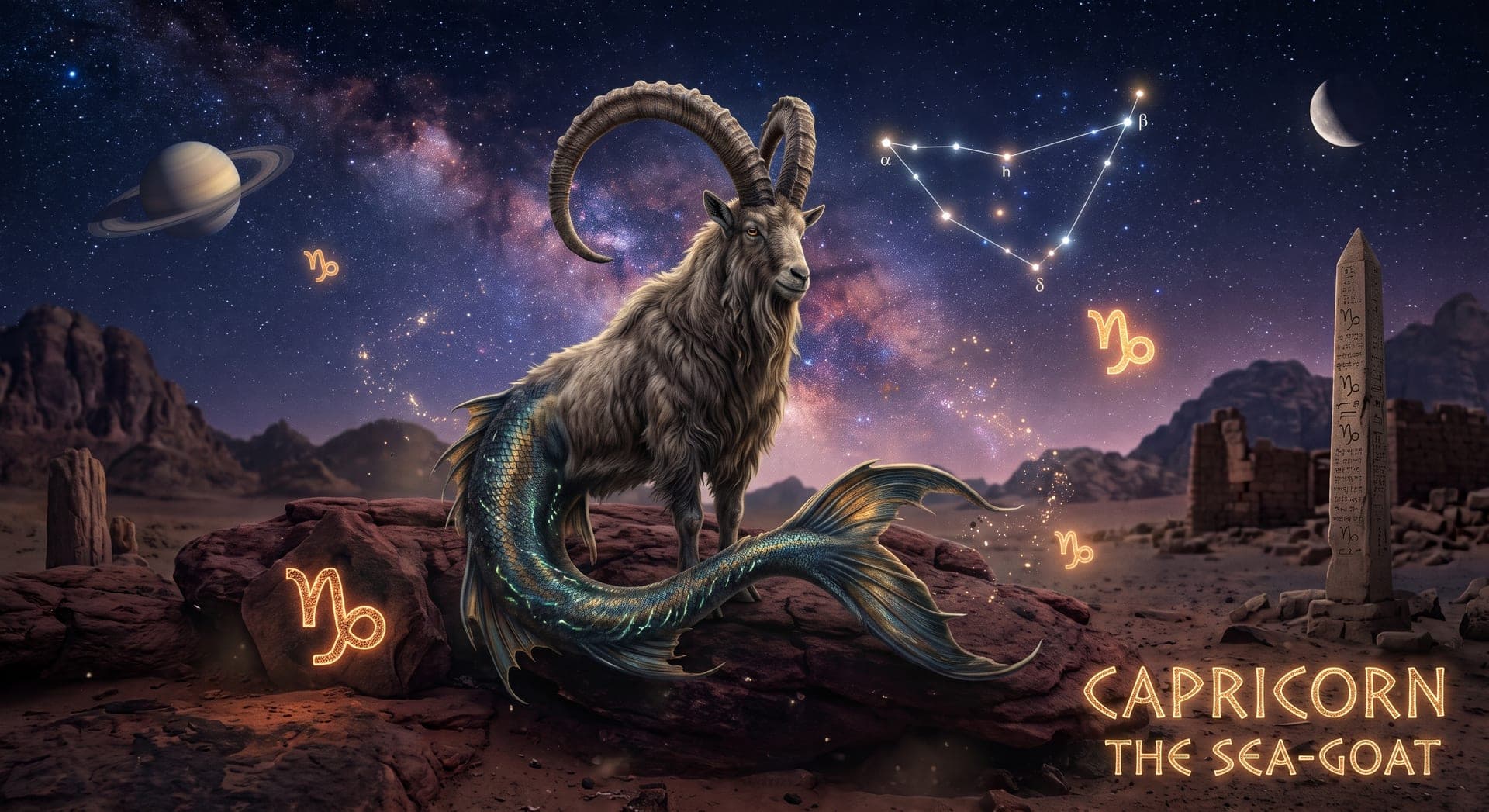
Capricorn, the tenth sign of the zodiac, spans December 22 to January 19 and is represented by the sea-goat, a mythical creature with the body of a goat and the tail of a fish, symbolizing an ability to navigate both the practical, earthly world and deeper emotional currents. Ruled by Saturn, the planet of discipline and time, Capricorns are often characterized as ambitious, patient, and deeply committed to long-term goals, willing to put in steady effort where others give up. As an Earth sign, Capricorn is grounded and practical, valuing tangible results and responsibility over impulsiveness. People born under this sign are frequently drawn to leadership and other structured pursuits where their organizational skills and work ethic can shine. Beneath a reserved, businesslike exterior, Capricorns are often said to carry a dry, understated sense of humor and a loyal, protective nature toward the people closest to them.
Personality Traits
Strengths
- Disciplined and self-controlled
- Responsible and dependable
- Excellent long-term planner
- Hardworking and persistent
- Good sense of humor once comfortable
Weaknesses
- Can be a know-it-all
- Unforgiving of mistakes, including their own
- Prone to pessimism
- Condescending toward those who don't work as hard
- Stubbornly resistant to changing plans
Compatible Signs
Fun Facts
- Capricorn's symbol, the sea-goat, comes from the Greek myth of Pan, who transformed his lower half into a fish tail to escape the monster Typhon while diving into the Nile.
- Saturn, Capricorn's ruling planet, was the Roman god of time, harvest, and generational structure, echoing the sign's association with patience and long-term thinking.
- Capricorn is one of only two zodiac signs represented by a hybrid creature, the other being Sagittarius, the centaur.
- Notable Capricorns include Michelle Obama, Martin Luther King Jr., Dolly Parton, LeBron James, and Isaac Newton.
- In traditional astrology, the winter solstice, the shortest day of the year, falls right at the start of Capricorn season in the Northern Hemisphere.
Born on December 30
- 1865
Rudyard Kipling
English author and poet, born in Bombay and long associated with the British Empire in India, whose works include The Jungle Book and the poem 'If—'; he became the first English-language writer to win the Nobel Prize in Literature.
- 1884
Hideki Tojo
Prime Minister of Japan during World War II
- 1919
David Willcocks
English organist, conductor and composer whose descant arrangements for Christmas carols, honed at King's College, Cambridge, became a fixture of British Christmas broadcasting.
- 1928
Bo Diddley
American singer-songwriter and guitarist
- 1931
John T. Houghton
Welsh physicist and climate scientist who co-founded the Intergovernmental Panel on Climate Change's scientific assessment work and became one of Britain's most influential voices on climate change.
- 1935
Sandy Koufax
American Major League Baseball pitcher
- 1937
Gordon Banks
English goalkeeper who won the 1966 World Cup with England and is often ranked among the greatest goalkeepers in football history.
- 1947
Jeff Lynne
English singer-songwriter and producer who founded the Electric Light Orchestra, blending rock with lush orchestral arrangements across a string of hit albums.
- 1959
Tracey Ullman
English actress, comedian and singer known for her sketch comedy on both British and American television, whose US show helped launch The Simpsons as a series of animated shorts.
- 1975
Tiger Woods
American professional golfer
- 1984
LeBron James
American professional basketball player
- 1986
Ellie Goulding
English singer-songwriter known for hits including 'Love Me Like You Do' and 'Lights,' one of Britain's best-selling female artists of the 2010s.
- 1990
Joe Root
English cricketer and prolific run-scorer who captained the England Test team and ranks among the highest run-scorers in Test cricket history.
On This Day in History
- 999
Brian Boru's combined Munster and Meath forces defeat Leinster and Dublin armies at the Battle of Glenmama in Ireland.
The Battle of Glenmama saw the forces of Brian Boru, who would later become Ireland's most celebrated high king, decisively defeat a rebellious alliance of Leinster and Dublin Viking-descended forces. The victory significantly consolidated Boru's growing power over Ireland, paving the way for his eventual, though brief, unification of the island under a single high kingship.
- 1066
A mob massacres Granada's Jewish population and crucifies vizier Joseph ibn Naghrela at the royal palace.
The 1066 Granada massacre, in which a mob incited by rival political factions killed the kingdom's Jewish vizier and thousands of the city's Jewish residents, stands as one of the deadliest anti-Jewish attacks in medieval Islamic Spain's history. The massacre reflected underlying tensions over the vizier's prominent political role, which had provoked resentment among segments of the Muslim population.
- 1460
Lancastrian forces defeat and kill the Duke of York at the Battle of Wakefield during the Wars of the Roses.
The Battle of Wakefield resulted in the death of Richard, Duke of York, whose claim to the English throne had ignited the Wars of the Roses, a prolonged dynastic conflict between the rival houses of Lancaster and York. His head was reportedly displayed on the gates of York wearing a paper crown in mockery of his royal ambitions, though his son would later avenge him and claim the throne as Edward IV.
- 1460
Richard, Duke of York, is killed at the Battle of Wakefield during the Wars of the Roses.
York's Yorkist army was routed by a larger Lancastrian force near his own castle at Sandal, and York himself was killed along with his teenage son Edmund, Earl of Rutland. Their deaths were a severe blow to the Yorkist cause, but York's eldest surviving son would avenge them within months, becoming King Edward IV.
- 1813
British and allied forces burn the American town of Buffalo, New York, during the War of 1812.
The raid came in retaliation for the American burning of Newark (present-day Niagara-on-the-Lake) earlier that month, part of a tit-for-tat escalation of destruction along the Niagara frontier. Most of Buffalo's buildings were destroyed and several residents killed, leaving the town to be rebuilt after the war.
- 1853
The United States completes the Gadsden Purchase, acquiring land from Mexico for a southern transcontinental railroad route.
The Gadsden Purchase, negotiated to resolve a border dispute following the Mexican-American War, acquired land in present-day southern Arizona and New Mexico primarily to secure a viable southern route for a proposed transcontinental railroad. Though the railroad envisioned at the time was never built along that exact route, the purchase finalized the contiguous continental boundaries of the United States.
- 1896
Filipino nationalist José Rizal is executed by Spanish firing squad in Manila.
José Rizal's execution by Spanish colonial authorities, carried out on charges of inciting rebellion despite his advocacy for peaceful reform rather than armed revolution, transformed him into a martyr whose death helped galvanize the Philippine independence movement. He remains revered as the Philippines' national hero, and his execution anniversary is commemorated annually as Rizal Day.
- 1897
The British colony of Natal formally annexes Zululand.
The annexation completed British absorption of the former Zulu kingdom's territory, nearly two decades after the Anglo-Zulu War had broken Zulu military power and after years of internal conflict and British administration. Zululand would remain part of Natal, and later South Africa, into the modern era.
- 1902
The British National Antarctic Expedition, led by Robert Falcon Scott, reaches a new 'Farthest South' record of 82°17'S.
Scott, accompanied by Ernest Shackleton and Edward Wilson, man-hauled sledges deep into unexplored Antarctic territory during the Discovery Expedition, breaking previous records for how far south anyone had travelled. Exhausted, snow-blind and low on food, the trio turned back; the experience helped shape Shackleton's own record-setting Antarctic expeditions in the years that followed.
- 1903
Fire tears through the Iroquois Theater in Chicago during a packed matinee performance, killing at least 605 people.
Despite being advertised as 'absolutely fireproof,' the newly opened theatre had inadequate exits and faulty fire safety equipment; when a stage light ignited a curtain, panicked crowds found many doors locked or opening the wrong way. It remains the deadliest single-building fire in American history and prompted sweeping reforms to theatre safety codes nationwide.
- 1916
The Russian mystic Grigori Rasputin is murdered by a group of noblemen led by Prince Felix Yusupov.
Rasputin, who held enormous influence over Tsar Nicholas II's family through his apparent ability to ease the haemophilia of the heir Alexei, was poisoned, shot and reportedly beaten before being thrown into the icy Neva River. His death, intended to save the monarchy from scandal, came too late to prevent the Russian Revolution just over two months later.
- 1922
The Union of Soviet Socialist Republics is formally established.
The formal establishment of the USSR united several Soviet republics, including Russia, Ukraine, Belarus, and the Transcaucasian Federation, under a single federal government following the Russian Civil War's conclusion. The union would expand over subsequent decades to include additional republics before its eventual dissolution nearly seven decades later.
- 1922
The Union of Soviet Socialist Republics is formally established.
Delegates from the Russian, Ukrainian, Byelorussian and Transcaucasian Soviet republics signed a treaty uniting them into a single federal state, the world's first constitutionally socialist country. The USSR would endure for almost seventy years, becoming one of the 20th century's two global superpowers before its dissolution in 1991.
- 1927
Tokyo's Ginza Line opens as the first subway line in Asia.
Tokyo's Ginza Line, running between Ueno and Asakusa, introduced subway transportation to Asia for the first time, reflecting Japan's rapid modernization during the interwar period. The line proved enormously popular from its opening and has since been continuously expanded, forming part of the extensive modern Tokyo Metro system that today serves millions of daily riders.
- 1943
Indian nationalist leader Subhas Chandra Bose raises the flag of an independent India at Port Blair.
With Japanese backing, Bose's Provisional Government of Free India had been ceded nominal control of the Andaman and Nicobar Islands after their occupation by Japan. His flag-raising ceremony, staged as a symbolic assertion of Indian independence from British rule, had little practical effect on the ground, where Japanese forces retained real control.
- 1947
King Michael I of Romania is forced to abdicate by the Soviet-backed communist government.
King Michael I's forced abdication, delivered under direct threat that the communist government would otherwise execute thousands of imprisoned students, ended Romania's monarchy after his family had ruled, with interruptions, for over eight decades. Michael, still a teenager when he first briefly held the throne, spent decades in exile before eventually returning to Romania following communism's collapse.
- 1952
A Royal Air Force Avro Lancaster bomber crashes at Luqa, Malta, killing its crew and a civilian on the ground.
The crash occurred at RAF Luqa, then a major British air base on the Mediterranean island, at a time when Malta remained a British colony and key military staging post. Accidents involving military aircraft were a recurring hazard of the era's demanding operational tempo, adding to a difficult toll on RAF crews during the postwar years.
- 2006
Former Iraqi President Saddam Hussein is executed by hanging.
Saddam Hussein's execution, carried out following his conviction for crimes against humanity related to the killing of Shia villagers, was captured on an unauthorized cell phone video that circulated widely and controversially showed taunting from witnesses present at the hanging. The execution's chaotic circumstances drew significant international criticism even from some who supported his prosecution.
- 2006
Former Iraqi president Saddam Hussein is executed by hanging.
Hussein was put to death in Baghdad after being convicted by an Iraqi tribunal of crimes against humanity for the 1982 killing of 148 Shia men and boys in Dujail. His hanging, filmed on a mobile phone and quickly leaked online, sparked international controversy over its chaotic, taunting conduct.
- 2009
A pipeline rupture in Shaanxi, China releases approximately 150,000 liters of diesel oil into the Wei River.
The Shaanxi pipeline rupture, spilling a substantial quantity of diesel fuel into a tributary of the Yellow River, raised significant concerns about water contamination affecting downstream communities that relied on the river for drinking water and agriculture. The incident highlighted ongoing challenges with industrial and pipeline safety infrastructure amid China's rapid economic development.