What’s Observed on December 31
Born on December 31: Capricorn ♑
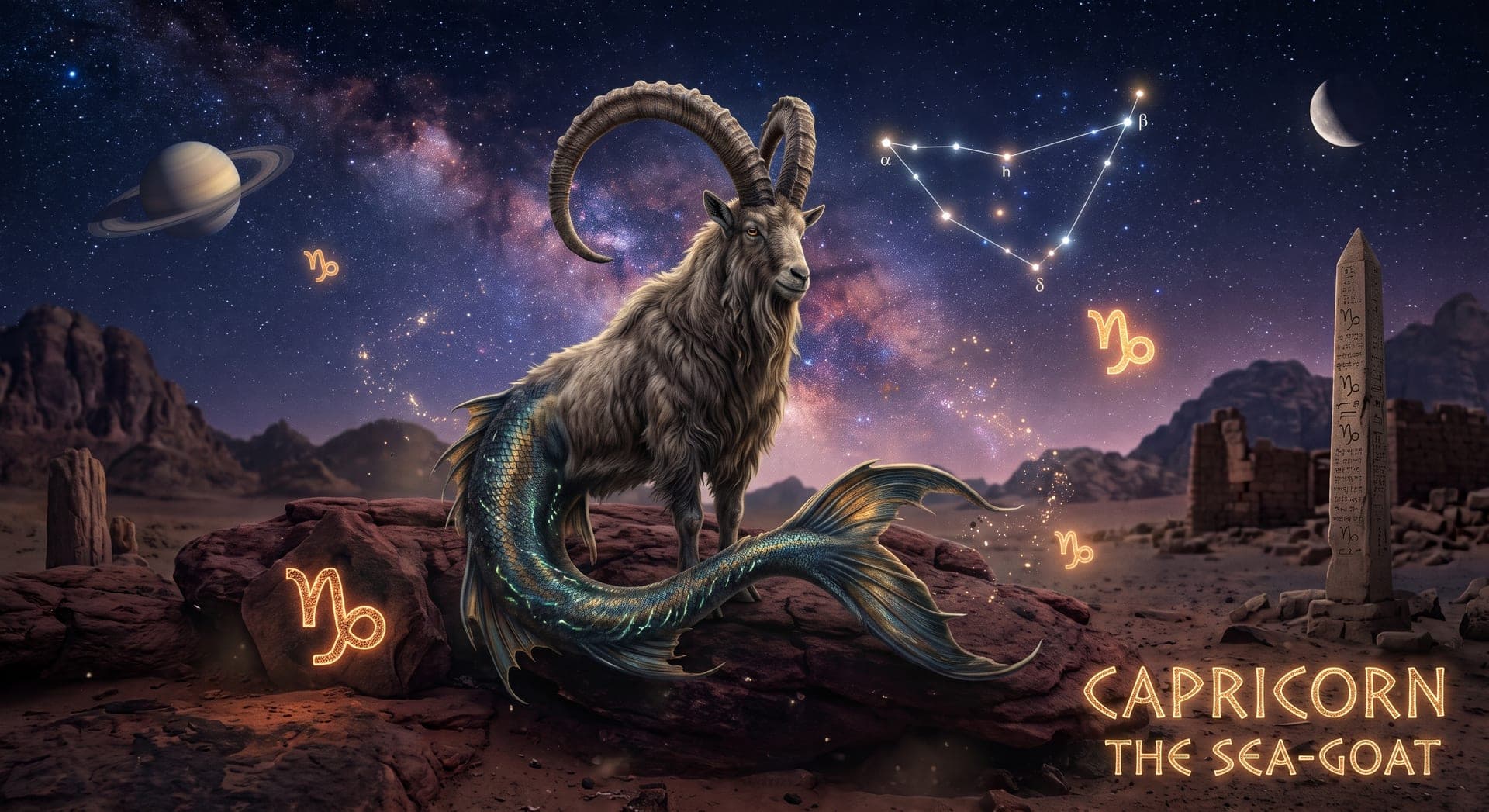
Capricorn, the tenth sign of the zodiac, spans December 22 to January 19 and is represented by the sea-goat, a mythical creature with the body of a goat and the tail of a fish, symbolizing an ability to navigate both the practical, earthly world and deeper emotional currents. Ruled by Saturn, the planet of discipline and time, Capricorns are often characterized as ambitious, patient, and deeply committed to long-term goals, willing to put in steady effort where others give up. As an Earth sign, Capricorn is grounded and practical, valuing tangible results and responsibility over impulsiveness. People born under this sign are frequently drawn to leadership and other structured pursuits where their organizational skills and work ethic can shine. Beneath a reserved, businesslike exterior, Capricorns are often said to carry a dry, understated sense of humor and a loyal, protective nature toward the people closest to them.
Personality Traits
Strengths
- Disciplined and self-controlled
- Responsible and dependable
- Excellent long-term planner
- Hardworking and persistent
- Good sense of humor once comfortable
Weaknesses
- Can be a know-it-all
- Unforgiving of mistakes, including their own
- Prone to pessimism
- Condescending toward those who don't work as hard
- Stubbornly resistant to changing plans
Compatible Signs
Fun Facts
- Capricorn's symbol, the sea-goat, comes from the Greek myth of Pan, who transformed his lower half into a fish tail to escape the monster Typhon while diving into the Nile.
- Saturn, Capricorn's ruling planet, was the Roman god of time, harvest, and generational structure, echoing the sign's association with patience and long-term thinking.
- Capricorn is one of only two zodiac signs represented by a hybrid creature, the other being Sagittarius, the centaur.
- Notable Capricorns include Michelle Obama, Martin Luther King Jr., Dolly Parton, LeBron James, and Isaac Newton.
- In traditional astrology, the winter solstice, the shortest day of the year, falls right at the start of Capricorn season in the Northern Hemisphere.
Born on December 31
- 1720
Charles Edward Stuart
Scottish Jacobite claimant to the British throne, popularly known as 'Bonnie Prince Charlie,' who led the failed 1745 rising in an attempt to restore his family's Stuart dynasty.
- 1738
Charles Cornwallis
English general and colonial administrator who, after surrendering British forces at Yorktown in 1781, went on to serve as Governor-General of India and Lord Lieutenant of Ireland.
- 1869
Henri Matisse
French painter and pioneer of modern art
- 1880
George Marshall
American general and U.S. Secretary of State who designed the Marshall Plan
- 1908
Simon Wiesenthal
Austrian Holocaust survivor and Nazi hunter
- 1912
John Frost
British Army general who led the airborne assault to hold the bridge at Arnhem during Operation Market Garden, an action later dramatised in the film A Bridge Too Far.
- 1917
Wilfrid Noyce
English mountaineer and writer who was part of the 1953 British expedition that achieved the first ascent of Mount Everest.
- 1925
Daphne Oram
British composer and pioneering electronic musician who co-founded the BBC Radiophonic Workshop and invented an early form of visual sound synthesis known as Oramics.
- 1929
Peter May
English cricketer regarded as one of the finest batsmen of his era, who captained England in more than forty Test matches during the 1950s.
- 1930
Odetta
American folk singer and civil rights activist
- 1941
Alex Ferguson
Scottish football manager who led Manchester United to an unprecedented run of domestic and European success over more than a quarter-century, becoming the most decorated manager in British football history.
- 1954
Alex Salmond
Scottish politician who led the Scottish National Party and served as First Minister of Scotland, leading the country's 2014 independence referendum campaign.
- 1959
Val Kilmer
American actor
- 1968
Junot Díaz
Dominican-American author
- 1995
Gabby Douglas
American Olympic gymnast
On This Day in History
- 870
Anglo-Saxon forces repel a Viking army at the Battle of Englefield in Berkshire.
Ealdorman Æthelwulf of Berkshire led local forces to victory over a raiding Viking column, killing one of its leaders, in one of the rare English successes during the 'Great Heathen Army's' campaigns of the 860s and 870s. The victory was short-lived; a larger Viking force defeated the same English army just days later at Reading.
- 1600
The British East India Company is chartered by Queen Elizabeth I, launching centuries of British trade and colonial influence in Asia.
The British East India Company's royal charter granted it an initial monopoly on English trade with Asia, and the company would gradually expand from a purely commercial trading enterprise into a de facto colonial ruling power across much of the Indian subcontinent. Its eventual dissolution followed a major rebellion in 1857, after which the British Crown assumed direct governmental control over India.
- 1600
Queen Elizabeth I grants a royal charter to the East India Company.
The charter gave a group of London merchants a monopoly on English trade with Asia, initially aimed at breaking into the lucrative spice trade dominated by the Dutch and Portuguese. Over the following two and a half centuries the company grew into a private empire that would conquer and administer much of the Indian subcontinent before Crown rule replaced it in 1858.
- 1670
The English naval officer John Narborough's expedition leaves Corral Bay, Chile, after a hostile encounter with Spanish colonial authorities.
Narborough had been sent by King Charles II to chart the Strait of Magellan and Chile's coastline and explore trade prospects, but Spanish officials, wary of English incursion into their territory, seized four of his men as hostages. The voyage nonetheless produced valuable navigational charts later used by English mariners in the region.
- 1759
Arthur Guinness signs a 9,000-year lease on the St. James's Gate Brewery in Dublin, founding the Guinness brewing company.
Arthur Guinness's extraordinarily long lease on the St. James's Gate Brewery in Dublin, still technically in effect today though its terms became largely symbolic long ago, marked the beginning of what would become one of the world's most recognized beer brands. The distinctive dark stout he and his successors developed became deeply intertwined with Irish cultural identity worldwide.
- 1759
Arthur Guinness signs a 9,000-year lease on a disused brewery at St. James's Gate, Dublin.
Paying £45 a year for the site under a lease designed to last effectively forever, Guinness began brewing what would become one of the world's best-known stouts. Dublin was then part of the Kingdom of Ireland under the British Crown, and Guinness went on to become one of the most recognisable beer brands to emerge from the British Isles.
- 1775
British forces repel an American assault on Quebec City in a blinding snowstorm.
A Continental Army force under General Richard Montgomery attacked the fortified city in an attempt to bring Canada into the American Revolution, but the British garrison under Guy Carleton beat back the assault; Montgomery was killed in the fighting. The failed attack secured British control of Canada for the remainder of the war.
- 1853
More than twenty scientists dine inside a life-size model of an iguanodon at London's Crystal Palace Park.
The sculptor Benjamin Waterhouse Hawkins and the anatomist Richard Owen, who had coined the word 'dinosaur' a decade earlier, hosted the eccentric New Year's Eve dinner inside the half-built concrete model to promote their new display of prehistoric creatures. The stunt captured Victorian Britain's fascination with the new science of palaeontology.
- 1857
Queen Victoria selects Ottawa as the capital of the Province of Canada.
The choice surprised many, since Ottawa was then a modest logging town far smaller than rivals such as Toronto, Montreal and Quebec City. Victoria's reasoning reportedly included Ottawa's relatively defensible inland position, away from the American border, and it has remained Canada's capital ever since.
- 1879
Thomas Edison publicly demonstrates his incandescent light bulb for the first time in Menlo Park, New Jersey.
Thomas Edison's public demonstration of his incandescent light bulb at his Menlo Park laboratory showcased a practical, long-lasting electric lighting solution after years of experimentation with various filament materials. The demonstration drew huge crowds eager to witness the novel technology, and Edison's subsequent commercialization efforts would help usher in the widespread electrification of homes and businesses.
- 1907
The first New Year's Eve ball drop takes place in New York's Times Square, establishing an enduring annual tradition.
The inaugural Times Square ball drop replaced an earlier tradition of fireworks displays, which New York City officials had banned due to safety concerns, providing New York Times owner Adolph Ochs with a new way to draw crowds and publicity to his newspaper's headquarters. The tradition has continued nearly every year since, becoming one of the most recognized New Year's celebrations in the world.
- 1942
The Royal Navy defeats the German Kriegsmarine at the Battle of the Barents Sea.
British cruisers and destroyers escorting an Arctic convoy to the Soviet Union fought off a much larger German squadron, including the heavy cruiser Admiral Hipper and the pocket battleship Lützow. Hitler was so enraged by the failure that he ordered Germany's surface fleet effectively scrapped, forcing the resignation of naval chief Grand Admiral Erich Raeder within weeks.
- 1951
The Marshall Plan officially expires after distributing more than $13 billion to rebuild postwar Western Europe.
Britain, its economy battered by six years of war, was the largest single recipient of Marshall Plan aid, using the funds to rebuild industry and infrastructure. The American-funded programme is widely credited with accelerating Western Europe's postwar recovery and cementing transatlantic ties during the early Cold War.
- 1963
The Central African Federation officially dissolves into the separate territories of Zambia, Malawi and Rhodesia.
The British-administered federation, which had tied together Northern Rhodesia, Southern Rhodesia and Nyasaland since 1953, collapsed under pressure from African nationalist movements demanding independence and an end to white minority rule. Northern Rhodesia and Nyasaland became independent as Zambia and Malawi within the year, while Southern Rhodesia's white minority government would unilaterally declare independence as Rhodesia in 1965.
- 1991
Soviet governmental institutions cease operations following the formal dissolution of the Soviet Union.
The formal cessation of Soviet governmental institutions on the final day of 1991 marked the definitive practical end of the Soviet Union's seven-decade existence, following the legal dissolution votes and Gorbachev's resignation earlier that same week. The transition left fifteen newly independent nations to navigate the complex political and economic challenges of the post-Soviet era.
- 1992
Czechoslovakia peacefully splits into two independent nations, the Czech Republic and Slovakia, in the "Velvet Divorce."
The "Velvet Divorce" split Czechoslovakia into the Czech Republic and Slovakia through a remarkably peaceful and orderly negotiated process, contrasting sharply with the violent ethnic conflicts that accompanied the breakup of Yugoslavia around the same period. The amicable separation, driven primarily by political leaders rather than significant popular demand, is often cited as a model for peaceful national divisions.
- 1999
Boris Yeltsin resigns as Russia's president, unexpectedly transferring power to Vladimir Putin.
Boris Yeltsin's surprise resignation, delivered in a televised New Year's Eve address, unexpectedly elevated his little-known Prime Minister Vladimir Putin to acting president, launching what would become one of the longest and most consequential political careers in modern Russian history. Yeltsin's decision was widely seen as an effort to secure legal immunity and protect his family's interests following his departure from power.
- 1999
The United States hands control of the Panama Canal over to Panama.
The transfer of the Panama Canal to full Panamanian control fulfilled the terms of a 1977 treaty negotiated under President Carter, ending nearly a century of American administration over the strategically vital waterway. The handover, achieved despite significant political controversy in the United States at the time of the original treaty's negotiation, has generally been regarded as a successful transition.
- 2004
Taipei 101 officially opens in Taiwan, becoming the world's tallest skyscraper at the time.
Taipei 101's opening, featuring a distinctive design inspired by traditional pagoda architecture and bamboo stalks, briefly held the world's tallest building title until surpassed years later by Dubai's Burj Khalifa. The skyscraper's advanced engineering, including a massive tuned mass damper to counteract swaying from earthquakes and typhoons, showcased significant achievements in tall building design for a seismically active region.
- 2019
The World Health Organization is notified of unexplained pneumonia cases in Wuhan, China, marking the emergence of COVID-19.
The World Health Organization's notification of mysterious pneumonia cases in Wuhan marked one of the first formal international acknowledgments of what would become the COVID-19 pandemic, though the full scale and severity of the emerging outbreak was not yet understood. Within months, the virus would spread globally, fundamentally transforming public health policy, daily life, and the global economy for years to come.