
What’s Observed on December 29
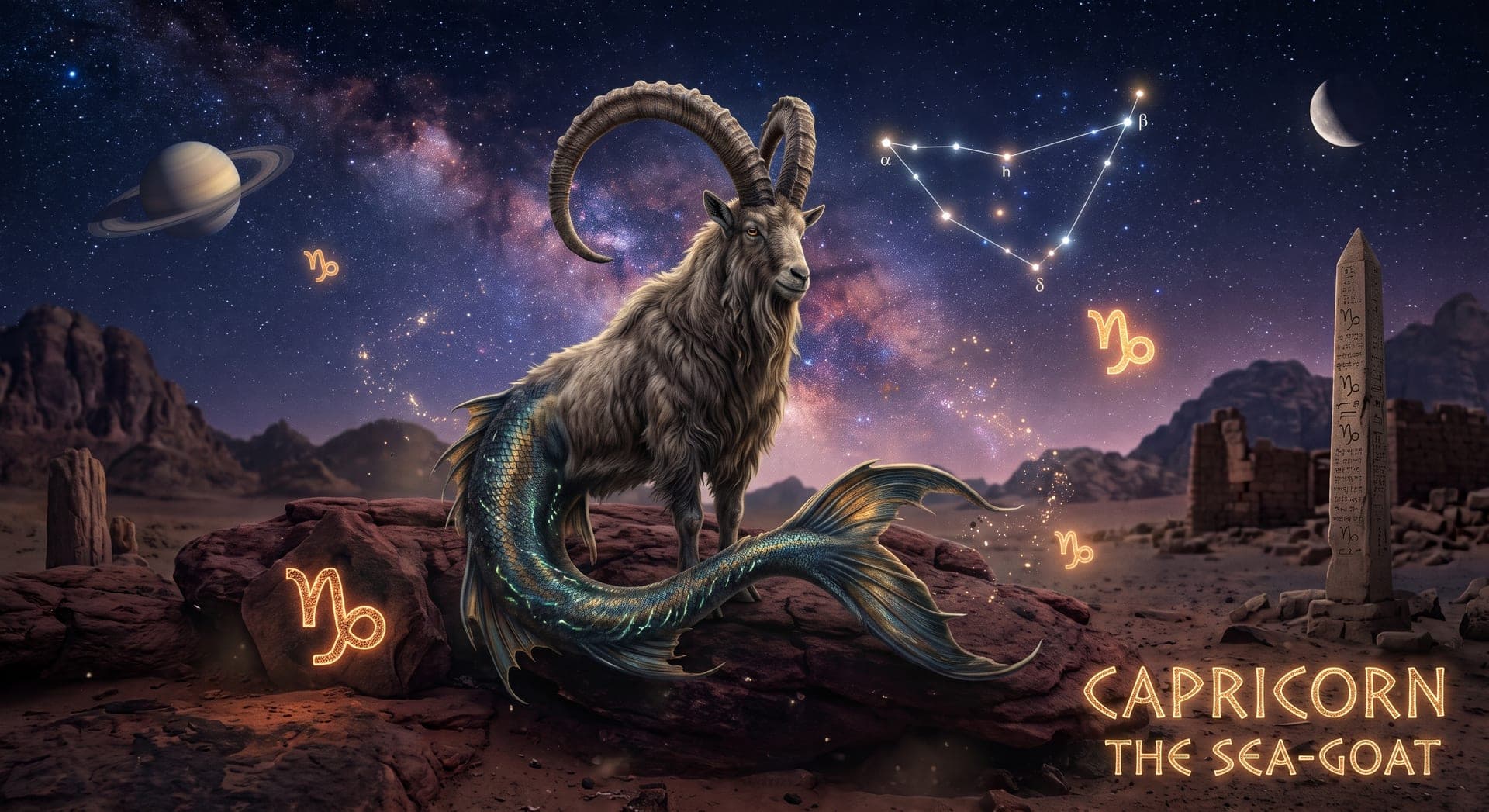
Born on December 29: Capricorn ♑
Capricorn, the tenth sign of the zodiac, spans December 22 to January 19 and is represented by the sea-goat, a mythical creature with the body of a goat and the tail of a fish, symbolizing an ability to navigate both the practical, earthly world and deeper emotional currents. Ruled by Saturn, the planet of discipline and time, Capricorns are often characterized as ambitious, patient, and deeply committed to long-term goals, willing to put in steady effort where others give up. As an Earth sign, Capricorn is grounded and practical, valuing tangible results and responsibility over impulsiveness. People born under this sign are frequently drawn to leadership and other structured pursuits where their organizational skills and work ethic can shine. Beneath a reserved, businesslike exterior, Capricorns are often said to carry a dry, understated sense of humor and a loyal, protective nature toward the people closest to them.
Personality Traits
Strengths
- Disciplined and self-controlled
- Responsible and dependable
- Excellent long-term planner
- Hardworking and persistent
- Good sense of humor once comfortable
Weaknesses
- Can be a know-it-all
- Unforgiving of mistakes, including their own
- Prone to pessimism
- Condescending toward those who don't work as hard
- Stubbornly resistant to changing plans
Compatible Signs
Fun Facts
- Capricorn's symbol, the sea-goat, comes from the Greek myth of Pan, who transformed his lower half into a fish tail to escape the monster Typhon while diving into the Nile.
- Saturn, Capricorn's ruling planet, was the Roman god of time, harvest, and generational structure, echoing the sign's association with patience and long-term thinking.
- Capricorn is one of only two zodiac signs represented by a hybrid creature, the other being Sagittarius, the centaur.
- Notable Capricorns include Michelle Obama, Martin Luther King Jr., Dolly Parton, LeBron James, and Isaac Newton.
- In traditional astrology, the winter solstice, the shortest day of the year, falls right at the start of Capricorn season in the Northern Hemisphere.
Born on December 29
- 1766
Charles Macintosh
Scottish chemist whose invention of a rubberised, waterproof fabric gave rise to the raincoat that still bears his name, the mackintosh.
- 1808
Andrew Johnson
17th President of the United States
- 1809
William Ewart Gladstone
English statesman who served four separate terms as British Prime Minister during the Victorian era, becoming one of the dominant political figures of 19th-century Britain.
- 1876
Pablo Casals
Catalan cellist and conductor
- 1910
Ronald Coase
English-American economist whose work on transaction costs and property rights won him the Nobel Memorial Prize in Economic Sciences and reshaped the field of law and economics.
- 1928
Bernard Cribbins
English actor and entertainer beloved across generations for roles including Wilfred Mott in Doctor Who, the voice of the Wombles, and decades of children's storytelling on Jackanory.
- 1936
Mary Tyler Moore
American actress and producer
- 1946
Marianne Faithfull
English singer-songwriter and actress who rose to fame in the 1960s London music scene before a critically acclaimed comeback as a distinctive, world-weary vocalist and performer.
- 1947
Ted Danson
American actor
- 1948
Peter Robinson
Northern Irish politician who led the Democratic Unionist Party and served as First Minister of Northern Ireland, playing a central role in the region's post-Troubles power-sharing government.
- 1953
Alan Rusbridger
English journalist who edited The Guardian for two decades, overseeing its digital transformation and its coverage of major stories including the Edward Snowden surveillance leaks.
- 1972
Jude Law
English actor known for roles in films including The Talented Mr. Ripley, Sherlock Holmes and Closer, and for his extensive stage work in London and New York.
- 1979
Diego Luna
Mexican actor and director
- 1989
Kei Nishikori
Japanese professional tennis player
On This Day in History
- 1170
Thomas Becket, Archbishop of Canterbury, is assassinated inside Canterbury Cathedral by followers of King Henry II.
Thomas Becket's assassination, carried out by four knights who believed they were acting on King Henry II's wishes following an offhand angry remark, shocked medieval Christendom and transformed the murdered archbishop into a venerated martyr. Becket's shrine at Canterbury Cathedral became one of medieval Europe's most important pilgrimage destinations, later immortalized in Chaucer's "Canterbury Tales."
- 1170
Archbishop Thomas Becket is murdered inside Canterbury Cathedral.
Four knights, believing they were acting on King Henry II's wishes after he reportedly raged about his troublesome archbishop, cut Becket down before the cathedral altar following years of conflict between Church and Crown. His murder caused international outrage, forced Henry into public penance, and made Becket's shrine one of medieval Europe's great pilgrimage sites.
- 1607
According to explorer John Smith's account, Pocahontas intervenes to save his life during a tribal encounter.
According to John Smith's own later account, Pocahontas, the young daughter of Powhatan chief Wahunsenacawh, intervened to prevent his execution during a tense encounter with her father's people. Historians have long debated the accuracy and interpretation of Smith's account, with some suggesting the event may have been a ritual adoption ceremony rather than a genuine rescue from execution.
- 1607
According to Captain John Smith's own account, Pocahontas intervenes to save his life at Jamestown.
Smith later wrote that Powhatan, father of the young Pocahontas, had ordered him executed after his capture, and that she threw herself over him to stop the killing. Historians still debate how much of the famous episode was accurate, embellished, or invented outright, but it became one of the founding legends of early colonial America.
- 1778
British forces capture Savannah, Georgia during the American Revolutionary War.
British forces' capture of Savannah gave them a crucial foothold in the American South during the Revolutionary War's later "Southern Strategy," as British commanders sought to exploit perceived greater loyalist sentiment in the southern colonies. Savannah would remain under British control for several years, serving as a base for further operations throughout the region.
- 1778
British forces capture Savannah, Georgia, during the American Revolutionary War.
A British expeditionary force landed near the city and routed its American defenders in a swift assault, seizing Georgia's capital and beginning a two-and-a-half-year occupation. The victory opened a new 'Southern strategy' phase of the war, as Britain shifted its focus to the American South.
- 1812
The USS Constitution defeats HMS Java off the coast of Brazil in a three-hour naval engagement during the War of 1812.
The USS Constitution's victory over HMS Java, achieved through the American frigate's superior construction and skilled gunnery that heavily damaged the British vessel beyond repair, further burnished the reputation earned by the ship's earlier victories that had given it the nickname "Old Ironsides." The ship remains preserved today as the world's oldest commissioned naval vessel still afloat.
- 1812
The American frigate USS Constitution defeats and sinks the Royal Navy frigate HMS Java off the coast of Brazil.
After a fierce two-hour engagement, Java was left too badly damaged to be brought home as a prize and was burned at sea. The loss was the third British frigate destroyed by an American ship in the war's first year, a stinging blow to the Royal Navy's prestige.
- 1835
The Treaty of New Echota cedes remaining Cherokee lands east of the Mississippi River to the United States.
The Treaty of New Echota, signed by a small, unauthorized faction of Cherokee leaders without the consent of the tribe's official government, provided the legal pretext the U.S. government used to force the removal of the Cherokee Nation from their ancestral lands. The resulting forced march west, known as the Trail of Tears, killed thousands of Cherokee people through exposure, disease, and starvation.
- 1860
HMS Warrior, the Royal Navy's first ocean-going iron-hulled armoured warship, is launched.
Built in response to France's pioneering ironclad Gloire, Warrior combined iron armour with steam power and was, at the time, the largest and most heavily armed warship afloat. Its launch triggered a naval arms race and made every wooden warship in the world's navies effectively obsolete overnight.
- 1890
The Wounded Knee Massacre results in the deaths of approximately 300 Lakota men, women, and children at Pine Ridge Reservation.
The Wounded Knee Massacre, in which U.S. Army troops killed several hundred Lakota men, women, and children following a chaotic confrontation during an attempted disarmament, is widely regarded as marking the brutal, tragic end of large-scale armed conflict between the U.S. military and Plains Indigenous nations. The massacre remains a profound and painful symbol of the broader violence inflicted upon Native American peoples during westward expansion.
- 1890
US cavalry troops kill an estimated 250 to 300 Lakota men, women and children at Wounded Knee, South Dakota.
The massacre followed the army's attempt to disarm a band of Lakota led by Chief Spotted Elk, camped near Wounded Knee Creek; a struggle triggered a chaotic slaughter using rifles and rapid-fire artillery. It is widely regarded as marking the end of large-scale armed conflict between the US government and Plains Indian nations.
- 1911
Mongolia declares independence from the collapsing Qing dynasty.
Mongolia's declaration of independence from the collapsing Qing dynasty established a Buddhist theocratic government under the Jebtsundamba Khutughtu, though full international recognition of Mongolian sovereignty would not come for decades, and the country would fall under significant Soviet influence following a subsequent revolution.
- 1934
Japan formally renounces the Washington and London Naval Treaties.
The two interwar treaties, negotiated in part by Britain to cap the size of the world's major navies including its own Royal Navy, had limited an arms race after the First World War. Japan's withdrawal freed it to build warships without restriction and alarmed British naval planners already anxious about defending imperial interests in Asia.
- 1937
A new constitution replaces the Irish Free State with the modern state of Ireland.
Ireland's new constitution, replacing the earlier Irish Free State framework established under the 1921 Anglo-Irish Treaty, asserted greater sovereignty from Britain while notably avoiding an outright declaration of a republic, a status Ireland would not formally claim until 1949. The document, still in force today with amendments, established the modern structure of Irish governance.
- 1937
The Irish Free State is replaced by a new state, Ireland, under a new constitution.
The constitution, championed by Taoiseach Éamon de Valera, dropped the state's remaining formal ties to the British Crown and asserted sovereignty over the whole island of Ireland, though Northern Ireland remained part of the United Kingdom. It marked one of the final steps in Ireland's long separation from British rule after the 1921 Anglo-Irish Treaty.
- 1940
German bombers set much of central London ablaze in a raid later called the Second Great Fire of London, killing around 200 people.
A concentrated Luftwaffe incendiary raid, timed to coincide with a low tide that hampered firefighters drawing water from the Thames, destroyed large parts of the historic City of London. Photographs of St Paul's Cathedral standing defiant amid the smoke became one of the most iconic images of the Blitz, a symbol of British resilience under bombardment.
- 1989
Václav Havel becomes Czechoslovakia's first post-communist president following the Velvet Revolution.
Václav Havel's election as Czechoslovakia's president, achieved through a unanimous parliamentary vote just weeks after his release from imprisonment as a dissident playwright, exemplified the remarkably swift and peaceful nature of the Velvet Revolution's transition from communist rule. His subsequent leadership guided the country through significant political and economic transformation, including its eventual peaceful division into separate Czech and Slovak states.
- 2006
Britain makes its final repayment on the loans it took from the United States and Canada to rebuild after the Second World War.
The original 1946 loan agreement had provided Britain with $3.75 billion from the US and a further loan from Canada to stabilise its shattered postwar economy. Fifty annual instalments later, the final payment quietly closed the book on one of the largest sovereign loans of the 20th century.
- 2024
Jeju Air Flight 2216 crashes in South Korea, becoming the nation's worst aviation disaster.
The Jeju Air crash, which occurred during a landing attempt following a reported bird strike and subsequent emergency, became South Korea's deadliest aviation disaster and prompted an extensive investigation into the incident's causes, including scrutiny of the runway's safety infrastructure. The disaster led to significant public mourning and calls for aviation safety reforms across the country.