What’s Observed on December 28
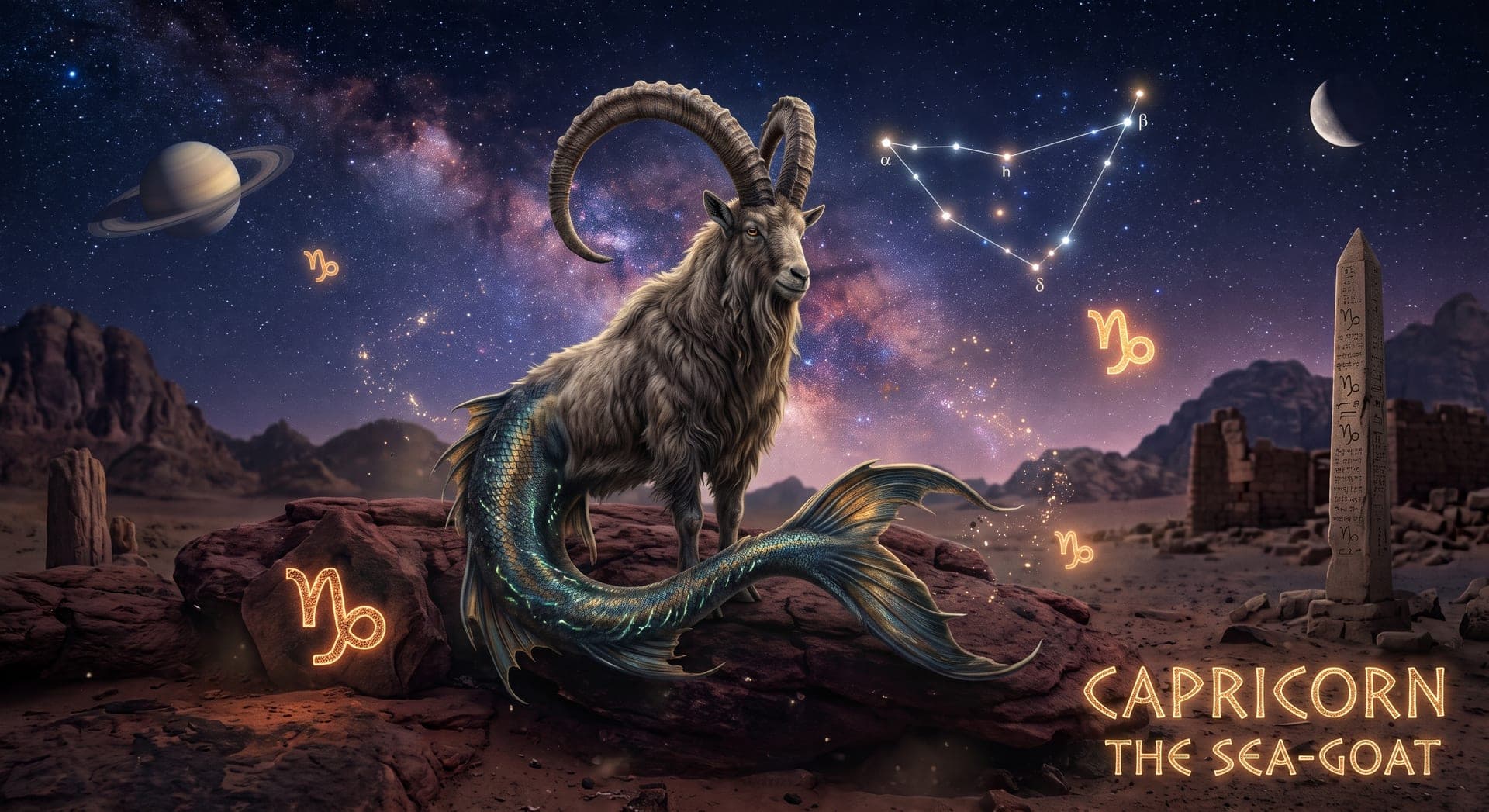
Born on December 28: Capricorn ♑
Capricorn, the tenth sign of the zodiac, spans December 22 to January 19 and is represented by the sea-goat, a mythical creature with the body of a goat and the tail of a fish, symbolizing an ability to navigate both the practical, earthly world and deeper emotional currents. Ruled by Saturn, the planet of discipline and time, Capricorns are often characterized as ambitious, patient, and deeply committed to long-term goals, willing to put in steady effort where others give up. As an Earth sign, Capricorn is grounded and practical, valuing tangible results and responsibility over impulsiveness. People born under this sign are frequently drawn to leadership and other structured pursuits where their organizational skills and work ethic can shine. Beneath a reserved, businesslike exterior, Capricorns are often said to carry a dry, understated sense of humor and a loyal, protective nature toward the people closest to them.
Personality Traits
Strengths
- Disciplined and self-controlled
- Responsible and dependable
- Excellent long-term planner
- Hardworking and persistent
- Good sense of humor once comfortable
Weaknesses
- Can be a know-it-all
- Unforgiving of mistakes, including their own
- Prone to pessimism
- Condescending toward those who don't work as hard
- Stubbornly resistant to changing plans
Compatible Signs
Fun Facts
- Capricorn's symbol, the sea-goat, comes from the Greek myth of Pan, who transformed his lower half into a fish tail to escape the monster Typhon while diving into the Nile.
- Saturn, Capricorn's ruling planet, was the Roman god of time, harvest, and generational structure, echoing the sign's association with patience and long-term thinking.
- Capricorn is one of only two zodiac signs represented by a hybrid creature, the other being Sagittarius, the centaur.
- Notable Capricorns include Michelle Obama, Martin Luther King Jr., Dolly Parton, LeBron James, and Isaac Newton.
- In traditional astrology, the winter solstice, the shortest day of the year, falls right at the start of Capricorn season in the Northern Hemisphere.
Born on December 28
- 1798
Thomas Henderson
Scottish astronomer who became the first person to measure the parallax, and thus the distance, of a star beyond the Sun, for Alpha Centauri, and later served as Scotland's first Astronomer Royal.
- 1856
Woodrow Wilson
28th President of the United States and Nobel Peace Prize laureate
- 1882
Arthur Eddington
English astrophysicist whose 1919 observations of a solar eclipse provided the first experimental confirmation of Einstein's general theory of relativity, making him one of the most influential scientists of his era.
- 1903
John von Neumann
Hungarian-American mathematician and computing pioneer
- 1922
Stan Lee
American comic book writer and Marvel Comics figurehead
- 1934
Maggie Smith
English actress and two-time Academy Award winner, celebrated across seven decades on stage and screen for roles including Professor McGonagall in the Harry Potter films and the Dowager Countess in Downton Abbey.
- 1945
Max Hastings
English journalist, military historian and former editor of The Daily Telegraph, known for his prolific writing on the Second World War and British military history.
- 1950
Clifford Cocks
English mathematician who, while working at Britain's GCHQ, secretly invented what became known as the RSA public-key encryption algorithm years before its independent public discovery.
- 1954
Denzel Washington
American actor and director
- 1956
Nigel Kennedy
English violinist known for his flamboyant style and genre-crossing career, whose 1989 recording of Vivaldi's Four Seasons became one of the best-selling classical albums ever made.
- 1969
Linus Torvalds
Finnish-American software engineer who created the Linux kernel
- 1978
John Legend
American singer-songwriter
- 1981
Sienna Miller
American-born English actress and fashion designer, a fixture of British film, television and fashion since the mid-2000s.
- 1990
David Archuleta
American singer
- 1994
Adam Peaty
English swimmer and multiple Olympic gold medallist, widely regarded as the greatest breaststroke swimmer in history.

On This Day in History
- 1065
Edward the Confessor's rebuilt Westminster Abbey is consecrated.
The Anglo-Saxon king had spent years and much of his wealth reconstructing the abbey church in the Romanesque style, modelled on Norman architecture. Too ill to attend the consecration himself, Edward died just over a week later and was buried within its walls; the abbey has hosted every English and British coronation since 1066.
- 1659
Maratha forces defeat the Adilshahi army at the Battle of Kolhapur in western India.
The Battle of Kolhapur saw the rising Maratha Empire defeat Adilshahi forces from the neighboring Bijapur Sultanate, an early demonstration of Maratha military strength under leadership that would eventually challenge Mughal dominance across much of the Indian subcontinent. The victory contributed to the Marathas' growing territorial control in western India during this formative period of the empire's expansion.
- 1768
King Taksin's coronation establishes Thonburi as the capital of Siam following military conquest.
King Taksin's establishment of Thonburi as Siam's capital came after he successfully drove out Burmese occupying forces and reunified the fractured kingdom following the earlier destruction of the previous capital, Ayutthaya. His reign, though relatively brief and ending in his own controversial overthrow, laid crucial groundwork for the subsequent Chakri dynasty that continues to rule Thailand today.
- 1795
Construction begins on Yonge Street in York, Upper Canada, which would grow into one of the world's longest streets.
Yonge Street's construction, ordered by Upper Canada's first lieutenant governor partly for military purposes to provide an inland route away from vulnerable American border areas, would eventually stretch for a considerable distance and become recognized, though the claim is now disputed, as one of the longest streets in the world. The road remains a major thoroughfare through Toronto and surrounding areas today.
- 1835
Seminole leader Osceola launches the Second Seminole War against United States forces in Florida.
Osceola's leadership of Seminole resistance against forced relocation under the Indian Removal Act launched the costliest and longest of the Seminole Wars, as Seminole and allied forces conducted effective guerrilla warfare against U.S. troops in Florida's dense terrain for years. Osceola himself was later captured under a false flag of truce and died in captivity, though Seminole resistance continued for years afterward.
- 1836
The British province of South Australia is proclaimed, with its capital at Adelaide.
Unlike Australia's earlier penal colonies, South Australia was founded on principles of free settlement and religious tolerance, backed by an Act of the British Parliament. Adelaide was named for Queen Adelaide, consort of King William IV, and the proclamation is still commemorated annually as South Australia's Proclamation Day.
- 1879
The Tay Rail Bridge in Scotland collapses as a train crosses it during a storm, killing approximately 75 people.
The Tay Bridge disaster, in which the central section of the recently completed rail bridge collapsed during a severe storm as a train crossed, killing everyone aboard, exposed serious design and construction flaws that had gone unaddressed despite earlier warning signs. The catastrophe prompted significant reforms to British engineering standards and bridge safety inspection practices.
- 1879
The central section of the Tay Rail Bridge in Scotland collapses during a storm, killing around 75 people.
A train crossing the bridge over the Firth of Tay plunged into the water below when its high girders gave way in gale-force winds, killing every passenger and crew member aboard. The disaster, one of Britain's worst rail catastrophes, exposed serious design and construction flaws and led to stricter engineering standards for bridge-building.
- 1895
The Lumière brothers hold their first paying public film screening at the Grand Café in Paris.
The Lumière brothers' inaugural paying screening, featuring a series of brief actuality films depicting everyday scenes, is widely regarded as the birth of cinema as a commercial public entertainment medium. Reports that early audiences panicked at footage of an oncoming train, though likely somewhat exaggerated by later accounts, reflect the genuinely revolutionary novelty of moving images at the time.
- 1895
The Lumière brothers hold the first paying public film screening, at a Paris café.
Auguste and Louis Lumière charged admission to see a programme of short films, including workers leaving their factory and a train arriving at a station, using their newly patented Cinématographe. The screening is widely regarded as the birth of cinema as a commercial medium.
- 1895
Wilhelm Röntgen publishes his discovery of X-rays.
The German physicist had stumbled on the mysterious rays weeks earlier while experimenting with cathode ray tubes, and quickly realised they could pass through soft tissue to reveal bones on a photographic plate. His discovery transformed medical diagnosis and earned him the first Nobel Prize in Physics in 1901.
- 1908
A devastating magnitude 7.1 earthquake and tsunami strike Messina, Italy, killing an estimated 80,000 people.
The 1908 Messina earthquake and accompanying tsunami devastated the Sicilian city and surrounding areas, destroying the vast majority of Messina's buildings within seconds and killing a staggering proportion of the city's population. The disaster prompted an outpouring of international humanitarian aid, including from the United States, and remains among the deadliest earthquakes in recorded European history.
- 1908
A magnitude 7.1 earthquake devastates Messina, Italy, killing an estimated 80,000 people.
The quake and the tsunami it triggered flattened much of the Sicilian city and the neighbouring Calabrian coast in the early morning, killing residents in their sleep. It remains one of the deadliest earthquakes in European history and prompted a major international relief effort.
- 1918
Constance Markievicz becomes the first woman elected to the British House of Commons.
Standing for Sinn Féin in Dublin, the Irish revolutionary won her seat in the general election that followed the end of the First World War, but like all Sinn Féin MPs she refused to take it up, instead joining the breakaway Irish assembly, Dáil Éireann. The first woman to actually sit in the Commons, Nancy Astor, was elected the following year.
- 1941
Operation Anthropoid, a British-backed plot to assassinate senior Nazi official Reinhard Heydrich, begins.
Two Czechoslovak soldiers, trained by Britain's Special Operations Executive, were parachuted from an RAF aircraft into occupied Czechoslovakia to prepare for the mission. Heydrich, architect of the Holocaust's 'Final Solution,' was fatally wounded in the resulting ambush the following May, though brutal Nazi reprisals followed.
- 1943
The Battle of Ortona ends as Canadian troops capture the Italian town from German paratroopers.
Fought street by street and house by house in freezing winter conditions, the week-long battle earned the nickname 'Little Stalingrad' for its brutal close-quarters combat. The 1st Canadian Infantry Division's capture of the Adriatic port town came at heavy cost to both sides.
- 1956
Malayan leaders and the communist insurgent Chin Peng meet at Baling to try to end the Malayan Emergency.
The talks brought together Tunku Abdul Rahman, the future first prime minister of independent Malaya, Singapore's chief minister David Marshall, and Chin Peng, leader of the communist guerrillas fighting British colonial forces. The negotiations collapsed without agreement, and the British-led counter-insurgency campaign continued for several more years before Malayan independence in 1957.
- 1958
The Baltimore Colts defeat the New York Giants in the first NFL sudden-death overtime championship game.
The first NFL sudden-death overtime game, decided when Baltimore Colts running back Alan Ameche scored the winning touchdown, is often credited with dramatically boosting professional football's popularity and helping establish overtime rules that would later become standard across the league. The dramatic finish, broadcast to a national television audience, is sometimes called "The Greatest Game Ever Played."
- 1973
President Richard Nixon signs the Endangered Species Act into law.
The Endangered Species Act established comprehensive federal protections for species threatened with extinction, along with mechanisms for designating and protecting their critical habitats. The landmark environmental legislation has since been credited with helping prevent the extinction of numerous species, including the bald eagle, though it has also remained a frequent subject of political and economic controversy.
- 2014
Indonesia AirAsia Flight 8501 crashes into the Karimata Strait, killing all 162 people aboard.
Indonesia AirAsia Flight 8501's crash, attributed to a combination of a faulty component and subsequent crew response errors during severe weather, resulted in the loss of all aboard and prompted a significant investigation into the airline's maintenance and safety protocols. The disaster led to enhanced regulatory scrutiny of budget airlines operating in the region.