What’s Observed on December 3
Born on December 3: Sagittarius ♐
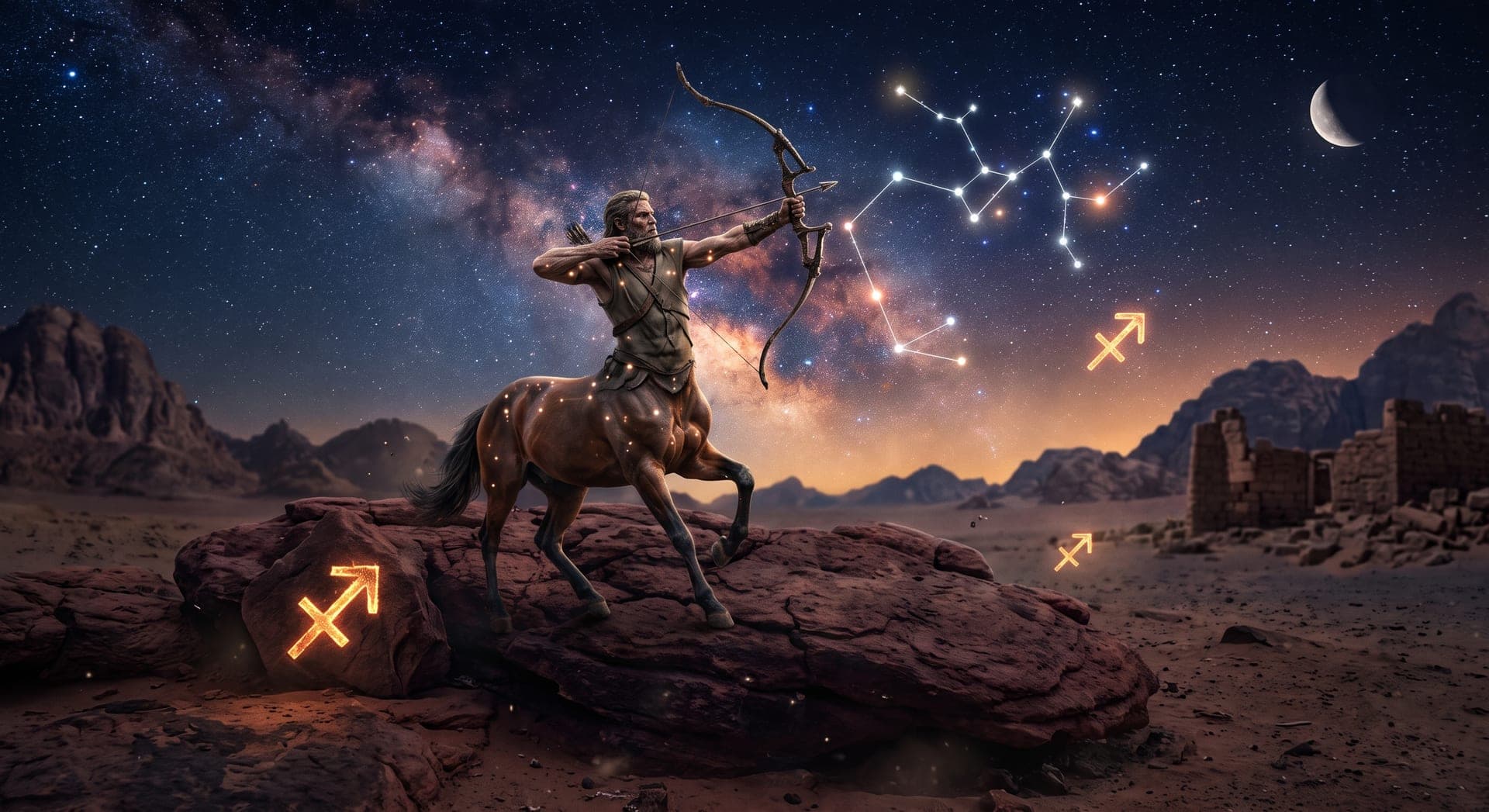
Sagittarius, the ninth sign of the zodiac, spans November 22 to December 21 and is symbolized by the archer, typically depicted as a centaur drawing a bow, representing a restless pursuit of knowledge, adventure, and far-off horizons. Ruled by Jupiter, the largest planet in the solar system and a symbol of growth, luck, and abundance, Sagittarius is widely regarded as one of the most optimistic and freedom-loving signs of the zodiac. As a Fire sign, Sagittarius approaches life with enthusiasm and a genuine hunger for new experiences, whether through literal travel or intellectual and philosophical exploration. Its Mutable modality reflects a deep aversion to routine and confinement, always looking toward the next adventure rather than settling into fixed patterns. People born under this sign are often drawn to travel, higher education, philosophy, or any pursuit that broadens their horizons and understanding of the world. Sagittarius's honesty and optimism make it excellent company, though its blunt directness and restless need for freedom can sometimes come across as tactless or noncommittal to those seeking more stability.
Personality Traits
Strengths
- Adventurous and open to new experiences
- Optimistic and enthusiastic
- Honest and direct
- Philosophical and broad-minded
- Generous and good-humored
Weaknesses
- Tactlessly blunt
- Impatient with routine
- Prone to overpromising
- Restless and commitment-averse
- Careless with details
Compatible Signs
Fun Facts
- Sagittarius's symbol, a centaur drawing a bow and arrow, connects to the Greek myth of Chiron, a wise and scholarly centaur unlike the more unruly members of his kind.
- Jupiter, Sagittarius' ruling planet, is the largest planet in the solar system, reflecting the sign's association with expansion, abundance, and big-picture thinking.
- Sagittarius is one of two zodiac signs, along with Capricorn, represented by a hybrid creature combining human and animal features.
- Notable Sagittarians include Taylor Swift, Walt Disney, Winston Churchill, and Jimi Hendrix.
- Sagittarius season spans the lead-up to the winter solstice, a period historically associated with travel, feasting, and philosophical reflection in many cultures.
Born on December 3
- 1826
George B. McClellan
Union Army general during the Civil War
- 1838
Octavia Hill
English social reformer who campaigned for housing for the poor and was a co-founder of the National Trust.
- 1857
Joseph Conrad
Polish-born British novelist and master prose stylist, celebrated for works such as Heart of Darkness and Lord Jim; he became a naturalised British subject and wrote entirely in his adopted English.
- 1884
Rajendra Prasad
First President of India
- 1895
Anna Freud
Austrian-born British psychoanalyst who settled in London and pioneered the field of child psychoanalysis.
- 1923
Trevor Bailey
English cricketer and commentator, a mainstay of the England Test team through the 1950s known for his gritty batting and accurate seam bowling.
- 1927
Andy Williams
American popular music singer
- 1944
Ralph McTell
English folk singer-songwriter best known for his song 'Streets of London'.
- 1948
Ozzy Osbourne
English singer-songwriter and self-styled 'Godfather of Heavy Metal', frontman of Black Sabbath and later a solo star and reality-television personality.
- 1959
Eamonn Holmes
Northern Irish broadcaster and television presenter, a longtime fixture of British breakfast television on GMTV and This Morning.
- 1960
Julianne Moore
American actress and Academy Award winner
- 1968
Brendan Fraser
American actor
On This Day in History
- 1775
The USS Alfred becomes the first vessel to display the Continental Union Flag, a precursor to the American flag.
The Continental Union Flag, sometimes called the Grand Union Flag, combined the British Union Jack in its canton with thirteen alternating red and white stripes representing the colonies, reflecting the colonists' still-ambiguous relationship with Britain early in the Revolutionary War. Displayed aboard Commodore Esek Hopkins' flagship, it served as an early precursor to the Stars and Stripes adopted roughly a year and a half later.
- 1800
French General Jean Moreau defeats Austrian forces at the Battle of Hohenlinden, hastening the end of the War of the Second Coalition.
The Battle of Hohenlinden, fought in a snow-covered forest near Munich, saw French forces under General Jean Moreau achieve a decisive victory over a larger Austrian and Bavarian army through skillful use of the difficult terrain and weather to disorganize enemy columns. The defeat forced Austria to sue for peace, resulting in the Treaty of Lunéville that ended the War of the Second Coalition against France.
- 1818
Illinois is admitted to the Union as the 21st U.S. state.
Illinois's admission as the 21st state came just three years after the Illinois Territory was organized, reflecting rapid settlement driven by fertile farmland and improving transportation access following the War of 1812. The new state's capital was initially established at Kaskaskia before later moving to more centrally located cities as population growth shifted northward.
- 1910
Georges Claude publicly demonstrates modern neon lighting for the first time at the Paris Motor Show.
Georges Claude's demonstration of neon lighting at the Paris Motor Show showcased his discovery that passing an electrical charge through neon gas sealed in a glass tube produced a distinctive, vivid red-orange glow. His subsequent patents and refinements, including the addition of other noble gases to produce different colors, launched the neon sign industry that would come to define urban nightlife and advertising for decades.
- 1925
Britain, the Irish Free State and Northern Ireland sign an agreement confirming the existing border and formalising the partition of Ireland.
The agreement followed the work of the Irish Boundary Commission, set up under the 1921 Anglo-Irish Treaty to determine the frontier between the Irish Free State and Northern Ireland. Rather than adjust the border, the three governments agreed to leave it unchanged, settling a question that had destabilised Anglo-Irish relations for years.
- 1967
Christiaan Barnard performs the world's first human heart transplant at Groote Schuur Hospital in Cape Town, South Africa.
Barnard's pioneering heart transplant, performed on patient Louis Washkansky, demonstrated for the first time that a human heart could be successfully transferred between individuals, though Washkansky survived only eighteen days due to complications from immunosuppressive drugs. The operation nonetheless opened an entirely new field of transplant medicine that would save countless lives as surgical techniques and anti-rejection drugs improved in subsequent decades.
- 1967
Surgeon Christiaan Barnard performs the world's first human-to-human heart transplant, in Cape Town, South Africa.
The patient, Louis Washkansky, received the heart of a young accident victim and survived for eighteen days before dying of pneumonia caused by the immunosuppressant drugs used to prevent organ rejection. Despite the short survival time, the operation was a landmark in cardiac surgery that paved the way for transplantation to become routine.
- 1971
Pakistan launches a preemptive military strike against India, initiating full-scale war.
Pakistan's preemptive strikes against Indian air bases were intended to prevent Indian intervention in the escalating crisis in East Pakistan, where a brutal crackdown against Bengali nationalists had triggered mass refugee flows into India. The resulting war concluded within two weeks with Pakistan's decisive defeat and the independence of Bangladesh as a new nation.
- 1971
The 1971 Indo-Pakistani War begins after Pakistan launches pre-emptive air strikes on Indian airbases.
The conflict grew out of the crisis in East Pakistan, where a brutal crackdown on the independence movement had sent millions of refugees fleeing into India. The war ended less than two weeks later with Pakistan's surrender in the east and the creation of the independent nation of Bangladesh.
- 1979
Ayatollah Ruhollah Khomeini becomes the first Supreme Leader of Iran under the country's new post-revolutionary constitution.
The position, ratified by national referendum, placed ultimate religious and political authority above the elected president and parliament. Khomeini, who had returned from exile earlier that year to lead the Iranian Revolution, held the role until his death in 1989, entrenching the system of clerical rule that still governs Iran.
- 1984
A catastrophic methyl isocyanate gas leak at a Union Carbide pesticide plant in Bhopal, India kills thousands.
The Bhopal disaster remains widely regarded as the worst industrial accident in history, as a toxic gas leak from a pesticide plant spread across a densely populated area while residents slept, killing thousands within days and causing lasting health effects for hundreds of thousands more. The catastrophe prompted major reforms in industrial safety regulation worldwide, though victims' compensation claims remained contentious for decades afterward.
- 1984
A massive leak of toxic gas from a pesticide plant in Bhopal, India, kills thousands of people in one of the world's worst industrial disasters.
The Union Carbide plant released methyl isocyanate gas over the sleeping city, killing an estimated 3,800 people within days and thousands more in the years that followed from related illnesses. The disaster prompted lasting changes to industrial safety regulation worldwide and remains the subject of ongoing disputes over compensation.
- 1989
U.S. President George H.W. Bush and Soviet leader Mikhail Gorbachev meet off Malta, signaling the Cold War's end.
The meeting between Bush and Gorbachev aboard a ship off the coast of Malta, though disrupted by severe storms, produced a joint statement in which both leaders indicated the Cold War's ideological confrontation was drawing to a close. The summit came just weeks after the fall of the Berlin Wall and set the stage for the rapid pace of change that would culminate in the Soviet Union's dissolution two years later.
- 1989
U.S. President George H. W. Bush and Soviet leader Mikhail Gorbachev meet at the Malta Summit and signal that the Cold War may be coming to an end.
Held aboard ship amid stormy weather, just weeks after the fall of the Berlin Wall, the summit was the first face-to-face meeting between the two leaders. While no formal agreements were signed, both sides described the tone as a turning point, and the meeting is widely seen as marking the symbolic close of more than four decades of Cold War tension.
- 1992
The world's first text message, reading 'Merry Christmas', is sent over the Vodafone network in the United Kingdom.
Software engineer Neil Papworth sent the message from a computer to the mobile phone of a Vodafone colleague, demonstrating the fledgling GSM Short Message Service. The technology, initially little more than an afterthought in the mobile phone standard, went on to transform personal communication worldwide.
- 1994
Sony releases the PlayStation video game console in Japan, entering the console market for the first time.
Originally conceived as a CD-ROM add-on for Nintendo before that partnership collapsed, the PlayStation went on to sell more than 100 million units worldwide and helped shift the industry toward CD-based, 3D gaming. Its success established Sony as a dominant force in gaming for decades to come.
- 1997
Representatives from 121 countries sign the Ottawa Treaty banning anti-personnel landmines.
The Ottawa Treaty, formally known as the Mine Ban Treaty, prohibited the use, stockpiling, production, and transfer of anti-personnel landmines, weapons that had caused enormous civilian casualties in conflicts worldwide. The treaty's rapid negotiation and adoption, driven significantly by grassroots humanitarian advocacy, represented a notable success for international disarmament efforts, though several major military powers have never signed it.
- 1997
Representatives of 121 countries sign the Ottawa Treaty, a landmark agreement banning the use, production and stockpiling of anti-personnel landmines.
The treaty grew out of a grassroots campaign led by the International Campaign to Ban Landmines, whose coordinator Jody Williams shared that year's Nobel Peace Prize for the effort. Several major military powers did not sign, but the treaty has been credited with dramatically reducing landmine casualties worldwide.
- 2024
South Korean President Yoon Suk Yeol declares martial law, triggering a major political crisis.
South Korean President Yoon Suk Yeol's surprise martial law declaration, citing alleged threats from opposition lawmakers and North Korean sympathizers, triggered immediate mass protests and a chaotic scene as lawmakers rushed to the National Assembly to vote down the measure within hours. The crisis ultimately led to Yoon's impeachment as the country's democratic institutions withstood the unprecedented challenge.
- 2024
South Korean President Yoon Suk Yeol declares martial law in a surprise late-night announcement, plunging the country into political crisis.
The declaration, the first of its kind in South Korea in more than four decades, was overturned within hours after lawmakers forced their way into the National Assembly to vote it down. The episode triggered Yoon's impeachment and a prolonged political crisis that dominated South Korean politics into 2025.