What’s Observed on November 4
Born on November 4: Scorpio ♏
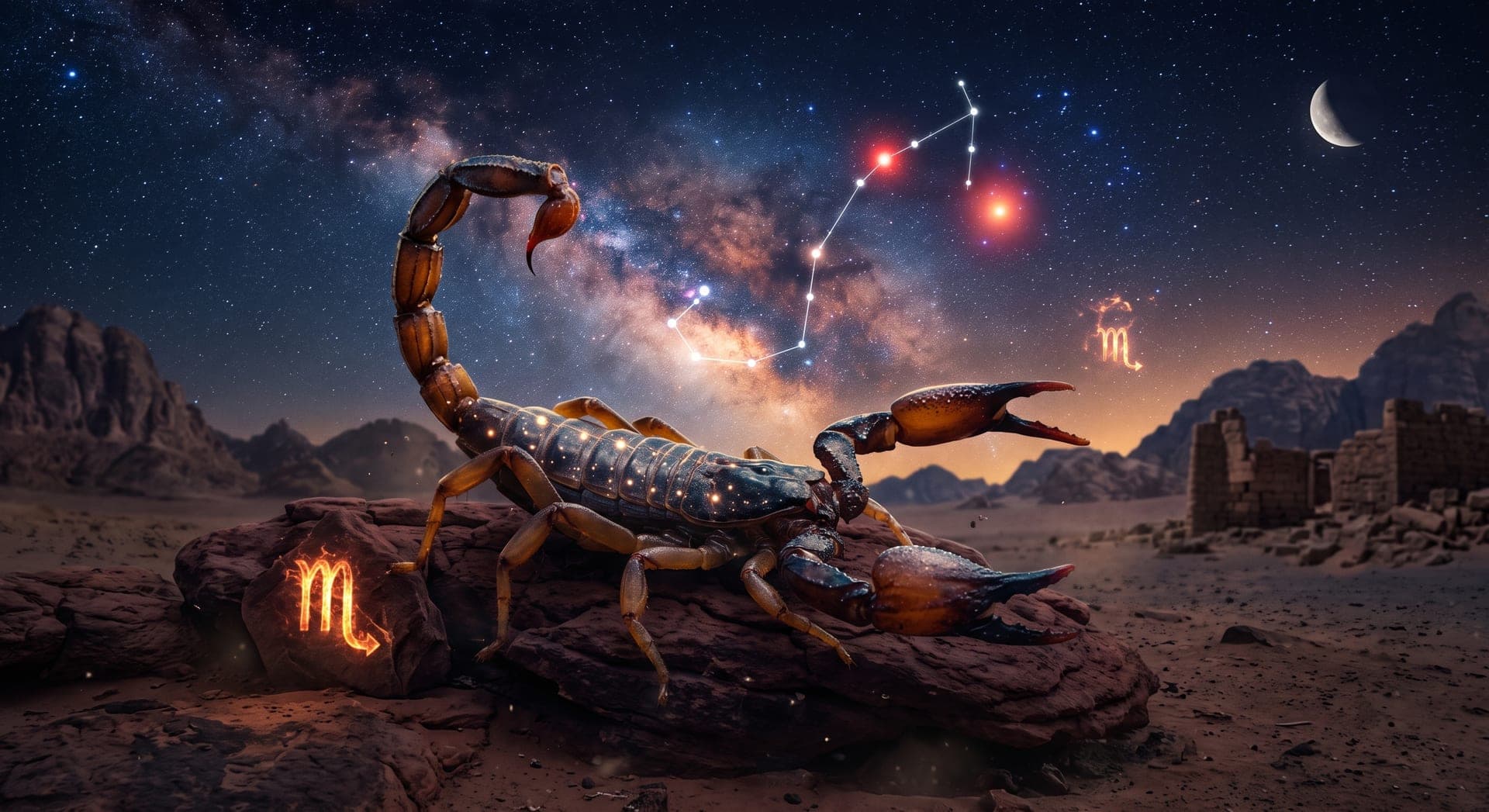
Scorpio, the eighth sign of the zodiac, spans October 23 to November 21 and is symbolized by the scorpion, a creature known for its defensive intensity and the sting it delivers when provoked. Traditionally ruled by Mars and, in modern astrology, by Pluto, the planet of transformation and the underworld, Scorpio carries a reputation as one of the most intense and emotionally powerful signs of the zodiac. As a Water sign, Scorpio experiences the world through deep, often hidden, emotion, guarding its inner life carefully while remaining acutely perceptive of others. Its Fixed modality gives Scorpio remarkable determination and resilience, able to endure hardship and pursue long-term goals with singular focus. People born under this sign are often drawn to work involving psychology, investigation, transformation, or anything requiring the ability to see beneath the surface. Scorpio's loyalty and passion run deep for those it trusts, but that same intensity can curdle into jealousy, suspicion, or an unwillingness to forgive when trust is broken.
Personality Traits
Strengths
- Deeply passionate and determined
- Fiercely loyal to those they trust
- Resourceful and strategic
- Highly perceptive
- Emotionally resilient
Weaknesses
- Prone to jealousy and possessiveness
- Secretive and guarded
- Can be vindictive when wronged
- Distrustful of others
- Prone to obsessiveness
Compatible Signs
Fun Facts
- Scorpio's scorpion symbol connects to the Greek myth of the scorpion sent by Gaia to kill the hunter Orion, with both later placed among the stars.
- Scorpio has two ruling planets: Mars in traditional astrology, and Pluto, discovered in 1930, in the modern system.
- Scorpio is often mistakenly grouped with the Fire signs due to its intensity, but it is actually a Water sign, driven by deep emotion rather than raw aggression.
- Notable Scorpios include Pablo Picasso, Marie Curie, Leonardo DiCaprio, and Hillary Clinton.
- Some astrological traditions associate Scorpio with a secondary, more elevated symbol, the eagle or phoenix, representing transformation and rebirth.
Born on November 4
- 1787
Edmund Kean
British Shakespearean stage actor renowned as one of the greatest tragedians of the early 19th-century English theatre, celebrated for his intense performances as Othello and Richard III.
- 1879
Will Rogers
American humorist and entertainer
- 1884
Harry Ferguson
Northern Irish engineer and inventor who developed the modern agricultural tractor and its three-point hitch system, revolutionizing farm mechanization worldwide.
- 1908
Joseph Rotblat
Polish-born British physicist and Nobel Peace Prize laureate who resigned from the Manhattan Project on moral grounds and became a leading campaigner against nuclear weapons.
- 1915
Marguerite Patten
English cookery writer and broadcaster whose wartime radio programmes and recipe books helped generations of British households cook on rations.
- 1916
Walter Cronkite
American broadcast journalist
- 1916
Ruth Handler
American businesswoman who created the Barbie doll
- 1918
Art Carney
American actor known for "The Honeymooners"
- 1946
Laura Bush
45th First Lady of the United States
- 1953
Peter Lord
English animator and director who co-founded Aardman Animations, the studio behind Wallace & Gromit and Chicken Run.
- 1960
Kathy Griffin
American comedian and actress
- 1963
Lena Zavaroni
Scottish singer and television presenter who became a child star in the 1970s after a breakout appearance on Opportunity Knocks.
- 1969
Sean Combs
American rapper and music producer
- 1969
Matthew McConaughey
American actor and Academy Award winner
- 1981
Guy Martin
English motorcycle racer and television personality known for competing at the Isle of Man TT and presenting popular engineering documentaries.
On This Day in History
- 1429
Joan of Arc successfully liberates the town of Saint-Pierre-le-Moûtier during the Armagnac-Burgundian civil war.
Joan of Arc's campaign to liberate Saint-Pierre-le-Moutier came during the later, less celebrated stretch of her military career, following her famous victories at Orleans earlier that year. The successful siege demonstrated her continued battlefield leadership, though she would be captured by Burgundian forces just months later, ultimately leading to her trial and execution.
- 1493
Christopher Columbus reaches the Leeward Islands during his second voyage across the Atlantic.
During his second voyage, which involved a much larger fleet of seventeen ships aimed at establishing permanent settlements, Columbus explored the Leeward Islands in the eastern Caribbean, naming several islands after saints. This expedition marked a shift from exploration toward colonization, as Spain began establishing lasting footholds throughout the region.
- 1501
Catherine of Aragon meets Arthur, Prince of Wales, the elder son of Henry VII, whom she is soon to marry.
The Spanish princess had traveled to England to wed the heir to the English throne as part of an alliance between the Tudor and Spanish crowns. Arthur died only months after their wedding, and Catherine later married his younger brother, who became Henry VIII — a union whose eventual annulment would trigger the English Reformation decades later.
- 1576
Spanish troops capture and sack the city of Antwerp during the Eighty Years' War.
Spanish troops under the Duke of Alba's forces sacked Antwerp during an event later known as the Spanish Fury, killing thousands of residents and destroying much commercial property in what was then one of Europe's wealthiest trading cities. The brutal episode further inflamed Dutch resistance against Spanish rule during the ongoing Eighty Years' War for independence.
- 1677
Mary, later Queen Mary II of England, marries William of Orange, a union that would later see them jointly rule Britain.
The marriage was arranged for primarily political reasons, uniting the Protestant William of Orange with Mary, the Catholic King James II's daughter, in hopes of stabilizing relations between England and the Netherlands. The pairing would prove historically decisive just over a decade later, when William and Mary jointly assumed the English throne following the Glorious Revolution.
- 1677
Mary, the future Mary II of England, marries her cousin William of Orange in a politically significant royal union.
The marriage, arranged by King Charles II to strengthen Protestant ties with the Dutch Republic, brought together two figures who would later jointly rule England, Scotland and Ireland. Eleven years later, William invaded England during the Glorious Revolution, and he and Mary were crowned joint sovereigns, reshaping the constitutional balance between crown and Parliament.
- 1791
A Native American confederacy inflicts a major defeat on U.S. forces at the Battle of the Wabash during the Northwest Indian War.
The Battle of the Wabash, also known as St. Clair's Defeat, remains the most decisive victory ever achieved by Native American forces against the United States military, with a confederation led by Miami chief Little Turtle inflicting devastating casualties on General Arthur St. Clair's poorly prepared army. The defeat prompted a major reorganization of U.S. military policy toward Native nations.
- 1839
The Newport Rising sees thousands of Chartists march on Newport, Wales, in the last large-scale armed insurrection in mainland Britain.
Led by John Frost, several thousand working-class Chartists, some armed, demanded political reform, including universal male suffrage, and attempted to free imprisoned fellow campaigners. British troops fired on the marchers outside the Westgate Hotel, killing more than 20 people and ending the uprising. The rising remains a landmark moment in the history of British working-class political movements.
- 1847
Scottish physician James Young Simpson discovers the anesthetic properties of chloroform.
Simpson, already a leading figure in obstetric medicine, discovered chloroform's anesthetic effects through self-experimentation with colleagues in his home, testing various compounds until they found one that induced unconsciousness. His subsequent advocacy helped popularize chloroform anesthesia in childbirth, despite initial religious objections, and famously received royal endorsement when Queen Victoria used it during delivery.
- 1847
Scottish physician Sir James Young Simpson discovers the anaesthetic properties of chloroform, revolutionizing pain relief in medicine.
Simpson, an Edinburgh professor of midwifery, had been experimenting with chemical compounds in search of a safer alternative to ether. After testing chloroform on himself and colleagues one evening, he recognized its powerful anaesthetic effect and quickly began using it in obstetric practice. Despite initial religious objections, chloroform anaesthesia became widespread after Queen Victoria used it during childbirth in 1853.
- 1890
The City and South London Railway opens as London's first deep-level tube railway, running between King William Street and Stockwell.
Using electric traction and tunnelling through deep clay, the line pioneered technology and construction methods that shaped the London Underground for the next century. It was the world's first major underground railway to use electric trains rather than steam locomotives, establishing London as a global leader in urban rail transport.
- 1922
British archaeologist Howard Carter discovers the entrance to King Tutankhamun's tomb in Egypt's Valley of the Kings.
After years of searching the Valley of the Kings with limited results and dwindling patron support, Carter's team uncovered a stone step that led to a sealed doorway bearing royal seals. The subsequent excavation revealed one of the only largely intact royal tombs ever found in Egypt, sparking a worldwide sensation and renewed fascination with ancient Egyptian civilization.
- 1922
British archaeologist Howard Carter discovers the entrance to the tomb of Tutankhamun in Egypt's Valley of the Kings.
Carter had spent years searching the valley, funded by the Earl of Carnarvon, before his team uncovered a stone step leading to a sealed doorway. When the tomb was opened weeks later, it proved to be the most intact pharaonic burial ever found, its treasures triggering a worldwide sensation and a lasting fascination with ancient Egypt that came to be known as 'Tutmania'.
- 1942
Field Marshal Erwin Rommel begins a retreat after his Afrika Korps is decisively defeated by British Commonwealth forces at the Second Battle of El Alamein.
The British Eighth Army under General Bernard Montgomery had broken through German and Italian lines after nearly two weeks of fighting in the Egyptian desert, forcing Rommel to withdraw despite Hitler's initial orders to hold. The victory, famously described by Winston Churchill as marking 'the end of the beginning', turned the tide of the North African campaign in the Allies' favor.
- 1960
English primatologist Jane Goodall observes wild chimpanzees making and using tools, the first such observation in a non-human animal.
Working at what is now Gombe Stream National Park in Tanzania, Goodall watched chimpanzees strip leaves from twigs to fashion tools for extracting termites from their mounds. The discovery overturned the long-held belief that tool-making was uniquely human and transformed scientific understanding of animal cognition, launching Goodall's decades-long career as one of the world's foremost primatologists.
- 1980
Ronald Reagan is elected the 40th U.S. President, defeating incumbent Jimmy Carter.
Reagan's decisive victory over incumbent Jimmy Carter reflected widespread public dissatisfaction with the economy, high inflation, and the ongoing Iran hostage crisis. His win marked a significant conservative political shift in American politics, ushering in policies focused on tax cuts, deregulation, and a more assertive foreign policy stance during the final stretch of the Cold War.
- 1980
Ronald Reagan is elected the 40th President of the United States in a landslide victory over incumbent Jimmy Carter.
Reagan's win, carrying 44 states, reflected voter frustration with economic stagnation and the Iran hostage crisis under President Carter. His election ushered in a conservative political realignment in American politics and a foreign policy defined by an assertive stance toward the Soviet Union, shaping the following decade of Cold War diplomacy and domestic economic policy.
- 2008
Barack Obama is elected the first African-American President of the United States.
Obama's victory over Republican nominee John McCain made him the first African-American president in United States history, a milestone achieved 143 years after the abolition of slavery. His election was seen by many as a watershed moment in the country's ongoing reckoning with its history of racial discrimination and exclusion.
- 2008
Barack Obama is elected President of the United States, becoming the first person of biracial or African-American descent to hold the office.
Obama, then a first-term US senator from Illinois, defeated Republican nominee John McCain amid a global financial crisis and public fatigue with the Iraq War. His victory was hailed worldwide as a landmark moment in the history of American race relations, and he took office in January 2009 as the country's forty-fourth president.
- 2010
Qantas Flight 32 suffers a mid-air engine failure but lands safely in Singapore, saving all 469 people aboard.
An uncontained engine failure aboard the Airbus A380 shortly after departing Singapore forced the highly experienced flight crew to manage extensive damage to the aircraft's systems and structure. Their successful emergency landing, achieved despite the loss of numerous critical systems, was widely praised as a masterclass in crew coordination and became a case study in aviation safety training.