What’s Observed on November 5
Born on November 5: Scorpio ♏
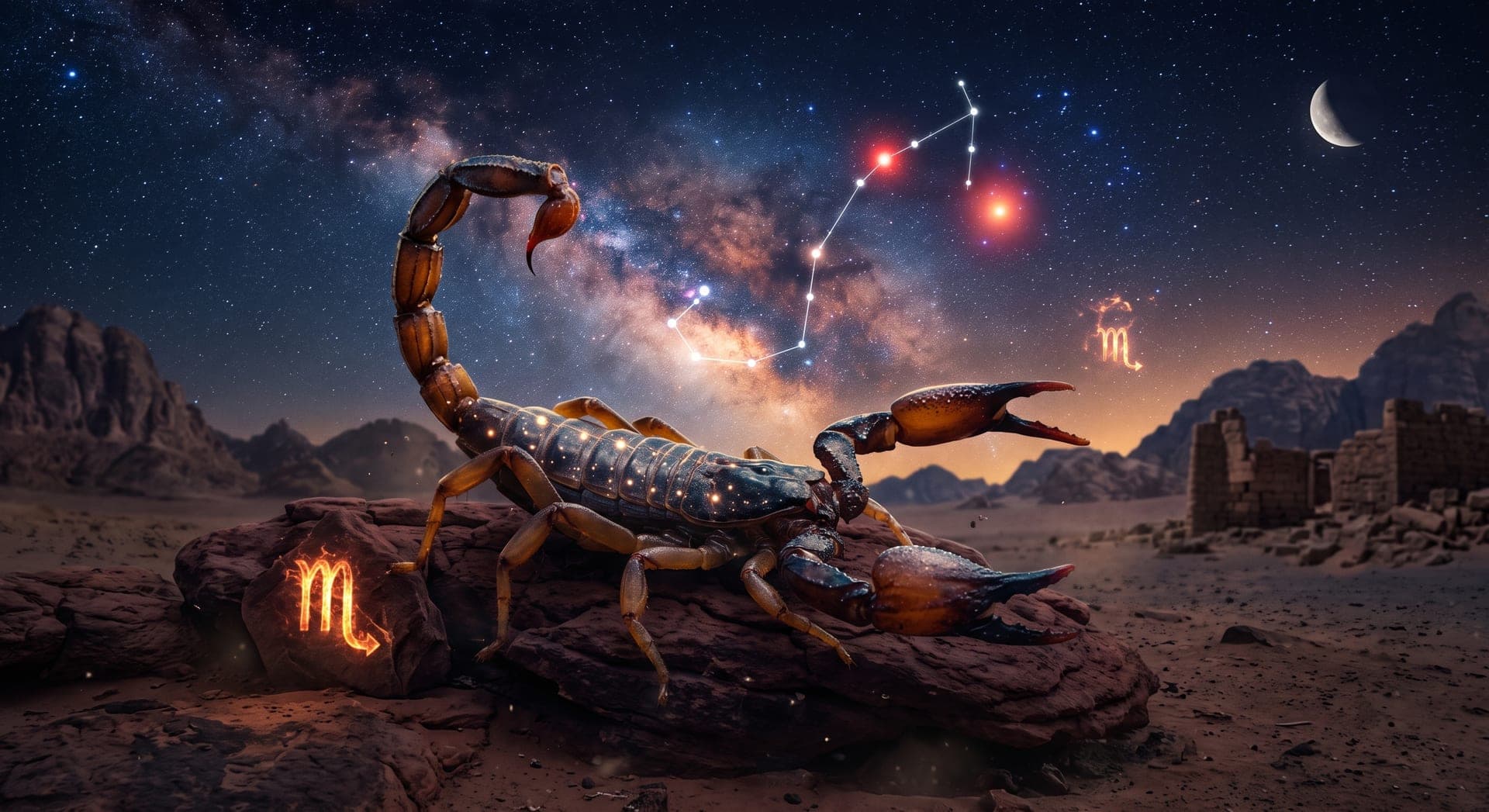
Scorpio, the eighth sign of the zodiac, spans October 23 to November 21 and is symbolized by the scorpion, a creature known for its defensive intensity and the sting it delivers when provoked. Traditionally ruled by Mars and, in modern astrology, by Pluto, the planet of transformation and the underworld, Scorpio carries a reputation as one of the most intense and emotionally powerful signs of the zodiac. As a Water sign, Scorpio experiences the world through deep, often hidden, emotion, guarding its inner life carefully while remaining acutely perceptive of others. Its Fixed modality gives Scorpio remarkable determination and resilience, able to endure hardship and pursue long-term goals with singular focus. People born under this sign are often drawn to work involving psychology, investigation, transformation, or anything requiring the ability to see beneath the surface. Scorpio's loyalty and passion run deep for those it trusts, but that same intensity can curdle into jealousy, suspicion, or an unwillingness to forgive when trust is broken.
Personality Traits
Strengths
- Deeply passionate and determined
- Fiercely loyal to those they trust
- Resourceful and strategic
- Highly perceptive
- Emotionally resilient
Weaknesses
- Prone to jealousy and possessiveness
- Secretive and guarded
- Can be vindictive when wronged
- Distrustful of others
- Prone to obsessiveness
Compatible Signs
Fun Facts
- Scorpio's scorpion symbol connects to the Greek myth of the scorpion sent by Gaia to kill the hunter Orion, with both later placed among the stars.
- Scorpio has two ruling planets: Mars in traditional astrology, and Pluto, discovered in 1930, in the modern system.
- Scorpio is often mistakenly grouped with the Fire signs due to its intensity, but it is actually a Water sign, driven by deep emotion rather than raw aggression.
- Notable Scorpios include Pablo Picasso, Marie Curie, Leonardo DiCaprio, and Hillary Clinton.
- Some astrological traditions associate Scorpio with a secondary, more elevated symbol, the eagle or phoenix, representing transformation and rebirth.
Born on November 5
- 1854
Paul Sabatier
French chemist and Nobel Prize laureate
- 1855
Eugene V. Debs
American labor leader and political activist
- 1857
Ida Tarbell
American investigative journalist
- 1885
Will Durant
American historian and philosopher
- 1892
J.B.S. Haldane
English-Indian geneticist and evolutionary biologist whose work helped establish the mathematical foundations of modern evolutionary theory and population genetics.
- 1892
John Alcock
British aviator who, with navigator Arthur Brown, made the first non-stop transatlantic flight in 1919, flying a modified Vickers Vimy bomber from Newfoundland to Ireland.
- 1910
John Hackett
British Army general and academic who commanded troops at the Battle of Arnhem, later serving as Principal of King's College London and writing the bestselling novel The Third World War.
- 1911
Roy Rogers
American singing cowboy actor
- 1913
Vivien Leigh
British actress celebrated for her Academy Award-winning performances as Scarlett O'Hara in Gone with the Wind and Blanche DuBois in A Streetcar Named Desire.
- 1935
Lester Piggott
English flat racing jockey widely regarded as one of the greatest of all time, winning the Epsom Derby a record nine times.
- 1941
Art Garfunkel
American singer-songwriter of Simon & Garfunkel
- 1959
Bryan Adams
Canadian rock musician
- 1960
Tilda Swinton
English actress and producer known for her versatile, often unconventional roles, and winner of the Academy Award for Best Supporting Actress for Michael Clayton.
- 1971
Jonny Greenwood
English guitarist, multi-instrumentalist and composer best known as the lead guitarist of the band Radiohead and for his film scores.
- 1983
Alexa Chung
English model, fashion designer and television presenter known for her influence on British fashion and style.
On This Day in History
- 1556
The Second Battle of Panipat begins between Hindu king Hem Chandra Vikramaditya and Mughal emperor Akbar.
The Second Battle of Panipat pitted the young Mughal emperor Akbar's forces against Hemu, a Hindu general who had briefly seized control of Delhi and declared himself king. Akbar's decisive victory secured Mughal dominance over northern India for generations, establishing the foundation for one of history's wealthiest and most influential empires.
- 1605
Guy Fawkes is arrested in the cellars of Parliament with gunpowder, foiling the Gunpowder Plot against King James I.
Fawkes was discovered guarding barrels of gunpowder hidden beneath the House of Lords, part of a conspiracy by a group of English Catholics to assassinate the Protestant King James I and much of the government during the state opening of Parliament. His capture and the plot's subsequent unraveling led to lasting British traditions commemorating the failed conspiracy every November 5th.
- 1605
Guy Fawkes is discovered guarding barrels of gunpowder beneath the House of Lords and arrested, foiling the Gunpowder Plot to assassinate King James I.
Fawkes, a Catholic convert and explosives expert, had been left to guard 36 barrels of gunpowder hidden in an undercroft beneath the Houses of Parliament, timed to detonate the next day when James I opened Parliament. The plot, organized by Robert Catesby and a group of fellow Catholics angered by continued religious persecution, was betrayed by an anonymous warning letter. Its failure is still commemorated every November 5th as Bonfire Night, with fireworks and burning effigies across Britain.
- 1688
Prince William of Orange lands at Brixham, England, launching his challenge to King James II's rule.
William's landing at Brixham launched what became known as the Glorious Revolution, as widespread dissatisfaction with the Catholic King James II's rule led many English nobles and military officers to defect to William's cause. James fled to France within weeks, and William and his wife Mary were subsequently installed as joint monarchs, permanently altering the balance of power between crown and Parliament.
- 1688
William of Orange lands at Brixham in Devon with a Dutch invasion fleet, beginning the campaign that would depose King James II.
Having set sail from the Netherlands days earlier, William's fleet of hundreds of ships anchored at Torbay and his forces came ashore at Brixham unopposed. His invitation from English Protestant nobles opposed to James's Catholicizing policies triggered the Glorious Revolution; James's support rapidly collapsed, and he fled to France weeks later. William and his wife Mary were crowned joint monarchs in 1689, cementing parliamentary sovereignty in England.
- 1757
Frederick the Great defeats French and Holy Roman Empire forces at the Battle of Rossbach.
Frederick the Great's outnumbered Prussian army achieved a stunning victory over a combined French and Holy Roman Empire force through superior tactics and disciplined maneuvering, inflicting far heavier casualties than it suffered. The triumph, part of the Seven Years' War, cemented Frederick's reputation as one of history's most skilled military commanders.
- 1872
Suffragist Susan B. Anthony votes illegally in the presidential election and is later fined $100.
Anthony's arrest for illegal voting became a landmark moment in the women's suffrage movement, as she used her subsequent trial as a public platform to argue that the Constitution already guaranteed women's right to vote under the Fourteenth Amendment. Though convicted and fined, she famously refused to pay, and her case helped galvanize decades of continued activism.
- 1912
Woodrow Wilson is elected the 28th U.S. President, defeating incumbent William Howard Taft.
Wilson's victory came in a fractured field after former President Theodore Roosevelt split from the Republican Party to run as a third-party Progressive candidate, dividing the Republican vote and clearing the path for Wilson's win. His presidency would go on to oversee significant progressive reforms and America's eventual entry into World War I.
- 1914
France and the British Empire formally declare war on the Ottoman Empire, opening a new front in the First World War.
The declaration followed Ottoman naval attacks on Russian Black Sea ports in late October, drawing the Ottoman Empire into the conflict alongside Germany and Austria-Hungary. The new front drew British and empire forces into campaigns across the Middle East and the Gallipoli peninsula, reshaping the map of the region and contributing to the eventual collapse of Ottoman rule after the war.
- 1925
British secret agent Sidney Reilly, often called the first 'super-spy' of the twentieth century, is executed by the Soviet secret police.
Reilly, who worked for British intelligence and had plotted against the Bolshevik government after the Russian Revolution, was lured back into Soviet territory in a deception operation and captured near the Finnish border. He was interrogated and shot by the OGPU days later, though Soviet authorities concealed his death for years. His flamboyant, adventurous career later helped inspire the fictional spy James Bond.
- 1940
Franklin D. Roosevelt becomes the first U.S. president reelected to a third consecutive term.
Roosevelt's decision to seek a third term broke with the two-term tradition established by George Washington, a precedent that had been informally honored by every president before him. His victory, amid growing concerns about war in Europe, reflected public confidence in his leadership during a period of economic recovery and international uncertainty.
- 1940
The armed merchant cruiser HMS Jervis Bay is sunk while defending a British convoy from the German pocket battleship Admiral Scheer.
Escorting a convoy of 37 merchant ships across the Atlantic, the lightly armed Jervis Bay under Captain Edward Fegen turned to engage the far more powerful German raider, buying time for the convoy to scatter. The ship was destroyed and Fegen was killed, but the sacrifice allowed most of the convoy to escape; Fegen was posthumously awarded the Victoria Cross for his gallantry.
- 1950
British and Australian troops of the 27th British Commonwealth Brigade halt an advancing Chinese division during the Korean War.
Fighting in North Korea as Chinese forces entered the war in massive numbers, the Commonwealth brigade's stand helped blunt the momentum of China's intervention during a critical early phase of the conflict. The action was one of many in which British and Commonwealth troops fought alongside United Nations forces throughout the three-year war on the Korean peninsula.
- 1956
British and French paratroopers land in Egypt at the start of the Suez Crisis, seeking to seize control of the Suez Canal.
The invasion followed Egyptian President Gamal Abdel Nasser's nationalization of the Suez Canal Company and a coordinated Israeli attack on the Sinai. Fierce international condemnation, including strong opposition from the United States, forced Britain and France into a humiliating withdrawal within days, an episode widely seen as marking the effective end of Britain's status as a leading global imperial power.
- 1968
Richard Nixon is elected the 37th President of the United States.
Nixon's narrow victory over Democratic nominee Hubert Humphrey came amid deep national divisions over the Vietnam War and widespread social unrest. His subsequent presidency would be marked by both significant foreign policy achievements, including outreach to China, and the Watergate scandal that ultimately forced his resignation in 1974.
- 2006
Saddam Hussein, the former President of Iraq, is sentenced to death for crimes against humanity in the al-Dujail trial.
The verdict followed a lengthy trial over the 1982 massacre of 148 Shia villagers in Dujail, carried out in reprisal for an assassination attempt against Hussein. He was executed by hanging in Baghdad the following December. The trial, held after Hussein's capture during the 2003 US-led invasion of Iraq, marked a rare instance of a deposed head of state facing domestic judicial prosecution for his own government's atrocities.
- 2007
Google unveils the Android mobile operating system to the public.
Google unveiled Android alongside the formation of the Open Handset Alliance, a consortium of technology companies aiming to create an open, flexible operating system for mobile devices. Android would go on to become the world's most widely used mobile operating system, fundamentally reshaping the smartphone industry over the following decade.
- 2007
Google unveils Android, the mobile operating system that would go on to power the majority of the world's smartphones.
Developed by Android Inc., which Google had acquired two years earlier, the open-source operating system was released alongside the founding of the Open Handset Alliance, a coalition of technology and telecommunications companies. Android went on to become the world's most widely used mobile operating system, fundamentally reshaping how billions of people access the internet and use software.
- 2024
Donald Trump becomes the first U.S. president elected to a non-consecutive second term in 132 years.
Trump's victory over Kamala Harris made him the first president since Grover Cleveland in the nineteenth century to win a second, non-consecutive term after previously losing reelection. The win capped a remarkable political comeback following his 2020 defeat and the legal and political turbulence of the intervening years.
- 2024
Donald Trump is elected President of the United States, becoming the first person since Grover Cleveland to win a non-consecutive second term.
Trump, who had lost his 2020 re-election bid to Joe Biden, defeated Vice President Kamala Harris to reclaim the presidency four years later. The victory capped a turbulent campaign season and made him only the second US president in history, after Cleveland in the 1890s, to serve two non-consecutive terms in office.