What’s Observed on November 19
Born on November 19: Scorpio ♏
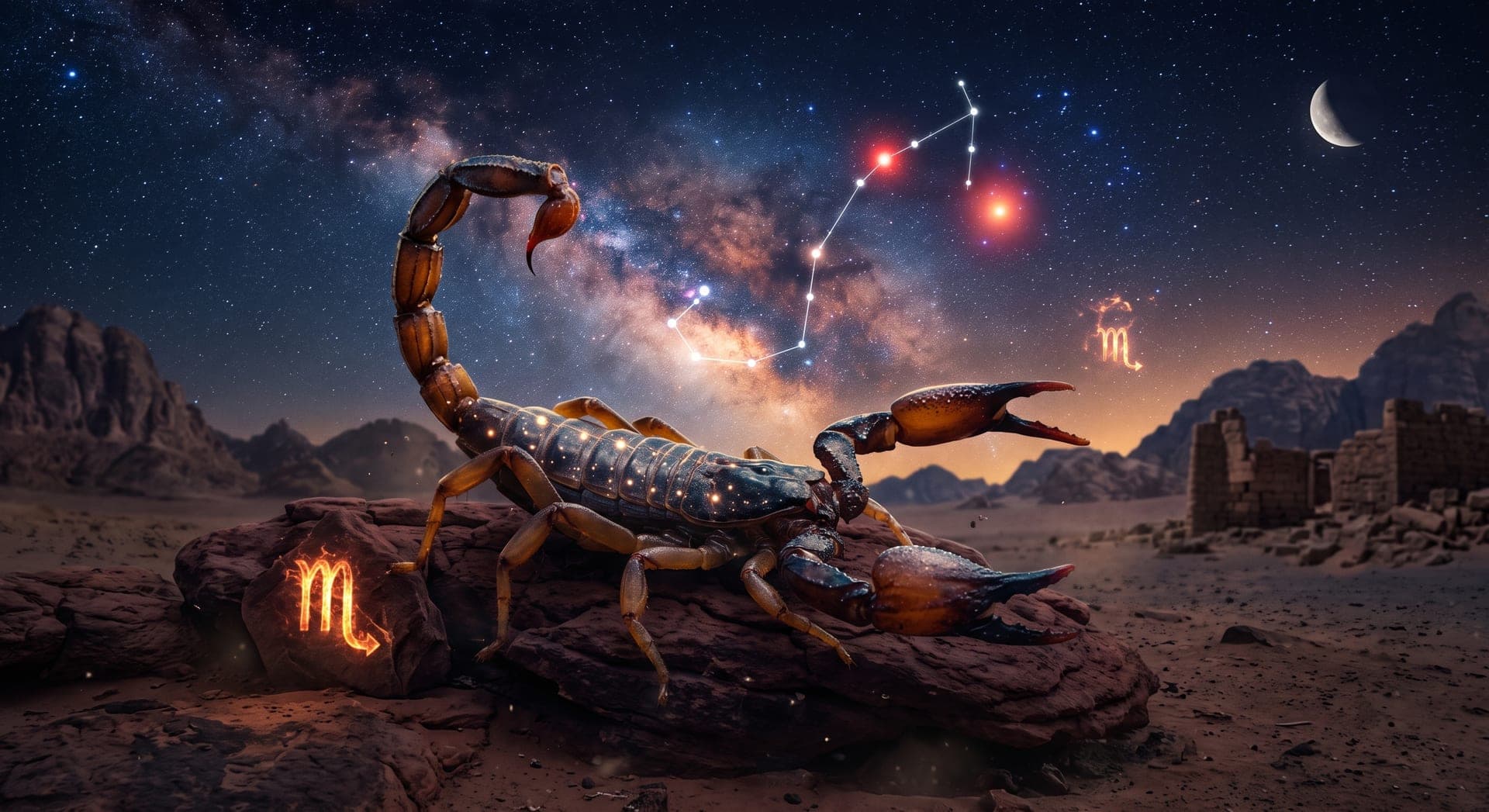
Scorpio, the eighth sign of the zodiac, spans October 23 to November 21 and is symbolized by the scorpion, a creature known for its defensive intensity and the sting it delivers when provoked. Traditionally ruled by Mars and, in modern astrology, by Pluto, the planet of transformation and the underworld, Scorpio carries a reputation as one of the most intense and emotionally powerful signs of the zodiac. As a Water sign, Scorpio experiences the world through deep, often hidden, emotion, guarding its inner life carefully while remaining acutely perceptive of others. Its Fixed modality gives Scorpio remarkable determination and resilience, able to endure hardship and pursue long-term goals with singular focus. People born under this sign are often drawn to work involving psychology, investigation, transformation, or anything requiring the ability to see beneath the surface. Scorpio's loyalty and passion run deep for those it trusts, but that same intensity can curdle into jealousy, suspicion, or an unwillingness to forgive when trust is broken.
Personality Traits
Strengths
- Deeply passionate and determined
- Fiercely loyal to those they trust
- Resourceful and strategic
- Highly perceptive
- Emotionally resilient
Weaknesses
- Prone to jealousy and possessiveness
- Secretive and guarded
- Can be vindictive when wronged
- Distrustful of others
- Prone to obsessiveness
Compatible Signs
Fun Facts
- Scorpio's scorpion symbol connects to the Greek myth of the scorpion sent by Gaia to kill the hunter Orion, with both later placed among the stars.
- Scorpio has two ruling planets: Mars in traditional astrology, and Pluto, discovered in 1930, in the modern system.
- Scorpio is often mistakenly grouped with the Fire signs due to its intensity, but it is actually a Water sign, driven by deep emotion rather than raw aggression.
- Notable Scorpios include Pablo Picasso, Marie Curie, Leonardo DiCaprio, and Hillary Clinton.
- Some astrological traditions associate Scorpio with a secondary, more elevated symbol, the eagle or phoenix, representing transformation and rebirth.
Born on November 19
- 1600
Charles I
King of England, Scotland, and Ireland whose conflicts with Parliament led to the English Civil War and his own execution in 1649.
- 1805
Ferdinand de Lesseps
French diplomat who developed the Suez Canal
- 1831
James A. Garfield
20th President of the United States
- 1905
Tommy Dorsey
American jazz trombonist and bandleader
- 1917
Indira Gandhi
3rd Prime Minister of India
- 1920
Gene Tierney
American actress
- 1921
Roy Campanella
American Major League Baseball catcher
- 1924
William Russell
English actor who originated the role of Ian Chesterton, the first companion in Doctor Who, and returned to the role nearly six decades later.
- 1925
Zygmunt Bauman
Polish-born British sociologist, based for decades at the University of Leeds, known for his influential writings on modernity, consumerism, and globalization.
- 1951
Charles Falconer
Scottish-born British lawyer and Labour politician who served as Lord Chancellor and Secretary of State for Justice.
- 1958
Isabella Blow
English fashion editor and stylist celebrated for championing designers including Alexander McQueen and Philip Treacy.
- 1961
Meg Ryan
American actress known for romantic comedies
- 1964
Nicholas Patrick
English-born American engineer and NASA astronaut who flew on two Space Shuttle missions to the International Space Station.
- 1965
Douglas Henshall
Scottish actor best known for playing Detective Inspector Jimmy Perez in the television series Shetland.
- 1976
Jack Dorsey
American businessman who co-founded Twitter
On This Day in History
- 636
The Rashidun Caliphate achieves a decisive victory over the Sasanian Empire at the Battle of al-Qadisiyyah in present-day Iraq.
The Rashidun Caliphate's forces achieved a decisive victory over the Sasanian Persian Empire at al-Qadisiyyah, a battle widely regarded as one of the most consequential in Islamic military history. The defeat opened Mesopotamia to Muslim conquest and ultimately contributed to the complete collapse of the centuries-old Sasanian Empire within just a few years.
- 1794
The United States and Great Britain sign Jay's Treaty, resolving lingering disputes from the Revolutionary War.
Jay's Treaty, negotiated by Chief Justice John Jay, resolved several unsettled disputes remaining from the Revolutionary War, including British withdrawal from forts in the Northwest Territory, while establishing improved trade relations between the United States and Britain. Though controversial domestically for perceived concessions, the treaty helped avert a renewed war between the two nations.
- 1794
The United States and Great Britain sign Jay's Treaty, resolving lingering disputes from the American Revolutionary War.
Negotiated by U.S. Chief Justice John Jay, the treaty secured Britain's withdrawal from forts it still held in the Northwest Territory and established a framework for resolving pre-war debts and boundary disputes through arbitration. Though it defused the immediate threat of renewed Anglo-American war, its perceived concessions to Britain provoked fierce domestic controversy in the United States.
- 1832
The Garinagu (Garifuna) people arrive by canoe at the settlement that would become Dangriga in British Honduras.
Fleeing persecution and displacement in the British Caribbean, Garifuna families landed on the coast of what is now Belize, then the British colony of British Honduras. Their arrival, still celebrated annually as Garifuna Settlement Day, marked the founding of a distinct Afro-Indigenous community that remains central to Belizean culture today.
- 1863
President Abraham Lincoln delivers the Gettysburg Address at the dedication of a military cemetery in Pennsylvania.
President Lincoln delivered his brief but profoundly influential Gettysburg Address at the dedication of a national cemetery for soldiers killed in the pivotal earlier battle, reframing the Civil War as a struggle to preserve democratic government and human equality. Though only about two minutes long, the speech remains one of the most quoted texts in American history.
- 1863
President Abraham Lincoln delivers the Gettysburg Address at the dedication of a Civil War cemetery in Pennsylvania.
Speaking for barely two minutes after a much longer oration by Edward Everett, Lincoln redefined the purpose of the Civil War as a struggle to preserve a nation dedicated to human equality. Despite Lincoln's own modest expectations for the speech, it became one of the most quoted texts in American history.
- 1911
The treacherous Doom Bar sandbank off Padstow, Cornwall, wrecks two ships in a single day.
The schooner Island Maid and the barque Angele both ran aground on the notorious sandbank at the mouth of the Camel Estuary, a hazard blamed for hundreds of shipwrecks over the centuries. All five of Island Maid's crew were rescued, but only the captain of Angele survived. The bar later lent its name to Cornwall's popular Doom Bar ale.
- 1912
Serbian forces capture Bitola, ending five centuries of Ottoman rule over Macedonia during the First Balkan War.
Serbian forces captured the strategically important city of Bitola during the First Balkan War, effectively ending five centuries of continuous Ottoman rule over the region of Macedonia. The war marked a significant contraction of Ottoman territory in Europe and reshaped the political map of the Balkans in the years leading up to World War I.
- 1942
Soviet forces launch Operation Uranus, a counteroffensive that reverses the momentum of the Battle of Stalingrad.
Soviet forces launched a massive pincer counteroffensive around the besieged German Sixth Army at Stalingrad, successfully encircling hundreds of thousands of German and Axis troops within days. The operation marked the decisive turning point of the battle and one of the most significant strategic reversals of the entire Eastern Front campaign.
- 1942
The Soviet Union launches Operation Uranus, a counteroffensive that encircles German forces at Stalingrad.
Striking the weaker Romanian and Hungarian units guarding the flanks of the German Sixth Army, Soviet pincers met four days later to trap roughly 250,000 Axis troops inside the city. The encirclement doomed the German position at Stalingrad and marked a decisive turning point on the Eastern Front.
- 1969
Apollo 12 astronauts Pete Conrad and Alan Bean become the third and fourth humans to walk on the Moon.
Astronauts Pete Conrad and Alan Bean successfully landed the Apollo 12 lunar module within walking distance of the earlier robotic Surveyor 3 probe, demonstrating NASA's improved precision landing capabilities following Apollo 11. Their mission included retrieving components from the Surveyor craft to study the effects of prolonged lunar exposure.
- 1969
Apollo 12 astronauts Charles Conrad and Alan Bean land on the Moon in the second crewed lunar landing.
Touching down with pinpoint precision near the earlier unmanned Surveyor 3 probe, the astronauts retrieved parts of the older spacecraft to study the effects of prolonged exposure to the lunar environment. The mission followed Apollo 11 by just four months, demonstrating that NASA could reliably repeat a crewed Moon landing.
- 1984
A series of explosions at a liquefied-petroleum-gas storage facility in San Juan Ixhuatepec, Mexico, kills approximately 500 people.
A ruptured pipeline released a huge vapor cloud that ignited, triggering a chain reaction of explosions and fireballs across the densely populated neighborhood surrounding the plant. Thousands more were injured, and the disaster remains one of the deadliest industrial accidents in Latin American history, prompting reforms to hazardous-facility siting rules.
- 1985
U.S. President Ronald Reagan and Soviet leader Mikhail Gorbachev hold their first summit meeting in Geneva.
Reagan and Gorbachev's first summit meeting in Geneva, though it produced no major formal agreements, marked a significant thaw in Cold War relations between the two superpowers and established a personal rapport between the leaders. Their ongoing dialogue in subsequent summits would eventually contribute to substantial arms reduction agreements later in the decade.
- 1985
US President Ronald Reagan and Soviet leader Mikhail Gorbachev hold their first meeting, at a summit in Geneva.
Though the two leaders reached no formal arms-control agreement, their private fireside talks built a personal rapport that helped thaw Cold War tensions. The Geneva summit set the stage for a series of further meetings that would eventually produce major nuclear arms reduction treaties before the decade's end.
- 1990
Pop duo Milli Vanilli is stripped of their Grammy Award after revelations they did not sing on their own recordings.
Milli Vanilli's Grammy Award for Best New Artist was revoked after producer Frank Farian publicly admitted that the duo, Rob Pilatus and Fab Morvan, had not actually sung on their hit album, with the actual vocals performed by uncredited session singers. The scandal became one of the most notorious controversies in music industry history and effectively ended the duo's career.
- 1994
The United Kingdom holds the first draw of its National Lottery.
Presented live on BBC television and hosted by Noel Edmonds, the inaugural draw's jackpot was shared by seven winners, who each received £839,254. The National Lottery quickly became a fixture of British life, raising billions of pounds for charitable, sporting, and arts causes through its 'good causes' fund while making instant millionaires of ordinary ticket-holders.
- 1999
China launches Shenzhou 1, the first flight of its crewed spacecraft program.
China's launch of Shenzhou 1 marked the beginning of its ambitious human spaceflight program, testing key spacecraft systems in an uncrewed configuration before eventual crewed missions. The successful test represented a major milestone in China's broader effort to establish itself as a leading spacefaring nation alongside the United States and Russia.
- 2002
The oil tanker Prestige splits and sinks off the coast of Galicia, causing a major environmental disaster.
The Prestige oil tanker, carrying tens of thousands of tons of fuel oil, split apart in rough seas off the Spanish coast after suffering hull damage, spilling massive quantities of oil that devastated marine ecosystems and coastal fishing industries. The disaster prompted significant reforms to European maritime safety and single-hull tanker regulations.
- 2002
The oil tanker Prestige splits in two and sinks off the coast of Galicia, Spain, causing a major environmental disaster.
Carrying some 77,000 tonnes of heavy fuel oil, the aging single-hulled tanker had been refused shelter by Spanish, Portuguese, and French authorities after its hull cracked in a storm, and was instead towed further out to sea before breaking apart. The resulting spill fouled thousands of kilometres of coastline and prompted stricter European rules on single-hulled tankers.
- 2023
Australia defeats India in the Cricket World Cup final at Narendra Modi Stadium in Ahmedabad.
Australia defeated India in a closely watched Cricket World Cup final held before a record-setting crowd at the world's largest cricket stadium in Ahmedabad, securing Australia's sixth World Cup title. The tournament, hosted entirely in India, drew enormous domestic viewership and underscored cricket's cultural significance across South Asia.