What’s Observed on November 18
Born on November 18: Scorpio ♏
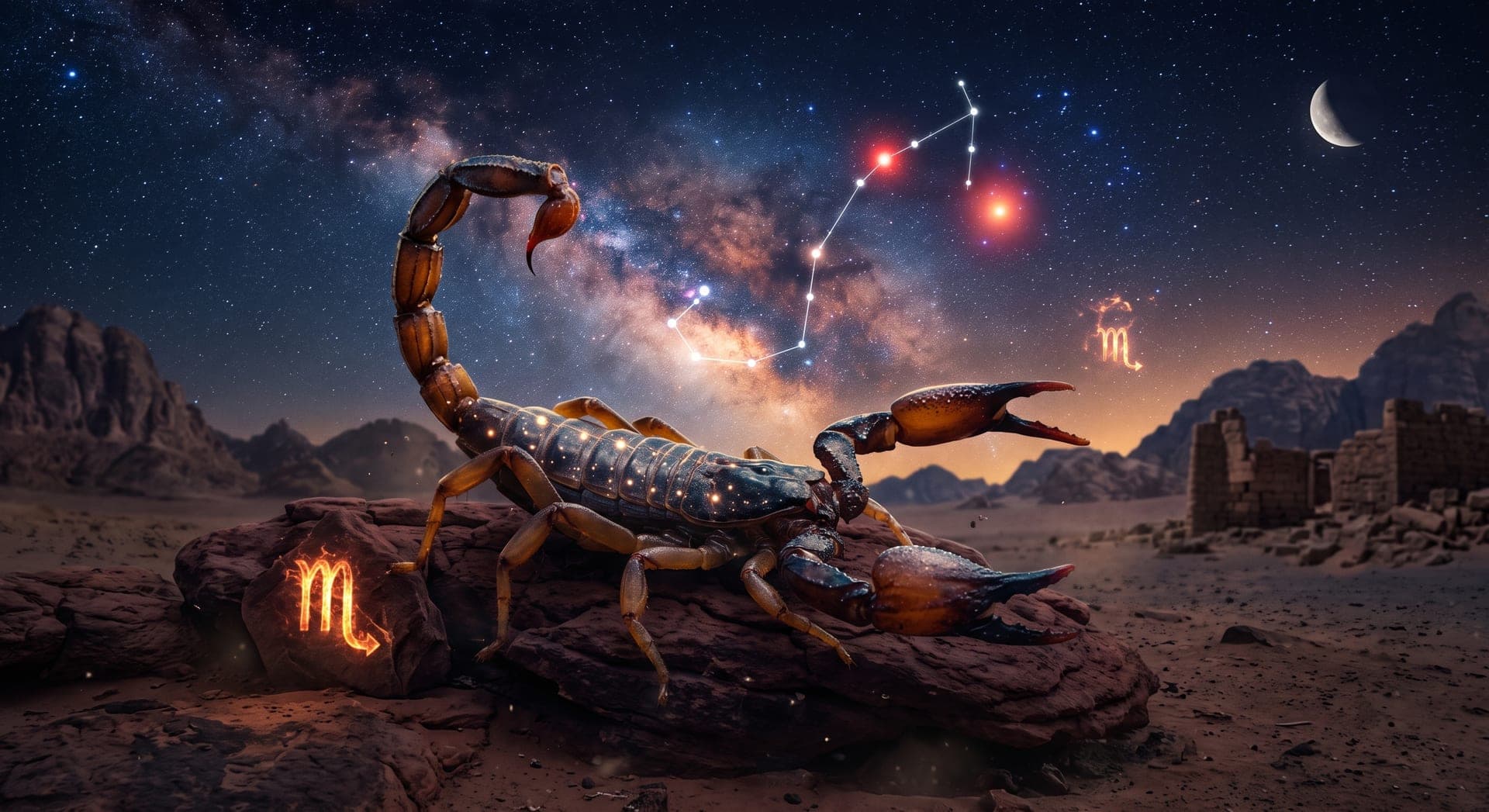
Scorpio, the eighth sign of the zodiac, spans October 23 to November 21 and is symbolized by the scorpion, a creature known for its defensive intensity and the sting it delivers when provoked. Traditionally ruled by Mars and, in modern astrology, by Pluto, the planet of transformation and the underworld, Scorpio carries a reputation as one of the most intense and emotionally powerful signs of the zodiac. As a Water sign, Scorpio experiences the world through deep, often hidden, emotion, guarding its inner life carefully while remaining acutely perceptive of others. Its Fixed modality gives Scorpio remarkable determination and resilience, able to endure hardship and pursue long-term goals with singular focus. People born under this sign are often drawn to work involving psychology, investigation, transformation, or anything requiring the ability to see beneath the surface. Scorpio's loyalty and passion run deep for those it trusts, but that same intensity can curdle into jealousy, suspicion, or an unwillingness to forgive when trust is broken.
Personality Traits
Strengths
- Deeply passionate and determined
- Fiercely loyal to those they trust
- Resourceful and strategic
- Highly perceptive
- Emotionally resilient
Weaknesses
- Prone to jealousy and possessiveness
- Secretive and guarded
- Can be vindictive when wronged
- Distrustful of others
- Prone to obsessiveness
Compatible Signs
Fun Facts
- Scorpio's scorpion symbol connects to the Greek myth of the scorpion sent by Gaia to kill the hunter Orion, with both later placed among the stars.
- Scorpio has two ruling planets: Mars in traditional astrology, and Pluto, discovered in 1930, in the modern system.
- Scorpio is often mistakenly grouped with the Fire signs due to its intensity, but it is actually a Water sign, driven by deep emotion rather than raw aggression.
- Notable Scorpios include Pablo Picasso, Marie Curie, Leonardo DiCaprio, and Hillary Clinton.
- Some astrological traditions associate Scorpio with a secondary, more elevated symbol, the eagle or phoenix, representing transformation and rebirth.
Born on November 18
- 1787
Louis Daguerre
French inventor of an early photographic process
- 1836
W. S. Gilbert
English playwright, poet, and illustrator, best known as the librettist half of the Gilbert and Sullivan comic opera partnership.
- 1860
Ignacy Jan Paderewski
Polish pianist and Prime Minister of Poland
- 1897
Patrick Blackett
English physicist awarded the Nobel Prize in Physics in 1948 for his work developing the Wilson cloud chamber and discoveries in cosmic ray physics.
- 1901
George Gallup
American pioneer of public opinion polling
- 1906
Alec Issigonis
Greek-born British car designer who created the original Mini, one of the most influential car designs of the 20th century.
- 1918
Tasker Watkins
Welsh soldier and judge who was awarded the Victoria Cross for bravery during the Normandy campaign and later became a senior Court of Appeal judge.
- 1923
Alan Shepard
American astronaut, first American in space
- 1939
Margaret Atwood
Canadian author known for "The Handmaid's Tale"
- 1953
Alan Moore
English author celebrated as one of comics' most influential writers, known for works including Watchmen and V for Vendetta.
- 1960
Kim Wilde
English singer-songwriter known for the international hit single 'Kids in America.'
- 1961
Steven Moffat
Scottish screenwriter and producer who served as showrunner of Doctor Who and co-created Sherlock.
- 1962
Kirk Hammett
American guitarist for Metallica
- 1975
Anthony McPartlin
English television presenter and comedian, one half of the popular duo Ant & Dec.
- 2001
Caleb Williams
American football quarterback
On This Day in History
- 1095
Pope Urban II convenes the Council of Clermont, a gathering that would soon lead to the call for the First Crusade.
Pope Urban II's Council of Clermont brought together church leaders and nobles to address various ecclesiastical reforms, but it became historically significant primarily for the pope's closing appeal calling on Christian knights to reclaim Jerusalem from Muslim control. That famous sermon, delivered days later, launched the First Crusade and centuries of subsequent conflict.
- 1493
Christopher Columbus sights the island now known as Puerto Rico during his second voyage.
During his second voyage across the Atlantic, Columbus sighted the mountainous island his crew named San Juan Bautista, later renamed Puerto Rico by Spanish settlers who established colonies there in subsequent years. The island would remain under Spanish colonial control for nearly four centuries before passing to the United States following the Spanish-American War.
- 1626
The newly rebuilt St. Peter's Basilica in Rome is formally consecrated after over a century of construction.
The consecration of the newly rebuilt St. Peter's Basilica marked the completion of one of the largest and most ambitious construction projects in Christian history, spanning more than a century and involving renowned architects including Michelangelo and Bernini. The magnificent basilica remains the ceremonial center of the Catholic Church and one of the world's largest churches.
- 1803
The Battle of Vertières concludes the Haitian Revolution, paving the way for Haiti to become the first Black republic in the Western Hemisphere.
The Battle of Vertieres, fought near Cap-Haitien, marked the decisive final military victory of formerly enslaved and free Black Haitian forces over French colonial troops attempting to reassert control over the colony. The victory secured Haitian independence, achieved the following January, making Haiti the first nation founded by a successful slave revolt.
- 1809
French frigates capture two British East India Company ships in a Bay of Bengal convoy battle.
During Commodore Jacques Hamelin's commerce-raiding cruise from Île de France (Mauritius), his frigates intercepted a convoy of three East Indiamen bound for British India. Two surrendered after only token resistance, while the third, Windham, fought off an attacking frigate before fleeing; it was recaptured by a British frigate days later, though the other prizes reached French territory.
- 1872
Susan B. Anthony and fourteen other women are arrested for illegally voting in the presidential election.
Susan B. Anthony and a group of fellow suffragists were arrested in Rochester, New York after attempting to vote in the presidential election, deliberately testing whether the Fourteenth Amendment's citizenship guarantees extended voting rights to women. Their organized act of civil disobedience became a significant moment in the ongoing campaign for women's suffrage.
- 1883
American and Canadian railroads adopt four standard time zones, ending confusion caused by thousands of local times.
American and Canadian railroad companies voluntarily adopted a standardized system of four time zones across the continent, replacing the confusing patchwork of thousands of local times that had complicated train scheduling and safety. The system proved so practical that governments later formally adopted it, and it remains the basis for time zones used today.
- 1901
Britain and the United States sign the Hay-Pauncefote Treaty, clearing the way for an American-built Panama Canal.
The treaty superseded an 1850 agreement that had required any Central American canal to be jointly controlled and unfortified. By relinquishing its claim to joint control, Britain allowed the United States to build, operate, and fortify the canal alone, reflecting Britain's growing willingness to accommodate American interests in the Western Hemisphere.
- 1910
Hundreds of suffragettes clash with police while marching on the British Parliament, in an event later known as Black Friday.
Organized by the Women's Social and Political Union after Prime Minister Asquith refused further parliamentary time for a bill extending the vote to women, some 300 suffragettes marching on Parliament Square were met by police and hostile crowds who assaulted them, some sexually, for nearly six hours. Well over 100 women were arrested, and the widely reported violence hardened public sympathy for the suffrage movement.
- 1916
General Douglas Haig calls off the Battle of the Somme after more than four months of fighting.
Launched on 1 July 1916 as a joint British-French offensive on the Western Front, the Somme became one of the bloodiest battles in history, with British and Commonwealth forces alone suffering some 420,000 casualties for territorial gains measured in a few miles. Its closure, ordered by Haig as winter weather halted operations, left a legacy that still shapes British memory of the First World War.
- 1928
The animated short Steamboat Willie debuts, becoming the first cartoon with fully synchronized sound.
Steamboat Willie introduced Mickey Mouse to the public in the first animated short with fully synchronized sound, a groundbreaking technical achievement that distinguished Walt Disney's studio from competitors still producing silent cartoons. The character's charm and the film's innovative use of sound quickly propelled Disney to prominence in the animation industry.
- 1928
Walt Disney's animated short Steamboat Willie premieres, popularizing Mickey Mouse and synchronized sound in animation.
Though not the first Mickey Mouse cartoon produced, it was the first released with synchronized sound, pairing music and effects precisely with the on-screen action. Its success established Disney as an animation innovator and made Mickey Mouse one of the most recognizable characters in entertainment history.
- 1943
The RAF launches a major raid on Berlin with 440 bombers, opening the Battle of Berlin campaign.
Ordered by Air Chief Marshal Arthur Harris, the raid was the first of a sustained series of attacks intended to break German civilian morale and hasten the war's end. Over the following months, RAF Bomber Command would return to Berlin repeatedly, at heavy cost in aircraft and aircrew, in a campaign that ultimately failed to force a German surrender on its own.
- 1971
Oman marks its National Day, commemorating its 1971 independence from British protection.
The date coincides with the birthday of Sultan Qaboos bin Said, who had deposed his father the previous year and ended nearly a century and a half of British-directed foreign and defence policy over the sultanate. Britain retained close military and economic ties with Oman afterward, and November 18 has been celebrated annually since as Oman's National Day.
- 1978
Cult leader Jim Jones orchestrates a mass murder-suicide in Jonestown, Guyana, killing 918 people.
Cult leader Jim Jones ordered members of his Peoples Temple community in Guyana to consume cyanide-laced beverages after followers murdered a visiting U.S. congressman investigating the group, resulting in the largest single loss of American civilian life in a deliberate act until September 11, 2001. The Jonestown massacre remains a chilling case study in cult psychology and manipulation.
- 1987
The King's Cross fire kills 31 people at one of London's busiest Underground stations.
A fire believed to have started from a discarded match beneath an escalator rapidly spread through King's Cross Underground station, trapping and killing commuters during the evening rush hour. The disaster exposed serious fire safety deficiencies in London's aging Underground system and prompted sweeping safety reforms across the network.
- 1987
A fire at King's Cross St Pancras Underground station kills 31 people in London.
Believed to have started when a discarded match ignited grease and rubbish beneath a wooden escalator, the blaze produced a rare 'trench effect' that sent flames flashing up into the ticket hall, catching passengers and staff by surprise. The disaster exposed serious safety failings on the London Underground and led to a ban on wooden escalators and smoking across the network.
- 1991
British envoy Terry Waite is freed after nearly five years held hostage in Lebanon.
Waite, who had travelled to Beirut in 1987 as a Church of England envoy attempting to negotiate the release of other hostages, was himself seized by an Islamist militant group and held largely in solitary confinement. He was released alongside American academic Thomas Sutherland, and his ordeal made him one of Britain's most recognized hostage survivors.
- 1996
A fire aboard a freight train damages roughly 500 metres of the Channel Tunnel linking Britain and France.
The blaze broke out on a heavy-goods-vehicle shuttle train travelling through the tunnel, forcing an evacuation of all passengers and crew without loss of life. Repairs kept part of the tunnel closed for several months and prompted a significant overhaul of its fire-safety systems, though full freight and passenger services eventually resumed.
- 2003
Massachusetts becomes the first U.S. state to legalize same-sex marriage following a state court ruling.
Massachusetts's highest court ruled that denying marriage licenses to same-sex couples violated the state constitution, making it the first U.S. state to legalize same-sex marriage. The landmark ruling set a significant legal precedent that influenced the broader national debate over marriage equality in the years leading up to nationwide legalization.