What’s Observed on November 16
Born on November 16: Scorpio ♏
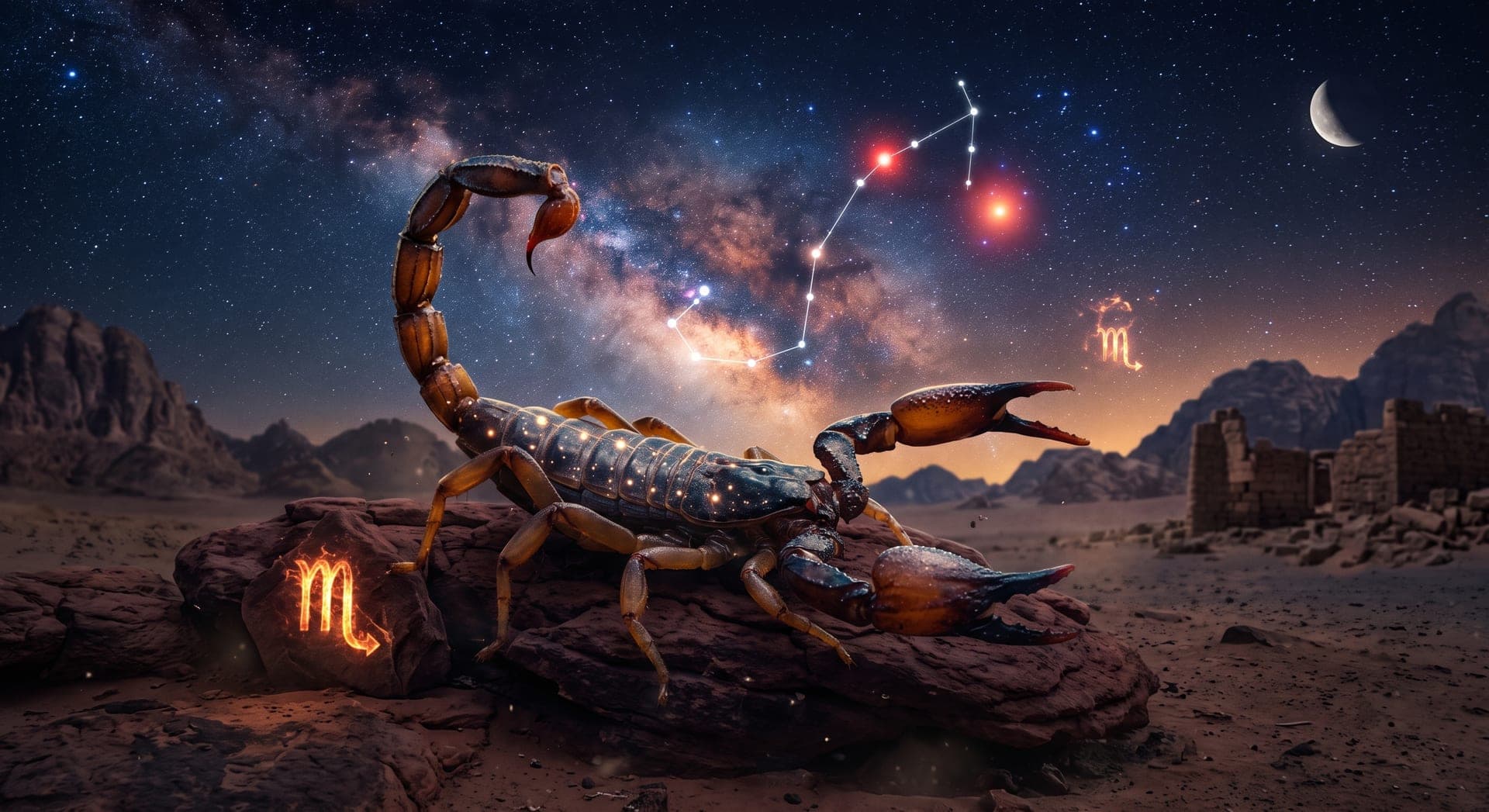
Scorpio, the eighth sign of the zodiac, spans October 23 to November 21 and is symbolized by the scorpion, a creature known for its defensive intensity and the sting it delivers when provoked. Traditionally ruled by Mars and, in modern astrology, by Pluto, the planet of transformation and the underworld, Scorpio carries a reputation as one of the most intense and emotionally powerful signs of the zodiac. As a Water sign, Scorpio experiences the world through deep, often hidden, emotion, guarding its inner life carefully while remaining acutely perceptive of others. Its Fixed modality gives Scorpio remarkable determination and resilience, able to endure hardship and pursue long-term goals with singular focus. People born under this sign are often drawn to work involving psychology, investigation, transformation, or anything requiring the ability to see beneath the surface. Scorpio's loyalty and passion run deep for those it trusts, but that same intensity can curdle into jealousy, suspicion, or an unwillingness to forgive when trust is broken.
Personality Traits
Strengths
- Deeply passionate and determined
- Fiercely loyal to those they trust
- Resourceful and strategic
- Highly perceptive
- Emotionally resilient
Weaknesses
- Prone to jealousy and possessiveness
- Secretive and guarded
- Can be vindictive when wronged
- Distrustful of others
- Prone to obsessiveness
Compatible Signs
Fun Facts
- Scorpio's scorpion symbol connects to the Greek myth of the scorpion sent by Gaia to kill the hunter Orion, with both later placed among the stars.
- Scorpio has two ruling planets: Mars in traditional astrology, and Pluto, discovered in 1930, in the modern system.
- Scorpio is often mistakenly grouped with the Fire signs due to its intensity, but it is actually a Water sign, driven by deep emotion rather than raw aggression.
- Notable Scorpios include Pablo Picasso, Marie Curie, Leonardo DiCaprio, and Hillary Clinton.
- Some astrological traditions associate Scorpio with a secondary, more elevated symbol, the eagle or phoenix, representing transformation and rebirth.
Born on November 16
- 42
Tiberius
Second Roman emperor
- 1811
John Bright
English Radical and Liberal politician who campaigned against the Corn Laws and for parliamentary reform, becoming one of the great orators of Victorian politics.
- 1873
W. C. Handy
American composer known as the "Father of the Blues"
- 1895
Paul Hindemith
German composer and violist
- 1907
Burgess Meredith
American actor and director
- 1914
Eddie Chapman
English safecracker turned World War II double agent, codenamed Zigzag, who spied for Britain after being recruited by German intelligence.
- 1922
Jose Saramago
Portuguese novelist and Nobel Prize laureate
- 1935
Magdi Yacoub
Egyptian-born English cardiac surgeon renowned for pioneering heart and heart-lung transplant techniques at Harefield Hospital.
- 1953
Griff Rhys Jones
Welsh comedian, actor, and broadcaster known for the sketch show Not the Nine O'Clock News and Alas Smith and Jones.
- 1961
Frank Bruno
English heavyweight boxer who won the WBC world title in 1995 and became one of Britain's most popular sporting figures.
- 1973
Christian Horner
English motorsport executive who has served as team principal of Red Bull Racing since 2005, guiding the team to multiple Formula One championships.
- 1974
Paul Scholes
English footballer regarded as one of the finest midfielders of his generation, spending his entire career at Manchester United and winning eleven Premier League titles.
- 1985
Sanna Marin
Prime Minister of Finland
On This Day in History
- 1272
Prince Edward becomes King of England upon the death of his father, Henry III, though he is away on crusade and not crowned for nearly two years.
Edward learned of his accession while returning from the Ninth Crusade and took his time travelling home through Europe, confident enough in the peace of his realm to delay his coronation until August 1274. He would reign as Edward I, remembered as 'Longshanks' for his conquests in Wales and wars against Scotland.
- 1532
Francisco Pizarro's forces capture Inca Emperor Atahualpa at the Battle of Cajamarca, a turning point in the Spanish conquest of Peru.
The Battle of Cajamarca saw Pizarro's small force ambush Atahualpa's much larger but unprepared retinue, capturing the Inca emperor and killing thousands of his followers with minimal Spanish casualties, thanks to superior weaponry and the element of surprise. His subsequent capture and eventual execution effectively decapitated Inca resistance, accelerating the Spanish conquest of the empire.
- 1532
Spanish conquistador Francisco Pizarro and his men capture the Inca emperor Atahualpa at the Battle of Cajamarca.
Despite being vastly outnumbered, Pizarro's small force ambushed Atahualpa's unarmed retinue, killing thousands of Inca attendants and taking the emperor hostage. Atahualpa's capture and subsequent execution the following year opened the way for the Spanish conquest of the Inca Empire.
- 1632
King Gustavus Adolphus of Sweden is killed at the Battle of Lützen during the Thirty Years' War.
King Gustavus Adolphus of Sweden, one of the most celebrated military innovators of his era, was killed leading a cavalry charge at the Battle of Lutzen during the Thirty Years' War, though his forces ultimately won the engagement. His death removed a formidable Protestant leader from the conflict but did not immediately alter Sweden's continued involvement in the war.
- 1776
British forces capture Fort Washington from Patriot defenders during the American Revolutionary War.
British and Hessian forces overwhelmed the American garrison defending Fort Washington on Manhattan Island, resulting in the capture of nearly 3,000 Continental Army soldiers, one of the most significant American defeats of the entire Revolutionary War. The loss forced General Washington's forces into a difficult retreat across New Jersey in the campaign's darkest period.
- 1776
British and Hessian forces capture Fort Washington on Manhattan Island, dealing a heavy blow to George Washington's Continental Army.
The assault overwhelmed the fort's garrison and netted nearly 3,000 American prisoners along with valuable artillery and supplies, one of the worst American defeats of the Revolutionary War. The loss forced Washington's army into a difficult retreat across New Jersey that winter, though it survived to fight on.
- 1828
Britain, France, and Russia sign the London Protocol, agreeing to establish an autonomous Greek state under nominal Ottoman suzerainty.
The agreement followed the three powers' naval intervention at the Battle of Navarino the previous year, which had crippled the Ottoman-Egyptian fleet during the Greek War of Independence. The protocol paved the way for full Greek independence, recognised two years later, and marked Britain's growing role as an arbiter of the Eastern Mediterranean's affairs.
- 1855
Explorer David Livingstone becomes the first European to see Victoria Falls in present-day Zambia-Zimbabwe.
David Livingstone became the first European recorded to see the massive waterfall on the Zambezi River, naming it Victoria Falls in honor of the British monarch, though local peoples had known the site for generations under different names. His accounts of the falls' scale and power sparked significant European interest in exploring the African interior.
- 1855
Scottish missionary and explorer David Livingstone becomes the first European to see the waterfall on the Zambezi River he names Victoria Falls.
Local Kololo guides knew the falls as Mosi-oa-Tunya, 'the smoke that thunders,' and Livingstone renamed them in honour of Queen Victoria. His account of the falls, among the largest in the world, captivated Victorian Britain and cemented his reputation as the era's most celebrated African explorer.
- 1857
Twenty-four Victoria Crosses are awarded for actions during the relief of Lucknow, the most ever presented for a single day's fighting.
The medals recognised acts of extraordinary bravery during the Indian Rebellion of 1857, as British and loyal Indian forces fought to break the siege of the Lucknow Residency. Instituted the previous year, the Victoria Cross remains Britain's highest award for gallantry in the presence of the enemy.
- 1904
English engineer John Ambrose Fleming receives a patent for the thermionic valve, the first practical vacuum tube.
Fleming's diode, developed while consulting for the Marconi Company, allowed alternating current to be converted into a detectable direct current signal, making it essential for early radio receivers. The device launched the field of electronics and remained central to radio, television, and computing technology until the transistor's invention decades later.
- 1914
The Federal Reserve Bank of the United States officially opens, establishing the nation's central banking system.
The Federal Reserve system began operations following passage of the Federal Reserve Act the previous year, establishing a network of regional reserve banks intended to provide the United States with a more stable and elastic currency and banking system. The system was created partly in response to recurring financial panics that had destabilized the American economy in preceding decades.
- 1938
Chemist Albert Hofmann first synthesizes LSD from ergotamine at Sandoz Laboratories in Basel, Switzerland.
Chemist Albert Hofmann first synthesized LSD while researching potential medicinal compounds derived from a fungus that grows on rye, though its powerful psychoactive properties were not discovered until he accidentally absorbed a small amount several years later. The substance would go on to play a significant, controversial role in psychiatric research and 1960s counterculture.
- 1940
The Royal Air Force bombs Hamburg in retaliation for the devastating German raid on Coventry days earlier.
The strike was part of an escalating cycle of night bombing between Britain and Germany during the early stages of the Blitz, as both air forces targeted each other's industrial cities. Hamburg, a major port and shipbuilding centre, would go on to suffer far larger Allied raids later in the war, including the devastating 1943 firestorm of Operation Gomorrah.
- 1945
UNESCO is established as an international organization for education, science, and cultural cooperation.
UNESCO was founded in the aftermath of World War II to promote international collaboration in education, science, and culture as a means of building lasting peace through mutual understanding between nations. The organization has since become known for initiatives including its World Heritage Site designation program, which recognizes places of outstanding cultural or natural significance.
- 1945
The United Nations Educational, Scientific and Cultural Organization is founded in London.
Established in the aftermath of the Second World War, UNESCO was created to promote international cooperation in education, science, and culture as a means of building lasting peace. It went on to establish the World Heritage List and numerous other programmes protecting cultural and natural sites around the globe.
- 1973
NASA launches Skylab 4, sending a crew of three astronauts on an 84-day mission.
Skylab 4's crew conducted the longest crewed spaceflight to date at the time, spending 84 days aboard America's first space station while performing extensive scientific research, including detailed observations of the Sun and Comet Kohoutek. The mission also gained notoriety for a brief crew strike over a demanding workload imposed by mission control.
- 1992
Metal detectorist Eric Lawes discovers the Hoxne Hoard in Suffolk, the largest hoard of late Roman gold and silver ever found in Britain.
Searching for a friend's lost hammer, Lawes instead unearthed nearly 15,000 Roman coins along with gold jewellery and silver tableware, buried around 410 AD as Roman rule in Britain collapsed. Now held by the British Museum, the hoard offered an unprecedented window into wealth and daily life in Roman Britain's final years.
- 2022
NASA launches Artemis 1, an uncrewed test flight beginning the program's return to the Moon.
Artemis 1 launched as an uncrewed test flight of NASA's new Space Launch System rocket and Orion spacecraft, sending the capsule on a journey around the Moon to validate systems before future crewed missions. The successful mission marked the beginning of NASA's renewed effort to return astronauts to the lunar surface after a decades-long absence.