What’s Observed on October 30
Born on October 30: Scorpio ♏
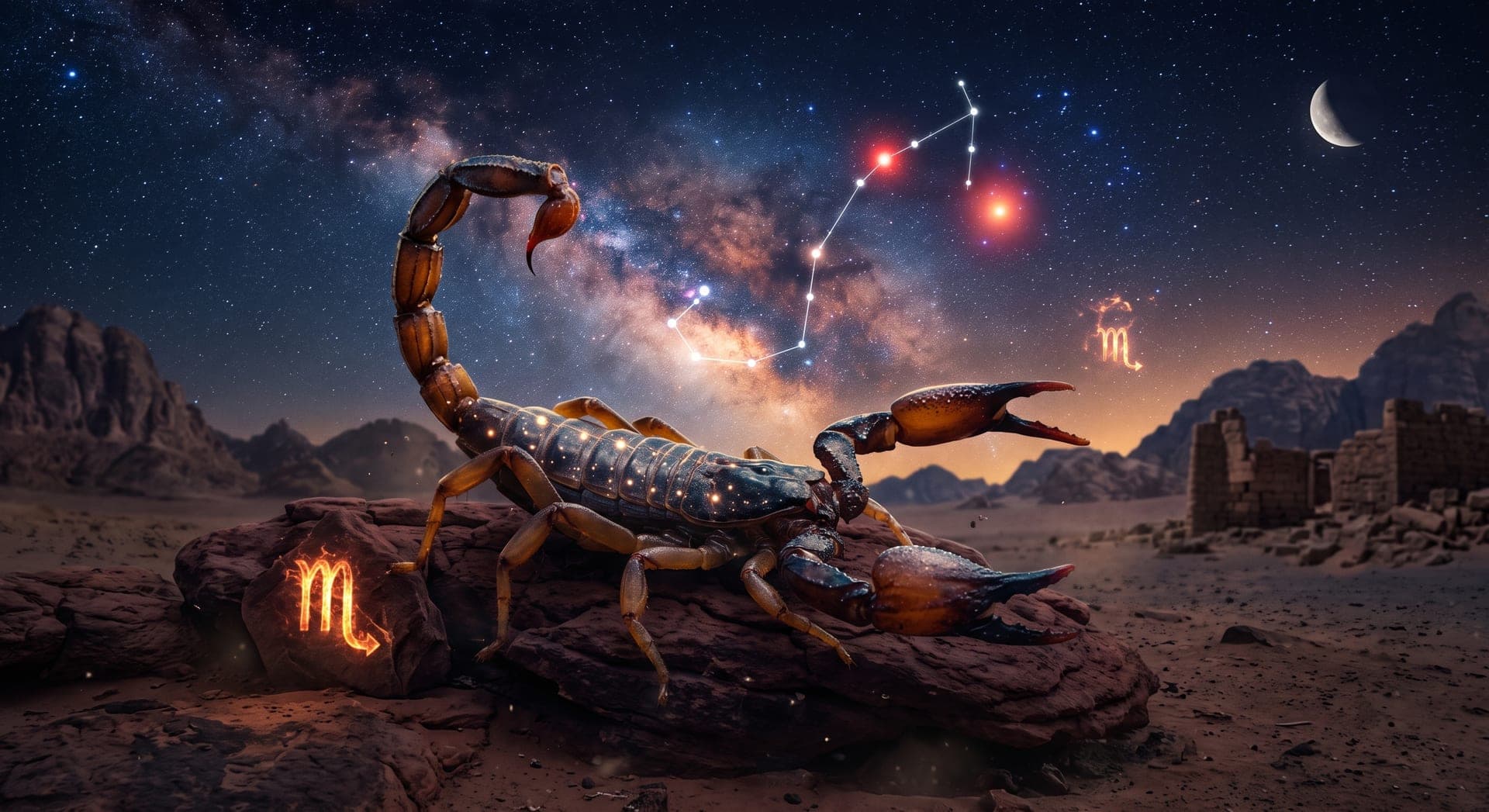
Scorpio, the eighth sign of the zodiac, spans October 23 to November 21 and is symbolized by the scorpion, a creature known for its defensive intensity and the sting it delivers when provoked. Traditionally ruled by Mars and, in modern astrology, by Pluto, the planet of transformation and the underworld, Scorpio carries a reputation as one of the most intense and emotionally powerful signs of the zodiac. As a Water sign, Scorpio experiences the world through deep, often hidden, emotion, guarding its inner life carefully while remaining acutely perceptive of others. Its Fixed modality gives Scorpio remarkable determination and resilience, able to endure hardship and pursue long-term goals with singular focus. People born under this sign are often drawn to work involving psychology, investigation, transformation, or anything requiring the ability to see beneath the surface. Scorpio's loyalty and passion run deep for those it trusts, but that same intensity can curdle into jealousy, suspicion, or an unwillingness to forgive when trust is broken.
Personality Traits
Strengths
- Deeply passionate and determined
- Fiercely loyal to those they trust
- Resourceful and strategic
- Highly perceptive
- Emotionally resilient
Weaknesses
- Prone to jealousy and possessiveness
- Secretive and guarded
- Can be vindictive when wronged
- Distrustful of others
- Prone to obsessiveness
Compatible Signs
Fun Facts
- Scorpio's scorpion symbol connects to the Greek myth of the scorpion sent by Gaia to kill the hunter Orion, with both later placed among the stars.
- Scorpio has two ruling planets: Mars in traditional astrology, and Pluto, discovered in 1930, in the modern system.
- Scorpio is often mistakenly grouped with the Fire signs due to its intensity, but it is actually a Water sign, driven by deep emotion rather than raw aggression.
- Notable Scorpios include Pablo Picasso, Marie Curie, Leonardo DiCaprio, and Hillary Clinton.
- Some astrological traditions associate Scorpio with a secondary, more elevated symbol, the eagle or phoenix, representing transformation and rebirth.
Born on October 30
- 1632
Christopher Wren
English architect and scientist who designed St Paul's Cathedral and dozens of London churches after the Great Fire of 1666.
- 1735
John Adams
Second President of the United States
- 1885
Ezra Pound
American poet
- 1892
Charles Atlas
Italian-American bodybuilder
- 1914
Anna Wing
English actress best remembered for playing matriarch Lou Beale in the soap opera EastEnders.
- 1935
Michael Winner
English film director and producer known for the Death Wish series and for his later career as a restaurant critic.
- 1939
Grace Slick
American singer for Jefferson Airplane
- 1939
Harvey Goldstein
English statistician known for his contributions to educational and biomedical statistics, including multilevel modelling.
- 1941
Bob Wilson
English footballer and Arsenal goalkeeper who later became a television football pundit and broadcaster.
- 1945
Henry Winkler
American actor known for "Happy Days"
- 1946
Chris Slade
Welsh drummer known for his work with the rock band AC/DC.
- 1948
Richard Alston
English dancer and choreographer who founded the Richard Alston Dance Company and led London Contemporary Dance Theatre.
- 1956
Juliet Stevenson
English actress celebrated for her stage work and for films including Truly, Madly, Deeply.
- 1960
Diego Maradona
Argentine footballer
- 1965
Gavin Rossdale
English singer for the band Bush
On This Day in History
- 637
Antioch surrenders to Rashidun Caliphate forces following the broader Arab-Byzantine conflict.
After a prolonged siege that severely strained its Byzantine defenders amid the broader rapid Arab-Byzantine conflict following the death of the Prophet Muhammad, the ancient and strategically vital city of Antioch surrendered to advancing Rashidun Caliphate forces, marking a significant early conquest during the swift Arab expansion across the eastern Mediterranean region.
- 1137
Ranulf of Apulia defeats King Roger II of Sicily at the Battle of Rignano.
Norman noble Ranulf of Apulia, allied with Pope Innocent II and Holy Roman Emperor Lothair III against the ambitious King Roger II of Sicily, achieved a significant victory at Rignano, though Roger ultimately prevailed in the broader conflict and consolidated his control over southern Italy and Sicily.
- 1270
The Eighth Crusade concludes through a negotiated agreement between Charles I of Anjou and the Hafsid dynasty.
The Eighth Crusade, led by King Louis IX of France before his death from illness during the campaign, concluded through a negotiated agreement with the Hafsid rulers of Tunis, ending what proved to be one of the final major Crusading expeditions to North Africa.
- 1340
Portuguese and Castilian forces halt a Muslim invasion at the Battle of Rio Salado in Spain.
Combined Portuguese and Castilian forces decisively defeated a large Muslim invasion force at Rio Salado in southern Spain, a significant Christian victory that halted the last major attempt by North African Muslim powers to reverse Christian territorial gains during the Reconquista.
- 1657
Spanish forces fail to recapture Jamaica from the English at the Battle of Ocho Rios.
English colonial forces, having seized Jamaica from Spain several years earlier as part of an ambitious but largely unsuccessful broader Caribbean campaign, successfully repelled a determined Spanish attempt to recapture the island at Ocho Rios. The victory secured lasting English control over the strategically valuable Caribbean island for the following centuries of colonial rule and sugar plantation economy.
- 1657
Spanish forces fail in their attempt to recapture Jamaica from the English, who had seized the island two years earlier.
England had invaded Jamaica in 1655 as part of Oliver Cromwell's 'Western Design' to expand English holdings in the Caribbean at Spain's expense. Spanish attempts to retake the island through guerrilla resistance and invasion continued for years but ultimately failed, and Jamaica remained under English, then British, colonial rule until its independence in 1962.
- 1806
A Prussian general surrenders the fortress city of Stettin to French forces during the War of the Fourth Coalition.
Following France's crushing defeat of Prussian forces earlier in the War of the Fourth Coalition, the Prussian garrison commander at Stettin surrendered the fortress city to a numerically smaller French force, an embarrassing capitulation that reflected the broader collapse of Prussian military resistance during this campaign.
- 1831
Nat Turner, leader of a slave rebellion in Virginia, is captured after more than two months in hiding.
Turner had led dozens of enslaved and free Black followers in an uprising that August, killing around sixty white residents of Southampton County before militia crushed the revolt. His capture led to a swift trial and execution, while the rebellion prompted Southern states to pass harsher laws restricting the movement, education and assembly of enslaved people.
- 1858
About twenty people die and hundreds fall ill in Bradford, England, after sweets are accidentally made with arsenic instead of a harmless filler.
A confectioner selling adulterated 'humbugs' at a local market had unknowingly bought a batch of white powder contaminated with arsenic trioxide instead of the gypsum typically used to bulk out cheap sweets. The Bradford sweets poisoning caused national outrage and helped push Parliament to pass the Pharmacy Act of 1868, tightening controls on the sale of poisons in Britain.
- 1888
British businessman Cecil Rhodes obtains the Rudd Concession, securing exclusive mineral rights in Matabeleland from King Lobengula.
Rhodes's agents persuaded Lobengula to sign the concession in exchange for guns, ammunition and a monthly payment, though the king later claimed he had been deceived about its scope. The concession became the legal basis for the British South Africa Company's royal charter and its subsequent colonisation of the territory that would become Rhodesia, now Zimbabwe.
- 1918
The Ottoman Empire signs the Armistice of Mudros aboard a British warship, ending its participation in the First World War.
Negotiated largely on Britain's behalf by Admiral Somerset Gough-Calthorpe aboard HMS Agamemnon in the harbour of Mudros, the armistice required the Ottomans to open the Dardanelles and Bosphorus straits to Allied ships and to demobilise their forces. It effectively ended four centuries of Ottoman rule over much of the Middle East and paved the way for the empire's dismantlement.
- 1938
Orson Welles broadcasts a radio adaptation of "The War of the Worlds," reportedly triggering widespread public panic.
Orson Welles's realistic radio dramatization of an alien invasion, presented in the style of breaking news bulletins, reportedly caused genuine panic among some listeners who believed the fictional events were actually occurring, though the scale of the resulting hysteria has since been significantly debated and likely exaggerated by contemporary newspaper coverage.
- 1938
Orson Welles's radio dramatisation of The War of the Worlds airs in the United States, sparking panic among some listeners who believed a Martian invasion was underway.
Presented in the style of breaking news bulletins, the broadcast convinced a portion of the audience that New Jersey was genuinely under attack, leading to alarmed phone calls and, according to contemporary press reports, some flight from homes. Later research suggested the scale of the panic was exaggerated by newspapers eager to discredit radio as a rival medium, but the broadcast became a landmark moment in media history.
- 1942
Two British sailors drown retrieving code books from the sinking German submarine U-559, a breakthrough that helped codebreakers crack the Enigma cipher.
Lieutenant Tony Fasson and Able Seaman Colin Grazier swam from HMS Petard to the crippled U-boat in the Mediterranean and passed vital cipher documents to a young canteen assistant before the submarine sank beneath them. Their haul allowed cryptanalysts at Bletchley Park to break the more complex four-rotor naval Enigma, significantly aiding the Allied fight against German U-boats in the Atlantic.
- 1947
Twenty-three nations, including Britain, sign the General Agreement on Tariffs and Trade in Geneva, establishing a framework for reducing global trade barriers.
GATT set out rules to cut tariffs and prevent discriminatory trade practices among its signatories, laying the institutional groundwork for decades of expanding international commerce. Though intended as an interim measure, it governed world trade for nearly fifty years through successive negotiating rounds before being superseded by the World Trade Organization in 1995.
- 1961
The Soviet Union detonates the Tsar Bomba, the most powerful explosive device ever tested.
The Soviet Union detonated the Tsar Bomba over a remote Arctic testing site, an experimental hydrogen bomb with a yield far exceeding any other nuclear weapon ever tested, a demonstration of raw destructive power intended primarily to showcase Soviet nuclear capability during the Cold War arms race.
- 1961
The Soviet Union detonates the Tsar Bomba over Novaya Zemlya, the most powerful nuclear device ever tested.
The hydrogen bomb released an explosive yield estimated at fifty megatons, roughly three thousand times more powerful than the bomb dropped on Hiroshima, and produced a mushroom cloud that rose over forty miles into the atmosphere. Though never intended for practical military deployment, the test was a stark demonstration of Soviet nuclear capability at the height of the Cold War arms race.
- 1995
Quebec voters narrowly reject a second sovereignty referendum, choosing to remain part of Canada.
In a remarkably close vote, Quebec residents narrowly rejected a second referendum on sovereignty from Canada, with the pro-Canada side prevailing by less than one percentage point, a result that left unresolved tensions over Quebec's political status within the Canadian federation.
- 1995
Quebec narrowly votes to remain part of Canada in a sovereignty referendum, with the 'No' side prevailing by less than one percentage point.
The result, decided by roughly 54,000 votes out of more than four million cast, was the closest of Quebec's two independence referendums and exposed deep divisions within the province and the country. The near-miss prompted the Canadian federal government to pass the Clarity Act, setting stricter conditions for any future referendum on provincial secession.
- 2020
A magnitude 7.0 earthquake strikes the Aegean Sea, triggering a tsunami that kills at least 119 people.
A powerful undersea earthquake, measuring magnitude 7.0, struck the Aegean Sea between Greece and Turkey, generating a localized tsunami that struck coastal areas of both countries. The Turkish port city of Izmir suffered particularly severe building collapses due to poor construction standards, contributing significantly to a death toll of at least 119 people across the affected region.