
What’s Observed on January 31
Born on January 31: Aquarius ♒
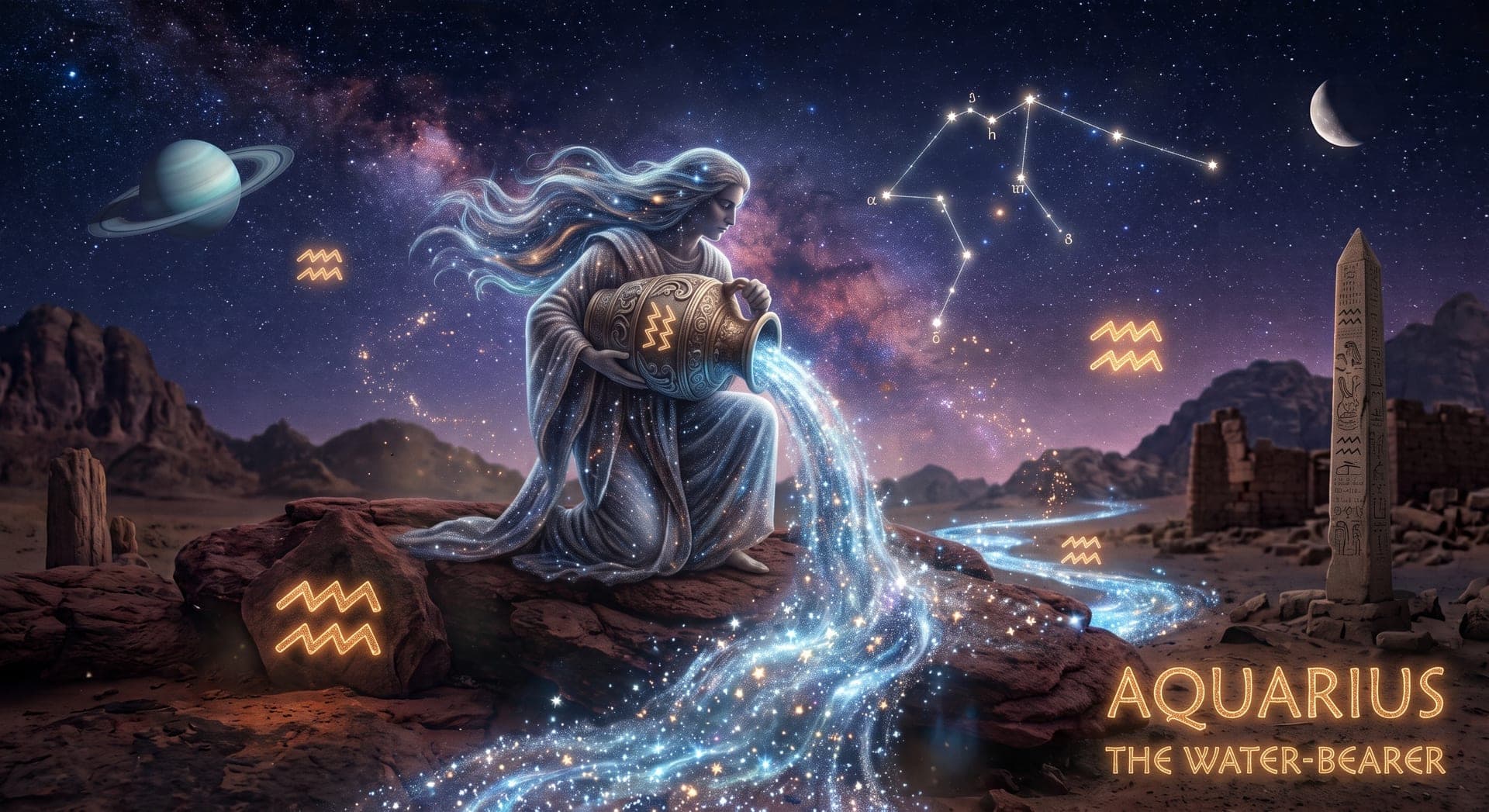
Aquarius, the eleventh sign of the zodiac, spans January 20 to February 18 and is symbolized by the water bearer, an image of someone pouring out knowledge and life-giving ideas to the world, despite Aquarius actually being an air sign rather than a water sign. Traditionally ruled by disciplined Saturn and, in modern astrology, by unpredictable Uranus, the planet of innovation and rebellion, Aquarius carries a distinctive blend of structure and originality. People born under this sign are often described as independent thinkers, forward-looking, and drawn to humanitarian causes, valuing the collective good over convention. As a Fixed sign, Aquarius can be famously stubborn once its mind is made up, even while championing change for everyone else. Intellectually curious and sometimes emotionally guarded, Aquarians tend to value friendship and community deeply, often serving as the visionary of their social circle, more comfortable debating ideas than discussing feelings.
Personality Traits
Strengths
- Original and forward-thinking
- Strong sense of fairness and justice
- Independent and self-sufficient
- Loyal to friends and causes alike
- Sees the bigger picture others miss
Weaknesses
- Can run from emotional expression
- Uncompromising once a position is fixed
- Prone to aloofness or detachment
- Sometimes contrarian just to stand apart
- Can prioritize ideas over people's feelings
Compatible Signs
Fun Facts
- Despite its watery name and imagery, Aquarius is classified as an air sign, grouped with Gemini and Libra as a sign of thought and communication rather than emotion.
- Aquarius has two ruling planets: Saturn in classical astrology, and Uranus, discovered in 1781, in the modern system most Western astrologers use today.
- The water bearer symbol traces back to Ganymede in Greek mythology, a cupbearer to the gods said to pour out a life-giving stream from the heavens.
- Notable Aquarians include Oprah Winfrey, Abraham Lincoln, Charles Darwin, Thomas Edison, and Bob Marley.
- Aquarius is one of the rarer signs to be represented by a person rather than an animal or object, alongside Gemini, Virgo, and Sagittarius's centaur half.
Born on January 31
- 1797
Franz Schubert
Austrian composer of the early Romantic era
- 1902
Tallulah Bankhead
American stage and film actress known for her wit
- 1919
Jackie Robinson
First Black player in Major League Baseball's modern era
- 1929
Rudolf Mossbauer
German physicist and Nobel Prize laureate
- 1929
Jean Simmons
English actress known for roles in Great Expectations and Spartacus
- 1931
Christopher Chataway
English athlete and politician who paced Roger Bannister's four-minute mile
- 1938
Beatrix of the Netherlands
Former Queen of the Netherlands
- 1942
Derek Jarman
English film director, stage designer, and artist known for avant-garde works
- 1945
Brenda Hale, Baroness Hale of Richmond
English judge who became the first female President of the UK Supreme Court
- 1947
Nolan Ryan
Baseball Hall of Fame pitcher with a record seven no-hitters
- 1956
John Lydon
English singer-songwriter known as Johnny Rotten, frontman of the Sex Pistols
- 1960
Grant Morrison
Scottish comic book writer known for acclaimed runs on Batman and X-Men
- 1970
Minnie Driver
English actress and singer-songwriter known for films including Good Will Hunting
- 1973
Portia de Rossi
Australian-American actress
- 1981
Justin Timberlake
Singer-songwriter and actor, formerly of NSYNC

On This Day in History
- 1606
Guy Fawkes and several other Gunpowder Plot conspirators are executed in London.
Guy Fawkes and his fellow Gunpowder Plot conspirators were dragged through London streets and subjected to the brutal punishment of hanging, drawing, and quartering, a public spectacle meant to deter future treason against the crown. The failed plot to blow up Parliament and King James I is still commemorated annually in Britain with bonfires and fireworks on Guy Fawkes Night each November.
- 1606
Four surviving Gunpowder Plot conspirators, including Guy Fawkes, are executed in London.
Fawkes and his co-conspirators were hanged, drawn, and quartered outside the Old Palace Yard at Westminster, two days after four other plotters met the same fate at St Paul's Churchyard. The executions brought a grim close to the failed 1605 plot to blow up Parliament, an event still commemorated annually in Britain with bonfires and fireworks.
- 1747
The London Lock Hospital opens the first dedicated venereal disease clinic in Britain.
The hospital, located near Hyde Park Corner, provided treatment for sexually transmitted infections at a time when such illnesses carried heavy social stigma and were largely untreated elsewhere in Britain. It became an important, if controversial, institution in British medical history, later expanding to include an asylum wing devoted to the moral rehabilitation of female patients.
- 1865
The U.S. Congress passes the Thirteenth Amendment, abolishing slavery, and sends it to the states for ratification.
The House vote, following the Senate's earlier approval, sent the amendment abolishing slavery to the states for ratification, a milestone President Lincoln had lobbied hard for despite significant opposition. The amendment was ratified by the required number of states by December 1865, permanently ending slavery throughout the United States, months after the Emancipation Proclamation had already freed enslaved people only in Confederate territory.
- 1915
Germany makes the first large-scale use of poison gas in warfare against Russian troops at the Battle of Bolimów.
German forces fired thousands of tear-gas-filled artillery shells at Russian troops on the Eastern Front, an early experiment in chemical warfare that largely failed due to the shells' liquid contents freezing in the winter cold rather than vaporizing effectively. Germany would escalate to far deadlier chlorine gas attacks against French and Canadian troops at Ypres just months later.
- 1918
Two Royal Navy submarines are lost in a series of accidental collisions in the Firth of Forth.
During a night exercise, a chain of collisions and near-misses among British submarines and other vessels, worsened by poor visibility and faulty equipment, caused the loss of two submarines and damage to several others, killing more than 100 sailors without any enemy involvement. The incident later became known as the "Battle of May Island."
- 1919
The Battle of George Square erupts in Glasgow during a campaign for a shorter working week.
Striking workers clashed with police in George Square amid demonstrations for a 40-hour working week, prompting the government to fear a Bolshevik-style revolutionary uprising and to deploy troops and tanks onto the city's streets. The episode, remembered as part of "Red Clydeside," remains a landmark moment in British labour history.
- 1942
Allied forces retreat into Singapore as the Battle of Malaya nears its end.
Overwhelmed by the rapid Japanese advance down the Malayan peninsula, British, Indian, and Australian troops withdrew across the causeway into Singapore, which the demolished causeway was meant to help defend. The island fell to Japanese forces just over two weeks later, in what Winston Churchill called the worst disaster in British military history.
- 1943
German Field Marshal Friedrich Paulus surrenders to Soviet forces at Stalingrad, a turning point of World War II.
Paulus's surrender at Stalingrad, defying Hitler's explicit orders to fight to the death, ended one of the bloodiest battles in human history, with well over a million total casualties on both sides. The catastrophic German defeat marked a decisive turning point on the Eastern Front, after which German forces were pushed steadily back toward Berlin over the following two years.
- 1945
British Commandos repel a Japanese counterattack at the Battle of Hill 170 in Burma.
Troops of the 3rd Commando Brigade held their fortified position on a hill overlooking the Kangaw road against repeated, determined Japanese assaults during the Arakan campaign, an important engagement in the wider Allied effort to reclaim Burma from Japanese occupation. The successful defense helped secure the Allied position ahead of subsequent offensives later that year.
- 1953
A severe North Sea storm surge floods coastal areas, killing over 300 people in Britain.
Hurricane-force winds combined with high tides to breach sea defenses along the east coast of England, drowning more than 300 people and destroying thousands of homes; the disaster killed even more, over 1,800 people, across the North Sea in the Netherlands. The floods prompted major investment in coastal defenses, eventually including London's Thames Barrier.
- 1958
The United States launches Explorer 1, its first satellite, which discovers the Van Allen radiation belt.
Launched hastily by the U.S. Army following the Soviet Union's earlier Sputnik satellites, Explorer 1 carried instruments designed by physicist James Van Allen that detected an unexpectedly intense band of radiation trapped by Earth's magnetic field. The discovery of what became known as the Van Allen radiation belts was one of the first major scientific findings of the space age.
- 1961
The chimpanzee Ham is launched into space aboard a Mercury-Redstone rocket, paving the way for American human spaceflight.
Ham, a chimpanzee trained to perform simple tasks in response to lights and sounds during the flight, demonstrated that a living creature could survive spaceflight and still function afterward, successfully completing his tasks despite a rougher-than-planned suborbital trajectory. His safe recovery, splashing down in the Atlantic Ocean, cleared the way for Alan Shepard's first American human spaceflight just months later.
- 1968
Viet Cong forces attack the U.S. embassy in Saigon as part of the wider Tet Offensive.
As part of the broader Tet Offensive launched across South Vietnam, a Viet Cong commando squad breached the U.S. embassy compound in Saigon, holding the grounds for several hours before being killed or captured by American and South Vietnamese forces. Television images of fighting inside the embassy compound stunned the American public and undercut official assurances that the war was nearly won.
- 1971
Apollo 14 launches toward the Moon's Fra Mauro highlands.
Apollo 14, commanded by Alan Shepard, the first American in space, launched toward the Moon's rugged Fra Mauro highlands, a landing site originally targeted by the ill-fated Apollo 13 mission. Shepard famously hit two golf balls across the lunar surface during the mission, and Apollo 14 successfully collected rock samples that helped advance understanding of the Moon's geological history.
- 2001
A Scottish court convicts Libyan agent Abdelbaset al-Megrahi for the 1988 bombing of Pan Am Flight 103 over Lockerbie.
Al-Megrahi, a Libyan intelligence officer, was convicted by a special Scottish court convened in the Netherlands for planting the bomb that destroyed Pan Am Flight 103 over Lockerbie, Scotland, in 1988, killing 270 people. He was controversially released from a life sentence in 2009 on compassionate grounds due to terminal illness, a decision that remains contested by victims' families.
- 2001
A special Scottish court convicts a Libyan agent for the Lockerbie bombing.
Sitting in the Netherlands under Scots law, the court found Libyan intelligence officer Abdelbaset al-Megrahi guilty of murder for planting the bomb that destroyed Pan Am Flight 103 over the Scottish town of Lockerbie in 1988, killing 270 people. A co-defendant was acquitted, and al-Megrahi's conviction remained the subject of ongoing legal controversy for years afterward.
- 2020
The United Kingdom formally leaves the European Union after 47 years of membership.
The UK's departure, following the 2016 Brexit referendum and years of contentious negotiations, marked the first time a member state had left the European Union since its founding. A transition period kept the UK following EU rules for most of the following year while a new trading relationship was negotiated, formally taking effect at the start of 2021.
- 2020
The United Kingdom formally leaves the European Union.
At 11pm GMT, the UK's membership of the European Union ended, 47 years after it had joined the bloc's predecessor, the European Economic Community, and more than three years after the 2016 referendum vote to leave. A transition period kept most existing trading and regulatory arrangements in place for the remainder of 2020 while a future relationship was negotiated.
- 2022
Sue Gray publishes an initial report into lockdown-breaching parties in the UK government, fuelling the "Partygate" scandal.
The senior civil servant's report examined gatherings held in Downing Street and other government buildings during COVID-19 lockdowns, when such events were prohibited for the public. Though heavily redacted pending a police investigation, its findings intensified political pressure on Prime Minister Boris Johnson, contributing to the erosion of his authority that led to his resignation later that year.