
What’s Observed on January 30
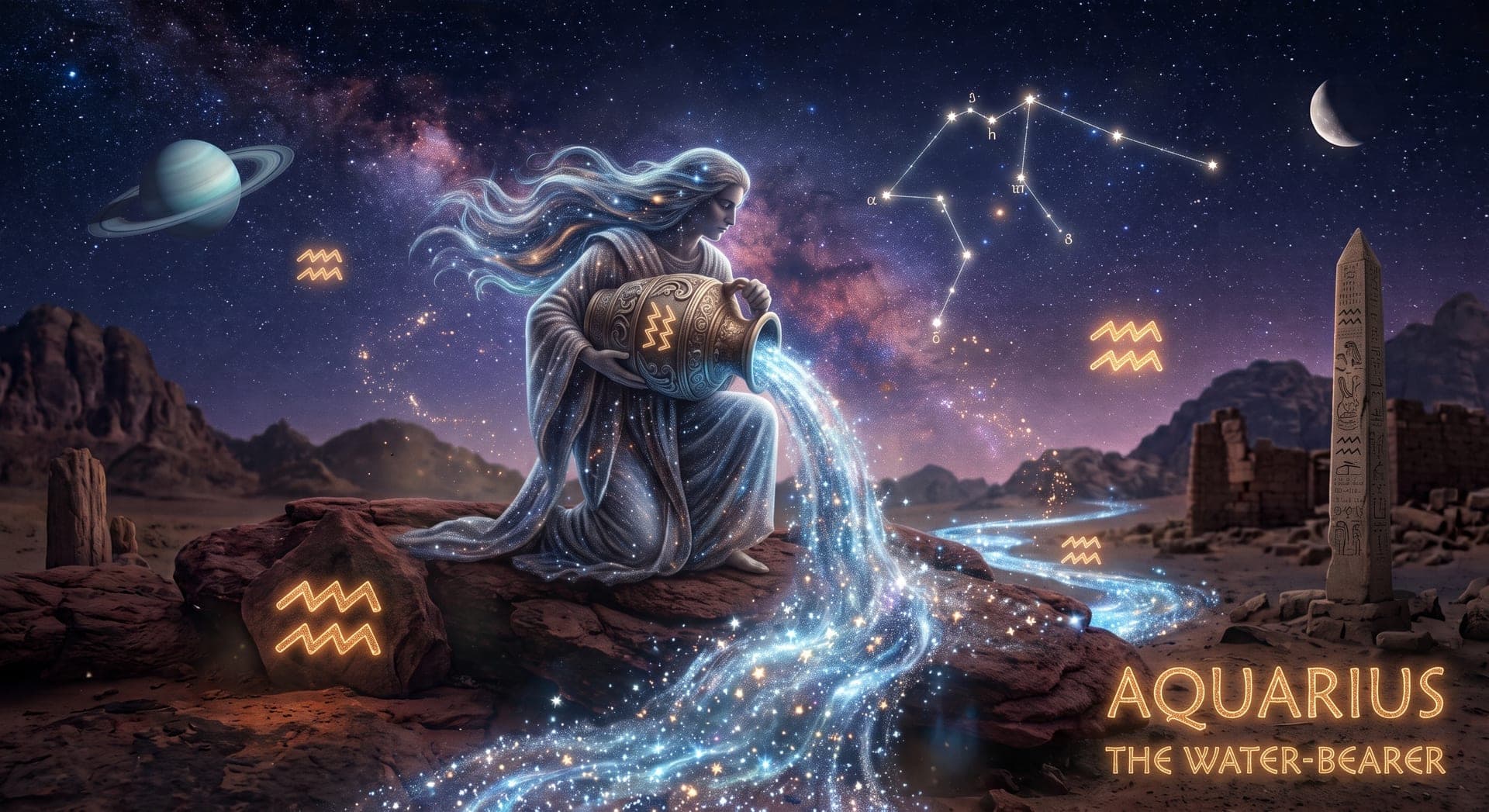
Born on January 30: Aquarius ♒
Aquarius, the eleventh sign of the zodiac, spans January 20 to February 18 and is symbolized by the water bearer, an image of someone pouring out knowledge and life-giving ideas to the world, despite Aquarius actually being an air sign rather than a water sign. Traditionally ruled by disciplined Saturn and, in modern astrology, by unpredictable Uranus, the planet of innovation and rebellion, Aquarius carries a distinctive blend of structure and originality. People born under this sign are often described as independent thinkers, forward-looking, and drawn to humanitarian causes, valuing the collective good over convention. As a Fixed sign, Aquarius can be famously stubborn once its mind is made up, even while championing change for everyone else. Intellectually curious and sometimes emotionally guarded, Aquarians tend to value friendship and community deeply, often serving as the visionary of their social circle, more comfortable debating ideas than discussing feelings.
Personality Traits
Strengths
- Original and forward-thinking
- Strong sense of fairness and justice
- Independent and self-sufficient
- Loyal to friends and causes alike
- Sees the bigger picture others miss
Weaknesses
- Can run from emotional expression
- Uncompromising once a position is fixed
- Prone to aloofness or detachment
- Sometimes contrarian just to stand apart
- Can prioritize ideas over people's feelings
Compatible Signs
Fun Facts
- Despite its watery name and imagery, Aquarius is classified as an air sign, grouped with Gemini and Libra as a sign of thought and communication rather than emotion.
- Aquarius has two ruling planets: Saturn in classical astrology, and Uranus, discovered in 1781, in the modern system most Western astrologers use today.
- The water bearer symbol traces back to Ganymede in Greek mythology, a cupbearer to the gods said to pour out a life-giving stream from the heavens.
- Notable Aquarians include Oprah Winfrey, Abraham Lincoln, Charles Darwin, Thomas Edison, and Bob Marley.
- Aquarius is one of the rarer signs to be represented by a person rather than an animal or object, alongside Gemini, Virgo, and Sagittarius's centaur half.
Born on January 30
- 1882
Franklin D. Roosevelt
32nd President of the United States
- 1915
John Profumo
English politician whose affair triggered the Profumo scandal that rocked the British government
- 1925
Douglas Engelbart
Computer scientist who invented the computer mouse
- 1927
Olof Palme
Prime Minister of Sweden
- 1930
Gene Hackman
Academy Award-winning American actor
- 1937
Vanessa Redgrave
English actress celebrated for her stage and screen career across seven decades
- 1946
John Bird, Baron Bird
English publisher who co-founded The Big Issue magazine to help homeless people
- 1947
Steve Marriott
English singer-songwriter and guitarist who fronted the Small Faces and Humble Pie
- 1951
Phil Collins
English singer-songwriter, drummer, and actor known as frontman of Genesis and for his solo hits
- 1974
Christian Bale
Welsh-born British actor known for roles including Batman in Christopher Nolan's trilogy
- 1974
Olivia Colman
English actress known for roles in The Crown and The Favourite

On This Day in History
- 1607
Severe flooding devastates roughly 200 square miles along the Bristol Channel in England and Wales.
A sudden and catastrophic inundation, likely caused by a storm surge combined with high spring tides, swept across low-lying coastal areas of Somerset, Gloucestershire, Devon, and South Wales. An estimated 2,000 people drowned, along with widespread destruction of homes, livestock, and farmland, making it one of the deadliest natural disasters in British history.
- 1649
King Charles I of England is publicly executed after being convicted of treason.
Charles I was convicted of treason by a specially convened High Court after his defeat in the English Civil War, becoming the first English monarch ever executed by his own subjects. His death temporarily abolished the monarchy in favor of Oliver Cromwell's Commonwealth, though the throne was restored to Charles's son, Charles II, just eleven years later.
- 1649
King Charles I of England is executed outside the Banqueting House in Whitehall, London.
Charles was beheaded on a public scaffold after being tried and convicted of treason by a specially convened court, following his defeat in the English Civil War. His execution marked the abolition of the monarchy and the start of an eleven-year republican interregnum under the Commonwealth and later Oliver Cromwell's Protectorate.
- 1661
Oliver Cromwell's exhumed body is ritually executed on the anniversary of Charles I's death.
More than two years after his death, Cromwell's corpse was dug up along with those of two fellow regicides and symbolically hanged and beheaded at Tyburn on the orders of the restored monarchy under Charles II. His head was displayed on a pole outside Westminster Hall for years afterward as a mark of royalist retribution.
- 1820
British naval officer Edward Bransfield sights the Trinity Peninsula and claims the discovery of Antarctica.
Bransfield, commanding a voyage south of the South Shetland Islands, sighted mountainous land now identified as part of the Antarctic Peninsula, among the earliest confirmed sightings of the continent's mainland. His claim came just days after a separate Russian expedition's own sighting, making the question of who first spotted Antarctica a matter of ongoing historical debate.
- 1826
The Menai Suspension Bridge, linking Wales to the island of Anglesey, opens to traffic.
Designed by engineer Thomas Telford, the bridge spanned the Menai Strait using wrought-iron chains, a pioneering technique that made it the world's first modern suspension bridge capable of carrying heavy road traffic. It dramatically improved travel between London and the port of Holyhead, and remains in use, having been strengthened and modified over the centuries.
- 1858
The first Hallé concert is given in Manchester, marking the founding of The Hallé orchestra.
German-born conductor Charles Hallé, who had settled in Manchester, established the orchestra to give the city a resident professional ensemble. It went on to become the oldest continuously performing professional symphony orchestra in Britain, playing a central role in Manchester's musical life and touring internationally under a succession of celebrated conductors.
- 1902
Britain and Japan sign the Anglo-Japanese Alliance in London.
The treaty committed each power to support the other in the event of war with more than one enemy power, and was aimed chiefly at checking Russian expansion in East Asia. It marked Britain's first formal alliance with a non-European power and significantly shaped Pacific and Asian diplomacy over the following two decades, before lapsing in the early 1920s.
- 1933
Adolf Hitler is appointed Chancellor of Germany, a pivotal step in the Nazi rise to power.
Hitler's appointment came through a backroom political deal among conservative elites who believed they could control him and use his popular support for their own ends, a serious miscalculation. Within weeks, Hitler used the Reichstag fire to justify emergency powers, quickly dismantling German democracy and consolidating the Nazi Party's total control over the state.
- 1939
In a Reichstag speech, Adolf Hitler threatens the "annihilation of the Jewish race in Europe" should another world war break out.
In a speech marking the sixth anniversary of his rise to power, Hitler explicitly threatened that a new world war would result in the destruction of European Jewry, a chilling public statement made years before the systematic mass murder of the Holocaust began in earnest. Historians frequently cite the speech as evidence of premeditated genocidal intent well before the war started.
- 1945
The German ship Wilhelm Gustloff is sunk by a Soviet submarine in the Baltic Sea, killing an estimated 9,400 people in history's deadliest single-ship maritime disaster.
The Wilhelm Gustloff, packed far beyond capacity with German refugees and military personnel fleeing the advancing Red Army, was torpedoed by a Soviet submarine in freezing Baltic waters. The overwhelming majority of those aboard, many of them women and children, drowned or froze to death, making it the deadliest maritime disaster in history, far surpassing the Titanic's death toll.
- 1948
Mahatma Gandhi is assassinated in New Delhi; India observes the date as Martyrs' Day.
Gandhi was shot by a Hindu nationalist extremist who blamed him for what he viewed as excessive concessions to Muslims during the bloody partition of India and Pakistan the previous year. His assassination, just months after India achieved independence from Britain, shocked the world and cemented his legacy as an enduring global symbol of nonviolent resistance.
- 1968
North Vietnamese and Viet Cong forces launch the Tet Offensive against South Vietnam and the United States.
Coordinated surprise attacks by North Vietnamese and Viet Cong forces struck dozens of cities and military installations across South Vietnam simultaneously during the Lunar New Year holiday truce. Although American and South Vietnamese forces ultimately repelled the offensive with heavy losses to the attackers, the sheer scale of the assault badly damaged American public confidence that the war was being won.
- 1969
The Beatles give their final public performance, an impromptu concert on the roof of Apple Records in London.
With relationships within the band deteriorating and their partnership nearing its end, the Beatles played an unannounced, impromptu 42-minute set on the rooftop of their Apple Corps headquarters in London, drawing curious crowds below and eventually a visit from police responding to noise complaints. It proved to be the group's final public performance together before officially disbanding two years later.
- 1969
The Beatles give their final live performance on the rooftop of Apple Records in London.
The band played an unannounced 42-minute set atop the Apple Corps building on Savile Row, drawing crowds and traffic below before police shut the performance down. Filmed for the documentary that became Let It Be, the rooftop concert is remembered as the group's last public performance together before their breakup the following year.
- 1972
British paratroopers kill 14 unarmed civil rights marchers in Derry, Northern Ireland, in what becomes known as Bloody Sunday.
British paratroopers opened fire on a civil rights march in the Bogside area of Derry protesting internment without trial, killing 14 unarmed Catholic civilians. The killings dramatically escalated the Troubles, the decades-long sectarian conflict in Northern Ireland, and a later official inquiry concluded the victims had been innocent and the shootings unjustified.
- 1972
British paratroopers open fire on civil rights marchers in Derry, Northern Ireland, killing 13 people.
Soldiers of the Parachute Regiment shot unarmed demonstrators during an anti-internment march, in an event that became known as Bloody Sunday. A fourteenth victim died of his injuries months later. The killings caused international outrage and became one of the most controversial and consequential episodes of the Troubles, fueling decades of conflict in Northern Ireland.
- 1972
Pakistan withdraws from the Commonwealth of Nations.
Pakistan left the Commonwealth of Nations, headed by Queen Elizabeth II, in protest at member states' recognition of Bangladesh, which had seceded from Pakistan the previous year following a bitter war of independence. Pakistan remained outside the organization for seventeen years before rejoining in 1989, reflecting the lasting diplomatic strain caused by the 1971 conflict.
- 1982
Richard Skrenta writes "Elk Cloner," widely considered the first computer virus to spread in the wild.
Skrenta, then a 15-year-old high school student, wrote the self-replicating program as a prank targeting Apple II computers, spreading via infected floppy disks and displaying a short humorous poem on every 50th boot. Though relatively harmless, Elk Cloner is widely considered the first computer virus to spread in the wild outside a research laboratory setting.
- 2020
The World Health Organization declares the COVID-19 outbreak a Public Health Emergency of International Concern.
The WHO's declaration came as COVID-19, first identified in Wuhan, China, weeks earlier, began spreading to additional countries, marking the organization's highest level of alarm short of declaring a full pandemic, which it did roughly six weeks later. The declaration triggered early international coordination efforts, travel restrictions, and public health measures that would intensify dramatically over the following months.