
What’s Observed on February 1
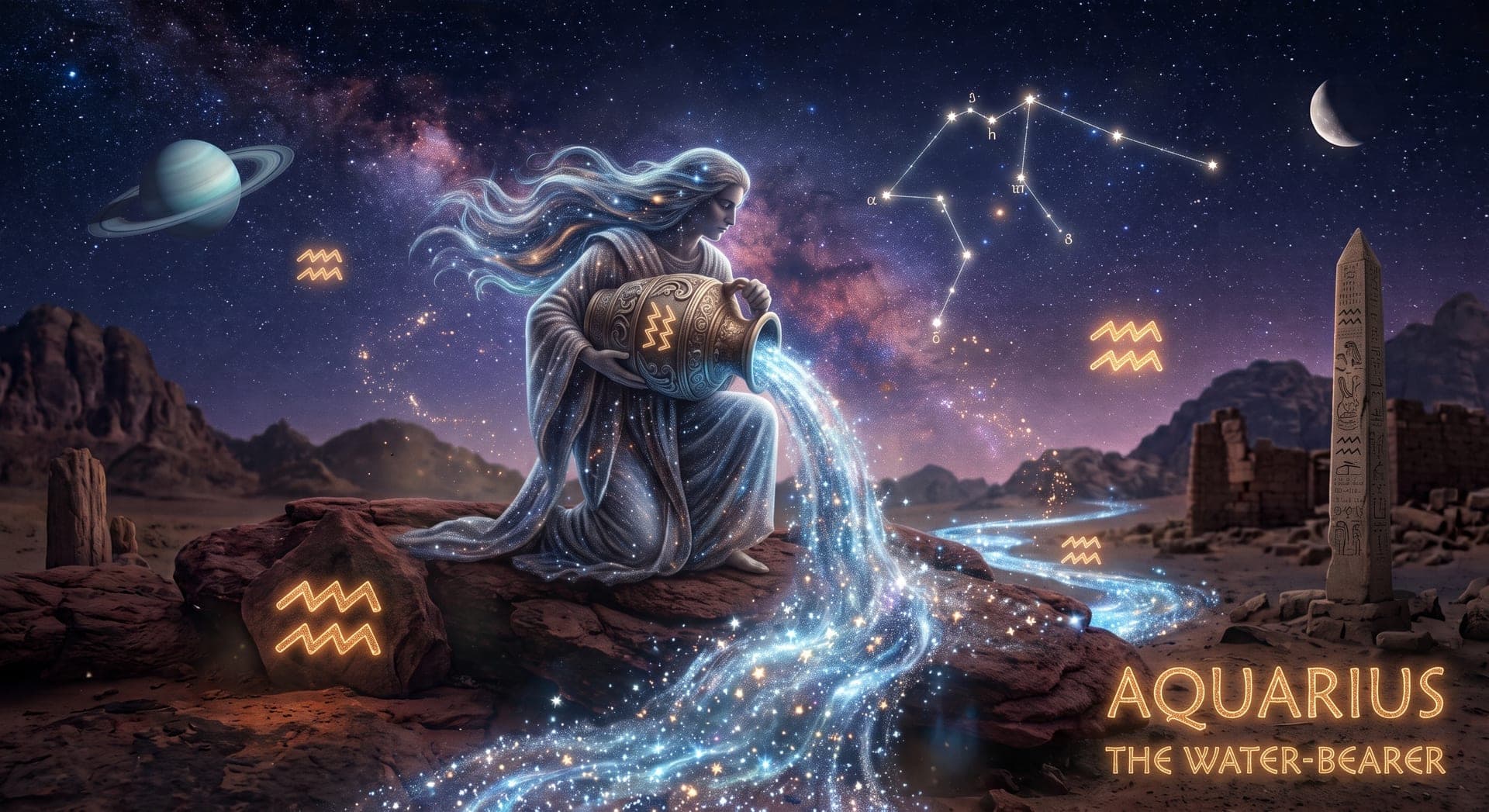
Born on February 1: Aquarius ♒
Aquarius, the eleventh sign of the zodiac, spans January 20 to February 18 and is symbolized by the water bearer, an image of someone pouring out knowledge and life-giving ideas to the world, despite Aquarius actually being an air sign rather than a water sign. Traditionally ruled by disciplined Saturn and, in modern astrology, by unpredictable Uranus, the planet of innovation and rebellion, Aquarius carries a distinctive blend of structure and originality. People born under this sign are often described as independent thinkers, forward-looking, and drawn to humanitarian causes, valuing the collective good over convention. As a Fixed sign, Aquarius can be famously stubborn once its mind is made up, even while championing change for everyone else. Intellectually curious and sometimes emotionally guarded, Aquarians tend to value friendship and community deeply, often serving as the visionary of their social circle, more comfortable debating ideas than discussing feelings.
Personality Traits
Strengths
- Original and forward-thinking
- Strong sense of fairness and justice
- Independent and self-sufficient
- Loyal to friends and causes alike
- Sees the bigger picture others miss
Weaknesses
- Can run from emotional expression
- Uncompromising once a position is fixed
- Prone to aloofness or detachment
- Sometimes contrarian just to stand apart
- Can prioritize ideas over people's feelings
Compatible Signs
Fun Facts
- Despite its watery name and imagery, Aquarius is classified as an air sign, grouped with Gemini and Libra as a sign of thought and communication rather than emotion.
- Aquarius has two ruling planets: Saturn in classical astrology, and Uranus, discovered in 1781, in the modern system most Western astrologers use today.
- The water bearer symbol traces back to Ganymede in Greek mythology, a cupbearer to the gods said to pour out a life-giving stream from the heavens.
- Notable Aquarians include Oprah Winfrey, Abraham Lincoln, Charles Darwin, Thomas Edison, and Bob Marley.
- Aquarius is one of the rarer signs to be represented by a person rather than an animal or object, alongside Gemini, Virgo, and Sagittarius's centaur half.
Born on February 1
- 1872
Clara Butt
English contralto celebrated as one of the era's greatest concert singers, famous for her performances of Elgar's 'Land of Hope and Glory'
- 1901
Clark Gable
Classic Hollywood leading man known as "The King of Hollywood"
- 1902
Langston Hughes
American poet and leading voice of the Harlem Renaissance
- 1915
Stanley Matthews
English footballer known as 'the Wizard of the Dribble', the first winner of the Ballon d'Or and European Footballer of the Year
- 1918
Muriel Spark
Scottish novelist best known for The Prime of Miss Jean Brodie
- 1931
Boris Yeltsin
First President of the Russian Federation
- 1942
Terry Jones
Welsh actor, writer, and director, a member of the Monty Python comedy troupe
- 1946
Elisabeth Sladen
English actress best known for playing companion Sarah Jane Smith in Doctor Who
- 1964
Linus Roache
English actor known for his stage work and television roles including Law & Order
- 1965
Brandon Lee
American actor known for "The Crow"
- 1968
Lisa Marie Presley
Singer-songwriter and daughter of Elvis Presley
- 1987
Ronda Rousey
Mixed martial artist and WWE wrestler
- 1994
Harry Styles
English singer-songwriter and actor who rose to fame with the band One Direction before a successful solo career

On This Day in History
- 1327
Edward III is crowned King of England at Westminster Abbey at the age of fourteen, following the deposition of his father, Edward II.
Although crowned king, the young Edward held little real power in these early years. Government was effectively controlled by his mother, Queen Isabella of France, and her lover Roger Mortimer, who had orchestrated Edward II's downfall. Edward III would not seize full personal control of the realm until 1330, after arresting Mortimer in a coup at Nottingham Castle. He went on to reign for fifty years, launching the Hundred Years' War against France.
- 1793
France declares war on the United Kingdom and the Netherlands, drawing the French Revolutionary Wars into a much wider European conflict.
France's declaration came after the execution of King Louis XVI angered European monarchies already alarmed by the spread of revolutionary ideas. The move drew Britain into a coalition war against France that, with brief interruptions, would continue for over two decades until Napoleon's final defeat at Waterloo in 1815.
- 1793
Revolutionary France declares war on the Kingdom of Great Britain and the Dutch Republic, drawing Britain into the French Revolutionary Wars.
The declaration came weeks after the execution of King Louis XVI shocked European monarchies. Britain, under Prime Minister William Pitt the Younger, joined a coalition of continental powers seeking to contain revolutionary France. The ensuing conflict, fought largely at sea and in the colonies, would continue almost without pause for over two decades, evolving into the Napoleonic Wars and cementing Britain's role as France's principal adversary until Waterloo in 1815.
- 1861
Texas secedes from the United States, becoming the seventh state to join the Confederacy ahead of the Civil War.
Texas's secession vote followed a statewide referendum despite the strong objections of Governor Sam Houston, who refused to swear loyalty to the Confederacy and was removed from office as a result. Texas became a significant source of cotton, cattle, and manpower for the Confederate war effort over the following four years.
- 1865
President Abraham Lincoln signs the joint resolution proposing the Thirteenth Amendment, which would formally abolish slavery once ratified by the states.
Although not constitutionally required, Lincoln added his signature to the resolution as a symbolic gesture of support the day after Congress passed it. The amendment still needed ratification by three-quarters of the states, a process completed by December 1865, permanently outlawing slavery throughout the reunified nation.
- 1884
The first volume of the Oxford English Dictionary is published, covering words from A to Ant.
The project had begun in 1857 under the Philological Society, aiming to trace the full history of every English word through dated quotations. Editor James Murray worked from a corrugated iron scriptorium in Oxford, drawing on thousands of volunteer readers who submitted citation slips from books. The complete dictionary would not be finished until 1928, forty-four years later, by which point it ran to twelve volumes.
- 1900
Field Marshal Lord Roberts is named commander-in-chief of British forces in South Africa during the Second Boer War.
Roberts took over after a string of British defeats during the war's opening months, known as 'Black Week'. Alongside his chief of staff Lord Kitchener, he reorganized the campaign, relieved besieged towns including Kimberley and Ladysmith, and captured the Boer capitals of Bloemfontein and Pretoria within months. His energetic leadership marked a turning point in a war that nonetheless dragged on for two more years of guerrilla fighting.
- 1908
King Carlos I of Portugal and his heir, Infante Luís Filipe, are shot dead by assassins during an open-carriage procession through Lisbon.
The killings, carried out by members of a republican revolutionary movement, plunged the Portuguese monarchy into crisis. Carlos's younger son, Manuel II, ascended the throne but proved unable to stabilize the country, and the monarchy itself was overthrown just two years later in the 1910 revolution that established the Portuguese Republic.
- 1924
The United Kingdom formally restores diplomatic relations with Soviet Russia, more than six years after the 1917 Communist revolution.
Recognition came shortly after Ramsay MacDonald's Labour government took office as Britain's first-ever Labour administration. The decision was controversial, dividing opinion between those who favored engagement with the new Soviet state and Conservative critics wary of Bolshevism. Full diplomatic and trade relations were established, though tensions over Soviet propaganda and espionage would repeatedly strain the relationship in the years that followed.
- 1946
Trygve Lie of Norway becomes the first Secretary-General of the United Nations, leading the young organization through its formative postwar years.
Lie, a Norwegian diplomat and former foreign minister, was selected as a compromise candidate acceptable to both Western powers and the Soviet Union amid early Cold War tensions. His tenure was marked by the founding challenges of the UN, including the outbreak of the Korean War, and he resigned early in 1952 after losing Soviet confidence.
- 1946
Norwegian foreign minister Trygve Lie is selected as the first Secretary-General of the United Nations.
Lie was chosen at the first session of the UN General Assembly, held in London, after larger powers on the Security Council could not agree on a candidate from among themselves. He took office as the fledgling organization's chief administrator during the early Cold War, a period that tested the UN's ability to mediate between the Western powers and the Soviet Union. He served until his resignation in 1953.
- 1960
Four Black college students stage a sit-in at a segregated lunch counter in Greensboro, North Carolina, sparking a wave of nonviolent civil rights protests nationwide.
The four freshmen at North Carolina A&T State University sat down at a whites-only Woolworth's lunch counter and remained after being refused service, returning daily with growing numbers of supporters. Their peaceful protest inspired similar sit-ins across the South and became one of the defining tactics of the civil rights movement.
- 1964
The Beatles achieve their first U.S. number one hit with "I Want to Hold Your Hand," igniting American Beatlemania.
The song's explosive popularity in the U.S., following the Beatles' earlier success in Britain, kicked off what became known as the British Invasion, a wave of British rock acts that reshaped American popular music. Weeks later, the band's appearance on The Ed Sullivan Show cemented Beatlemania as a full-blown cultural phenomenon.
- 1979
Ayatollah Ruhollah Khomeini returns to Tehran after nearly 15 years in exile, setting the stage for the Iranian Revolution.
Khomeini's return, greeted by millions of jubilant supporters lining the streets of Tehran, came just weeks after the Shah had fled the country amid mass uprisings against his rule. Within days, Khomeini's forces effectively took control, and a referendum soon established Iran as an Islamic republic under his leadership.
- 1979
Ayatollah Ruhollah Khomeini returns to Tehran after nearly fifteen years of exile, greeted by millions of supporters.
Khomeini's homecoming came days after Shah Mohammad Reza Pahlavi had fled the country amid mass protests. Within days a provisional government loyal to Khomeini was installed, and by April the Iranian Revolution had toppled the monarchy entirely, establishing the Islamic Republic of Iran. Khomeini became the country's Supreme Leader, a position he held until his death a decade later.
- 2003
Space Shuttle Columbia disintegrates during re-entry over Texas, killing all seven astronauts aboard.
Columbia broke apart roughly 16 minutes before its scheduled landing, having sustained fatal damage during launch when a piece of foam insulation struck its wing. The disaster grounded the shuttle program for over two years and led to sweeping safety reforms, including new procedures for inspecting the orbiter while in space.
- 2003
Space Shuttle Columbia disintegrates during reentry over Texas, killing all seven astronauts aboard mission STS-107.
The disaster was later traced to a piece of foam insulation that broke off the external fuel tank during launch and damaged the shuttle's heat-resistant wing panels. The breach allowed superheated gas to penetrate the wing during reentry, causing the orbiter to break apart roughly sixteen minutes before its scheduled landing. The tragedy led NASA to ground the shuttle fleet for more than two years.
- 2005
King Gyanendra of Nepal dismisses the government and seizes direct power in a royal coup.
Gyanendra, who had become king in unusual circumstances after a 2001 palace massacre killed most of the royal family, dismissed the elected government and assumed direct emergency rule, citing the ongoing Maoist insurgency. The power grab triggered massive pro-democracy protests that ultimately forced his abdication and the end of Nepal's monarchy in 2008.
- 2013
The View from The Shard, the public viewing gallery atop London's Shard skyscraper, opens to visitors for the first time.
Designed by architect Renzo Piano, The Shard had topped out the previous year as the tallest building in the United Kingdom and one of the tallest in Western Europe, rising more than 300 meters above London Bridge. The viewing gallery, spanning three floors near the summit, offers panoramic views stretching up to 40 miles across the capital and beyond on a clear day.
- 2021
Myanmar's military stages a coup, detaining civilian leader Aung San Suu Kyi and ending a decade of fragile democratic reform.
The military justified the coup by alleging fraud in the previous election, which Aung San Suu Kyi's party had won decisively. The takeover reversed years of gradual democratic opening in Myanmar, triggered mass civil disobedience, and plunged the country into a prolonged armed conflict between the junta and resistance forces.