What’s Observed on August 11
Born on August 11: Leo ♌
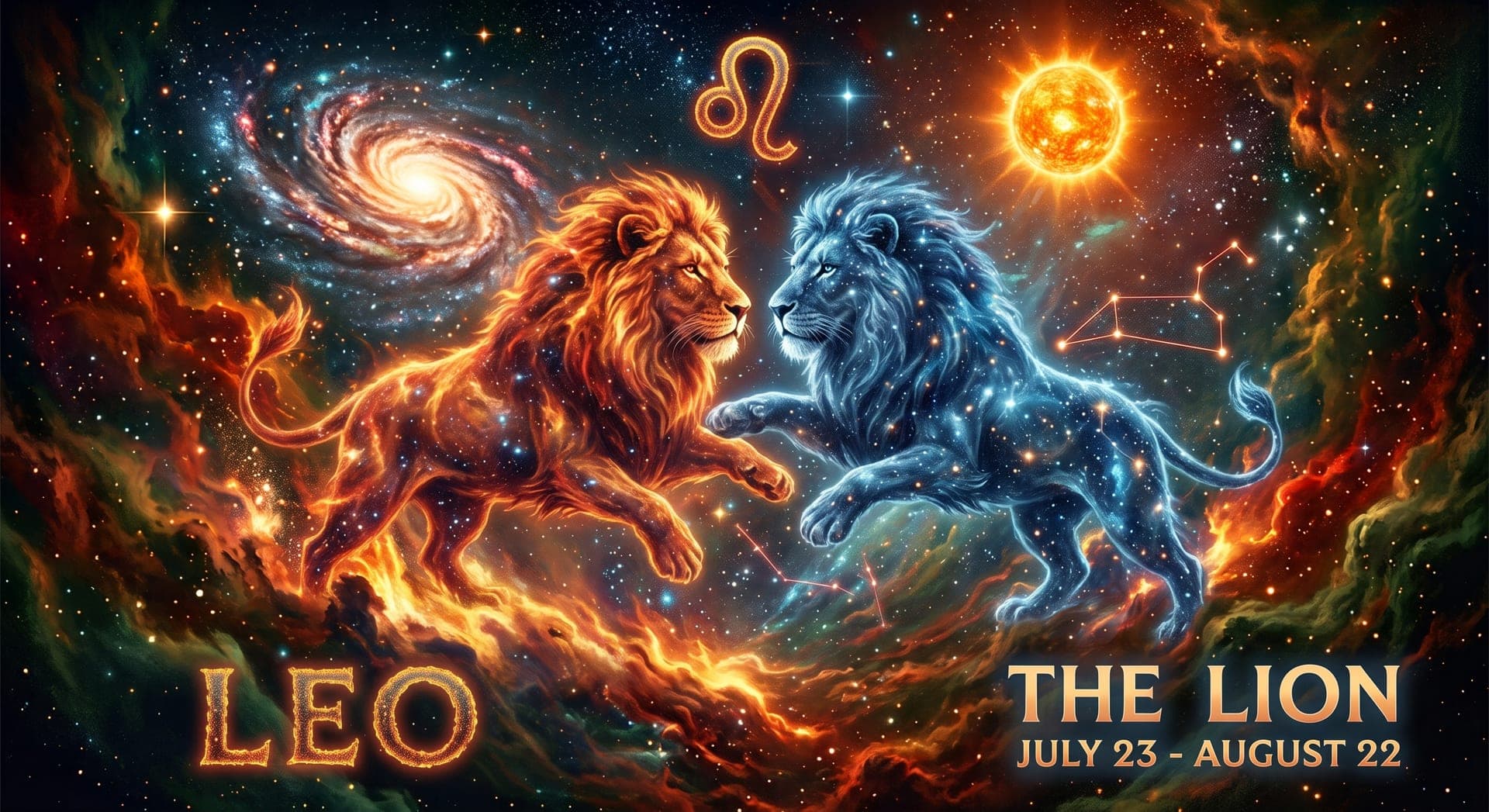
Leo, the fifth sign of the zodiac, spans July 23 to August 22 and is symbolized by the lion, an animal long associated with courage, pride, and natural leadership. Ruled by the Sun, the center of the solar system and the source of light and life, Leo is widely regarded as one of the most confident, warm, and charismatic signs of the zodiac, naturally drawn to the spotlight. As a Fire sign, Leo approaches life with passion, enthusiasm, and a flair for the dramatic, rarely content to blend quietly into the background. Its Fixed modality gives Leo a strong sense of loyalty and consistency, along with a stubborn streak once its mind is made up. People born under this sign are often natural performers, leaders, or creatives who thrive when appreciated and celebrated by those around them. Leo's generosity and warmth make it a beloved friend and steadfast ally, though its genuine need for recognition and admiration can tip into vanity or a demand for center stage if left unchecked.
Personality Traits
Strengths
- Naturally charismatic leader
- Generous and warm-hearted
- Confident and self-assured
- Creative and expressive
- Loyal to friends and family
Weaknesses
- Prone to arrogance
- Craves attention and validation
- Stubborn once decided
- Can be domineering
- Sensitive to criticism of their ego
Compatible Signs
Fun Facts
- Leo's lion symbol connects to the Greek myth of the Nemean Lion, slain by Hercules as the first of his twelve labors.
- Leo is ruled by the Sun, the only zodiac sign ruled directly by a star rather than a planet or moon.
- As a Fixed Fire sign, Leo season falls at the height of summer, when the sun's warmth and intensity are strongest in the Northern Hemisphere.
- Notable Leos include Barack Obama, Madonna, Jennifer Lawrence, and Napoleon Bonaparte.
- Leo rules the heart in traditional medical astrology, reflecting the sign's association with vitality, courage, and life force.
Born on August 11
- 1870
Tom Richardson
English fast bowler regarded as one of the finest cricketers of the Victorian era, taking over 2,000 first-class wickets.
- 1892
Hugh MacDiarmid
Scottish poet and key figure of the Scottish Renaissance, celebrated for A Drunk Man Looks at the Thistle and his championing of the Scots language.
- 1897
Enid Blyton
English children's author of hugely popular series including the Famous Five and Noddy, among the best-selling authors of all time.
- 1913
Angus Wilson
English novelist and short-story writer known for satirical works such as Anglo-Saxon Attitudes exploring English middle-class life.
- 1921
Alex Haley
American author of "Roots"
- 1926
Aaron Klug
Lithuanian-British chemist and Nobel laureate
- 1944
Ian McDiarmid
Scottish actor best known for playing Emperor Palpatine in the Star Wars film series.
- 1950
Steve Wozniak
American computer engineer who co-founded Apple
- 1953
Hulk Hogan
American professional wrestler
- 1954
Joe Jackson
English singer-songwriter and pianist known for new wave hits including 'Is She Really Going Out with Him?' and 'Steppin' Out.'
- 1967
Joe Rogan
American podcast host and comedian
- 1968
Sophie Okonedo
English actress recognised for her Oscar-nominated role in Hotel Rwanda and extensive stage and screen work.
- 1983
Chris Hemsworth
Australian actor known for playing Thor
On This Day in History
- 3114 BCE
The Mesoamerican Long Count calendar, later used by the Maya and other civilizations, begins its epoch according to traditional reckoning.
According to traditional Maya reckoning later adopted by other Mesoamerican cultures, this date marked the mythological starting point of the current era in the Long Count calendar system, a sophisticated method of tracking time across vast spans. The calendar became widely known outside academic circles due to popular but scientifically unfounded speculation surrounding its next major cycle completion in December 2012.
- 106
Southwestern Dacia is formally incorporated into the Roman Empire as a province.
Following a prolonged military campaign, Emperor Trajan completed the conquest of the Dacian kingdom in what is now largely Romania, formally incorporating its resource-rich southwestern territories into the Roman Empire as a new province. The conquest brought substantial gold and silver wealth into Roman coffers and left a lasting linguistic and cultural legacy still visible in modern Romanian identity.
- 117
Hadrian becomes Roman emperor following the death of Trajan.
Following the sudden death of Emperor Trajan while campaigning in the east, his ward and distant relative Hadrian was declared emperor by the eastern legions. Hadrian's subsequent reign focused on consolidating and defending existing imperial borders rather than further expansion, most famously reflected in the construction of Hadrian's Wall across northern Britain.
- 1315
The Great Famine gripping Europe grows so severe that even King Edward II of England struggles to find bread for his household.
Years of relentless rain had ruined harvests across northern Europe, triggering the worst subsistence crisis in centuries. Grain prices soared, livestock died from disease, and starvation and cannibalism were reported in chronicles of the time. The famine, which lasted until 1317, killed a significant share of the population and left lasting economic and social scars across England and its neighbours.
- 1332
Edward Balliol's English-backed army routs the Scottish forces of the young King David II at the Battle of Dupplin Moor.
Supported by disaffected Scottish nobles and quietly encouraged by Edward III of England, Balliol landed in Scotland to press his claim to the throne. His heavily outnumbered force used longbowmen to devastating effect against the massed Scottish ranks near Perth, killing the regent Domhnall II, Earl of Mar. The victory briefly installed Balliol as king and reignited the Second War of Scottish Independence.
- 1492
Rodrigo de Borja is elected head of the Catholic Church, taking the name Pope Alexander VI.
Rodrigo Borgia, a wealthy and politically ambitious Spanish-Italian cardinal, was elected pope following a conclave marked by allegations of extensive bribery, taking the name Alexander VI. His controversial papacy, marked by nepotism and political intrigue involving his children, including Cesare and Lucrezia Borgia, remains one of the most notorious in Catholic Church history.
- 1786
Captain Francis Light establishes the British settlement of Penang in present-day Malaysia.
British East India Company captain Francis Light negotiated with the Sultan of Kedah to establish a trading settlement on the island of Penang, securing a strategic port along vital shipping lanes between India and China. The settlement grew into an important British colonial trading hub and later became part of independent Malaysia.
- 1786
Captain Francis Light establishes the British colony of Penang on behalf of the East India Company.
Light negotiated the cession of the island from the Sultan of Kedah, founding what became Britain's first settlement in Southeast Asia and naming its main town Georgetown after King George III. Penang grew into a major free-trade port and served as an early foothold for British commercial and colonial expansion in the region, eventually forming part of the Straits Settlements.
- 1812
French cavalry defeat British and Portuguese forces at the Battle of Majadahonda during the Peninsular War.
Fought near Madrid as Wellington's army besieged the city, the engagement saw French dragoons rout an allied cavalry brigade covering the siege operations. Though a tactical defeat, it caused only a minor setback to the broader allied campaign in Spain, which continued to push French forces back and would culminate two years later in Napoleon's defeat and the war's end.
- 1858
Charles Barrington and his guides achieve the first successful ascent of the Eiger in the Swiss Alps.
After the notoriously difficult and dangerous Eiger had claimed the interest of alpine climbers for years, a team led by Irishman Charles Barrington successfully reached its summit via a route now considered relatively straightforward. The peak's much more treacherous north face would not be successfully climbed until nearly eight decades later, in 1938.
- 1871
An explosion at a guncotton factory in Stowmarket, England, kills 28 workers.
The blast tore through the Patent Safety Guncotton Company's works, one of Britain's leading explosives manufacturers, in the deadliest industrial accident the small Suffolk town had known. The disaster prompted tighter safety regulation of explosives manufacturing in Britain, though guncotton production, valued for both military and mining use, continued at the site and elsewhere in the country.
- 1918
The Battle of Amiens ends in a major Allied victory during World War I.
Allied forces launched a coordinated offensive near Amiens, France, employing large numbers of tanks, aircraft, and infantry in a combined-arms assault that achieved a stunning breakthrough against previously entrenched German lines. German commander Erich Ludendorff later described the attack's opening day as "the black day of the German Army," a psychological blow that hastened the war's end.
- 1918
The Battle of Amiens ends after a stunning Allied victory that broke German lines and hastened the end of the First World War.
Spearheaded by British, Australian, Canadian, and French forces using massed tanks, aircraft, and artillery in close coordination, the offensive shattered German defences so completely that General Erich Ludendorff called it 'the black day of the German Army.' The battle marked the start of the Hundred Days Offensive, the decisive Allied advance that forced Germany to seek an armistice within three months.
- 1920
Irish republican prisoners begin a hunger strike in Cork, including the city's Lord Mayor, Terence MacSwiney.
Held in British custody on charges linked to the Irish War of Independence, MacSwiney and dozens of fellow republicans refused food to protest their imprisonment without trial. MacSwiney's 74-day strike, which ended in his death in Brixton Prison in October, drew worldwide attention and sympathy for the Irish independence cause, becoming one of the most powerful propaganda moments of the war.
- 1929
Babe Ruth becomes the first baseball player to hit 500 career home runs.
Playing for the New York Yankees at League Park in Cleveland, Ruth reached the milestone in a game against the Indians, cementing his status as the sport's dominant power hitter. His home run total would keep climbing until his retirement in 1935, and the 500 mark he set that day became one of baseball's most storied benchmarks for slugging greatness.
- 1942
Actress Hedy Lamarr and composer George Antheil are granted a patent for an early frequency-hopping spread-spectrum communication system.
Devised as a way to prevent Axis forces from jamming radio-guided torpedoes, the invention switched rapidly between frequencies according to a shared pattern, making signals far harder to intercept or block. Though the US Navy did not adopt it during the war, the underlying principle later became foundational to modern technologies including Wi-Fi, Bluetooth, and GPS.
- 1960
Chad achieves independence from French colonial rule.
The Central African nation of Chad, formerly part of French Equatorial Africa, achieved full independence, with Francois Tombalbaye becoming its first president. The newly independent country soon faced significant internal ethnic and religious tensions between its northern and southern regions, contributing to decades of subsequent civil conflict.
- 1965
Race riots break out in the Watts neighbourhood of Los Angeles after a traffic stop escalates into violence.
Sparked by the arrest of a Black motorist and long-simmering anger over police treatment, poverty, and segregation, the unrest lasted six days and left 34 people dead and hundreds of buildings destroyed. The Watts riots became a defining moment in the civil rights era, prompting a state investigation into the underlying social conditions in South Los Angeles.
- 1973
DJ Kool Herc hosts a Bronx house party widely considered the birthplace of hip-hop music and culture.
At a back-to-school party in the Bronx, Jamaican-American DJ Kool Herc extended the instrumental "breaks" of funk records using two turntables, creating a continuous rhythmic loop that dancers, or breakdancers, could perform to. This innovative technique is widely credited by music historians as the foundational moment that launched hip-hop as a musical and cultural movement.
- 2023
Russia launches the Luna 25 lunar lander from the Vostochny Cosmodrome.
Russia's Luna 25 mission launched aboard a Soyuz rocket, intended as the country's first lunar landing attempt since 1976, targeting the Moon's south polar region believed to contain water ice deposits. The mission ultimately ended in failure just days later when the spacecraft crashed into the lunar surface during a pre-landing maneuver.