What’s Observed on July 13
Born on July 13: Cancer ♋
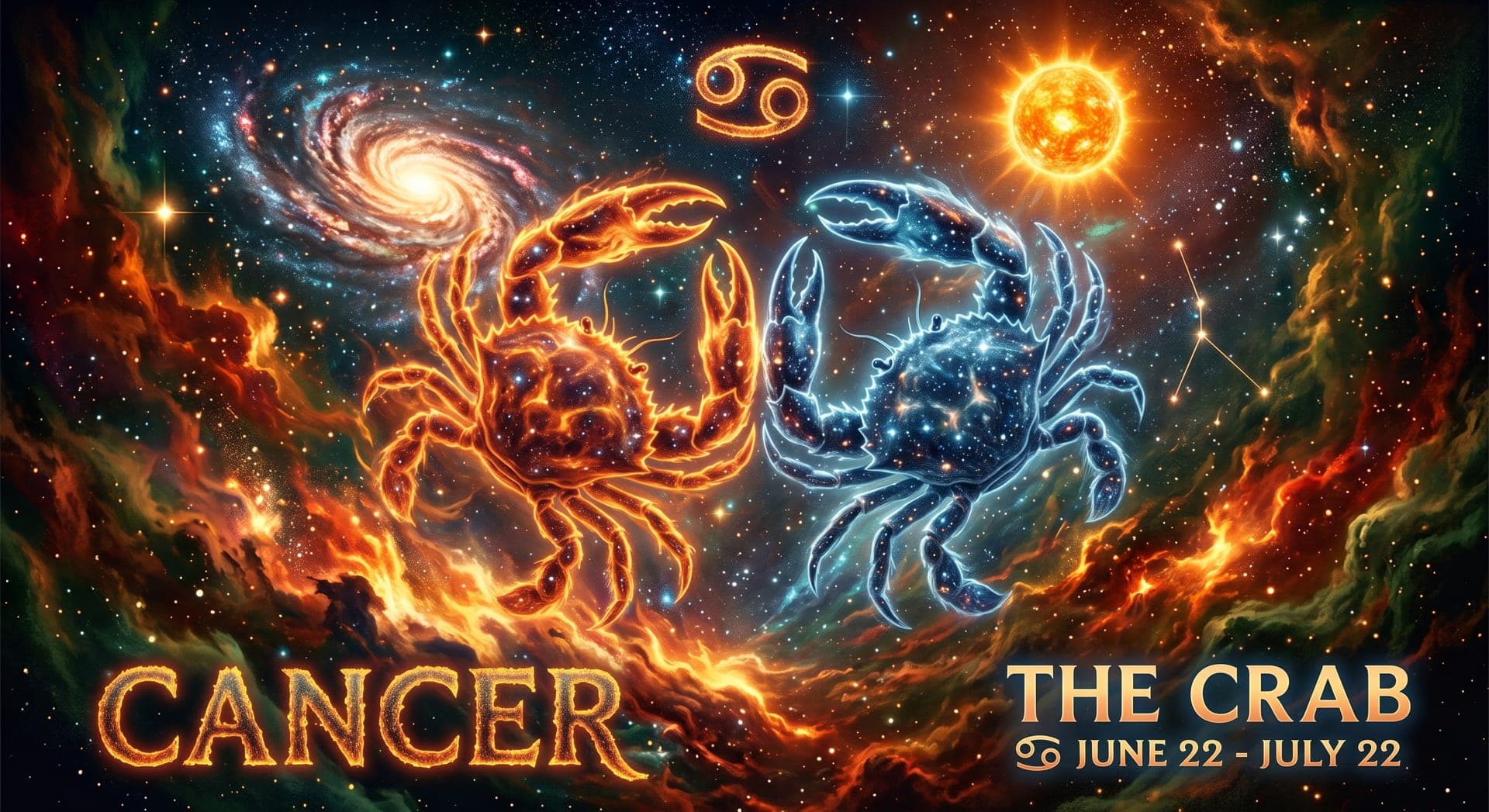
Cancer, the fourth sign of the zodiac, spans June 21 to July 22 and is symbolized by the crab, an animal known for carrying a protective shell while remaining soft and vulnerable underneath. Ruled by the Moon, the celestial body long associated with emotion, intuition, and the subconscious, Cancer is widely regarded as one of the most nurturing and emotionally attuned signs of the zodiac. As a Water sign, Cancer navigates the world through deep feeling, often forming strong emotional bonds and an acute sensitivity to the moods of others. Its Cardinal modality places it at the start of summer, beginning right at the June solstice, reflecting an instinct to initiate and create, especially around home and family. People born under this sign tend to be deeply loyal, protective of loved ones, and drawn to creating a comfortable, secure home environment. Cancer's emotional depth is a genuine strength, but it can also make the sign prone to moodiness or withdrawal when hurt, retreating like a crab into its shell until it feels safe enough to re-emerge.
Personality Traits
Strengths
- Deeply caring and nurturing
- Highly intuitive
- Fiercely loyal and protective
- Strong sense of family and tradition
- Emotionally perceptive
Weaknesses
- Prone to moodiness
- Overly sensitive to criticism
- Can be clingy
- Tends to hold grudges
- Retreats when hurt
Compatible Signs
Fun Facts
- Cancer's crab symbol comes from Greek mythology, where the goddess Hera placed a crab that had fought Hercules among the stars.
- Cancer is ruled by the Moon, the only zodiac sign ruled by a celestial body other than a planet.
- As a Cardinal sign, Cancer initiates summer, beginning at the June solstice, the longest day of the year in the Northern Hemisphere.
- Notable Cancers include Princess Diana, Tom Hanks, Ariana Grande, and Nelson Mandela.
- The crab's hard shell and soft interior are often used as a metaphor for Cancer's protective exterior guarding a deeply sensitive emotional core.
Born on July 13
- 1527
John Dee
English mathematician, astronomer, and astrologer who served as an advisor to Queen Elizabeth I
- 1793
John Clare
English poet celebrated for his vivid depictions of the English countryside and rural life
- 1841
Otto Wagner
Austrian architect
- 1859
Sidney Webb, 1st Baron Passfield
English economist and social reformer who co-founded the London School of Economics and the Fabian Society
- 1863
Margaret Murray
British archaeologist and anthropologist who was among the first women to hold a formal academic post in the field
- 1894
Isaac Babel
Russian short story writer
- 1908
Dorothy Round
English tennis player who won the Wimbledon singles title twice, in 1934 and 1937
- 1934
Wole Soyinka
Nigerian playwright and Nobel laureate
- 1940
Patrick Stewart
English actor known for playing Captain Jean-Luc Picard in Star Trek: The Next Generation and Professor X in the X-Men films
- 1942
Harrison Ford
American actor known for "Star Wars" and "Indiana Jones"
- 1942
Roger McGuinn
American musician and co-founder of The Byrds
- 1944
Ernő Rubik
Hungarian inventor of the Rubik's Cube
- 1960
Ian Hislop
English journalist and satirist, editor of the magazine Private Eye
On This Day in History
- 1174
King William I of Scotland is captured by English forces at Alnwick during a revolt against Henry II of England.
William, known as 'the Lion,' had invaded northern England to support a rebellion by Henry II's sons but was captured in thick fog outside Alnwick Castle. His capture forced Scotland to accept the humiliating Treaty of Falaise, recognising English overlordship until it was annulled by Richard I in 1189.
- 1249
Alexander III is crowned King of Scots at Scone at the age of just seven.
His long minority was dominated by rival noble factions vying for control of the regency. Alexander later ruled during a period often remembered as a golden age of medieval Scotland, before his sudden death in 1286 triggered a succession crisis that led to war with England.
- 1558
Spanish forces defeat the French at the Battle of Gravelines during the Italian Wars.
During the Italian Wars, Spanish and allied forces decisively defeated the French army near Gravelines in present-day France, contributing to French exhaustion that helped bring the prolonged conflict to a close the following year with the Peace of Cateau-Cambresis, which reshaped territorial control across Italy.
- 1643
Royalist forces decisively defeat the Parliamentarian army at the Battle of Roundway Down during the English Civil War.
The rout, in which Parliamentarian cavalry were driven over a steep escarpment, was one of the most crushing Royalist victories of the war. It temporarily secured Royalist dominance in the west of England, though the tide of the war would later turn decisively against them.
- 1690
French naval forces raid the English coastal town of Teignmouth during the Nine Years' War.
The raid, launched shortly after a French naval victory at the Battle of Beachy Head, saw much of the town burned and looted. It remains one of the last significant hostile landings by a foreign force on English soil.
- 1787
The Congress of the Confederation enacts the Northwest Ordinance, establishing a process for admitting new states and restricting the expansion of slavery into the territory.
Adopted by the Confederation Congress under the Articles of Confederation, the ordinance established a structured process for organizing and eventually admitting new states from the territory north of the Ohio River, on an equal footing with the original thirteen. It also notably prohibited slavery in the territory, setting an important precedent for later debates over slavery's expansion.
- 1793
French revolutionary journalist Jean-Paul Marat is assassinated in his bath by Charlotte Corday.
A radical supporter of the French Revolution, Marat was stabbed to death in his medicinal bath, where he often worked due to a chronic skin condition, by Charlotte Corday, a Girondin sympathizer who blamed him for escalating revolutionary violence. His death, memorialized in Jacques-Louis David's famous painting, made him a martyr for the radical Jacobin cause.
- 1841
The London Straits Convention is signed, restricting foreign warships' passage through the Bosphorus and Dardanelles.
Negotiated among Britain, Russia, Austria, Prussia, France, and the Ottoman Empire, the agreement aimed to stabilise the balance of power in the region by closing the straits to foreign warships during peacetime. It reflected British efforts to limit Russian naval expansion toward the Mediterranean.
- 1863
The New York City draft riots begin, escalating into the worst civil disorder in American history.
Fueled by resentment over a new conscription law that allowed wealthy men to buy exemptions, working-class New Yorkers, many of them Irish immigrants, rioted violently for several days, targeting draft offices and Black residents. The unrest required federal troops fresh from Gettysburg to suppress, and it remains one of the deadliest incidents of civil unrest in American history.
- 1878
The Treaty of Berlin redraws Balkan boundaries, granting independence to Serbia, Montenegro, and Romania.
Negotiated among the major European powers following the Russo-Turkish War, the treaty significantly redrew the political map of the Balkans, granting full independence to Serbia, Montenegro, and Romania while creating a smaller autonomous Bulgaria. The settlement reflected the great powers' efforts to balance Ottoman decline against Austro-Hungarian and Russian regional ambitions.
- 1878
The Treaty of Berlin is signed, redrawing the map of the Balkans and granting independence to Serbia, Montenegro, and Romania.
Negotiated at a congress chaired by German chancellor Otto von Bismarck, the treaty revised the earlier Treaty of San Stefano at the insistence of Britain and Austria-Hungary, who feared excessive Russian influence in the region. British Prime Minister Benjamin Disraeli played a leading role in shaping its terms.
- 1919
The British airship R34 completes the first transatlantic return journey by an aircraft.
Having flown from Scotland to New York earlier that month, R34 completed the return leg to England, becoming the first aircraft to cross the Atlantic in both directions. The achievement demonstrated the potential, later unrealised at scale, of airships for long-distance passenger travel.
- 1930
The first FIFA World Cup begins in Uruguay.
Held in Montevideo, Uruguay, the inaugural FIFA World Cup brought together thirteen national teams in the first global tournament of its kind, with host nation Uruguay ultimately claiming the title. The event established the framework for what became the world's most-watched sporting competition, held roughly every four years since.
- 1956
The Dartmouth workshop convenes, widely regarded as the founding event of artificial intelligence as a field of study.
A small gathering of researchers convened at Dartmouth College for a summer workshop proposing that machine intelligence could in principle be precisely simulated, coining the term "artificial intelligence." Though progress proved far slower than the organizers' optimistic predictions, the workshop is widely regarded as the founding moment that established AI as a distinct academic field.
- 1962
British Prime Minister Harold Macmillan dismisses seven Cabinet ministers in a sweeping reshuffle known as the 'Night of the Long Knives.'
The abrupt sacking of a third of his Cabinet, including the Chancellor of the Exchequer, was intended to revive Macmillan's flagging government but instead created an impression of panic and instability. The episode badly damaged public confidence in his leadership ahead of his resignation the following year.
- 1973
White House aide Alexander Butterfield reveals to Watergate investigators the existence of Nixon's secret Oval Office taping system.
During closed testimony before the Senate Watergate Committee, White House deputy chief of staff Butterfield disclosed the existence of a voice-activated recording system installed in the Oval Office. The revelation proved pivotal to the unfolding scandal, ultimately providing the evidence that led to Nixon's resignation the following year.
- 1985
The Live Aid benefit concerts are held simultaneously in London and Philadelphia, raising funds for famine relief in Ethiopia.
Organized by musicians Bob Geldof and Midge Ure, the dual benefit concerts in London and Philadelphia featured dozens of major rock and pop acts performing before a combined stadium audience and an estimated global television audience of nearly two billion. The event raised tens of millions of dollars for famine relief in Ethiopia and became a template for large-scale charity concerts.
- 1985
The Live Aid benefit concert is held simultaneously at Wembley Stadium in London and JFK Stadium in Philadelphia.
Organised by Bob Geldof and Midge Ure to raise funds for famine relief in Ethiopia, the concert was broadcast to an estimated global television audience of nearly two billion people. It featured major acts including Queen, David Bowie, and U2, and raised well over £100 million for famine relief.
- 2014
Germany defeats Argentina 1-0 in extra time to win the FIFA World Cup final in Brazil.
Germany defeated Argentina 1-0 in extra time at the Maracana Stadium in Rio de Janeiro, with substitute Mario Gotze scoring the decisive goal. The victory secured Germany's fourth World Cup title and capped a tournament remembered partly for Germany's stunning 7-1 semifinal rout of host nation Brazil days earlier.
- 2016
David Cameron resigns as Prime Minister of the United Kingdom, and Theresa May succeeds him.
Cameron stepped down after the country voted to leave the European Union in the June 2016 Brexit referendum, a result he had campaigned against. May became only the second woman to serve as British prime minister, inheriting the task of negotiating Britain's withdrawal from the EU.