What’s Observed on July 1
Born on July 1: Cancer ♋
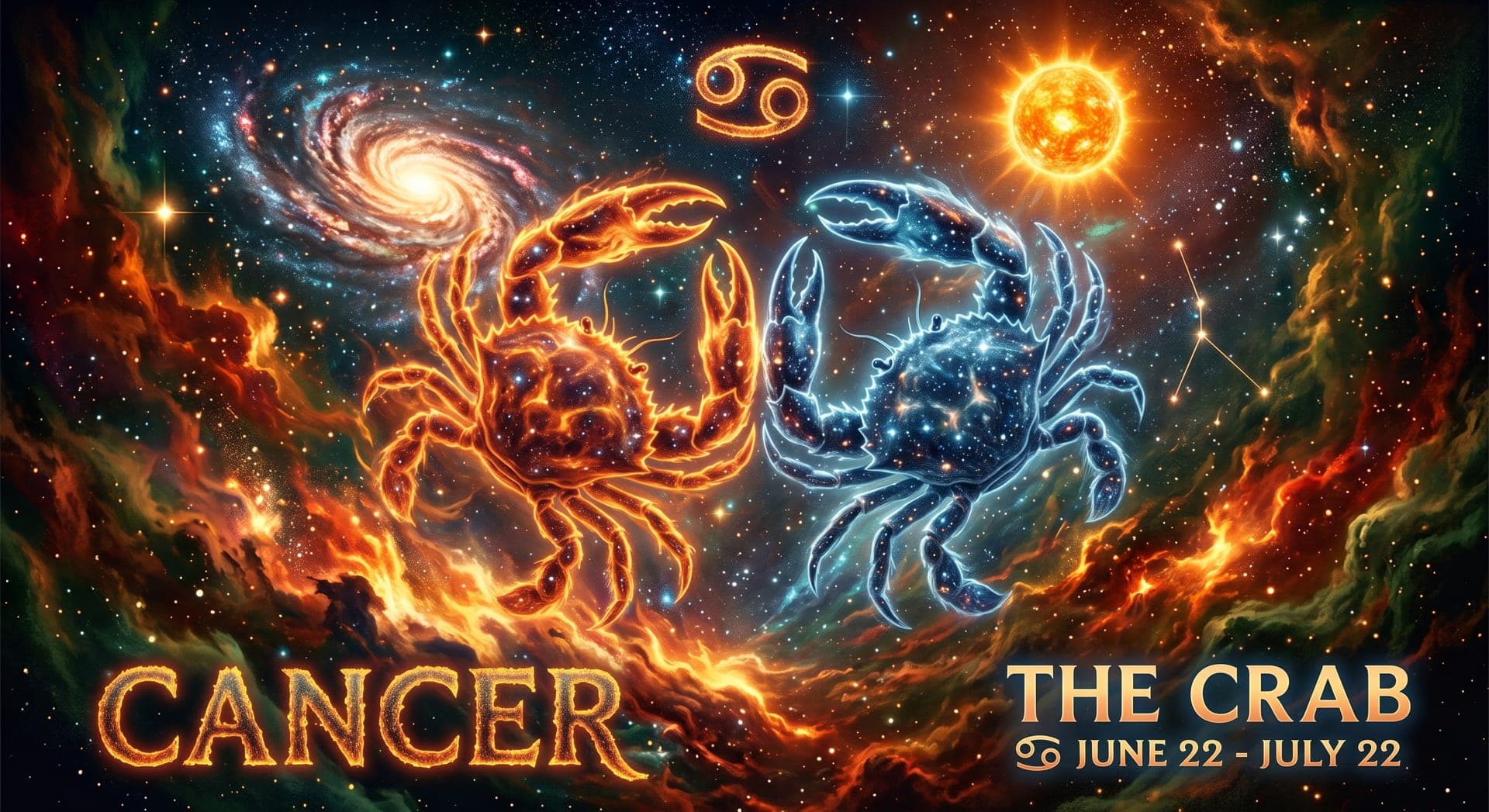
Cancer, the fourth sign of the zodiac, spans June 21 to July 22 and is symbolized by the crab, an animal known for carrying a protective shell while remaining soft and vulnerable underneath. Ruled by the Moon, the celestial body long associated with emotion, intuition, and the subconscious, Cancer is widely regarded as one of the most nurturing and emotionally attuned signs of the zodiac. As a Water sign, Cancer navigates the world through deep feeling, often forming strong emotional bonds and an acute sensitivity to the moods of others. Its Cardinal modality places it at the start of summer, beginning right at the June solstice, reflecting an instinct to initiate and create, especially around home and family. People born under this sign tend to be deeply loyal, protective of loved ones, and drawn to creating a comfortable, secure home environment. Cancer's emotional depth is a genuine strength, but it can also make the sign prone to moodiness or withdrawal when hurt, retreating like a crab into its shell until it feels safe enough to re-emerge.
Personality Traits
Strengths
- Deeply caring and nurturing
- Highly intuitive
- Fiercely loyal and protective
- Strong sense of family and tradition
- Emotionally perceptive
Weaknesses
- Prone to moodiness
- Overly sensitive to criticism
- Can be clingy
- Tends to hold grudges
- Retreats when hurt
Compatible Signs
Fun Facts
- Cancer's crab symbol comes from Greek mythology, where the goddess Hera placed a crab that had fought Hercules among the stars.
- Cancer is ruled by the Moon, the only zodiac sign ruled by a celestial body other than a planet.
- As a Cardinal sign, Cancer initiates summer, beginning at the June solstice, the longest day of the year in the Northern Hemisphere.
- Notable Cancers include Princess Diana, Tom Hanks, Ariana Grande, and Nelson Mandela.
- The crab's hard shell and soft interior are often used as a metaphor for Cancer's protective exterior guarding a deeply sensitive emotional core.
Born on July 1
- 1646
Gottfried Wilhelm Leibniz
German mathematician and philosopher who co-invented calculus
- 1731
Adam Duncan, 1st Viscount Duncan
Scottish admiral who led the Royal Navy to a decisive victory over the Dutch fleet at the Battle of Camperdown
- 1804
George Sand
French novelist and memoirist
- 1872
Louis Blériot
French aviator who made the first flight across the English Channel
- 1872
William Duddell
English physicist and engineer who invented the singing arc, an early device for generating radio waves
- 1899
Charles Laughton
English actor who won an Academy Award for The Private Life of Henry VIII and starred in Mutiny on the Bounty
- 1903
Amy Johnson
English aviator, the first woman to fly solo from Britain to Australia
- 1907
Norman Pirie
Scottish-English biochemist known for co-crystallizing tobacco mosaic virus
- 1916
Olivia de Havilland
British-American actress
- 1934
Jean Marsh
English actress and screenwriter who co-created the television series Upstairs, Downstairs
- 1935
David Prowse
English actor and bodybuilder who physically portrayed Darth Vader in the original Star Wars trilogy
- 1945
Debbie Harry
American singer and lead vocalist of Blondie
- 1952
Dan Aykroyd
Canadian actor and screenwriter
On This Day in History
- 1520
Spanish conquistadors under Hernan Cortes are forced to fight their way out of Tenochtitlan under cover of darkness in the disastrous retreat known as La Noche Triste.
Cortes and his men had seized the Aztec capital months earlier, but after the death of Emperor Moctezuma II the population revolted. Attempting to flee the city with looted treasure across the Tlacopan causeway, the Spanish and their allies suffered catastrophic losses, with many drowning under the weight of gold they refused to abandon. Cortes later regrouped and returned to conquer the city in 1521.
- 1523
The Union of Lublin is confirmed, merging the Kingdom of Poland and the Grand Duchy of Lithuania into the Polish-Lithuanian Commonwealth.
Negotiated over months at a diet in the city of Lublin, the union transformed a personal dynastic connection between Poland and Lithuania into a single federated state with a shared monarch, parliament, and foreign policy while preserving separate armies, treasuries, and legal systems. The Commonwealth became one of the largest and most populous states in Europe until its partitions in the late 18th century.
- 1543
Scotland and England conclude the Treaty of Greenwich, agreeing to the future marriage of the infant Mary, Queen of Scots to Prince Edward, son of Henry VIII.
Henry VIII sought to unite the two crowns through the marriage as part of his broader ambitions over Scotland. Scottish nobles repudiated the treaty within months, prompting Henry to launch a punitive military campaign against Scotland known as the 'Rough Wooing,' which dragged on for years without securing the marriage it was meant to guarantee.
- 1690
William III's Williamite forces defeat the deposed James II's Jacobite army at the Battle of the Boyne in Ireland.
Fought near Drogheda, the battle secured William's hold on the English, Scottish, and Irish thrones and dealt a lasting blow to Jacobite hopes of restoring Catholic rule. It became a foundational event for the Protestant Ascendancy in Ireland and is still commemorated annually by the Orange Order, though on July 12 due to later calendar changes.
- 1823
Five Central American nations declare independence from the short-lived First Mexican Empire.
The United Provinces of Central America emerged from the collapse of the First Mexican Empire, comprising the territories of modern Guatemala, Honduras, El Salvador, Nicaragua, and Costa Rica. The federation struggled with internal conflict between liberal and conservative factions and fully dissolved by 1841, though the declaration remains commemorated as the region's independence day across the five successor nations.
- 1837
A national system of civil registration of births, marriages, and deaths comes into effect in England and Wales.
Administered by the newly created General Register Office, the system ran alongside existing parish registers and gave the state, for the first time, a comprehensive record of vital events across the population. It transformed public health statistics and remains the backbone of genealogical research in England and Wales today.
- 1858
Charles Darwin and Alfred Russel Wallace's joint papers on evolution by natural selection are read to the Linnean Society of London.
The two naturalists had independently arrived at strikingly similar theories; their papers were presented together on the same evening as a compromise, since Darwin was mourning his young son and Wallace was still abroad in the Malay Archipelago. The reading preceded Darwin's full account, On the Origin of Species, published the following year.
- 1863
The Battle of Gettysburg begins in Pennsylvania, becoming the deadliest and most consequential engagement of the American Civil War.
Confederate General Robert E. Lee's invasion of the North collided with Union forces near the small Pennsylvania town, initially by accident as cavalry scouts clashed. Over three days the battle grew into the largest ever fought in North America, with roughly 50,000 combined casualties. The Union victory ended Lee's northern campaign and, combined with the fall of Vicksburg the next day, marked a turning point in the war.
- 1867
Canada is established as a self-governing dominion when the British North America Act takes effect, with John A. Macdonald becoming the first prime minister.
The British North America Act united the Province of Canada, Nova Scotia, and New Brunswick into a single federal dominion within the British Empire, granting significant self-governance while retaining ties to the crown. The date is now celebrated annually as Canada Day. Macdonald, a key architect of confederation, went on to serve as prime minister for most of the next two decades.
- 1867
The British North America Act takes effect, uniting Canada, New Brunswick, and Nova Scotia into the Dominion of Canada with John A. Macdonald as its first prime minister.
Passed by the Parliament of the United Kingdom, the Act created the federal framework of Canadian government and remained part of Canada's constitution until it was patriated in 1982 as the Constitution Act, 1867. The anniversary of its taking effect is celebrated annually as Canada Day.
- 1916
The Battle of the Somme begins in France, resulting in roughly 19,000 British deaths on its first day alone, the bloodiest day in British military history.
British and French forces launched a massive offensive along the Somme River intended to relieve pressure on French troops at Verdun and break the stalemate of trench warfare. The opening day became the single bloodiest in the history of the British Army, with roughly 57,000 casualties. The battle dragged on for over four months, advancing the front only a few miles at enormous human cost.
- 1916
The Battle of the Somme opens on the Western Front, with roughly 19,000 British soldiers killed and 40,000 wounded on the first day alone.
It remains the deadliest single day in the history of the British Army. The offensive, intended partly to relieve pressure on French forces at Verdun, continued into November 1916 and produced enormous casualties on both sides for only modest territorial gains, coming to symbolize the grinding, industrialized slaughter of the First World War.
- 1921
The Chinese Communist Party is founded by Chen Duxiu and Li Dazhao.
Founded at a clandestine meeting in Shanghai attended by delegates including a young Mao Zedong, the party began as a small Marxist study group influenced by the Russian Revolution and the May Fourth Movement. It grew over the following decades through alliance and civil war with the Nationalists, ultimately seizing control of mainland China in 1949 and remaining the country's sole ruling party ever since.
- 1960
Somalia and Ghana both achieve significant milestones in African independence, with Somalia uniting as an independent nation and Ghana becoming a republic.
Somalia achieved independence by merging the former British Somaliland protectorate with the Italian-administered Trust Territory of Somalia into a single unified state. On the same day, Ghana transitioned from a Commonwealth realm to a full republic under President Kwame Nkrumah, having gained independence from Britain three years earlier. Both events reflected the broader wave of African decolonization sweeping the continent.
- 1963
The British government confirms that former intelligence officer Kim Philby had worked as a Soviet double agent.
Philby, a senior figure in British intelligence, was part of the so-called 'Cambridge Five' spy ring recruited in the 1930s. He had defected to Moscow earlier in 1963 after coming under suspicion, and the government's confirmation marked one of the most damaging espionage scandals in the history of British intelligence.
- 1967
The European Community is formally established through the merger of three separate European organizations.
The merger combined the European Coal and Steel Community, the European Economic Community, and the European Atomic Energy Community under a single set of institutions, including a unified Commission and Council. This administrative consolidation streamlined governance among member states and laid essential institutional groundwork for the deeper political and economic integration that eventually produced the European Union in 1993.
- 1972
Around two thousand people take part in the first Gay Pride Rally in London, marking the first gay pride march in England.
Organised to coincide roughly with the anniversary of the 1969 Stonewall riots in New York, the march gave early public visibility to the gay rights movement in Britain at a time when homosexuality had only recently been partially decriminalised. It became the forerunner of the annual Pride parades now held across the country.
- 1997
China resumes sovereignty over Hong Kong, ending 156 years of British colonial rule.
Under the terms of a 1984 Sino-British joint declaration, sovereignty over Hong Kong reverted to China after more than a century and a half as a British colony, acquired in stages following the Opium Wars. The handover ceremony established the "one country, two systems" framework, promising Hong Kong a high degree of autonomy and its existing capitalist system for fifty years.
- 1997
China resumes sovereignty over Hong Kong, ending 156 years of British colonial rule.
Hong Kong had been ceded and later leased to Britain through nineteenth-century treaties following the Opium Wars. The handover ceremony, attended by Prince Charles and the territory's last governor, Chris Patten, established the 'one country, two systems' framework guaranteeing Hong Kong a high degree of autonomy for fifty years.
- 1999
The Scottish Parliament officially opens, with legislative powers transferred from the Scottish Office to the newly created Scottish Executive.
It was the first sitting of a Scottish parliament since the Acts of Union in 1707, following a devolution referendum held in 1997. The Parliament initially met in temporary premises in Edinburgh before moving into the purpose-built Holyrood building in 2004.