What’s Observed on June 7
Born on June 7: Gemini ♊
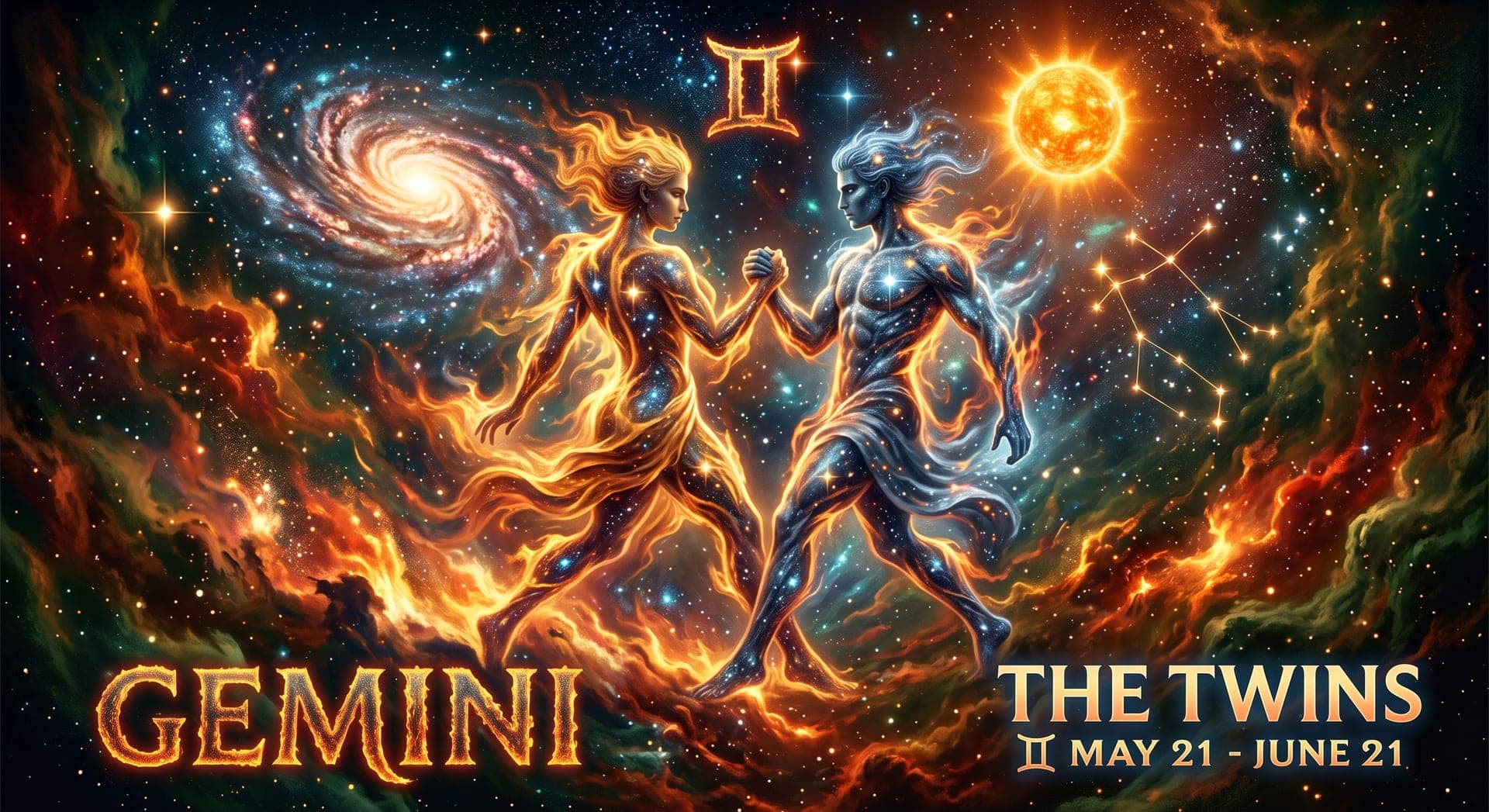
Gemini, the third sign of the zodiac, spans May 21 to June 20 and is symbolized by twins, representing the sign's dual nature and its ability to see multiple sides of any situation at once. Ruled by Mercury, the planet of communication and intellect, Gemini is widely regarded as one of the most talkative, curious, and quick-witted signs of the zodiac, constantly gathering new information and ideas. As an Air sign, Gemini approaches the world primarily through thought and conversation, thriving on mental stimulation and social interaction. Its Mutable modality reflects a restless adaptability, since Gemini tends to resist routine and prefers variety, novelty, and the freedom to change course whenever something more interesting comes along. People born under this sign are often skilled communicators, natural storytellers, and quick learners who can hold their own in nearly any conversation. That same adaptability can also come across as inconsistency, and Gemini's dual nature sometimes earns an unfair reputation for being two-faced, when in reality it simply reflects genuine curiosity about every side of a story.
Personality Traits
Strengths
- Quick-witted and intelligent
- Excellent communicator
- Adaptable to new situations
- Curious and eager to learn
- Charming and sociable
Weaknesses
- Prone to inconsistency
- Can be superficial
- Easily bored
- Indecisive
- Tendency to gossip
Compatible Signs
Fun Facts
- Gemini's twin symbol traces back to the Greek myth of Castor and Pollux, twin brothers placed among the stars as the constellation Gemini.
- Mercury, Gemini's ruling planet, was the swift Roman messenger god, reflecting the sign's associations with communication and quick thinking.
- Gemini is one of only a few zodiac signs represented by human figures rather than animals or objects.
- Notable Geminis include Marilyn Monroe, Kanye West, Angelina Jolie, and John F. Kennedy.
- Gemini season overlaps with the transition from spring to summer in the Northern Hemisphere, reflecting the sign's changeable, in-between nature.
Born on June 7
- 1761
John Rennie the Elder
Scottish civil engineer renowned for designing canals, docks, and bridges, including London's Waterloo and Southwark bridges.
- 1770
Robert Banks Jenkinson, 2nd Earl of Liverpool
English statesman who served as Prime Minister of the United Kingdom from 1812 to 1827, overseeing Britain's transition from the Napoleonic Wars to a period of postwar reform.
- 1811
James Young Simpson
Scottish obstetrician who pioneered the use of chloroform as an anaesthetic during childbirth, transforming the practice of surgery and obstetrics.
- 1831
Amelia Edwards
English novelist and journalist who became a pioneering Egyptologist, co-founding the Egypt Exploration Fund to promote archaeological research in Egypt.
- 1848
Paul Gauguin
French post-impressionist painter
- 1868
Charles Rennie Mackintosh
Scottish architect, designer, and artist whose Art Nouveau-influenced work, including the Glasgow School of Art, made him one of Europe's most influential designers.
- 1917
Dean Martin
American singer and actor
- 1940
Tom Jones
Welsh singer known for his powerful voice and hits such as 'It's Not Unusual' and 'Delilah,' one of the best-selling recording artists of his era.
- 1952
Liam Neeson
Irish actor
- 1958
Prince
American singer-songwriter and multi-instrumentalist
- 1965
Damien Hirst
English artist and leading figure of the Young British Artists movement, known for provocative works such as preserved animals in formaldehyde.
- 1974
Bear Grylls
British adventurer, author, and television presenter born in Northern Ireland, best known for hosting survival series such as Man vs. Wild.
- 1975
Allen Iverson
American basketball Hall of Famer
On This Day in History
- 1099
Crusader forces begin the siege of Jerusalem during the First Crusade.
Crusader forces arrived outside the walls of Jerusalem and began their siege of the holy city during the First Crusade, a campaign that would culminate weeks later in the city's capture through a brutal assault, followed by a massacre of much of its Muslim and Jewish population, establishing the Crusader-controlled Kingdom of Jerusalem.
- 1494
Spain and Portugal sign the Treaty of Tordesillas, dividing newly discovered lands in the Americas between the two powers.
Spain and Portugal signed the Treaty of Tordesillas, brokered with papal approval, dividing newly discovered and future territories in the Americas and beyond along a north-south meridian line, with Spain claiming lands to the west and Portugal to the east, an agreement that notably granted Portugal its later claim to Brazil.
- 1614
The Addled Parliament, the second Parliament of King James I of England, ends after two months without passing a single bill.
Summoned mainly to raise money, the assembly clashed with James I over royal finances and the king's prerogative, refusing to grant subsidies before its grievances were addressed. Frustrated by the deadlock, the king dissolved Parliament on 7 June 1614 without a single act being passed, earning it the nickname the 'Addled Parliament' and deepening tensions between crown and Commons that would resurface for decades.
- 1628
King Charles I of England grudgingly grants royal assent to the Petition of Right, a foundational document limiting royal authority.
King Charles I of England reluctantly granted royal assent to the Petition of Right after Parliament refused to approve further funding without it, a landmark document asserting that the king could not levy taxes without parliamentary consent, imprison subjects without cause, or impose martial law arbitrarily, laying important groundwork for later constitutional limits on royal power.
- 1628
The Petition of Right, a landmark English constitutional document limiting royal power, receives the royal assent of King Charles I.
Drafted by Parliament amid disputes over forced loans, arbitrary imprisonment, and martial law, the Petition of Right asserted that the king could not levy taxes without parliamentary consent, imprison subjects without cause, or quarter soldiers in private homes. Charles I's reluctant assent on 7 June 1628 marked a major milestone in the long struggle to define the limits of royal authority in England.
- 1776
Richard Henry Lee introduces a resolution to the Continental Congress calling for American independence, directly leading to the Declaration of Independence.
Virginia delegate Richard Henry Lee introduced a formal resolution to the Continental Congress declaring that the American colonies "are, and of right ought to be, free and independent states," a motion that directly led Congress to appoint a committee, including Thomas Jefferson, to draft the formal Declaration of Independence adopted weeks later.
- 1832
The Great Reform Act receives royal assent in Britain, expanding voting rights and reforming the electoral system.
The Great Reform Act received royal assent in Britain, significantly expanding voting rights to a broader segment of the middle class and eliminating numerous notoriously corrupt "rotten borough" parliamentary seats that had long been controlled by wealthy patrons, marking a pivotal early step toward more representative democratic government in the United Kingdom.
- 1832
The Great Reform Act, which overhauls England and Wales's electoral system, receives royal assent.
The act abolished many of the 'rotten boroughs' controlled by a handful of voters, redistributed seats to growing industrial towns, and widened the franchise to include more property-owning men. Though modest by later standards, it marked the first major step toward a more representative House of Commons and set a precedent for further electoral reform throughout the nineteenth century.
- 1862
Britain and the United States sign the Lyons–Seward Treaty, agreeing to cooperate in suppressing the transatlantic slave trade.
Named for British minister Lord Lyons and US Secretary of State William Seward, the treaty granted each country's navy the right to search and seize the other's merchant vessels suspected of carrying slaves off the African and Cuban coasts. It marked a significant strengthening of Anglo-American cooperation against the slave trade after decades of half-hearted enforcement efforts.
- 1906
The ocean liner RMS Lusitania is launched from the John Brown shipyard in Clydebank, Glasgow.
Built for the Cunard Line to compete with German rivals for the prestigious Blue Riband, the Lusitania was for a time the largest passenger ship in the world. The Clydebank-built liner became a celebrated symbol of British shipbuilding before its sinking by a German U-boat in 1915 turned it into one of the most infamous ships in maritime history.
- 1917
Allied forces detonate massive underground mines beneath German trenches at the Battle of Messines during World War I.
Allied engineers detonated a series of massive underground mines they had spent months tunneling beneath German trench positions at Messines Ridge in Belgium, an explosion so powerful it was reportedly heard as far away as London, allowing British and Commonwealth forces to capture the strategic ridge with comparatively low casualties.
- 1917
British and Allied forces detonate a series of massive mines beneath German lines at the Battle of Messines, killing around 10,000 soldiers.
After months spent tunnelling beneath no man's land, British engineers packed nineteen mines with nearly a million pounds of explosives under the Messines Ridge in Belgium. Their simultaneous detonation on 7 June 1917 produced one of the largest planned explosions in history up to that point, devastating German defences and allowing Allied troops to capture the ridge with comparatively low casualties.
- 1919
British soldiers kill four demonstrators during the Sette Giugno riots against colonial rule in Valletta, Malta.
Rising food prices and resentment of British colonial governance fuelled protests by Maltese nationalists demanding self-government. When crowds attacked pro-British properties in the capital, British troops opened fire, killing four Maltese civilians. The episode galvanised the Maltese self-determination movement and is still commemorated as a national day in Malta.
- 1940
King Haakon VII of Norway and his government flee Tromsø for exile in London as German forces overrun the country.
With Norwegian resistance collapsing after two months of fighting, King Haakon VII, Crown Prince Olav, and government ministers boarded a British cruiser at Tromsø, the last unoccupied Norwegian town, and sailed for Britain. From London, the king became a rallying symbol for Norwegian resistance, broadcasting to his occupied homeland throughout the war until his return in 1945.
- 1942
The Battle of Midway concludes with a decisive American victory over the Japanese navy.
The Battle of Midway concluded with a decisive American naval victory over the Imperial Japanese Navy, whose loss of four aircraft carriers and hundreds of experienced pilots dealt a blow from which Japan's naval air power never fully recovered, fundamentally shifting the strategic balance of the Pacific War in the Allies' favor.
- 1946
The BBC resumes television broadcasting after suspending its service for almost seven years during the Second World War.
The BBC had shut down the world's first regular television service in September 1939 to prevent its signal guiding enemy bombers to London and to free engineers for wartime radar work. When broadcasting resumed in 1946, the announcer picked up mid-sentence exactly where the pre-war Mickey Mouse cartoon had been interrupted, a wry touch marking Britain's return to peacetime television.
- 1967
Israeli forces capture the Old City of Jerusalem during the Six-Day War.
Israeli paratroopers fought their way into the Old City of Jerusalem and captured it from Jordanian control during the Six-Day War, reuniting the city under Israeli control for the first time since 1948 and giving Jewish worshippers access to the Western Wall, a moment of profound religious and national significance still commemorated annually.
- 1975
Sony launches the Betamax, the first consumer videocassette recorder format, in Japan.
Sony introduced the Betamax, the first videocassette recorder format designed for home consumer use, in Japan, launching what became known as the "format war" against the rival VHS system developed by JVC, a competition Betamax ultimately lost commercially despite retaining a reputation among some enthusiasts for superior picture quality.
- 1977
An estimated 500 million people worldwide watch television coverage of Queen Elizabeth II's Silver Jubilee celebrations.
Marking twenty-five years since her accession, the Silver Jubilee saw the Queen tour the country amid street parties and beacon-lighting ceremonies, culminating in a service of thanksgiving at St Paul's Cathedral. Global television coverage of the celebrations underscored the enduring international fascination with the British monarchy and offered a rare moment of national unity during a difficult economic period.
- 1991
Mount Pinatubo erupts catastrophically in the Philippines, sending an enormous ash column into the atmosphere.
Mount Pinatubo in the Philippines erupted catastrophically, ejecting an enormous column of ash and gas into the stratosphere in the second-largest volcanic eruption of the 20th century, an event that measurably cooled global average temperatures for roughly two years and forced the evacuation of tens of thousands of nearby residents.