What’s Observed on June 5
Born on June 5: Gemini ♊
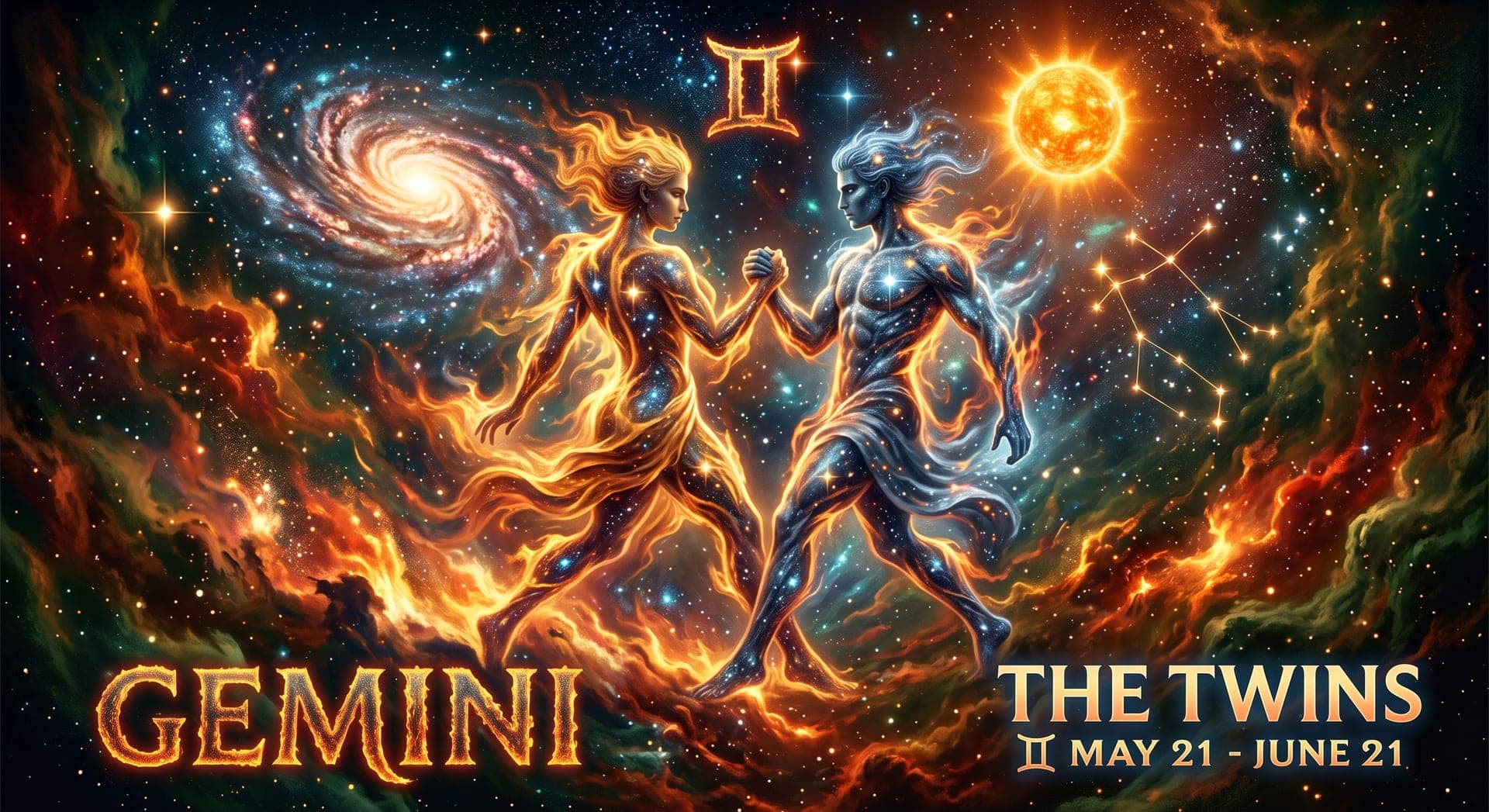
Gemini, the third sign of the zodiac, spans May 21 to June 20 and is symbolized by twins, representing the sign's dual nature and its ability to see multiple sides of any situation at once. Ruled by Mercury, the planet of communication and intellect, Gemini is widely regarded as one of the most talkative, curious, and quick-witted signs of the zodiac, constantly gathering new information and ideas. As an Air sign, Gemini approaches the world primarily through thought and conversation, thriving on mental stimulation and social interaction. Its Mutable modality reflects a restless adaptability, since Gemini tends to resist routine and prefers variety, novelty, and the freedom to change course whenever something more interesting comes along. People born under this sign are often skilled communicators, natural storytellers, and quick learners who can hold their own in nearly any conversation. That same adaptability can also come across as inconsistency, and Gemini's dual nature sometimes earns an unfair reputation for being two-faced, when in reality it simply reflects genuine curiosity about every side of a story.
Personality Traits
Strengths
- Quick-witted and intelligent
- Excellent communicator
- Adaptable to new situations
- Curious and eager to learn
- Charming and sociable
Weaknesses
- Prone to inconsistency
- Can be superficial
- Easily bored
- Indecisive
- Tendency to gossip
Compatible Signs
Fun Facts
- Gemini's twin symbol traces back to the Greek myth of Castor and Pollux, twin brothers placed among the stars as the constellation Gemini.
- Mercury, Gemini's ruling planet, was the swift Roman messenger god, reflecting the sign's associations with communication and quick thinking.
- Gemini is one of only a few zodiac signs represented by human figures rather than animals or objects.
- Notable Geminis include Marilyn Monroe, Kanye West, Angelina Jolie, and John F. Kennedy.
- Gemini season overlaps with the transition from spring to summer in the Northern Hemisphere, reflecting the sign's changeable, in-between nature.
Born on June 5
- 1660
Sarah Churchill
English courtier and Duchess of Marlborough whose close friendship with Queen Anne made her one of the most influential women in Britain
- 1819
John Couch Adams
English mathematician and astronomer who calculated the predicted position of the planet Neptune
- 1868
James Connolly
Scottish-born Irish socialist and republican leader executed for his role in the 1916 Easter Rising
- 1883
John Maynard Keynes
English economist whose theories on government intervention transformed modern macroeconomic policy
- 1884
Ivy Compton-Burnett
English novelist known for her sharply observed dialogue-driven novels of Victorian and Edwardian family life
- 1898
Federico García Lorca
Spanish poet and playwright
- 1916
Louis Brandeis
First Jewish justice of the U.S. Supreme Court
- 1939
Joe Clark
Canadian politician and Prime Minister of Canada
- 1949
Ken Follett
Welsh author of historical thrillers including The Pillars of the Earth
- 1971
Mark Wahlberg
American actor and producer
- 1971
Susan Lynch
Northern Irish actress known for films including Waking Ned and Nora

On This Day in History
- 830
Theodora is crowned Byzantine empress, later credited with restoring the veneration of icons and ending a major religious controversy.
Theodora, wife of Byzantine Emperor Theophilos, was crowned empress and later served as regent for her young son, using her position of power to reverse the empire's official policy of iconoclasm, restoring the veneration of religious icons after decades of controversy and destruction, an event still commemorated in Eastern Orthodox tradition as the "Triumph of Orthodoxy."
- 1610
The masque Tethys' Festival is performed at Whitehall Palace to celebrate the investiture of Henry Frederick as Prince of Wales.
Written by Samuel Daniel with elaborate stage designs by Inigo Jones, the masque was one of the most lavish court entertainments of the Jacobean era, featuring Queen Anne of Denmark and her ladies performing as water nymphs. Prince Henry, King James I's eldest son, was widely seen as a promising future monarch, but he died of typhoid fever just two years later at the age of eighteen.
- 1829
The Royal Navy schooner HMS Pickle captures the slave ship Voladora off the coast of Cuba, freeing hundreds of captives aboard.
The seizure was part of Britain's long anti-slave-trade patrols in the Atlantic, conducted by the Royal Navy's West Africa Squadron and allied vessels following Britain's abolition of the slave trade in 1807. HMS Pickle had earlier gained fame as the schooner that carried news of Nelson's victory and death at Trafalgar back to England in 1805.
- 1832
The June Rebellion breaks out in Paris against the monarchy of Louis Philippe, later immortalized in Victor Hugo's "Les Misérables."
Republican insurgents opposed to the constitutional monarchy of Louis Philippe rose up in Paris during the funeral procession of a popular general, briefly seizing parts of the city before government troops crushed the uprising within two days, an episode of urban revolt later immortalized as the backdrop for the barricade scenes in Victor Hugo's novel "Les Miserables."
- 1873
Sultan Barghash bin Said of Zanzibar agrees to close the island's slave market under pressure from the British government.
The closure came after decades of British diplomatic and naval pressure to end the East African slave trade, spearheaded by figures such as explorer and missionary David Livingstone, whose accounts of the trade's brutality shocked British public opinion. The former slave market site in Stone Town later became the location of an Anglican cathedral built to commemorate the trade's abolition.
- 1883
The Orient Express departs Paris on its first regularly scheduled journey toward Constantinople.
The Orient Express departed Paris's Gare de l'Est on its first regularly scheduled journey toward Constantinople, inaugurating a legendary long-distance rail route that came to symbolize luxury travel and international intrigue, later immortalized in numerous novels and films, including Agatha Christie's famous mystery set aboard the train.
- 1900
British forces occupy Pretoria, capital of the South African Republic, during the Second Boer War.
The capture came after British troops under Lord Roberts advanced steadily through the Transvaal following the relief of besieged towns earlier in the war. Although Pretoria's fall marked the effective end of conventional fighting, Boer commandos continued a lengthy guerrilla campaign for nearly two more years before the war finally ended with the Treaty of Vereeniging in 1902.
- 1916
Louis Brandeis is sworn in as the first Jewish justice of the U.S. Supreme Court.
Louis Brandeis was formally sworn in as an Associate Justice of the U.S. Supreme Court, becoming the first Jewish justice in the Court's history after a contentious confirmation battle. He went on to serve for 23 years, authoring influential opinions on free speech, privacy rights, and economic regulation that continue to shape American constitutional law.
- 1944
British bombers strike German coastal defences in Normandy as final preparations begin for the D-Day landings.
The raids targeted gun batteries, radar stations, and transport links along the invasion coast in the hours before the largest amphibious assault in history was launched. Poor weather had already forced a one-day postponement of the invasion, and the overnight bombing campaign formed part of a broader deception and softening-up effort ahead of the landings early the next morning.
- 1947
U.S. Secretary of State George Marshall announces the Marshall Plan at Harvard University, proposing massive American aid to rebuild postwar Europe.
U.S. Secretary of State George Marshall outlined a sweeping plan for American economic aid to help rebuild war-devastated Western European economies in a commencement address at Harvard University, a proposal that became known as the Marshall Plan and ultimately channeled billions of dollars into postwar reconstruction while also helping contain the spread of Soviet influence.
- 1967
Israel launches surprise airstrikes against Egyptian airfields, beginning the Six-Day War.
Israeli warplanes launched coordinated surprise strikes destroying much of Egypt's air force while it sat on the ground, opening the Six-Day War with a devastating first-strike advantage. The brief but consequential conflict ended with Israel capturing the Sinai Peninsula, Gaza Strip, West Bank, and Golan Heights, reshaping Middle Eastern geopolitics for decades to come.
- 1967
Israel launches surprise airstrikes against Egyptian airfields, beginning the Six-Day War against Egypt, Jordan, and Syria.
The preemptive strikes destroyed much of Egypt's air force on the ground within hours, giving Israel air superiority for the remainder of the conflict. Within six days, Israeli forces had captured the Sinai Peninsula, the Gaza Strip, the West Bank, and the Golan Heights, dramatically reshaping the map of the Middle East and setting the stage for decades of subsequent conflict.
- 1968
U.S. presidential candidate Robert F. Kennedy is shot by Sirhan Sirhan at a Los Angeles hotel shortly after winning the California primary.
Kennedy died the following day from his wounds, one of two Kennedy brothers assassinated within five years of each other. His death, coming just two months after the assassination of Martin Luther King Jr., deepened a sense of national crisis in the United States during a turbulent election year and dramatically altered the course of the 1968 presidential race.
- 1975
The Suez Canal reopens to shipping after being closed for eight years following the Six-Day War.
The Suez Canal reopened to international shipping after remaining closed for eight years following its blockage during the 1967 Six-Day War, a closure that had forced global shipping companies to reroute vessels around the southern tip of Africa, and the reopening restored a critical, faster maritime trade link between Europe and Asia.
- 1975
The United Kingdom holds its first-ever nationwide referendum, asking voters whether the country should remain in the European Economic Community.
Held two years after Britain had joined the EEC under Prime Minister Edward Heath, the referendum was called by Harold Wilson's Labour government partly to settle deep divisions within his own party over membership. Voters backed staying in by a wide margin, though the question of Britain's relationship with Europe would resurface decades later in the 2016 Brexit referendum.
- 1981
The U.S. Centers for Disease Control reports a cluster of rare pneumonia cases among five previously healthy young men in Los Angeles, the first recognized reports of what would become known as AIDS.
Published in the Morbidity and Mortality Weekly Report, the cases involved Pneumocystis pneumonia, an infection almost never seen outside severely immunocompromised patients. The report marked the beginning of medical recognition of the AIDS epidemic, which went on to kill tens of millions of people worldwide and reshape public health policy over the following decades.
- 1989
An unidentified man, later dubbed "Tank Man," halts a column of tanks for over 30 minutes near Tiananmen Square, becoming an enduring image of protest.
An unidentified man carrying shopping bags stepped in front of a column of tanks near Tiananmen Square and refused to move despite the lead tank's attempts to maneuver around him, a spontaneous act of individual defiance captured by journalists that became one of the most iconic images of protest and government repression in modern history.
- 2012
The last transit of Venus across the sun visible until the year 2117 occurs, drawing astronomers and skywatchers worldwide.
Astronomers and skywatchers around the world observed the transit of Venus across the face of the sun, a rare astronomical alignment that will not recur until the year 2117, drawing significant public and scientific interest given the historical importance such transits once held for calculating the astronomical unit and the scale of the solar system.
- 2012
Venus crosses the face of the Sun in the last transit of Venus visible from Earth until the year 2117.
Transits of Venus occur in pairs eight years apart separated by more than a century, making them exceptionally rare astronomical events; the previous transit had occurred in 2004. Historically, observations of Venus transits were used by astronomers including Edmond Halley to help calculate the distance between the Earth and the Sun, and the 2012 event drew widespread public and scientific interest before the long wait until the next one.
- 2024
Boeing's Starliner capsule launches on its first crewed flight to the International Space Station.
Boeing's long-delayed Starliner capsule launched on its first crewed test flight, carrying two NASA astronauts to the International Space Station as part of NASA's Commercial Crew Program, though the mission later encountered significant propulsion problems that led to an extended, unplanned stay in orbit for the crew before their eventual return.