
What’s Observed on April 8
Born on April 8: Aries ♈
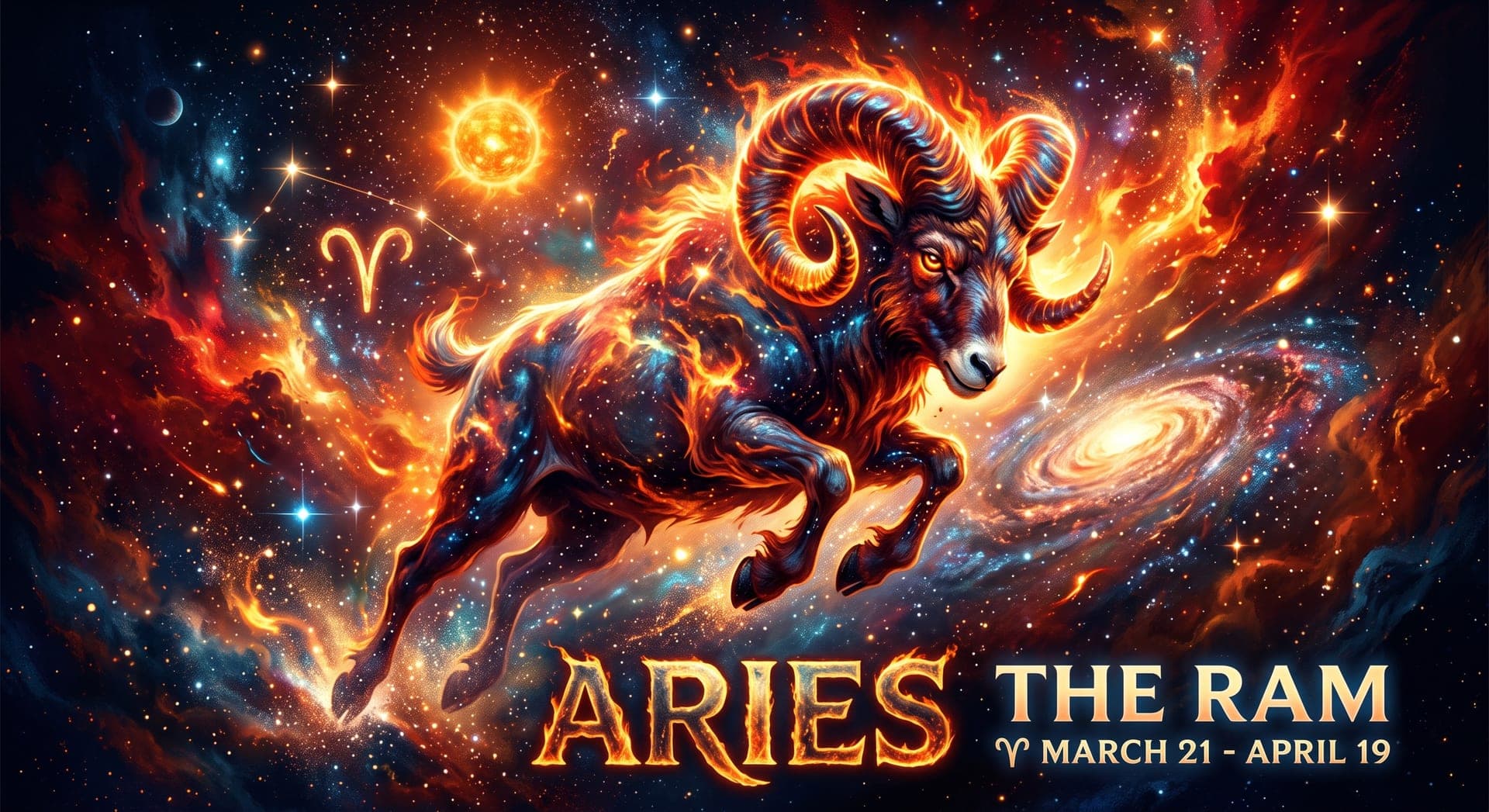
Aries, the first sign of the zodiac, spans March 21 to April 19 and is represented by the ram, an animal known for its boldness, stubborn determination, and willingness to charge forward. Ruled by Mars, the planet of action, drive, and war, Aries is often characterized as one of the most energetic and assertive signs in the zodiac, comfortable taking initiative and leading the way into new territory. As a Fire sign, Aries burns with passion and enthusiasm, approaching life with an instinctive, competitive edge and a low tolerance for hesitation. Its Cardinal modality reflects its role as an initiator, the sign that kicks off the astrological year at the spring equinox and each new season's start. People born under this sign are frequently drawn to leadership roles, sports, entrepreneurship, or any pursuit that rewards courage and quick decision-making. Direct and refreshingly honest, Aries individuals tend to say exactly what they think and rarely shy away from a challenge worth having.
Personality Traits
Strengths
- Courageous and determined
- Natural-born leader
- Honest and direct
- Enthusiastic and optimistic
- Quick to act on opportunities
Weaknesses
- Impatient and quick-tempered
- Impulsive, acts before thinking
- Can be overly competitive
- Struggles with follow-through
- Prone to selfishness
Compatible Signs
Fun Facts
- Aries is the first sign of the zodiac, marking the start of the astrological year at the spring equinox.
- The ram symbol is tied to the Greek myth of the golden-fleeced ram that rescued Phrixus, whose fleece later became the prize sought by Jason and the Argonauts.
- Mars, Aries' ruling planet, was the Roman god of war, reflecting the sign's associations with boldness, drive, and aggression.
- As a Cardinal sign, Aries is one of four signs, along with Cancer, Libra, and Capricorn, that initiate a new season.
- Notable Aries include Lady Gaga, Robert Downey Jr., Mariah Carey, and Leonardo da Vinci.
Born on April 8
- 1859
Edmund Husserl
German philosopher who founded phenomenology
- 1889
Adrian Boult
English conductor who led the BBC Symphony Orchestra and championed British composers such as Elgar and Vaughan Williams
- 1892
Mary Pickford
Canadian-American actress and co-founder of United Artists
- 1902
Andrew Irvine
English mountaineer who disappeared with George Mallory near the summit of Everest in 1924
- 1912
Sonja Henie
Norwegian figure skater and actress
- 1918
Betty Ford
First Lady of the United States and health advocate
- 1929
Jacques Brel
Belgian singer-songwriter
- 1938
Kofi Annan
Ghanaian diplomat and UN Secretary-General
- 1941
Vivienne Westwood
English fashion designer who brought punk style into the mainstream and became one of Britain's most influential designers
- 1943
James Herbert
English horror novelist best known for The Rats and other bestselling supernatural thrillers
- 1949
John Madden
English director known for films including Shakespeare in Love and Mrs Brown
- 1963
Alec Stewart
English cricketer who captained the national team and was renowned as one of its finest wicket-keeper batsmen
- 1963
Julian Lennon
English singer-songwriter and musician, son of Beatles member John Lennon

On This Day in History
- 217
Roman Emperor Caracalla is assassinated, succeeded by Praetorian Guard prefect Macrinus.
Roman Emperor Caracalla, known for his brutal and paranoid rule, was assassinated by a soldier while traveling near Carrhae in the eastern provinces, reportedly on the orders of his own Praetorian Guard prefect, Macrinus, who then seized the throne himself. Macrinus became the first Roman emperor to rule without ever having served in the Senate, a break from tradition that unsettled the Roman elite.
- 217
Roman emperor Caracalla is assassinated and is succeeded by his Praetorian Guard prefect, Marcus Opellius Macrinus.
Caracalla, notorious for the brutality of his reign and for extending Roman citizenship to nearly all free inhabitants of the empire, was killed while traveling near Carrhae in modern-day Turkey, stabbed by a soldier during a roadside stop. His death brought Macrinus to power as the first Roman emperor who was not a member of the senatorial class.
- 1139
Pope Innocent II excommunicates Roger II of Sicily amid a dispute over control of southern Italy.
Pope Innocent II excommunicated Roger II of Sicily amid a broader dispute over papal authority and territorial control in southern Italy, part of the complex power struggles between the papacy and Norman rulers who had established a powerful kingdom in the region. Roger nonetheless continued to consolidate and expand his rule, eventually forcing a reconciliation with the papacy.
- 1232
Mongol forces begin their siege of Kaifeng, the capital of the Jin dynasty in China.
Mongol forces under Ögedei Khan's commanders began a prolonged siege of Kaifeng, the heavily fortified capital of the Jin dynasty in northern China, employing sophisticated siege engines and gunpowder weapons. The city's eventual fall the following year marked a decisive step in the Mongol conquest of northern China, which would culminate decades later in Kublai Khan's establishment of the Yuan dynasty.
- 1250
King Louis IX of France is captured by Egyptian forces during the Seventh Crusade at the Battle of Fariskur.
During the Seventh Crusade, Egyptian Ayyubid forces decisively defeated and captured King Louis IX of France along with much of his army at the Battle of Fariskur in the Nile Delta. Louis was later ransomed for an enormous sum, and the crusade's failure marked a significant setback for European ambitions to reclaim the Holy Land through direct military conquest.
- 1250
Ayyubid forces of Egypt capture King Louis IX of France at the Battle of Fariskur during the Seventh Crusade.
The battle marked a catastrophic end to Louis's crusade in Egypt, as his weakened and disease-ridden army was overwhelmed near the Nile. Louis himself was held for a substantial ransom before being released, and the defeat effectively ended the crusade's aims in Egypt, though he later mounted an unsuccessful Eighth Crusade two decades afterward.
- 1271
Mamluk Sultan Baibars captures the Crusader fortress of Krak des Chevaliers in Syria.
Mamluk Sultan Baibars captured Krak des Chevaliers, one of the most formidable Crusader fortresses in the Levant, after a lengthy siege, reportedly through a mix of military pressure and a forged letter tricking the garrison into surrendering. The fortress's fall marked a major step in the broader Mamluk campaign that ultimately drove the Crusader states from the eastern Mediterranean by the century's end.
- 1271
The Mamluk sultan Baibars conquers the Krak des Chevaliers, a Crusader stronghold in Syria.
Held by the Knights Hospitaller for over a century, the castle was considered one of the most formidable fortifications built during the Crusades. Its fall, achieved after Baibars tricked the remaining garrison with a forged letter into surrendering, marked a significant blow to the shrinking Crusader states in the Levant.
- 1812
Russian Tsar Alexander I designates Helsinki as the new capital of the Grand Duchy of Finland.
Russian Tsar Alexander I, who had recently annexed Finland from Sweden and granted it status as an autonomous Grand Duchy, designated the small coastal town of Helsinki as its new capital, replacing Turku. The decision reflected strategic considerations, including Helsinki's proximity to St. Petersburg, and spurred the town's transformation into a significant planned capital city over the following decades.
- 1820
The Venus de Milo, an ancient Greek statue, is discovered on the Aegean island of Milos.
French farmers discovered the ancient Greek marble statue now known as the Venus de Milo buried in a field on the Aegean island of Milos, and it was soon acquired by French diplomats and shipped to the Louvre in Paris. Missing its arms since antiquity, the statue, believed to depict the goddess Aphrodite, became one of the most celebrated and recognizable works of ancient sculpture in the world.
- 1820
The ancient Greek statue known as the Venus de Milo is discovered on the Aegean island of Milos.
The armless marble statue, believed to depict the goddess Aphrodite and dated to around the 2nd century BCE, was found by a farmer and soon acquired by French diplomats. It was subsequently presented to King Louis XVIII and placed in the Louvre, where it remains one of the most celebrated works of ancient sculpture.
- 1886
British Prime Minister William Ewart Gladstone introduces the first Irish Home Rule Bill into the House of Commons.
The bill proposed to give Ireland its own parliament for domestic affairs while remaining part of the United Kingdom, a compromise Gladstone hoped would defuse growing Irish nationalist agitation. It split his own Liberal Party and was ultimately defeated, but it set the terms for a debate over Irish self-government that would dominate British politics for decades to come.
- 1904
France and Britain sign the Entente Cordiale, resolving colonial disputes and laying groundwork for their World War I alliance.
Britain and France signed the Entente Cordiale, a series of agreements resolving longstanding colonial disputes over territories including Egypt, Morocco, and parts of Africa and Southeast Asia. While not a formal military alliance, the agreement marked a significant warming of relations between the two historic rivals and laid important diplomatic groundwork for their cooperation against Germany in World War I a decade later.
- 1904
France and the United Kingdom sign the Entente cordiale, resolving colonial disputes and establishing closer diplomatic cooperation.
The agreement settled long-standing disagreements over territory in Africa, including recognition of British control in Egypt and French control in Morocco, and ended centuries of intermittent rivalry between the two powers. Though not a formal military alliance, it laid the diplomatic groundwork for Britain and France to fight together as allies in both World Wars.
- 1959
A team of computer manufacturers and academics led by Grace Hopper meets to discuss creating a new programming language that would become COBOL.
The meeting brought together representatives from government, industry, and universities to address the lack of a standardized business-oriented programming language that could run across different computer systems. The resulting language, COBOL, became one of the most widely used programming languages for business and administrative computing for decades afterward.
- 1968
BOAC Flight 712 catches fire shortly after takeoff from London Heathrow Airport, killing five people.
Stewardess Barbara Jane Harrison remained aboard the burning aircraft to help passengers escape rather than saving herself, and died in the attempt. For her bravery she was posthumously awarded the George Cross, the highest civilian gallantry award in the UK honours system, and remains the only woman to have received it during peacetime.
- 1974
Hank Aaron hits his 715th career home run, surpassing Babe Ruth's long-standing record.
Atlanta Braves outfielder Hank Aaron hit his 715th career home run against the Los Angeles Dodgers, surpassing Babe Ruth's long-standing record that many had considered unbreakable. Aaron achieved the milestone while facing significant racist hostility and death threats, and his historic hit is remembered as both a landmark athletic achievement and a significant moment in the broader civil rights era.
- 1974
Hank Aaron hits his 715th career home run, passing Babe Ruth to become baseball's all-time home run leader.
Aaron broke the record, long considered one of the most hallowed in American sports, against pitcher Al Downing at Atlanta-Fulton County Stadium, amid intense media attention and, for Aaron personally, a barrage of racist hate mail. He would go on to extend the record to 755 home runs before retiring, a mark that stood for over three decades.
- 2010
US President Barack Obama and Russian President Dmitry Medvedev sign the New START Treaty in Prague.
The agreement committed both nations to substantial reductions in their deployed strategic nuclear warheads and delivery systems, replacing the expired START I treaty and reflecting a period of improved US-Russian relations known as the "reset." It included verification measures allowing each side to inspect the other's nuclear arsenal.
- 2024
A total solar eclipse crosses North America, visible along a path from Mexico through the United States and into Canada.
A total solar eclipse swept across a broad path from Mexico through the United States and into eastern Canada, drawing millions of spectators to witness several minutes of daytime darkness as the moon fully blocked the sun. The eclipse's path crossed major U.S. population centers, making it one of the most widely viewed astronomical events in recent American history.