What’s Observed on April 30
Born on April 30: Taurus ♉
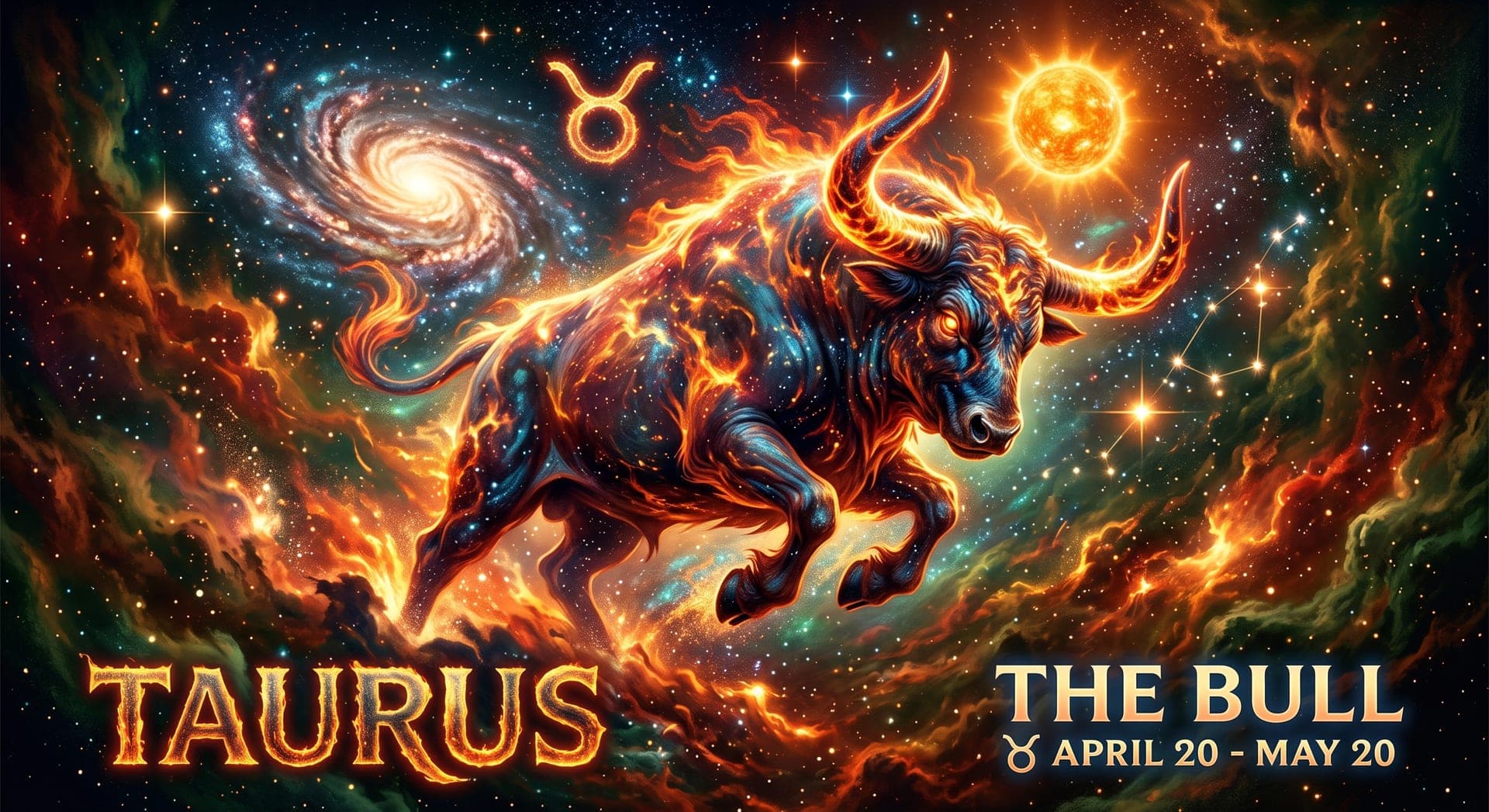
Taurus, the second sign of the zodiac, spans April 20 to May 20 and is symbolized by the bull, an animal prized for its strength, steadiness, and quiet determination. Ruled by Venus, the planet of love, beauty, and material comfort, Taurus is often described as one of the most sensual and pleasure-loving signs, drawn to good food, fine art, and physical comfort. As an Earth sign, Taurus is grounded, practical, and deeply connected to the physical world, valuing stability and tangible security over abstract ideas or sudden change. Its Fixed modality gives Taurus a well-earned reputation for stubbornness, since once a Taurus has settled on a plan or opinion, shifting it can be remarkably difficult. People born under this sign tend to be dependable, loyal, and patient, often the steady presence others rely on during difficult times. While their resistance to change can occasionally frustrate those around them, Taurus's persistence and work ethic make them exceptionally good at seeing long-term goals through to completion.
Personality Traits
Strengths
- Dependable and steady
- Patient and persistent
- Devoted to loved ones
- Appreciates beauty and comfort
- Financially sensible
Weaknesses
- Extremely stubborn
- Resistant to change
- Can be possessive
- Overindulgent
- Slow to forgive
Compatible Signs
Fun Facts
- Taurus's bull symbol connects to the Greek myth of Zeus transforming into a white bull to abduct Europa.
- Venus, Taurus' ruling planet, is the Roman goddess of love and beauty, reflecting the sign's love of comfort, art, and sensory pleasure.
- Taurus is considered by many astrologers to be the most stubborn sign of the zodiac, a trait often attributed to its Fixed modality and bull symbolism.
- Notable Taureans include Queen Elizabeth II, William Shakespeare, Adele, and David Beckham.
- The star cluster known as the Pleiades sits within the constellation Taurus and has been referenced in mythology and literature across many cultures.
Born on April 30
- 1662
Mary II
Queen of England, Scotland, and Ireland born in London, who ruled jointly with her husband William III following the Glorious Revolution.
- 1770
David Thompson
Cartographer and explorer born in Westminster, London, who mapped vast areas of western Canada and the northwestern United States.
- 1777
Carl Friedrich Gauss
German mathematician and physicist, one of history's most influential
- 1870
Franz Lehár
Hungarian composer known for operettas including "The Merry Widow"
- 1883
Jaroslav Hašek
Czech author known for "The Good Soldier Švejk"
- 1909
Juliana of the Netherlands
Queen of the Netherlands
- 1916
Claude Shannon
American mathematician known as the father of information theory
- 1920
Tom Moore
British army officer born in Keighley, Yorkshire, who raised over £30 million for healthcare charities by walking laps of his garden in 2020.
- 1937
Tony Harrison
English poet and playwright born in Leeds, celebrated for verse that drew on his working-class Yorkshire upbringing.
- 1946
Carl XVI Gustaf
King of Sweden
- 1959
Stephen Harper
Canadian economist and former Prime Minister of Canada
- 1969
Justine Greening
English politician born in Rotherham, who served as Secretary of State for Education and for International Development.
- 1973
Leigh Francis
English comedian and actor born in Leeds, best known for creating and performing the character Keith Lemon.
- 1981
Kunal Nayyar
Actor born in London, raised in India, known for playing Raj Koothrappali on the television series The Big Bang Theory.
On This Day in History
- 1492
Spain formally commissions Christopher Columbus for his westward voyage, naming him admiral of the ocean sea.
Spanish monarchs Ferdinand and Isabella formally commissioned Christopher Columbus for his westward voyage, granting him the titles "admiral of the ocean sea" and viceroy over any territories he might discover, finalizing the arrangements that would send his small fleet across the Atlantic later that year.
- 1513
Edmund de la Pole, Earl of Suffolk, is executed on the order of King Henry VIII.
A Yorkist claimant to the English throne descended from Edward IV's sister, de la Pole had spent years as a prisoner in the Tower of London after being handed over to Henry VII under a guarantee of safety. Henry VIII disregarded that promise and had him beheaded, eliminating a potential rival claim and a lingering threat from the defeated House of York.
- 1598
King Henry IV of France issues the Edict of Nantes, granting substantial religious freedoms to French Protestants.
King Henry IV of France issued the Edict of Nantes, granting substantial religious toleration and civil rights to French Protestant Huguenots after decades of brutal religious warfare, a landmark act of religious pragmatism that brought relative peace to France until the edict's controversial revocation nearly a century later.
- 1789
George Washington takes the oath of office at Federal Hall in New York City, becoming the first President of the United States.
George Washington took the presidential oath of office on the balcony of Federal Hall in New York City, becoming the first President of the United States under the newly ratified Constitution and establishing precedents for the peaceful transfer of power that would shape the young republic's political traditions.
- 1803
The United States completes the Louisiana Purchase, acquiring vast western territory from France for $15 million.
The United States completed the Louisiana Purchase, acquiring roughly 828,000 square miles of French territory west of the Mississippi River for approximately $15 million, one of the largest land acquisitions in history, which effectively doubled the size of the young nation and opened vast new territory for westward expansion.
- 1812
The Territory of Orleans is admitted to the Union as the state of Louisiana.
The Territory of Orleans was admitted to the Union as the state of Louisiana, becoming the eighteenth U.S. state and the first to be carved from the vast territory acquired in the Louisiana Purchase, bringing a distinctive blend of French, Spanish, and Creole cultural heritage into the American union.
- 1859
Charles Dickens publishes the first issue of his weekly literary magazine, All the Year Round.
Dickens launched the publication after a falling-out with his former magazine Household Words, serializing his own novel A Tale of Two Cities in its debut issue. The magazine went on to serialize major works by Dickens and other Victorian authors, including Wilkie Collins, and ran successfully for two decades under Dickens and later his son.
- 1897
Physicist J.J. Thomson announces his discovery of the electron at the Royal Institution in London.
Physicist J.J. Thomson announced his discovery of the electron at the Royal Institution in London, identifying a subatomic particle with negative charge far smaller than the atom itself, a finding that upended the prevailing view of atoms as indivisible and laid crucial groundwork for the development of modern atomic and particle physics.
- 1897
British physicist J. J. Thomson announces his discovery of the electron, the first identified subatomic particle.
Working at the Cavendish Laboratory at the University of Cambridge, Thomson conducted experiments with cathode rays that revealed particles far smaller and lighter than atoms, overturning the idea of the atom as indivisible. The discovery opened the field of particle physics and earned Thomson the 1906 Nobel Prize in Physics.
- 1943
The British submarine HMS Seraph casts adrift a corpse carrying false invasion plans off the coast of Spain.
As part of the deception known as Operation Mincemeat, British intelligence dressed a body as a fictitious Royal Marines officer carrying documents suggesting an Allied invasion of Greece and Sardinia rather than the actual target, Sicily. The ruse successfully deceived German intelligence, helping divert enemy defenses and easing the Allied invasion of Sicily weeks later.
- 1945
Adolf Hitler and Eva Braun commit suicide in the Führerbunker as Soviet forces close in on Berlin.
With Soviet troops just blocks from his underground bunker in Berlin, Adolf Hitler shot himself while Eva Braun, whom he had married the previous day, took cyanide, ending the life of the Nazi dictator responsible for World War II and the Holocaust just as Soviet soldiers raised their flag over the nearby Reichstag.
- 1945
Stalag Luft I, a German prisoner-of-war camp holding Allied airmen, is liberated, freeing nearly 9,000 prisoners.
Located near Barth on Germany's Baltic coast, the camp held thousands of captured British and American airmen, including many Royal Air Force officers shot down over occupied Europe. Advancing Soviet forces reached the camp as the war neared its end, and the liberated airmen were subsequently evacuated by air to Allied lines.
- 1963
The Bristol Bus Boycott begins, protesting racial discrimination in employment by a British bus company.
The Bristol Omnibus Company had an unofficial policy of refusing to employ Black or South Asian workers as bus crews, prompting a boycott organized by local activists inspired by the American civil rights movement. The campaign's success in overturning the ban is credited with contributing to the passage of Britain's Race Relations Act the following year.
- 1975
Saigon falls to North Vietnamese and Viet Cong forces, ending the Vietnam War with South Vietnam's unconditional surrender.
North Vietnamese and Viet Cong forces captured Saigon, the capital of South Vietnam, prompting the government's unconditional surrender and formally ending the Vietnam War, a conflict that had killed millions and profoundly shaped American politics and society over the preceding two decades.
- 1975
Communist forces capture Saigon, marking the end of the Vietnam War.
North Vietnamese and Viet Cong troops entered the South Vietnamese capital as the government collapsed, prompting a chaotic US evacuation of remaining personnel and Vietnamese allies by helicopter in the war's final hours. The city was subsequently renamed Ho Chi Minh City, and the fall marked the reunification of Vietnam under communist rule after decades of conflict.
- 1980
Armed gunmen seize the Iranian Embassy in London, taking 26 hostages.
A group of Iranian Arab separatists took over the embassy in Kensington, demanding the release of prisoners held in Iran's Khuzestan province. The six-day siege ended when the British Army's Special Air Service stormed the building in a dramatic televised assault, killing five of the six hostage-takers and rescuing all but one hostage, an operation that brought the SAS international fame.
- 1989
A gunman kills one person and wounds sixteen others in a shooting spree in Monkseaton, in the north east of England.
The attacker opened fire in the seaside town near Whitley Bay before being confronted and stopped, in one of the deadlier mass shootings in English history prior to the tightening of British firearms laws in the 1990s. The incident, along with other shootings of that era, contributed to a national debate over gun control in the United Kingdom.
- 1993
CERN announces that World Wide Web technology will be freely available to everyone, with no fees required.
Physicists at CERN, the European particle physics laboratory, publicly announced that the World Wide Web technology developed there by Tim Berners-Lee would be made freely available to anyone, with no licensing fees required, a decision widely credited with enabling the web's rapid, open global growth in the years that followed.
- 1999
Neo-Nazi David Copeland carries out the last of three nail bombings in London, targeting a gay pub in Soho.
Over 13 days, Copeland had already bombed markets in Brixton and Brick Lane targeting Black and Bangladeshi communities before detonating a nail bomb at the Admiral Duncan pub, killing three people and injuring dozens more. He was later convicted of murder and sentenced to life imprisonment, and the attacks prompted a major review of British policing's response to far-right terrorism.
- 2009
Automaker Chrysler files for Chapter 11 bankruptcy protection amid the global financial crisis.
American automaker Chrysler filed for Chapter 11 bankruptcy protection amid the global financial crisis, becoming the first major U.S. automaker to do so in decades, a restructuring that involved significant federal government support and an eventual partnership with Italian automaker Fiat to help the company survive.