What’s Observed on April 13
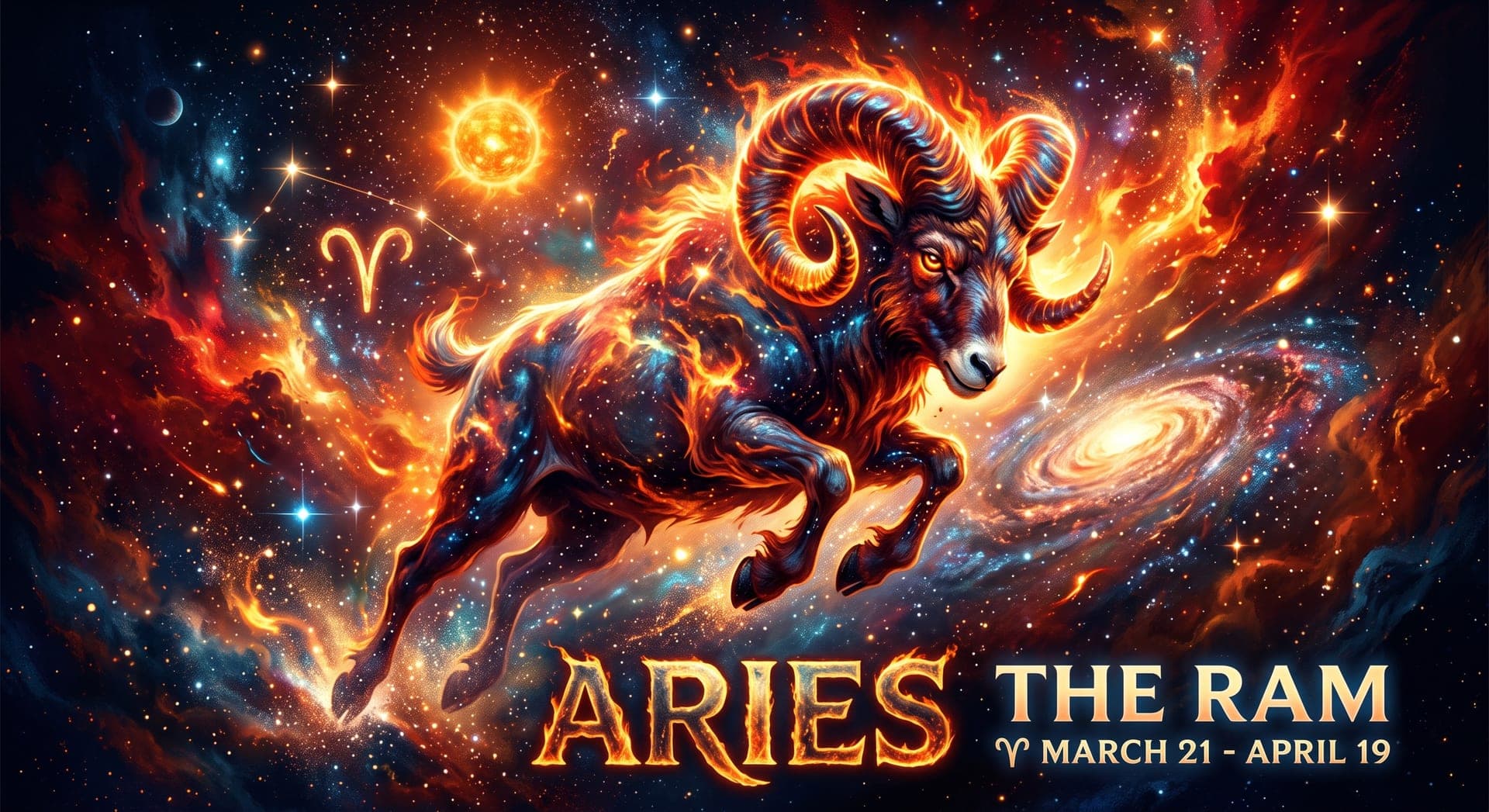
Born on April 13: Aries ♈
Aries, the first sign of the zodiac, spans March 21 to April 19 and is represented by the ram, an animal known for its boldness, stubborn determination, and willingness to charge forward. Ruled by Mars, the planet of action, drive, and war, Aries is often characterized as one of the most energetic and assertive signs in the zodiac, comfortable taking initiative and leading the way into new territory. As a Fire sign, Aries burns with passion and enthusiasm, approaching life with an instinctive, competitive edge and a low tolerance for hesitation. Its Cardinal modality reflects its role as an initiator, the sign that kicks off the astrological year at the spring equinox and each new season's start. People born under this sign are frequently drawn to leadership roles, sports, entrepreneurship, or any pursuit that rewards courage and quick decision-making. Direct and refreshingly honest, Aries individuals tend to say exactly what they think and rarely shy away from a challenge worth having.
Personality Traits
Strengths
- Courageous and determined
- Natural-born leader
- Honest and direct
- Enthusiastic and optimistic
- Quick to act on opportunities
Weaknesses
- Impatient and quick-tempered
- Impulsive, acts before thinking
- Can be overly competitive
- Struggles with follow-through
- Prone to selfishness
Compatible Signs
Fun Facts
- Aries is the first sign of the zodiac, marking the start of the astrological year at the spring equinox.
- The ram symbol is tied to the Greek myth of the golden-fleeced ram that rescued Phrixus, whose fleece later became the prize sought by Jason and the Argonauts.
- Mars, Aries' ruling planet, was the Roman god of war, reflecting the sign's associations with boldness, drive, and aggression.
- As a Cardinal sign, Aries is one of four signs, along with Cancer, Libra, and Capricorn, that initiate a new season.
- Notable Aries include Lady Gaga, Robert Downey Jr., Mariah Carey, and Leonardo da Vinci.
Born on April 13
- 1570
Guy Fawkes
English soldier best known as a member of the 1605 Gunpowder Plot to blow up the House of Lords and assassinate King James I.
- 1732
Frederick North, Lord North
English statesman who served as Prime Minister of Great Britain during the American Revolutionary War.
- 1743
Thomas Jefferson
Third President of the United States and principal author of the Declaration of Independence
- 1771
Richard Trevithick
Cornish engineer and inventor who built the first full-scale working railway steam locomotive, laying the groundwork for the railway age.
- 1828
Josephine Butler
English feminist and social reformer who campaigned against the Contagious Diseases Acts and for the rights of women and victims of trafficking.
- 1852
Frank Winfield Woolworth
Businessman who founded the F. W. Woolworth Company
- 1892
Robert Watson-Watt
Scottish physicist and engineer who pioneered the development of radar, a technology that proved decisive for Britain's air defences in the Second World War.
- 1906
Samuel Beckett
Irish playwright and Nobel Prize laureate known for "Waiting for Godot"
- 1909
Eudora Welty
American short story writer and novelist
- 1939
Seamus Heaney
Poet born in County Londonderry, Northern Ireland, awarded the Nobel Prize in Literature for verse rooted in rural life, history, and language.
- 1940
Max Mosley
English racing figure and engineer who co-founded March Engineering and later served as president of the FIA, motorsport's governing body.
- 1949
Christopher Hitchens
English essayist, journalist, and author known for his combative political and religious commentary.
- 1950
Ron Perlman
American actor known for "Hellboy"
- 1963
Garry Kasparov
Russian chess grandmaster and former World Champion
On This Day in History
- 1204
Constantinople falls to the Fourth Crusade after the sack of the city, temporarily ending the Byzantine Empire and installing a Latin emperor.
After breaching the city's walls the previous day, soldiers of the Fourth Crusade completed their conquest of Constantinople, subjecting the Byzantine capital to a brutal sack that included widespread looting, destruction, and violence against its Christian residents. The crusaders installed a Latin emperor over the fractured remains of the Byzantine Empire, a division that persisted for decades and permanently weakened Byzantine power.
- 1204
Crusaders of the Fourth Crusade storm and sack Constantinople, toppling the Byzantine Empire.
What had begun as a campaign to reclaim Jerusalem was diverted by debts, politics, and the ambitions of Venice into an assault on fellow Christians. The crusaders plundered the city's treasures and art, much of which never returned, and installed a Latin ruler over the fractured territory. Byzantine successor states would not fully restore Greek rule over Constantinople until 1261.
- 1699
Guru Gobind Singh formally establishes the Khalsa, a defining institution of the Sikh faith, in northern India.
Guru Gobind Singh, the tenth Sikh guru, formally established the Khalsa, a collective religious community bound by a distinct code of conduct and identity, during a gathering at Anandpur Sahib in Punjab. The founding of the Khalsa remains one of the most significant events in Sikh history, and its anniversary is celebrated annually as the festival of Vaisakhi.
- 1742
George Frideric Handel's oratorio "Messiah" receives its world premiere in Dublin, Ireland.
George Frideric Handel's oratorio "Messiah," now among the most frequently performed choral works in the Western musical canon, received its world premiere at a charity concert in Dublin, Ireland, to great acclaim. The piece, including its famous "Hallelujah" chorus, was composed in an astonishingly short period of about three weeks and has become a staple of Christmas and Easter concert programs worldwide.
- 1742
George Frideric Handel's oratorio Messiah receives its world premiere in Dublin.
Handel, a German-born composer who had become a naturalised British subject and made London his home, wrote the entire oratorio in just over three weeks. It debuted as a charity benefit concert at the New Musick Hall on Fishamble Street, raising funds for local hospitals and a debtors' prison. Messiah went on to become one of the most frequently performed choral works in Britain and the English-speaking world.
- 1777
British and Hessian forces under General Cornwallis launch a surprise dawn attack on American troops at the Battle of Bound Brook, New Jersey.
During the American Revolutionary War, roughly 4,000 British and allied German troops attempted to encircle and destroy a much smaller Continental Army outpost commanded by General Benjamin Lincoln. Most of the American defenders escaped, though they lost supplies, papers, and several cannon in the process. The raid was one of several British probing actions around New Jersey during the lull after the winter campaign.
- 1829
The Roman Catholic Relief Act 1829 grants Roman Catholics across the United Kingdom the right to vote and to sit in Parliament.
Known as Catholic Emancipation, the act dismantled centuries of penal restrictions imposed after the Reformation. It followed sustained political pressure from Daniel O'Connell's Catholic Association in Ireland and was reluctantly steered through Parliament by the Duke of Wellington's government, which feared renewed unrest. While Catholics still faced some barriers to high office, the act marked a decisive step toward religious equality in Britain and Ireland.
- 1861
Union forces surrender Fort Sumter to Confederate troops after a 34-hour bombardment.
After a sustained 34-hour bombardment by Confederate artillery, the Union garrison at Fort Sumter, commanded by Major Robert Anderson, surrendered the fort without any fatalities from the shelling itself, though the formal surrender ceremony the next day claimed the war's first casualties in an accidental explosion. The fort's fall marked the opening chapter of the American Civil War.
- 1861
Union forces surrender Fort Sumter to Confederate troops after a 34-hour bombardment, in the opening engagement of the American Civil War.
The fort in Charleston Harbor, South Carolina, had been besieged since Confederate batteries opened fire on April 12. With supplies exhausted and the garrison unable to hold out, Major Robert Anderson formally surrendered the following day. No soldiers were killed in the exchange, but the confrontation triggered a wave of enlistments across both the Union and Confederacy as the nation plunged into war.
- 1870
The Metropolitan Museum of Art is founded in New York City.
A group of prominent American civic leaders and philanthropists founded the Metropolitan Museum of Art in New York City, intending to bring great works of art to American audiences and foster art education. Since opening its doors a few years later, the museum has grown into one of the largest and most visited art museums in the world.
- 1919
British troops kill hundreds of unarmed demonstrators at the Jallianwala Bagh massacre in Amritsar, India, galvanizing the Indian independence movement.
British Indian Army troops under General Reginald Dyer opened fire without warning on a large, peaceful crowd of unarmed demonstrators gathered in an enclosed public garden in Amritsar, India, killing hundreds and wounding many more. The Jallianwala Bagh massacre became a pivotal moment that galvanized widespread Indian outrage and significantly strengthened the movement for independence from British colonial rule.
- 1919
British Indian Army troops under Brigadier-General Reginald Dyer open fire on a crowd of unarmed civilians at Jallianwala Bagh in Amritsar.
Troops fired for roughly ten minutes into a gathering trapped in the walled garden, killing between 379 and 1,000 people and wounding well over a thousand more. The massacre shocked British and Indian public opinion alike, drew condemnation from figures such as Winston Churchill, and became a defining grievance that hardened support for the Indian independence movement led by Mahatma Gandhi.
- 1943
Nazi Germany announces the discovery of mass graves of Polish officers killed by Soviet forces in the Katyn Forest.
Nazi German authorities publicly announced the discovery of mass graves in the Katyn Forest near Smolensk containing the remains of thousands of Polish military officers, using the finding for propaganda purposes to drive a wedge between the Soviet Union and its Western Allies. The Soviet Union, in fact responsible for the massacre, denied involvement for decades until finally admitting responsibility in 1990.
- 1943
Germany announces the discovery of mass graves in the Katyn Forest containing the remains of thousands of Polish officers killed by Soviet forces.
The revelation exposed one of the Second World War's most controversial atrocities, in which Soviet secret police had executed thousands of Polish military officers and intellectuals in 1940. The announcement caused a bitter diplomatic rupture between the Soviet Union and the Polish government-in-exile, which demanded an independent investigation. Moscow denied responsibility for decades, only formally acknowledging Soviet guilt in 1990.
- 1953
CIA Director Allen Dulles authorizes Project MKUltra, a covert program researching mind control and behavioral manipulation.
Conducted largely without the knowledge or consent of its subjects, MKUltra involved experiments with hallucinogenic drugs, sensory deprivation, and psychological abuse across dozens of institutions in North America. The program's existence remained secret until congressional investigations in the 1970s exposed its scope, prompting reforms to oversight of intelligence agencies and lasting controversy over the ethics of Cold War-era human experimentation.
- 1970
An oxygen tank explodes aboard Apollo 13, forcing NASA to abort the Moon landing and focus on returning the crew safely to Earth.
An oxygen tank aboard the Apollo 13 spacecraft exploded roughly 200,000 miles from Earth, crippling the vessel's power and life support systems and forcing NASA to abandon the planned Moon landing in favor of an urgent effort to bring the three astronauts home alive. The subsequent rescue, achieved through resourceful improvisation, became one of the most celebrated episodes in spaceflight history.
- 1970
An oxygen tank aboard the Apollo 13 spacecraft explodes en route to the Moon, crippling the mission and endangering its three-man crew.
The explosion knocked out power and life support in the command module, forcing astronauts James Lovell, Jack Swigert, and Fred Haise to shelter in the lunar module as a makeshift lifeboat. Mission control and the crew improvised solutions to conserve power, water, and breathable air during the perilous return journey. All three astronauts splashed down safely four days later, in what became known as a successful failure.
- 1975
A deadly attack on a bus in Beirut marks the start of Lebanon's 15-year civil war.
A bus carrying Palestinian passengers was ambushed and attacked by Christian Phalangist militiamen in a Beirut suburb, killing around two dozen people in an incident widely regarded as the spark that ignited Lebanon's devastating 15-year civil war. The conflict that followed drew in numerous regional and international powers and left the country deeply fractured along sectarian lines for decades.
- 1997
Tiger Woods wins the Masters Tournament by a record 12 strokes, becoming the youngest champion in the event's history.
A 21-year-old Tiger Woods won the Masters Tournament by a record-setting 12 strokes, becoming both the youngest golfer ever to win the event and the first player of Black or Asian heritage to claim a major championship. His dominant, record-breaking performance signaled the arrival of a talent that would go on to reshape the sport of golf over the following two decades.
- 1997
Tiger Woods becomes the youngest golfer ever to win the Masters Tournament, at age 21.
Woods finished the tournament at 18-under-par, a record score, and won by twelve strokes, the largest margin of victory in Masters history at the time. His dominant performance at Augusta National announced him as a transformative figure in golf and helped broaden the sport's popularity and diversity. The victory is widely regarded as one of the greatest performances in major championship history.