
What’s Observed on April 12
Born on April 12: Aries ♈
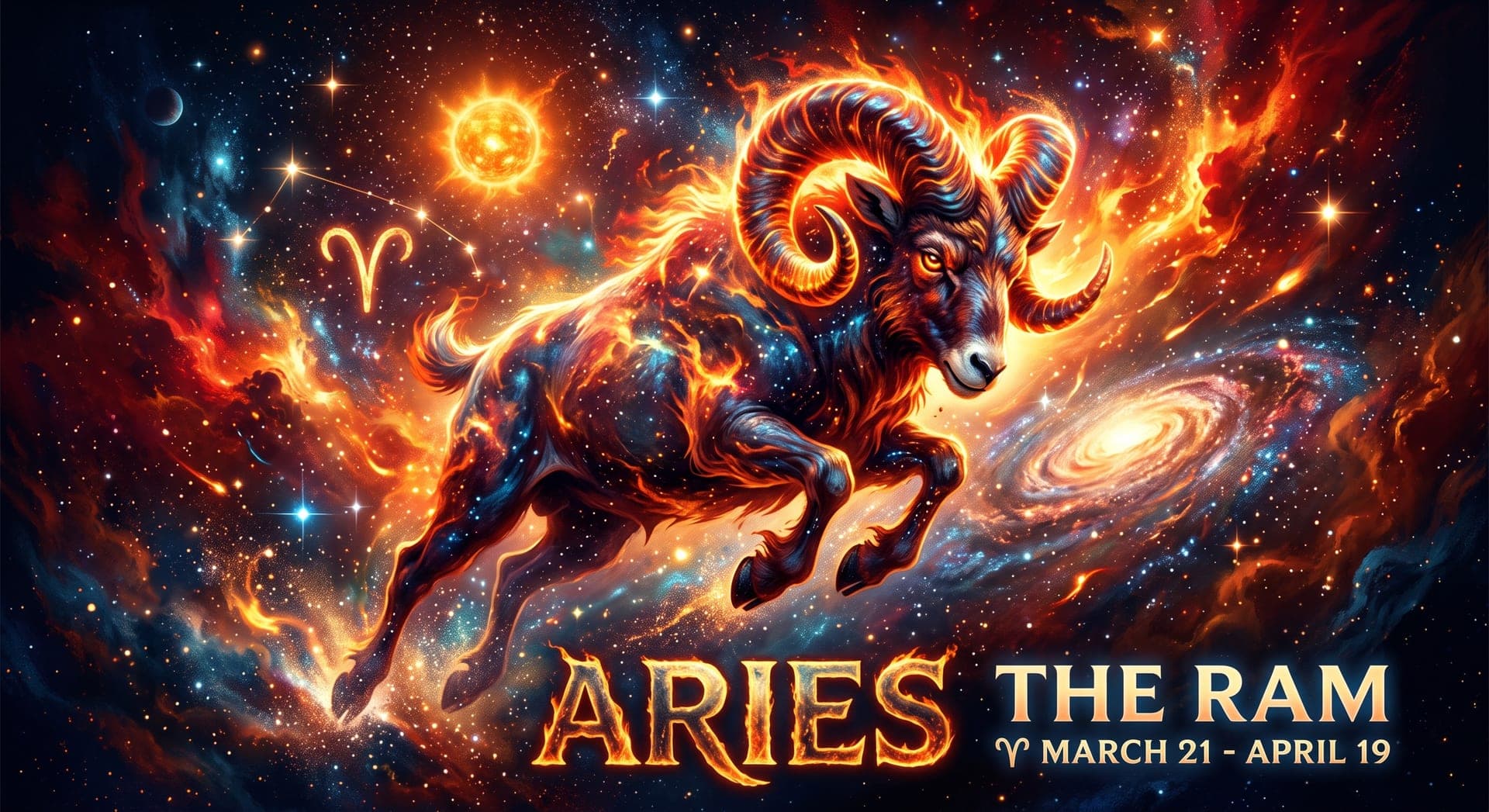
Aries, the first sign of the zodiac, spans March 21 to April 19 and is represented by the ram, an animal known for its boldness, stubborn determination, and willingness to charge forward. Ruled by Mars, the planet of action, drive, and war, Aries is often characterized as one of the most energetic and assertive signs in the zodiac, comfortable taking initiative and leading the way into new territory. As a Fire sign, Aries burns with passion and enthusiasm, approaching life with an instinctive, competitive edge and a low tolerance for hesitation. Its Cardinal modality reflects its role as an initiator, the sign that kicks off the astrological year at the spring equinox and each new season's start. People born under this sign are frequently drawn to leadership roles, sports, entrepreneurship, or any pursuit that rewards courage and quick decision-making. Direct and refreshingly honest, Aries individuals tend to say exactly what they think and rarely shy away from a challenge worth having.
Personality Traits
Strengths
- Courageous and determined
- Natural-born leader
- Honest and direct
- Enthusiastic and optimistic
- Quick to act on opportunities
Weaknesses
- Impatient and quick-tempered
- Impulsive, acts before thinking
- Can be overly competitive
- Struggles with follow-through
- Prone to selfishness
Compatible Signs
Fun Facts
- Aries is the first sign of the zodiac, marking the start of the astrological year at the spring equinox.
- The ram symbol is tied to the Greek myth of the golden-fleeced ram that rescued Phrixus, whose fleece later became the prize sought by Jason and the Argonauts.
- Mars, Aries' ruling planet, was the Roman god of war, reflecting the sign's associations with boldness, drive, and aggression.
- As a Cardinal sign, Aries is one of four signs, along with Cancer, Libra, and Capricorn, that initiate a new season.
- Notable Aries include Lady Gaga, Robert Downey Jr., Mariah Carey, and Leonardo da Vinci.
Born on April 12
- 1777
Henry Clay
American statesman and U.S. Secretary of State
- 1888
Cecil Kimber
English automobile engineer who founded the MG car marque
- 1916
Beverly Cleary
American author of children's literature
- 1925
Oliver Postgate
English animator and writer behind beloved children's shows including Bagpuss and The Clangers
- 1939
Alan Ayckbourn
English playwright and director known for prolific, socially observant comedies staged around the world
- 1940
Herbie Hancock
American jazz pianist and composer
- 1941
Bobby Moore
English footballer who captained England to victory in the 1966 FIFA World Cup
- 1946
George Robertson
Scottish politician who served as Secretary General of NATO
- 1947
David Letterman
American comedian and late-night talk show host
- 1978
Guy Berryman
Scottish musician best known as the bassist of the rock band Coldplay
- 1979
Claire Danes
American actress known for "Homeland"
- 1992
The Vivienne
Welsh drag performer who won the first season of RuPaul's Drag Race UK

On This Day in History
- 627
King Edwin of Northumbria is converted to Christianity by Paulinus, Bishop of York.
Edwin's baptism, said to have taken place at York, marked a significant moment in the Christianization of Anglo-Saxon England, as Northumbria was one of the most powerful kingdoms of the time. His conversion, encouraged by his Christian wife Æthelburh, helped establish York as an early center of the English church.
- 1204
Crusaders of the Fourth Crusade breach the walls of Constantinople, beginning their sack of the Byzantine capital.
Soldiers of the Fourth Crusade, originally intended to recapture Jerusalem, instead breached the walls of Constantinople, the Christian Byzantine capital, after a dispute over payment and succession diverted the crusade from its original target. The attack marked the beginning of a brutal three-day sack of the city, one of the most notorious episodes of misdirected violence in the crusading era.
- 1204
Crusaders of the Fourth Crusade breach the walls of Constantinople and enter the city.
The crusade, originally intended to reconquer Jerusalem, was diverted by financial and political disputes into an attack on the Byzantine capital, which was subsequently sacked and looted. The conquest led to the establishment of a short-lived Latin Empire and dealt a blow to Byzantine power from which it never fully recovered.
- 1606
The Union Flag is adopted as the flag to be flown by English and Scottish ships.
Created after the 1603 union of the crowns of England and Scotland under James I, the flag combined the red cross of St George with the white saltire of St Andrew. Though its use was initially restricted to ships, this early version of the "Union Jack" laid the visual foundation for the flag that would later represent the United Kingdom as a whole.
- 1776
North Carolina's Provincial Congress issues the Halifax Resolves, the first formal call by an American colony for independence from Britain.
North Carolina's Provincial Congress adopted the Halifax Resolves, formally authorizing its delegates to the Continental Congress to vote for American independence from Britain, making it the first American colony to issue such an explicit instruction. The date is now commemorated on North Carolina's state flag in recognition of the colony's early and decisive stance toward independence.
- 1782
A Royal Navy fleet led by Admiral George Rodney defeats a French fleet at the Battle of the Saintes.
Fought in the Caribbean near Guadeloupe, the battle prevented a planned French and Spanish invasion of Jamaica and restored British naval dominance in the region after a difficult period during the American Revolutionary War. Rodney's use of unconventional tactics, breaking through the enemy line, was later studied as an important innovation in naval warfare.
- 1796
Napoleon Bonaparte wins his first major military victory as a general at the Battle of Montenotte in Italy.
A young General Napoleon Bonaparte won his first major independent battlefield victory at Montenotte in northern Italy, defeating Austrian and Piedmontese forces and splitting their armies apart. The triumph launched Napoleon's celebrated Italian campaign, rapidly establishing his reputation as a brilliant military strategist and setting him on the path toward greater political power in France.
- 1861
Confederate forces open fire on Fort Sumter in Charleston, South Carolina, beginning the American Civil War.
Confederate artillery batteries opened fire on the Union-held Fort Sumter in Charleston Harbor, South Carolina, marking the first military engagement of the American Civil War after months of escalating tension over secession. The fort's Union garrison surrendered after a 34-hour bombardment, and President Lincoln's subsequent call for troops pushed several more Southern states to secede.
- 1877
The United Kingdom annexes the Transvaal, a Boer republic in southern Africa.
British officials justified the annexation partly on the grounds that the Transvaal government was financially unstable and vulnerable to attack from neighboring African kingdoms. Boer resentment of British rule grew steadily afterward and erupted into open rebellion in 1880, leading to the First Boer War, in which the Transvaal regained its independence.
- 1917
Canadian forces capture Vimy Ridge from German defenders during World War I, a battle that became a defining moment in Canadian national identity.
Canadian troops achieved a hard-won but decisive victory over heavily fortified German positions at Vimy Ridge during World War I, succeeding where previous French and British assaults had failed. Fighting together as a unified Canadian Corps for the first time, the battle is often cited by historians as a pivotal moment in the emergence of Canada's distinct national identity separate from Britain.
- 1917
Canadian forces complete the capture of Vimy Ridge from German forces during the Battle of Arras.
The assault, part of a wider British-led offensive, saw the four divisions of the Canadian Corps fight together for the first time and take a heavily fortified ridge that previous French and British attempts had failed to seize. Though it came at a high cost in casualties, the victory became a defining moment of national pride for Canada.
- 1937
English engineer Frank Whittle ground-tests the first jet engine designed for aircraft use.
Whittle had patented his turbojet design years earlier but struggled to secure funding and interest from the British government and industry before finally getting his engine running. His work laid the foundation for jet propulsion, and Britain's first jet aircraft, the Gloster E.28/39, flew successfully a few years later using an engine derived from his design.
- 1945
President Franklin D. Roosevelt dies in office; Vice President Harry S. Truman is sworn in as president.
President Franklin D. Roosevelt died suddenly of a cerebral hemorrhage at his retreat in Warm Springs, Georgia, just months into his unprecedented fourth term and weeks before Germany's surrender in World War II. Vice President Harry Truman, who had been kept largely uninformed about major wartime decisions including the atomic bomb project, was sworn in as president within hours.
- 1945
US President Franklin D. Roosevelt dies suddenly, and Vice President Harry S. Truman succeeds him.
Roosevelt died of a cerebral hemorrhage at his retreat in Warm Springs, Georgia, just weeks before the end of the Second World War in Europe. Truman, who had been vice president for less than three months and had not been briefed on the atomic bomb program, was thrust into leading the final defeat of Germany and Japan.
- 1955
Dr. Jonas Salk's polio vaccine is declared safe and effective, launching a mass vaccination effort that would nearly eradicate the disease.
Researchers at the University of Michigan announced that clinical trials had proven Dr. Jonas Salk's polio vaccine safe and highly effective, triggering nationwide celebration and a massive rollout of vaccinations across the United States. The vaccine dramatically reduced polio cases within just a few years, transforming a disease that had terrified American parents for decades into a rare and largely preventable illness.
- 1955
The polio vaccine developed by Dr. Jonas Salk is declared safe and effective.
The announcement followed a massive field trial involving over a million American schoolchildren and was met with widespread public celebration after years of polio epidemics that had left thousands paralyzed. The vaccine's rapid rollout dramatically reduced polio cases in the following years and became one of the landmark achievements of twentieth-century public health.
- 1961
Soviet cosmonaut Yuri Gagarin becomes the first human to travel into outer space, orbiting Earth aboard Vostok 1.
Soviet cosmonaut Yuri Gagarin became the first human to travel into outer space, completing a single orbit of Earth aboard the Vostok 1 spacecraft in a flight lasting 108 minutes. His historic mission dealt a significant propaganda blow to the United States in the Space Race and made Gagarin an instant international celebrity and enduring symbol of Soviet technological achievement.
- 1961
Soviet cosmonaut Yuri Gagarin becomes the first human to travel into outer space, aboard Vostok 1.
Gagarin's single orbit of the Earth, lasting 108 minutes, was a landmark triumph for the Soviet space program and a major moment in the Cold War space race with the United States. His flight made him an instant global celebrity and spurred the United States to accelerate its own crewed spaceflight efforts, leading eventually to the Apollo moon landings.
- 1981
Space Shuttle Columbia launches on STS-1, the first flight of NASA's Space Shuttle program.
Space Shuttle Columbia launched from Kennedy Space Center on STS-1, the first flight of NASA's Space Shuttle program and the first American human spaceflight since the Apollo-Soyuz mission six years earlier. The mission demonstrated the viability of a reusable spacecraft, ushering in three decades of shuttle missions that would carry astronauts, satellites, and space station components into orbit.
- 1992
Euro Disneyland, later renamed Disneyland Paris, opens outside Paris, France.
Euro Disneyland, later renamed Disneyland Paris, opened to the public outside Paris, France, as the Walt Disney Company's first theme park in Europe. The park faced early financial struggles and cultural criticism in France, but it eventually became one of Europe's most visited tourist attractions after restructuring its operations and better tailoring offerings to European visitors.