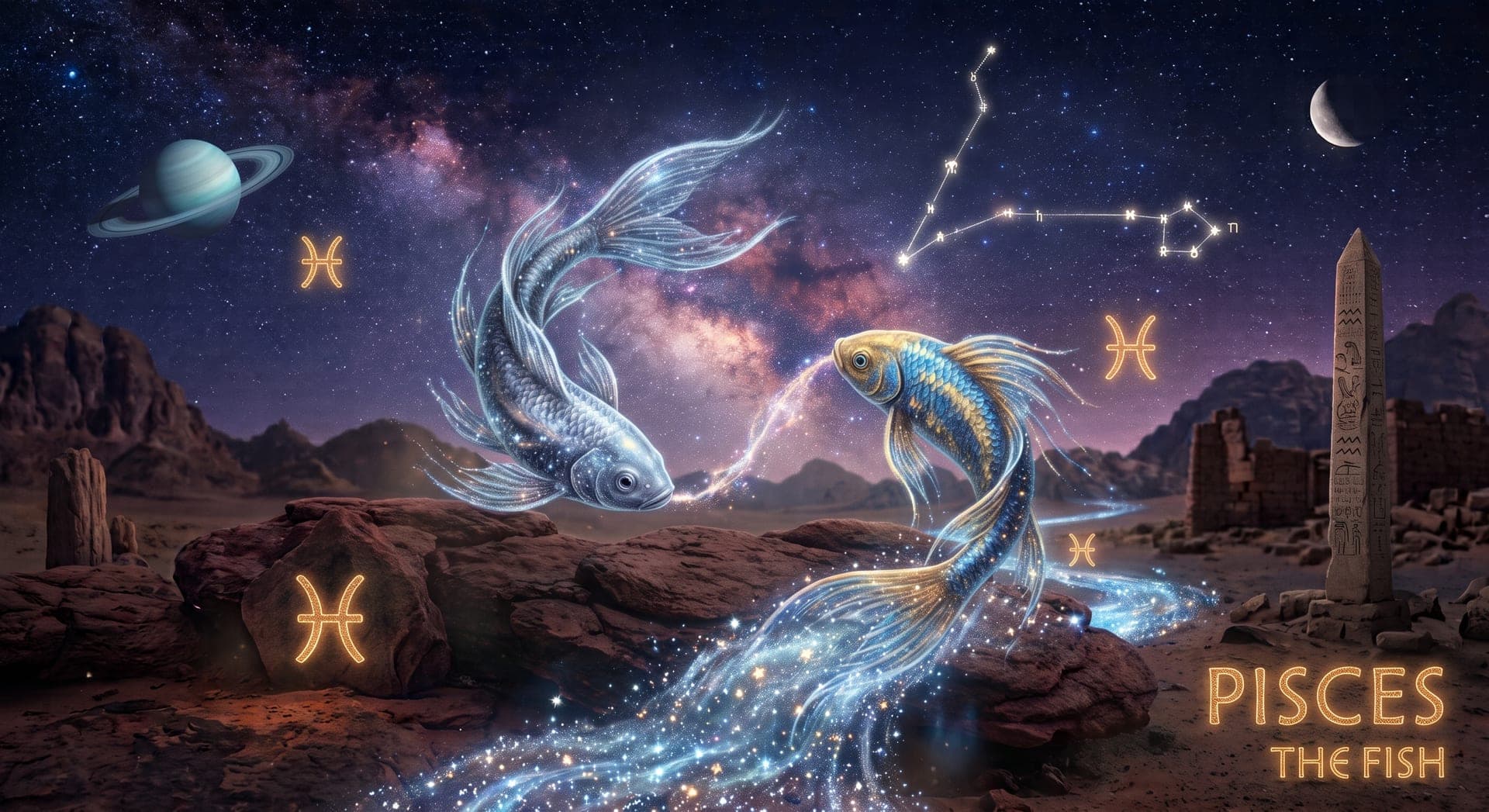
Born on February 29: Pisces ♓
Pisces, the twelfth and final sign of the zodiac, spans February 19 to March 20 and is symbolized by two fish swimming in opposite directions, tied together by a cord, representing the tension between fantasy and reality, or the conscious and subconscious mind. Ruled by Neptune, the planet of dreams, intuition, and illusion, Pisces is widely regarded as the most emotionally sensitive and imaginative sign of the zodiac. As a Water sign, Pisces navigates the world primarily through feeling and empathy, often absorbing the moods of people around it as though they were its own. Its Mutable modality reflects a deep adaptability and fluidity, comfortable going with the flow rather than forcing rigid plans. People born under this sign are often drawn to art, music, and other creative or spiritual pursuits where their vivid imagination can take shape. Compassionate to a fault, Pisces individuals are frequently the ones quietly caring for others, sometimes at the expense of their own boundaries and needs.
Personality Traits
Strengths
- Deeply empathetic and compassionate
- Highly imaginative and artistic
- Intuitive and perceptive
- Selfless and generous
- Adaptable to change
Weaknesses
- Prone to escapism or avoidance
- Overly trusting, can be taken advantage of
- Difficulty setting boundaries
- Tends toward melancholy
- Indecisive
Compatible Signs
Fun Facts
- Pisces' symbol of two fish bound together swimming in opposite directions comes from a Greek myth in which Aphrodite and Eros transformed into fish and tied themselves together to escape the monster Typhon.
- As the twelfth and final sign of the zodiac, Pisces is often described as embodying traits of all the preceding signs, a kind of culmination of the zodiac wheel.
- Neptune, Pisces' modern ruling planet, is the Roman god of the sea, discovered in 1846 and named for its blue, oceanic appearance.
- Notable Pisces include Albert Einstein, Rihanna, Steve Jobs, and Kurt Cobain.
- Classical astrology assigns Jupiter as Pisces' ruler, before Neptune's discovery in the 19th century gave the sign its modern ruling planet.
Born on February 29
- 1692
John Byrom
English poet and educator remembered for the hymn 'Christians, Awake!' and for inventing an early shorthand system
- 1736
Ann Lee
English religious leader, born in Manchester, who founded the Shaker movement after emigrating to America
- 1792
Gioachino Rossini
Italian composer known for "The Barber of Seville"
- 1812
James Milne Wilson
Scottish-born politician who served as Premier of Tasmania after emigrating to Australia
- 1860
Herman Hollerith
Inventor whose tabulating company became part of IBM
- 1896
Morarji Desai
Fourth Prime Minister of India
- 1904
Jimmy Dorsey
American jazz saxophonist and bandleader
- 1908
Alf Gover
English cricketer who played for Surrey and England as a fast bowler, later a renowned coach
- 1928
Joss Ackland
English actor known for a long stage and film career including roles in Lethal Weapon 2 and The Hunt for Red October
- 1928
Jean Adamson
British writer and illustrator who co-created the children's book series Topsy and Tim
- 1948
Hermione Lee
English literary critic and biographer known for acclaimed biographies of Virginia Woolf and Edith Wharton
- 1960
Tony Robbins
American motivational speaker and author
- 1972
Pedro Sanchez
Prime Minister of Spain
- 1976
Ja Rule
American rapper and actor

On This Day in History
- 888
Odo, Count of Paris, is crowned King of West Francia by the Archbishop of Sens at Compiègne.
Odo had risen to prominence for his successful defence of Paris against a prolonged Viking siege in 885-886, which won him wide acclaim. With the Carolingian line in disarray after the deposition of Emperor Charles the Fat, Frankish nobles elected Odo king, making him the first ruler from outside the Carolingian dynasty in West Francia, though Carolingian claimants would later reclaim the throne.
- 1504
Stranded in Jamaica, Christopher Columbus uses his foreknowledge of an approaching lunar eclipse to convince wary local inhabitants to continue providing his crew with supplies.
Stranded after his ships became unseaworthy, Columbus used an almanac predicting a lunar eclipse to convince the local Taíno inhabitants, who had grown reluctant to keep supplying his stranded crew, that his god was angry and would darken the moon, a bit of astronomical foreknowledge that secured his crew's survival.
- 1504
Christopher Columbus uses his foreknowledge of a lunar eclipse to persuade indigenous Jamaicans to resume supplying his stranded crew with food.
Marooned on Jamaica during his fourth voyage, Columbus and his men faced starvation after the local population, weary of feeding the Spaniards, cut off supplies. Consulting an almanac that predicted a lunar eclipse, Columbus warned the islanders that his god would darken the moon in anger, and when the eclipse occurred as foretold, frightened locals resumed provisioning his men until rescue arrived months later.
- 1704
French forces and their Native American allies raid the English settlement of Deerfield in the Massachusetts Bay Colony, killing dozens and taking more than a hundred captive.
The attack came during Queen Anne's War, the North American theatre of the War of the Spanish Succession, in which France and Britain fought for colonial supremacy. Raiders killed around 56 residents and marched more than 100 captives north to Canada in the depths of winter, a journey that killed several more; some captives were later ransomed while others remained and were assimilated into French or Native communities.
- 1796
The Jay Treaty between the United States and Great Britain formally comes into force, easing tensions and expanding trade between the two nations after the Revolutionary War.
The Jay Treaty, negotiated by Chief Justice John Jay, resolved lingering disputes left over from the Revolutionary War, including British withdrawal from forts in the Northwest Territory, and helped avert a renewed war between the two countries, though it proved controversial domestically for its perceived concessions to Britain.
- 1796
The Jay Treaty between the United States and Great Britain comes into force, resolving lingering disputes left unsettled after the American Revolutionary War.
Negotiated by Chief Justice John Jay, the treaty addressed British withdrawal from forts still held in the American Northwest, trade relations, and boundary disputes, though it left issues such as impressment of American sailors unresolved. It was deeply controversial in the United States, provoking fierce political division, but it secured a decade of peace between the two nations and expanded trade at a critical time for the young republic.
- 1916
The United Kingdom formally annexes Tokelau, a group of Pacific atolls, incorporating it into the Gilbert and Ellice Islands colony.
Tokelau, then also known as the Union Islands, had been under informal British influence for decades before formal annexation brought it under direct colonial administration. Britain later transferred administration of the islands to New Zealand in 1925, and Tokelau remains a New Zealand territory today, though the 1916 annexation marked its formal absorption into the British imperial system in the Pacific.
- 1940
Hattie McDaniel becomes the first African American to win an Academy Award, honored for her supporting role in "Gone with the Wind."
McDaniel's historic Oscar win came despite the segregated ceremony venue requiring her to sit at a separate table from her white castmates. Her achievement remains a landmark in Hollywood history, even as her career was constrained by the era's limited and often stereotypical roles available to Black actors.
- 1940
Hattie McDaniel becomes the first African American to win an Academy Award, taking Best Supporting Actress for her role in Gone with the Wind.
McDaniel won for her portrayal of Mammy, a performance widely praised at the time though later criticised for its portrayal of a Black domestic servant during the slavery era. She accepted the award at a segregated Los Angeles ceremony where she was seated apart from her white co-stars, a stark reminder of the era's racial barriers even as she broke one of Hollywood's most prominent ones.
- 1944
Allied forces invade the Admiralty Islands in the Pacific under General Douglas MacArthur, securing a key strategic position against Japan.
The invasion of the Admiralty Islands, executed ahead of schedule based on intelligence suggesting weaker-than-expected Japanese defenses, secured a key strategic naval and air base that helped isolate major Japanese garrisons elsewhere in the Pacific.
- 1960
A powerful earthquake destroys much of Agadir, Morocco, killing an estimated 12,000 people.
The Agadir earthquake struck the Moroccan coastal city with little warning, and poor construction in much of the city contributed to a death toll that may have reached a third of the city's population, prompting Morocco to adopt significantly stricter seismic building codes afterward.
- 1960
A magnitude 5.7 earthquake devastates the Moroccan coastal city of Agadir, killing an estimated 12,000 people.
The quake struck late at night with its epicentre close to the city, and though moderate in magnitude, its shallow depth and Agadir's poor building construction caused catastrophic destruction, flattening much of the city within seconds. Roughly a third of the city's population died, and the disaster prompted Morocco to rebuild Agadir according to modern seismic building codes under King Mohammed V's direction.
- 1964
A British Eagle International Airlines Vickers Viscount crashes into the Tux Alps near Innsbruck, Austria, killing all 75 people aboard.
The aircraft, operating a charter flight, struck mountainous terrain in poor weather while approaching Innsbruck Airport, an approach made notoriously difficult by the surrounding peaks. The disaster remains one of the deadliest crashes involving a British airline and prompted scrutiny of approach procedures at Alpine airports, which continued to pose risks to airliners for years afterward.
- 1984
Canadian Prime Minister Pierre Trudeau announces his retirement from politics after nearly 16 years in power.
Trudeau's retirement announcement, made after a famous solitary walk in a snowstorm that he later said helped him reach the decision, ended a transformative era in Canadian politics that included patriating Canada's constitution from Britain and establishing the Canadian Charter of Rights and Freedoms.
- 1984
Canadian Prime Minister Pierre Trudeau announces his retirement as leader of the Liberal Party and from federal politics.
Trudeau, who had dominated Canadian politics for most of the previous sixteen years and overseen the patriation of Canada's constitution, announced his decision after what he described as a long walk in a snowstorm that helped him reach the choice. His departure triggered a leadership race won by John Turner, who briefly succeeded him as prime minister before losing that year's general election to Brian Mulroney's Progressive Conservatives.
- 1996
The Siege of Sarajevo officially ends after nearly four years, the longest siege of a capital city in modern warfare.
The Siege of Sarajevo, the longest siege of a capital city in modern history, had subjected residents to nearly four years of constant shelling and sniper fire during the Bosnian War, killing thousands of civilians before international pressure and a peace agreement finally ended the encirclement.
- 2004
Haitian President Jean-Bertrand Aristide is removed from power amid an armed uprising and departs the country.
Aristide's removal, amid an armed rebellion and disputed accounts of whether he resigned voluntarily or was forced out with U.S. and French involvement, plunged Haiti into further political instability, part of a recurring pattern of coups and unrest throughout the country's history.
- 2008
Prince Harry is withdrawn from his frontline deployment in Afghanistan after details of his presence there are published by foreign media, ending an operational security blackout.
Harry had served for ten weeks with the British Army in Helmand Province under a media blackout agreed between the Ministry of Defence and news organisations, which had kept his deployment secret to protect his safety and that of his unit. Once foreign media broke the embargo, defence chiefs judged the risk too great to continue and flew him home, cutting short what had been intended as a longer tour.
- 2020
The United States and the Taliban sign the Doha Agreement, laying out a framework for the withdrawal of American troops from Afghanistan.
The Doha Agreement outlined a phased withdrawal of U.S. and NATO troops from Afghanistan in exchange for Taliban commitments to prevent the country from being used as a base for terrorism. It set the framework for the eventual full American withdrawal in 2021, after which the Taliban swiftly retook control of the country.
- 2024
Israeli forces open fire near a crowd gathered around an aid convoy in Gaza City, killing over a hundred Palestinians in an incident that drew intense international scrutiny.
The incident occurred as crowds gathered around trucks delivering food aid amid a severe humanitarian crisis in Gaza, with witnesses and officials offering conflicting accounts of whether the deaths resulted primarily from gunfire, a stampede, or both, drawing widespread international calls for an independent investigation.