
What’s Observed on December 1
Born on December 1: Sagittarius ♐
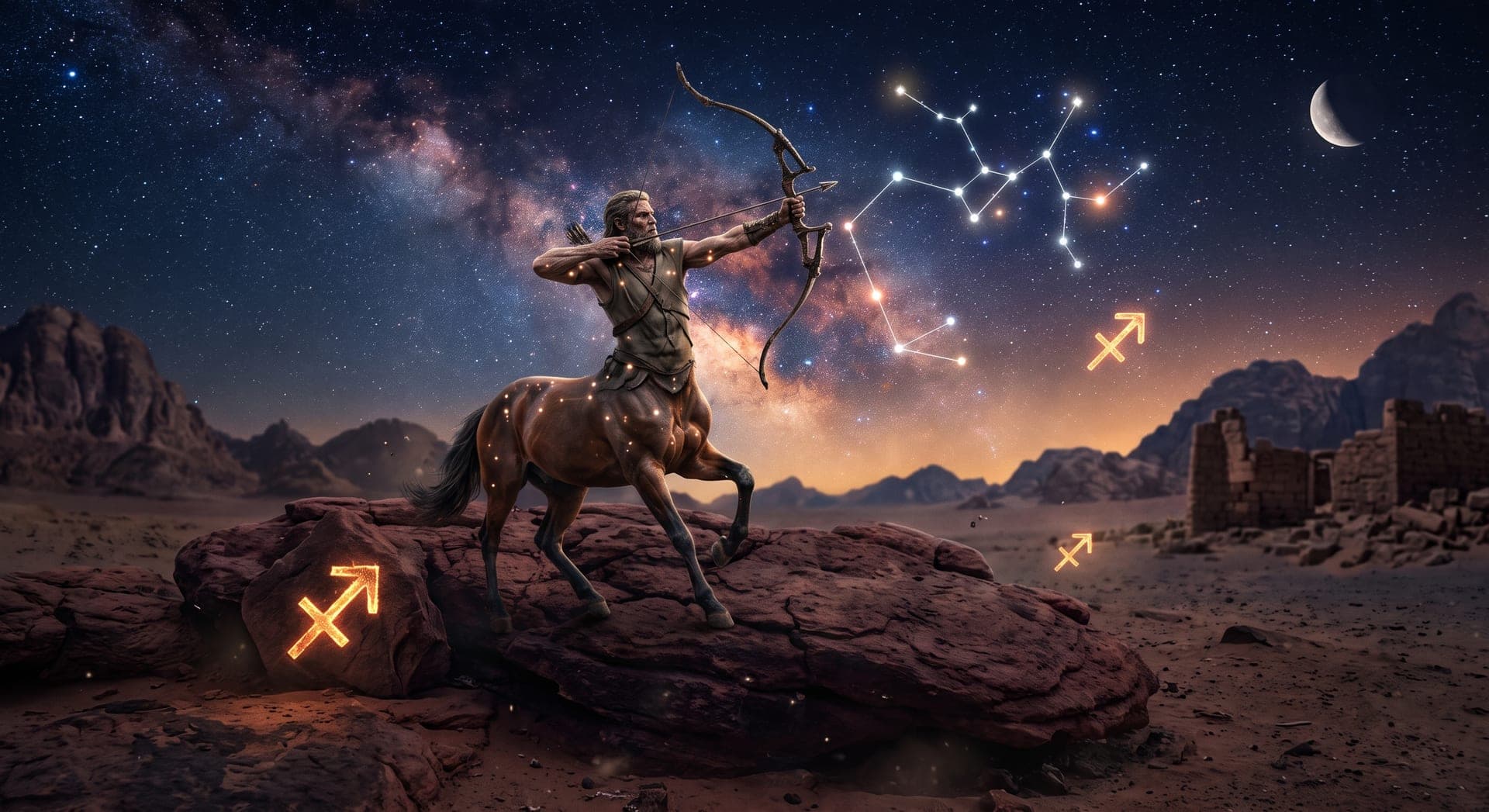
Sagittarius, the ninth sign of the zodiac, spans November 22 to December 21 and is symbolized by the archer, typically depicted as a centaur drawing a bow, representing a restless pursuit of knowledge, adventure, and far-off horizons. Ruled by Jupiter, the largest planet in the solar system and a symbol of growth, luck, and abundance, Sagittarius is widely regarded as one of the most optimistic and freedom-loving signs of the zodiac. As a Fire sign, Sagittarius approaches life with enthusiasm and a genuine hunger for new experiences, whether through literal travel or intellectual and philosophical exploration. Its Mutable modality reflects a deep aversion to routine and confinement, always looking toward the next adventure rather than settling into fixed patterns. People born under this sign are often drawn to travel, higher education, philosophy, or any pursuit that broadens their horizons and understanding of the world. Sagittarius's honesty and optimism make it excellent company, though its blunt directness and restless need for freedom can sometimes come across as tactless or noncommittal to those seeking more stability.
Personality Traits
Strengths
- Adventurous and open to new experiences
- Optimistic and enthusiastic
- Honest and direct
- Philosophical and broad-minded
- Generous and good-humored
Weaknesses
- Tactlessly blunt
- Impatient with routine
- Prone to overpromising
- Restless and commitment-averse
- Careless with details
Compatible Signs
Fun Facts
- Sagittarius's symbol, a centaur drawing a bow and arrow, connects to the Greek myth of Chiron, a wise and scholarly centaur unlike the more unruly members of his kind.
- Jupiter, Sagittarius' ruling planet, is the largest planet in the solar system, reflecting the sign's association with expansion, abundance, and big-picture thinking.
- Sagittarius is one of two zodiac signs, along with Capricorn, represented by a hybrid creature combining human and animal features.
- Notable Sagittarians include Taylor Swift, Walt Disney, Winston Churchill, and Jimi Hendrix.
- Sagittarius season spans the lead-up to the winter solstice, a period historically associated with travel, feasting, and philosophical reflection in many cultures.
Born on December 1
- 1761
Marie Tussaud
French-English sculptor who founded Madame Tussauds wax museum
- 1792
Nikolai Lobachevsky
Russian mathematician known for pioneering non-Euclidean geometry
- 1844
Alexandra of Denmark
Danish-born queen consort of the United Kingdom as wife of Edward VII, admired for her style and charitable work; the annual Alexandra Rose Day charity appeal is named in her honour.
- 1871
Archie MacLaren
English cricketer and captain who set a world record first-class score of 424 in 1895, a mark that stood for many years afterward.
- 1895
Henry Williamson
English author and naturalist best known for his nature novel Tarka the Otter.
- 1896
Georgy Zhukov
Soviet marshal and military commander during World War II
- 1910
Alicia Markova
English ballerina and choreographer regarded as one of the greatest ballerinas of the 20th century and a founding figure of British ballet.
- 1913
Mary Martin
American Broadway actress and singer
- 1940
Richard Pryor
American comedian and actor
- 1940
Mike Denness
Scottish cricketer who captained the England Test team through the mid-1970s.
- 1945
Bette Midler
American singer-songwriter and actress
- 1948
N. T. Wright
English New Testament scholar and Anglican bishop, one of the most influential biblical theologians of his generation.
- 1982
Riz Ahmed
English actor and rapper known for Four Lions, Nightcrawler, and Sound of Metal, the first Muslim actor nominated for the Academy Award for Best Actor.

On This Day in History
- 1420
Henry V of England enters Paris alongside King Charles VI of France, solidifying English influence during the Hundred Years' War.
Henry V's triumphant entry into Paris came in the aftermath of his decisive victory at Agincourt five years earlier and the Treaty of Troyes, which recognized him as heir to the French throne. His alliance with the ailing Charles VI represented the high-water mark of English fortunes in the Hundred Years' War, though his death just two years later, before he could claim the French crown, left the achievement incomplete and set the stage for France's eventual recovery under Joan of Arc.
- 1420
Henry V of England enters Paris alongside his father-in-law, King Charles VI of France.
The entry followed the Treaty of Troyes, signed earlier that year, which recognised Henry as heir to the French throne and disinherited the Dauphin. The moment marked the high point of English fortunes in the Hundred Years' War, though the union of the two crowns Henry envisioned would collapse within a generation.
- 1577
Courtiers Christopher Hatton and Thomas Heneage are knighted by Queen Elizabeth I.
Both men were rising favourites at Elizabeth's court: Hatton would go on to become Lord Chancellor of England despite having no formal legal training, while Heneage served as a trusted privy councillor and treasurer of the chamber. Their knighthoods reflect the close, personal style of patronage that defined advancement in the Elizabethan court.
- 1640
Portugal ends its union with Spain by proclaiming João IV as king, concluding 60 years under the Philippine Dynasty.
Portugal had been forcibly united with Spain since 1580 following a succession crisis, an arrangement many Portuguese nobles resented as foreign domination. A group of conspirators seized the royal palace in Lisbon and proclaimed the Duke of Braganza as King João IV, launching the Portuguese Restoration War that would take nearly three decades to fully secure Portuguese independence and end Habsburg rule over the kingdom.
- 1662
Diarist John Evelyn records watching people skating on the frozen lake in St James's Park, London.
Evelyn's diary entry describes the 'strange and wonderful dexterity' of the skaters, an activity newly fashionable in England after exiled royalists returned from the Netherlands with Dutch-style ice skates following the Restoration. The anecdote is often cited as one of the earliest English records of recreational ice skating.
- 1821
José Núñez de Cáceres secures Dominican independence from Spain, establishing the short-lived Republic of Spanish Haiti.
Núñez de Cáceres, a lawyer and colonial official, declared independence for the Spanish-speaking eastern portion of Hispaniola shortly after Spain's grip on the region weakened, hoping to align with Gran Colombia. The independent state proved extremely short-lived, as Haitian forces invaded and unified the entire island under Haitian rule just weeks later, an occupation that would last until 1844.
- 1834
Slavery is formally abolished in the Cape Colony under the terms of the British Slavery Abolition Act 1833.
The Act, passed by the British Parliament the previous year, freed enslaved people across most of the British Empire, with the Cape of Good Hope's emancipation taking effect on this date. Formerly enslaved people were initially required to serve a period of 'apprenticeship' to their former owners, a compromise that delayed full freedom for years in many colonies.
- 1878
President Rutherford B. Hayes has the first telephone installed at the White House.
The White House telephone installation reflected the telephone's still-novel status less than two years after Alexander Graham Bell's original patent, with the instrument installed primarily for practical government communication rather than as a personal convenience for the president. Early telephone technology required manual switchboard operation, and the White House's phone number was famously simple, reflecting the small number of telephones then in Washington.
- 1918
Iceland achieves sovereignty as a separate kingdom while remaining united with Denmark under a shared monarch.
The 1918 Act of Union recognized Iceland as a fully sovereign state joined with Denmark only through a shared monarch, ending centuries of direct Danish administrative control while stopping short of complete independence. This arrangement proved transitional, as Iceland would sever its remaining ties to the Danish crown entirely in 1944, becoming a fully independent republic during the German occupation of Denmark in World War II.
- 1919
Nancy Astor, Viscountess Astor, becomes the first female Member of Parliament to take her seat in the House of Commons.
American-born Astor had won the Plymouth Sutton by-election weeks earlier, succeeding her husband's seat after he inherited a peerage. Although Constance Markievicz had been elected as an MP the year before, she never took her seat as a Sinn Féin abstentionist, leaving Astor as the first woman to actually sit in the Commons.
- 1955
Rosa Parks refuses to give up her bus seat in Montgomery, Alabama, an act that triggers the Montgomery Bus Boycott.
Parks' arrest was not spontaneous but occurred within a context of organized civil rights activism, as she was an active NAACP member who had received training in nonviolent resistance. Her refusal to move, followed swiftly by her arrest for violating Montgomery's segregation ordinance, gave local civil rights leaders the catalyst they needed to launch a coordinated, sustained boycott that would ultimately dismantle legal bus segregation in the city.
- 1955
Rosa Parks refuses to give up her bus seat to a white passenger in Montgomery, Alabama, and is arrested.
Her arrest sparked the Montgomery Bus Boycott, a 381-day mass protest organised in part by a young Martin Luther King Jr. that ended with the desegregation of the city's buses. The episode became one of the defining moments of the American civil rights movement and made Parks a lasting symbol of quiet, resolute protest.
- 1959
The Antarctic Treaty opens for signatures, designating Antarctica as a scientific preserve and banning military activity there.
The Antarctic Treaty was negotiated among twelve nations active in Antarctic research, establishing the continent as a demilitarized zone dedicated exclusively to peaceful scientific cooperation and explicitly setting aside contentious territorial claims. The treaty has since been recognized as one of the most successful examples of international cooperation, expanding to nearly 60 signatory nations and serving as a model for later agreements governing shared global commons.
- 1959
The Antarctic Treaty opens for signature, setting aside Antarctica as a scientific preserve free of military activity.
Negotiated during a period of international scientific cooperation, the treaty banned new territorial claims and nuclear testing across the continent while guaranteeing freedom of research for signatory nations. Signed initially by twelve countries active in Antarctic exploration, it remains the foundation of international governance over the continent today.
- 1988
World AIDS Day is proclaimed by UN member states, establishing the first global health awareness day.
The proclamation by UN member states formalized what had begun the previous year as a World Health Organization initiative, establishing December 1st as an annual occasion to raise awareness of the growing HIV/AIDS epidemic. This marked the first time the international community had designated a specific day for global health awareness, a model that has since been replicated for numerous other health conditions and causes.
- 1990
Workers tunnelling from Britain and France meet beneath the seabed as sections of the Channel Tunnel connect for the first time.
The breakthrough came more than 40 metres below the seabed, physically linking the island of Britain to mainland Europe for the first time since the last Ice Age. British engineer Graham Fagg and French engineer Philippe Cozette shook hands through the gap, and the completed tunnel opened to rail traffic in 1994.
- 2006
South Africa legalizes same-sex marriage, becoming the first African nation to do so.
South Africa's Constitutional Court had ruled the previous year that denying marriage rights to same-sex couples violated the country's post-apartheid constitution, which uniquely among nations at the time explicitly prohibited discrimination based on sexual orientation. The subsequent legislation made South Africa the fifth country in the world, and the first in Africa, to legalize same-sex marriage nationally.
- 2009
The Treaty of Lisbon enters into force, reforming the institutions and decision-making processes of the European Union.
The treaty created permanent posts including the President of the European Council, expanded the European Parliament's powers, and introduced, for the first time, a formal legal mechanism for a member state to withdraw from the union. That mechanism, Article 50, later became central to the United Kingdom's departure from the EU.
- 2019
The first known COVID-19 case is later traced to Wuhan, China, marking the start of the global pandemic.
Retrospective epidemiological investigation identified early COVID-19 cases connected to a market in Wuhan, China, though the virus's precise origin point and initial transmission pathway remain subjects of ongoing scientific and political debate. The subsequent global spread of the virus over the following months would develop into a pandemic that fundamentally altered daily life, healthcare systems, and economies worldwide for years afterward.
- 2019
The outbreak later identified as COVID-19 is traced by investigators to cases emerging around this date in Wuhan, China.
The novel coronavirus spread rapidly beyond its origins in central China to become a global pandemic within months, prompting unprecedented lockdowns, travel restrictions, and a race to develop vaccines. By the time the World Health Organization declared an end to the public health emergency in 2023, the virus had caused millions of deaths worldwide.